


This article was automatically translated from the original Turkish version.
+2 More
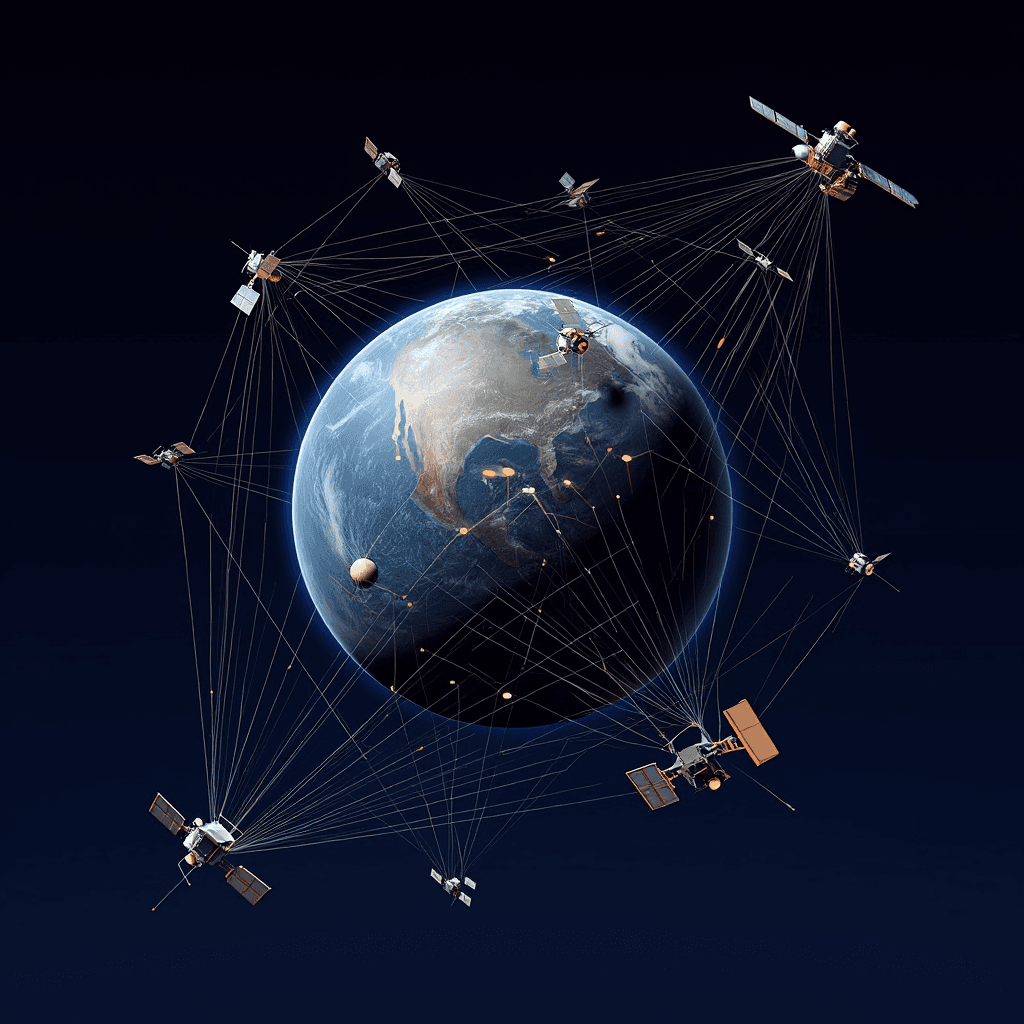
Microsatellite Technologies (Generated with Artificial Intelligence)
Mass Class | Microsatellite: 10–100 kg, Nanosatellite: 1–10 kg, Picosatellite: 0.1–1 kg, Femtosatellite: <0.1 kg | ||||||||
|---|---|---|---|---|---|---|---|---|---|
Standard Form Factor (CubeSat) | 1U = 10×10×10 cm, 1.33 kg, Common configurations: 3U, 6U, 12U, 16U | ||||||||
Orbit Type | Low Earth Orbit (LEO), 300–600 km, Sun-synchronous orbit (SSO) | ||||||||
Mission Lifetime | 3–5 years (typical); up to 7 years with micro-electric propulsion systems | ||||||||
Energy Source | Gallium arsenide (GaAs) solar panels, 28–30% efficiency, LiFePO₄ battery system | ||||||||
Power Capacity | Average 10–80 W (dependent on CubeSat configuration) | ||||||||
Communication Systems | UHF: 9.6 kbps, S-band: 1 Mbps, X-band: 1 Gbps, Ka-band (High Data Rate) | ||||||||
Propulsion System | Electric ablation micro-thruster (Teflon fuel), Alternative: ion micro-thruster, cold gas micro-thruster | ||||||||
Application Area(s) | Maritime security (AIS tracking) Space science (astrophysics-heliophysics-planetary science) Communication and IoT networks Earth observation and climate monitoring (CO₂-CH₄ sensors) | ||||||||
Microsatellites are small spacecraft typically weighing between 10 and 100 kilograms. This category forms part of the small satellite (smallsat) family along with even smaller subclasses: nanosatellites (1–10 kg), picosatellites (0.1–1 kg), and femtosatellites (<0.1 kg). Among the earliest examples is Sputnik 1, launched in 1957, which is considered the starting point of this technological lineage due to its mass being close to that of modern microsatellites.【1】
The concept of small satellites gained a systematic engineering framework with the introduction of the CubeSat standard in 1999 by Bob Twiggs and Jordi Puig-Suari. This design is based on a 1U unit (10×10×10 cm, 1.33 kg) and can be scaled into multi-unit configurations (3U, 6U, 12U, 16U) to create flexible mission platforms.【2】
Microsatellites stand out compared to traditional large satellites due to their low cost, short development time, and modular design. Key components include power generation and storage units, propulsion systems, attitude control, communication systems, and the payload. For instance, a 16U CubeSat design measures 226×226×454 mm and weighs 23 kg, using three-axis reaction wheels for attitude control; its power system generates an average of 10 W and provides 32 GB of data storage capacity.【3】
Micro-electric ablation motors or ion micro-thrusters used in propulsion systems enable orbit adjustments and formation flying missions. Teflon-fueled micro-thrusters operating via electrical ablation are preferred in low-cost missions due to their high density (2.21 g/cm³) and low evaporation characteristics.
The increasing data transmission demands of small satellites have necessitated the development of communication systems operating in high-frequency bands. Missions led by NASA’s Jet Propulsion Laboratory (JPL), such as ASTERIA, MarCO, and ISARA, are prominent in this context. The S-band communication system used in ASTERIA operates in the 2.0–2.11 GHz receive and 2.2–2.3 GHz transmit frequency ranges, achieving data rates of up to 1 Mbps. In the ISARA mission, Ka-band antennas provided higher bandwidth around 35.75 GHz, significantly increasing data transmission capacity. These systems enable reliable communication for microsatellites not only in low Earth orbit (LEO) but also in distant missions such as Mars transits.
Microsatellites perform high-resolution Earth imaging and climate monitoring using multispectral and hyperspectral sensors. For example, a CubeSat developed by Bauman Moscow State Technical University equipped with a Fourier Transform Infrared (FTIR) spectrometer is designed to measure atmospheric concentrations of CO₂ and O₂. This system provides a spectral resolution of 2 cm⁻¹ in the 2.0–2.2 µm wavelength range and can detect methane (CH₄) emissions with a spatial resolution of 50 m.【4】
Micro and picosatellites are used for real-time positioning and tracking systems in maritime safety. Canada’s AISSat-1 and M3MSat projects have monitored ship traffic by receiving Automatic Identification System (AIS) signals in the VHF band from space. Such systems have a data transfer capacity of 1.5 Mbps and provide daily coverage of 12–15% from altitudes of 300–400 km, enabled by their low Earth orbit motion.【5】
According to a report by the Keck Institute for Space Studies led by Caltech and JPL, microsatellite platforms support new mission concepts in astrophysics (RELIC), heliophysics (L5 Space Weather Sentinels), and planetary science (ExCSITE). In these missions, clusters of 1–10 kg CubeSats operate together to perform multi-point measurements, providing data on phenomena such as stellar explosions, solar wind, or the chemical properties of Europa’s surface.【6】
The development and launch costs of small satellites are up to 90% lower than those of traditional large satellites. While the launch cost of an average microsatellite mission is in the millions of dollars, it can drop to just thousands of dollars for picosatellite systems. This has facilitated the participation of developing countries and universities in space research, democratizing access to space.【7】
Key challenges facing microsatellite technologies include orbital congestion, communication spectrum management, limited power capacity, and thermal control. The growing number of satellites in low Earth orbit increases collision risks and necessitates international traffic management for sustainable space operations. Additionally, mission lifetimes are typically limited to 3–4 years; ion propulsion systems and micro-electric propulsion solutions are being developed to extend these durations.【8】
In the future, microsatellites are expected to be equipped with artificial intelligence (AI)-based autonomous mission control, 5G/6G network integration, and high-speed laser communication systems. These advancements will facilitate real-time data transmission through multi-satellite constellations, opening new application possibilities ranging from climate change monitoring to disaster management.【9】
"Monitoring." *arXiv* (2022). Accessed October 30, 2025.https://arxiv.org/abs/2212.07680.
Babuscia, Alessandra. “Telecommunication Systems for Small Satellites Operating at High Frequencies: A Review.” *Information* 11, no. 5 (2020): 258. Accessed October 30, 2025.https://doi.org/10.3390/info11050258
Keck Institute for Space Studies. *Small Satellites: A Revolution in Space Science. Final Report.* California Institute of Technology, Pasadena, CA, July 2014. Accessed October 30, 2025.https://www.kiss.caltech.edu/final_reports/SmallSat_final_report.pdf
Mantzouris, G. “Micro and Pico Satellites in Maritime Security Operations.” *Journal of Naval Sciences and Engineering* 8, no. 2 (2012): 1–30. Accessed October 30, 2025.https://dergipark.org.tr/en/pub/jnse/issue/9997/123507#article_cite
Mayorova, Victoria, Andrey Morozov, Iliya Golyak, Nikita Lazarev, Valeriia Melnikova, Dmitry Rachkin, Victor Svirin, Stepan Tenenbaum and Igor Fufurin. “Small Spacecraft for Global Greenhouse Gas
NASA. "State-of-the-Art Small Spacecraft Technology. NASA/TP—20250000142." Ames Research Center ve Goddard Space Flight Center, 2025. Accessed October 30, 2025.https://www.nasa.gov/wp-content/uploads/2025/02/soa-2024.pdf?emrc=8a3a41
Siddique, Iqtiar. “Small Satellites: Revolutionizing Space Exploration and Earth Observation.” Zenodo 11 (2024): 118–124. Accessed October 30, 2025.https://doi.org/10.5281/zenodo.12750228.
Triharjanto, Robertus. “System Designs of Microsatellites: A Review of Two Schools of Thoughts.” In *IntechOpen* (2020). Accessed October 30, 2025.https://doi.org/10.5772/intechopen.92659.
[1]
Mantzouris, G. “Micro and Pico Satellites in Maritime Security Operations.” Journal of Naval Sciences and Engineering 8, no. 2 (2012): 1–30. Erişim Tarihi: 30 Ekim 2025. https://dergipark.org.tr/en/pub/jnse/issue/9997/123507#article_cite.
[2]
Keck Institute for Space Studies. Small Satellites: A Revolution in Space Science. Final Report. California Institute of Technology, Pasadena, CA, July 2014. Erişim Tarihi: 30 Ekim 2025. https://www.kiss.caltech.edu/final_reports/SmallSat_final_report.pdf.
[3]
Mayorova, Victoria, Andrey Morozov, Iliya Golyak, Nikita Lazarev, Valeriia Melnikova, Dmitry Rachkin, Victor Svirin, Stepan Tenenbaum ve Igor Fufurin. “Small Spacecraft for Global Greenhouse Gas Monitoring.” arXiv (2022). Erişim Tarihi: 30 Ekim 2025. https://arxiv.org/abs/2212.07680.
[4]
Mayorova, Victoria, Andrey Morozov, Iliya Golyak, Nikita Lazarev, Valeriia Melnikova, Dmitry Rachkin, Victor Svirin, Stepan Tenenbaum ve Igor Fufurin. “Small Spacecraft for Global Greenhouse Gas Monitoring.” arXiv (2022). Erişim Tarihi: 30 Ekim 2025. https://arxiv.org/abs/2212.07680.
[5]
Mantzouris, G. “Micro and Pico Satellites in Maritime Security Operations.” Journal of Naval Sciences and Engineering 8, no. 2 (2012): 1–30. Erişim Tarihi: 30 Ekim 2025. https://dergipark.org.tr/en/pub/jnse/issue/9997/123507#article_cite.
[6]
Keck Institute for Space Studies. Small Satellites: A Revolution in Space Science. Final Report. California Institute of Technology, Pasadena, CA, July 2014. Erişim Tarihi: 30 Ekim 2025. https://www.kiss.caltech.edu/final_reports/SmallSat_final_report.pdf.
[7]
Mantzouris, G. “Micro and Pico Satellites in Maritime Security Operations.” Journal of Naval Sciences and Engineering 8, no. 2 (2012): 1–30. Erişim Tarihi: 30 Ekim 2025. https://dergipark.org.tr/en/pub/jnse/issue/9997/123507#article_cite.
[8]
Siddique, Iqtiar. “Small Satellites: Revolutionizing Space Exploration and Earth Observation.” Zenodo 11 (2024): 118–124. Erişim Tarihi: 30 Ekim 2025. https://doi.org/10.5281/zenodo.12750228.
[9]
Siddique, Iqtiar. “Small Satellites: Revolutionizing Space Exploration and Earth Observation.” Zenodo 11 (2024): 118–124. Erişim Tarihi: 30 Ekim 2025. https://doi.org/10.5281/zenodo.12750228.

Microsatellite Technologies (Generated with Artificial Intelligence)
Mass Class | Microsatellite: 10–100 kg, Nanosatellite: 1–10 kg, Picosatellite: 0.1–1 kg, Femtosatellite: <0.1 kg | ||||||||
|---|---|---|---|---|---|---|---|---|---|
Standard Form Factor (CubeSat) | 1U = 10×10×10 cm, 1.33 kg, Common configurations: 3U, 6U, 12U, 16U | ||||||||
Orbit Type | Low Earth Orbit (LEO), 300–600 km, Sun-synchronous orbit (SSO) | ||||||||
Mission Lifetime | 3–5 years (typical); up to 7 years with micro-electric propulsion systems | ||||||||
Energy Source | Gallium arsenide (GaAs) solar panels, 28–30% efficiency, LiFePO₄ battery system | ||||||||
Power Capacity | Average 10–80 W (dependent on CubeSat configuration) | ||||||||
Communication Systems | UHF: 9.6 kbps, S-band: 1 Mbps, X-band: 1 Gbps, Ka-band (High Data Rate) | ||||||||
Propulsion System | Electric ablation micro-thruster (Teflon fuel), Alternative: ion micro-thruster, cold gas micro-thruster | ||||||||
Application Area(s) | Maritime security (AIS tracking) Space science (astrophysics-heliophysics-planetary science) Communication and IoT networks Earth observation and climate monitoring (CO₂-CH₄ sensors) | ||||||||
No Discussion Added Yet
Start discussion for "Microsatellite Technologies" article
Structural Features and System Architecture
Communication Technologies
Scientific and Applied Applications
Earth Observation and Environmental Monitoring
Maritime Security
Space Science and Planetary Research
Economic and Operational Advantages
Technological and Regulatory Challenges
Future Trends