This article was automatically translated from the original Turkish version.
Artist | Michelangelo | ||||||||
|---|---|---|---|---|---|---|---|---|---|
Frame | 16th century Italian frame | ||||||||
Current Location | National Gallery, London — Room 51 (Main Collection) | ||||||||
Technique | Tempera on wood | ||||||||
Size | 104 5 × 77 cm | ||||||||
Full Title | The Virgin and Child with Saint John and Angels (Manchester Madonna) | ||||||||
Acquisition Credit | Acquired, 1870 | ||||||||
Production Date(s) | c. 1494 | ||||||||
Original Name | Madonna di Manchester | ||||||||
Artist Who Created the Work | Michelangelo Buonarroti | ||||||||
Production Date | c. 1494–1497 | ||||||||
Technique Used | Tempera on poplar wood | ||||||||
Dimensions of the Work | 104.5 × 77 cm | ||||||||
Location of the Work | National Gallery, London | ||||||||
Depicted Figures | The Virgin Mary, Child Jesus, John the Baptist, and Angels | ||||||||
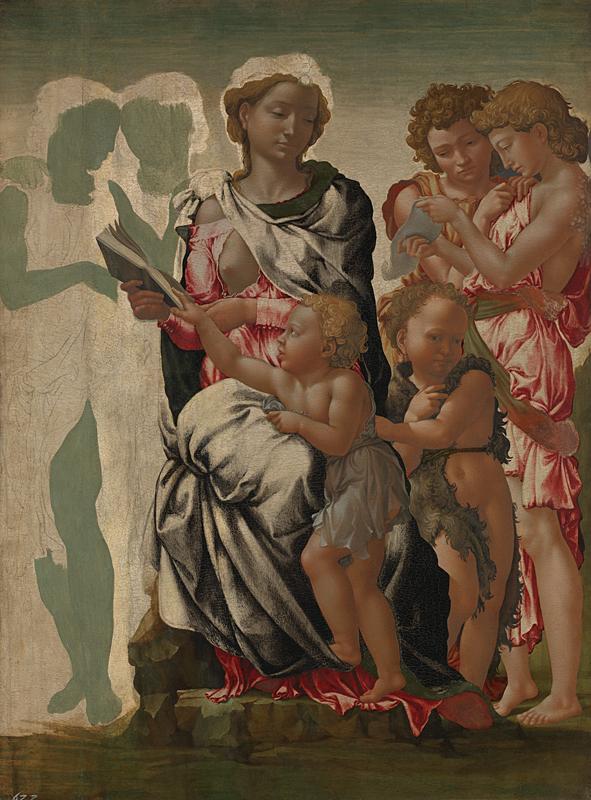
The Manchester Madonna, attributed to the Italian Renaissance artist Michelangelo Buonarroti, is an unfinished panel painting executed in egg tempera on poplar wood.
The work has been popularly known by this name since it was exhibited in 1857 at the Great Manchester Exhibition (Manchester Art Treasures Exhibition). Dating approximately to 1494–1497, it is considered one of the earliest surviving paintings by the artist.【1】
Michelangelo received training in drawing and composition in the workshop of Domenico Ghirlandaio in Florence. Bank records show that the 22-year-old Michelangelo made a payment on 27 June 1497 for a panel to be painted; this reference is generally associated with this painting. However, the intended purpose of the panel remains unknown. The technical and stylistic features of the surviving work suggest it may have been begun as early as 1494, due to its close resemblance to the artist’s early sculptures. It is unclear why the work was never completed, though it is noted that his approximately 1500–1501 panel, The Entombment, was similarly left unfinished.【2】
The work measures 104.5 by 77 centimetres and, due to its unfinished state, reveals the stages of 15th-century tempera technique.
The black underpainting on the Virgin’s mantle reveals the brushwork used to model volume, as the final layer of navy blue paint was never applied. In the figures of the angels on the left, outlines defining the folds of their garments and areas of traditional greenish underpainting (terra verde) used to balance the pink flesh tones can be observed.【3】
The layering of fast-drying egg-based paints demonstrates the artist’s technical mastery and his sculptural approach to form. The strong contour lines used to emphasize the Virgin’s figure and the scraping of paint to create a three-dimensional effect reflect his training as a sculptor.【4】
In the composition, the Virgin Mary is depicted seated on a rock, accompanied by the Christ Child and the young John the Baptist. The exposure of the Virgin’s right breast suggests she has just nursed the child. Her hand drawing the book away from the Child’s outstretched hand is interpreted as an allusion to Isaiah 53, prophesying Christ’s future crucifixion.【5】
John the Baptist is seen stabilizing his cousin Jesus by holding one foot within a fold of his mother’s mantle, in a precarious balance; his gaze outward from the picture plane is interpreted as signifying his role in preparing the way for Christ’s ministry. The parchment held by the angels may be associated with the traditional phrase “Ecce Agnus Dei,” referencing Christ’s crucifixion.【6】
The figures fill the entire panel, while the background is kept minimal, giving the work a monumental, sculptural effect. This approach is seen as a reflection of Michelangelo’s sculptural training under Lorenzo de’ Medici in the Florence palace. The angelic figures are noted to draw formal inspiration from Luca della Robbia’s 1430s sculpted choir stalls (Cantoria) in the Florence Cathedral. The painting is a significant example of how the artist blurred the boundaries between painting and sculpture at an early stage in his career.【7】
Francesco Granacci’s painting of similar dimensions, The Rest on the Flight into Egypt with the Infant St John the Baptist, exhibits clear compositional similarities to The Manchester Madonna, albeit in reverse orientation.
In Granacci’s work, the Virgin is seated on a rocky ledge, and the young John the Baptist reaches toward her, mirroring the arrangement in Michelangelo’s panel.
Although the exact date of Granacci’s panel is unknown, it is generally dated to around 1494, though some scholars argue it could be as late as ten years afterward.【8】
Hall, James. "The 'Manchester Madonna' and Its Influence on Granacci and Raphael." *The Burlington Magazine* 162 (June 2020): 481–483. Accessed March 10, 2026. https://www.academia.edu/43253969/Michelangelos_Manchester_Madonna_and_its_Impact_on_Granacci_and_Raphael
National Gallery. "The Virgin and Child with Saint John and Angels ('The Manchester Madonna')." nationalgallery.org.uk. Accessed March 10, 2026. https://www.nationalgallery.org.uk/paintings/michelangelo-the-manchester-madonna
[1]
National Gallery, "The Virgin and Child with Saint John and Angels 'The Manchester Madonna')," erişim tarihi 10 Mart 2026, https://www.nationalgallery.org.uk/paintings/michelangelo-the-manchester-madonna.
[2]
National Gallery, "The Virgin and Child with Saint John and Angels 'The Manchester Madonna')."
[3]
National Gallery, "The Virgin and Child with Saint John and Angels 'The Manchester Madonna')."
[4]
National Gallery, "The Virgin and Child with Saint John and Angels 'The Manchester Madonna')."
[5]
National Gallery, "The Virgin and Child with Saint John and Angels 'The Manchester Madonna')."
[6]
National Gallery, "The Virgin and Child with Saint John and Angels 'The Manchester Madonna')."
[7]
National Gallery, "The Virgin and Child with Saint John and Angels 'The Manchester Madonna')."
[8]
James Hall, "The 'Manchester Madonna' and Its Influence on Granacci and Raphael," The Burlington Magazine 162, June 2020, p. 481, https://www.academia.edu/43253969/Michelangelos_Manchester_Madonna_and_its_Impact_on_Granacci_and_Raphael.

Artist | Michelangelo | ||||||||
|---|---|---|---|---|---|---|---|---|---|
Frame | 16th century Italian frame | ||||||||
Current Location | National Gallery, London — Room 51 (Main Collection) | ||||||||
Technique | Tempera on wood | ||||||||
Size | 104 5 × 77 cm | ||||||||
Full Title | The Virgin and Child with Saint John and Angels (Manchester Madonna) | ||||||||
Acquisition Credit | Acquired, 1870 | ||||||||
Production Date(s) | c. 1494 | ||||||||
Original Name | Madonna di Manchester | ||||||||
Artist Who Created the Work | Michelangelo Buonarroti | ||||||||
Production Date | c. 1494–1497 | ||||||||
Technique Used | Tempera on poplar wood | ||||||||
Dimensions of the Work | 104.5 × 77 cm | ||||||||
Location of the Work | National Gallery, London | ||||||||
Depicted Figures | The Virgin Mary, Child Jesus, John the Baptist, and Angels | ||||||||
No Discussion Added Yet
Start discussion for "Madonna from Manchester (Painting)" article
Historical Context
Technical Features
Iconographic Features
Place in Art History
Influences