


This article was automatically translated from the original Turkish version.
Lemmon Comet, Solar System within observed and visible from Earth during specific periods with the naked eye or through telescopes, is one of the comets. Named after the observatory where its discovery was made, the Lemmon Comet has attracted the attention of amateur and professional astronomers due to its bright nucleus and prominent tail. It has been observed from various countries at different times and featured in the press and scientific-popular publications.
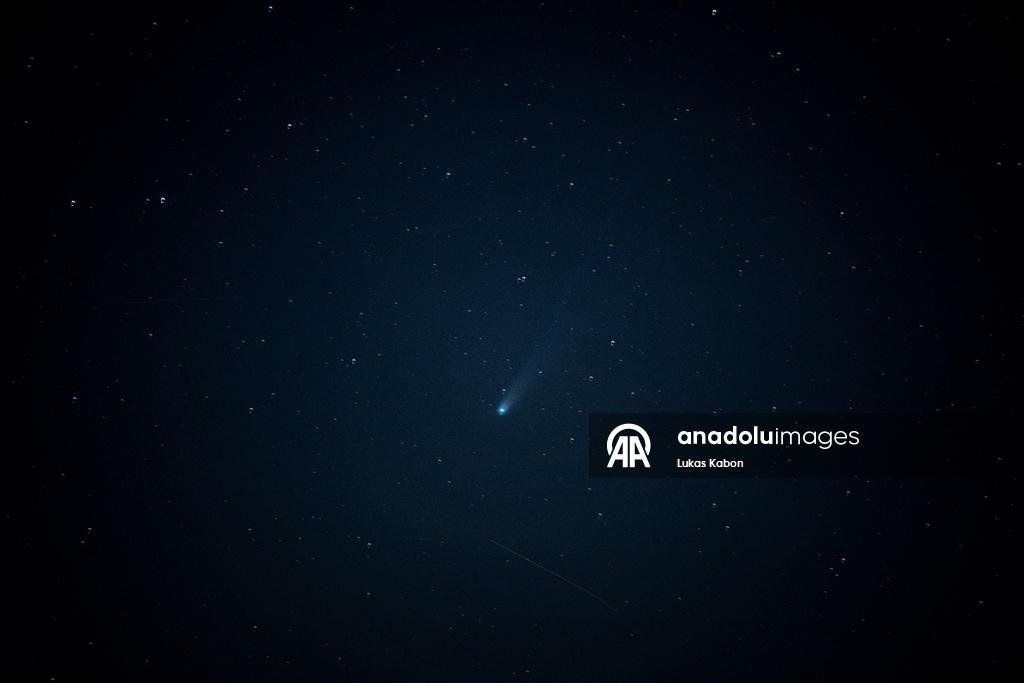
Image of the Lemmon Comet (Anadolu Ajansı)
The Lemmon Comet derives its name from the Mount Lemmon Observatory where its discovery was made. The comet was detected during systematic sky surveys and subsequently registered by the international astronomical community. Post-discovery observations provided detailed data on the object’s brightness and tail structure.
The celestial body consists of the typical comet components: nucleus, coma and tail. Observations have reported that the coma exhibits greenish tones and a distinct tail structure extends due to the influence of the solar wind. The length and shape of the tail vary depending on the comet’s distance from the Sun.
This comet has been observed from various regions of Earth at different times. Observations made in Spain and the Czech Republic demonstrated that the object is clearly visible under favorable atmospheric conditions. Although it occasionally reached high brightness levels, most detailed observations were conducted using binoculars and telescopes.
Amateur astronomers used star charts and updated observing guides to determine the comet’s position in the sky. Professional observations focused on tracking changes in brightness, tail structure and motion across the celestial sphere.
This celestial body has contributed to the understanding of cometary physical properties. It has also reached the general public through photo galleries and popular science publications, helping to increase public interest in astronomical phenomena.
Anadolu Ajansı. "Kuyruklu Yıldız Lemmon İspanya’nın Pedraforca Dağı’nın Üzerinden Geçti." Foto galeri. Anadolu Ajansı. Accessed January 11, 2026.
Anadolu Ajansı. "Lemmon Kuyruklu Yıldızı Çekya Semalarında Gözlemlendi." Foto galeri. Anadolu Ajansı. Accessed January 11, 2026.
Bilim Genç (TÜBİTAK). "Gökyüzünde İki Parlak Kuyruklu Yıldız: Lemmon ve Swan." TÜBİTAK Bilim Genç. Accessed January 11, 2026.
NASA Astronomy Picture of the Day (APOD). "C/2025 A6 (Lemmon)." APOD. Accessed January 11, 2026.
Saint Louis Science Center. "Night Sky Update October 20: Comets C/2025 A6 (Lemmon) — How to Find." Saint Louis Science Center. Accessed January 11, 2026.

Discovery and Naming
Physical Characteristics
Observations and Visibility
Amateur and Professional Observations
Scientific and Social Context