


This article was automatically translated from the original Turkish version.
+1 More
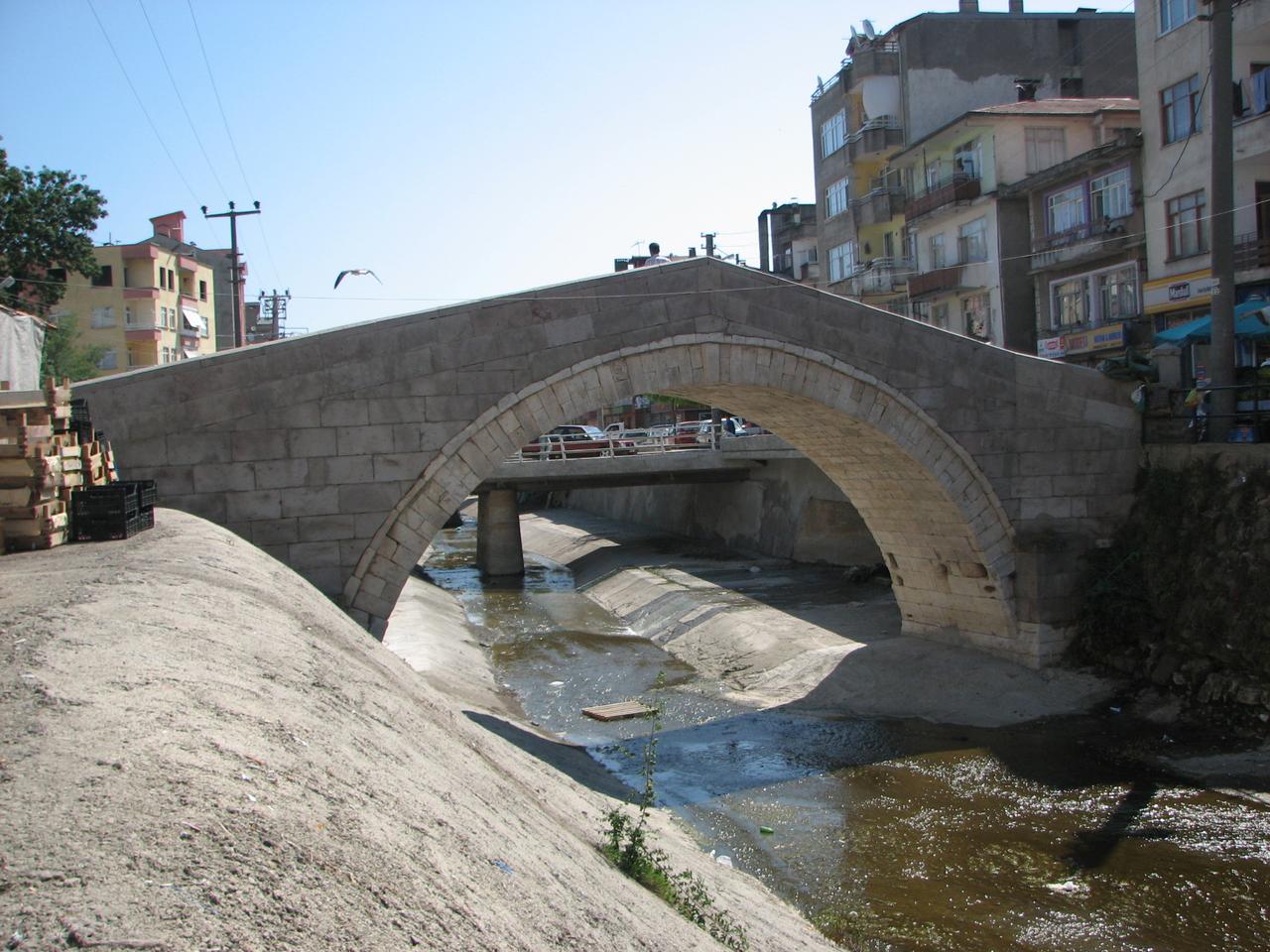
Kemere Bridge
Place | Bartın Amasra Türkiye Black Sea Region | ||||||||
|---|---|---|---|---|---|---|---|---|---|
Type | Stone arch bridge | ||||||||
Culture | Roman, Byzantine | ||||||||
Construction Period | Period of Roman Emperor Claudius (estimated 1st century AD) | ||||||||
Kemere Bridge is a historical Roman-era bridge located in the Amasra district of Bartın Province, within Türkiye’s Black Sea Region. This single-arch, round-arched stone bridge connects the Sormagir Neighborhood of Amasra with the Boztepe-Zindan Neighborhood and was constructed as part of the Roman road network. Believed to have been built during the reign of Roman Emperor Claudius, the bridge is among Amasra’s most significant historical landmarks.
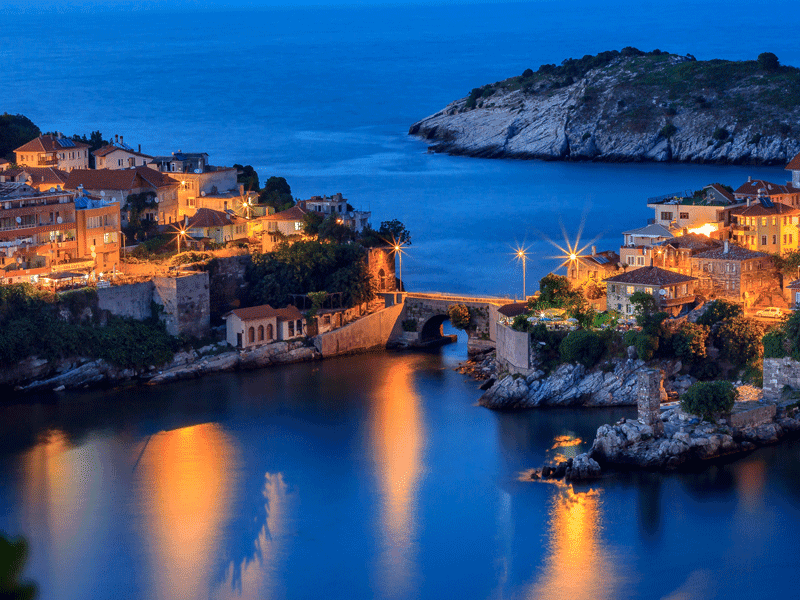
Night view of Kemere Bridge. (Republic of Türkiye Ministry of Bartın)
It is believed that Kemere Bridge was constructed during the Roman period using large rock blocks. The bridge is 5.89 meters wide and 26.69 meters long. A faint relief at the base of the bridge depicts seven soldiers engaged in a spear fight during the Roman-Pontic Wars. The bridge serves as a continuation of the Amasra Kuşkayasi Road Monument and is counted among the important historical remains from the Roman era.
During the Byzantine period, the bridge underwent repairs in the 8th and 9th centuries. It was also reinforced in the 9th century by the Byzantines to connect Sormagir Castle on Boztepe with Zindan Castle in Amasra.
In earlier times, the underside of the bridge was covered with pebbles, where boats and skiffs were maintained and repaired. These activities contributed over time to the development of tourist attractions such as boat tours. However, due to water currents, the bridge faced a risk of collapse in the 2010s. Upon this, the bridge was restored and placed under protection by the Ministry of Culture and Tourism in 2016. During restoration, a 30 cm diameter drainage pipe on the western section was relocated, rendering that part nonfunctional. Additionally, repair work was carried out between 2013 and 2014 by the 15th Regional Directorate of Highways.
The bridge connects Amasra’s Zindan Island with the mainland, providing access via two separate passages. Built to regulate sea currents and maintain cleanliness in the Small Harbor area, the bridge has held strategic and commercial importance throughout history.
Thanks to recent restoration efforts, Kemere Bridge has been integrated into tourism. Strengthened against natural threats such as landslides, the bridge is preserved as an essential component of Amasra’s historical and cultural heritage.
Amasra Kaymakamlığı. "Tarihi Kemere Köprüsü." Accessed April 19, 2025.http://www.amasra.gov.tr/tarihi-kemere-koprusu.
Bartın Valiliği. “Kemere Köprü - Amasra,” Accessed April 19, 2025.http://www.bartin.gov.tr/kemere-kopru---amasra.
Culture Inventory. "Kemere Köprüsü." Accessed April 19, 2025.https://kulturenvanteri.com/yer/kemere-koprusu/#16.66/41.750088/32.385403
Türkiye’s Historical Monuments. "Kemere Köprüsü." Accessed April 19, 2025.https://www.turkiyenintarihieserleri.com/?oku=2727

Kemere Bridge
Place | Bartın Amasra Türkiye Black Sea Region | ||||||||
|---|---|---|---|---|---|---|---|---|---|
Type | Stone arch bridge | ||||||||
Culture | Roman, Byzantine | ||||||||
Construction Period | Period of Roman Emperor Claudius (estimated 1st century AD) | ||||||||
History and Features
Location and Function
Architectural Features
Current Status