This article was automatically translated from the original Turkish version.
+2 More
Type | Space telescope | ||||||||
|---|---|---|---|---|---|---|---|---|---|
Launch Date | 25 Aralık 2021 | ||||||||
Primary Missions | To study the early stages of the universe To observe star and planet formation To analyze exoplanet atmospheres To observe the Solar System | ||||||||
Scientific Instruments | NIRCam FGS-NIRISS MIRI NIRSpec | ||||||||
Developing Organizations | NASA European Space Agency (ESA) Canadian Space Agency (CSA) | ||||||||
Launch Vehicle | Ariane 5 ECA | ||||||||
Planned Mission Duration | At least 10 years (initially 5 years) | ||||||||
Observation Area | Infrared astronomy | ||||||||
Launch Site | Guiana Space Centre (Kourou, French Guiana) | ||||||||
Mission Location | Lagrange point 2 (L2) | ||||||||
First Scientific Images | 11–12 July 2022 | ||||||||
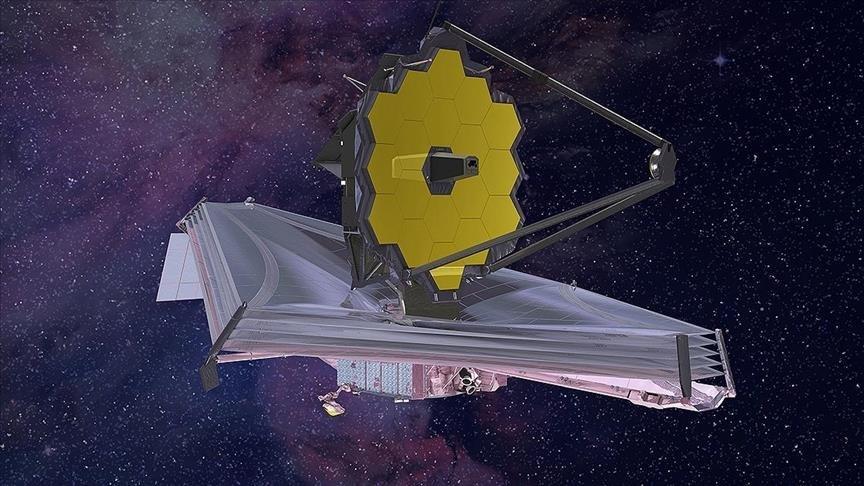
The James Webb Space Telescope (JWST) is a space telescope designed to explore the depths of space. Launched on December 25, 2021, JWST was built to succeed the Hubble Space Telescope and gather more detailed information about deeper and more distant galaxies and stars. Webb is particularly known for its capacity to perform infrared observations, and this feature enables it to provide data about the early universe that were previously unattainable.
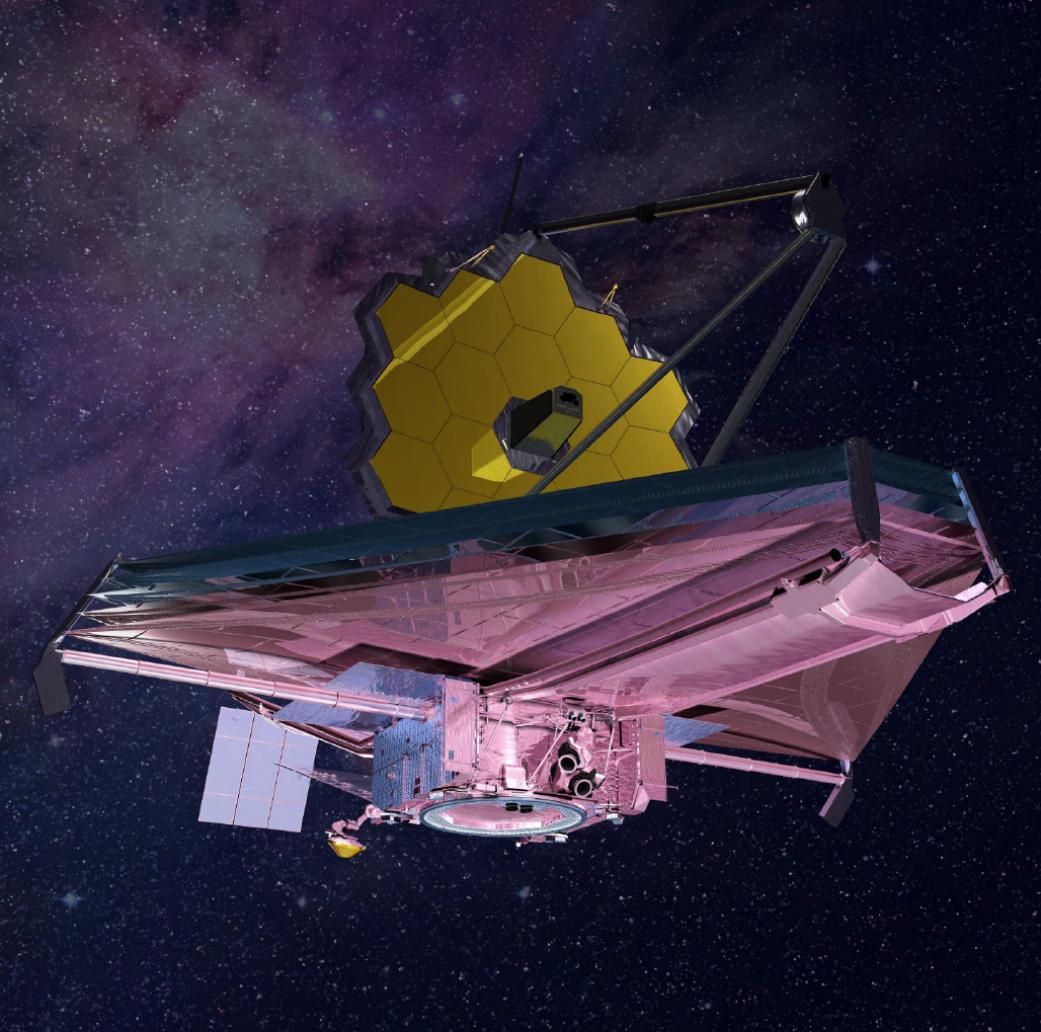
James Webb Space Telescope (NASA)
The primary mission of the James Webb Space Telescope is to examine the history of the universe in all its stages and provide advanced scientific data to the field of astronomy. In pursuit of this mission, Webb has been configured to study the structural formations and transformations that have occurred along the cosmic timeline from the Big Bang to the present day.
The telescope’s main scientific objectives are grouped around four key themes:
The James Webb Space Telescope was developed under the leadership of NASA in collaboration with the European Space Agency (ESA) and the Canadian Space Agency (CSA). The development process was initiated based on lessons learned from the Hubble Space Telescope and carried out through a long-term engineering plan.
Webb’s innovative architecture required its large mirror and sunshield, which is the size of a tennis court, to be folded for launch and then deployed in space. Consequently, the telescope was designed to be foldable so that it could unfold its structure in the weightless environment of space. This engineering solution made it possible to transport the telescope into space.
The James Webb Space Telescope was launched on December 25, 2021 aboard an Ariane 5 rocket from the European Spaceport in French Guiana. After launch, the telescope was directed toward the Lagrange Point 2 (L2), approximately 1.5 million kilometers from Earth.【1】 There, Webb orbits the Sun in a fixed position relative to Earth and is positioned to observe with minimal thermal and light interference from the Sun, Earth, and spacecraft systems.
Following launch, the telescope embarked on a journey of approximately one month to reach its orbit, during which it gradually deployed its sunshield, mirrors, and scientific instruments to become fully operational. This successful launch and deployment process established a critical foundation for the telescope’s scientific mission.
The structure of the James Webb Space Telescope consists of four main components, specially developed to enable infrared observations in space: the Optical Telescope Element (OTE), the Integrated Science Instrument Module (ISIM), the Sunshield, and the Spacecraft Bus. These components were designed as an integrated system to ensure the telescope’s observational capabilities and operational reliability throughout its mission.
Optical Telescope Element (OTE) is defined as the telescope’s “eye.” The OTE comprises a primary mirror with a diameter of 6.5 meters and a structural backplane that supports it. This primary mirror has a segmented design made up of 18 hexagonal, gold-coated mirrors. The mirror system was engineered to fold for launch and unfold in space, optimized to direct light toward the scientific instruments.
Integrated Science Instrument Module (ISIM) houses the telescope’s primary scientific instruments. This module contains four main scientific instruments:
These instruments analyze infrared light using different techniques and produce high-resolution data.
Sunshield is a large, five-layer structure that separates the hot and cold sides of the telescope. It protects the telescope from heat generated by the Sun, Earth, and spacecraft systems. This allows the OTE and ISIM components to operate under the low-temperature conditions required for infrared observations. The sunshield is designed to deploy in space and is one of the key structures ensuring the telescope’s thermal stability.
Spacecraft Bus houses the systems that support the observatory’s operations. This platform contains six main subsystems:
In addition to these main components, supplementary elements such as the momentum flap that balances solar radiation pressure, the antenna for transmitting data to Earth, the solar panel that always faces the Sun, and the star trackers used to determine the telescope’s orientation, contribute to the overall system integrity.
All these components were designed to be foldable and deployable to operate with high precision in space. This design approach enabled the telescope to be launched aboard the Ariane 5 rocket and achieve full functionality at its operational location, Lagrange Point 2.
The first scientific data were collected under the Early Release Observations (ERO) program, designed to demonstrate Webb’s observational capabilities. The first of these images were unveiled on July 11, 2022, and subsequently published by NASA on July 12. The images were made publicly available through the Mikulski Archive for Space Telescopes (MAST).
ERO targets included galaxy clusters, star-forming regions, planetary nebulae, and exoplanet atmospheres. The observations demonstrated both Webb’s resolution and sensitivity capabilities and its scientific potential.
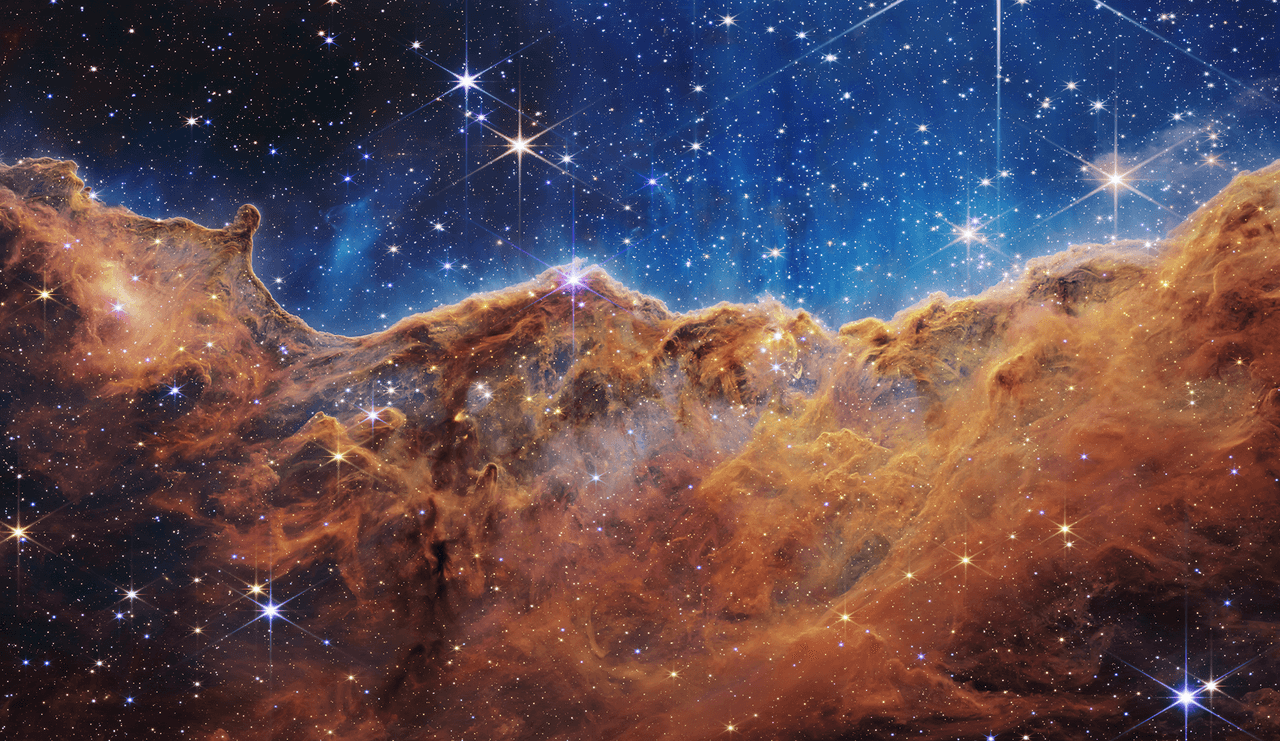
One of James Webb’s First Scientific Images, the Carina Nebula (NASA)
JWST is among the first telescopes capable of observing in infrared wavelengths. Infrared radiation is crucial for studying light from the oldest and most distant regions of the universe. The scientific contributions enabled by Webb’s observation capabilities include:
This galaxy cluster enabled Webb to observe distant galaxies in the early universe through gravitational lensing. Six-band images obtained with NIRCam provided detailed insights into galaxies from the early universe. Multi-object spectroscopic data collected with NIRSpec offered information on star-forming regions and redshifts of galaxies. The field has been surveyed into a catalog containing galaxies up to a redshift of z ~ 10.
In this interacting system of multiple galaxies, intergalactic interactions, star formation, and active galactic nuclei (AGN) were observed. Webb’s NIRCam images revealed dust filaments and interaction signatures in galaxy structures, while the MIRI instrument imaged large-scale shock regions and embedded star clusters. Detailed spectroscopic analysis of the AGN region was conducted using NIRSpec IFU and MIRI MRS spectroscopy.
In this star-forming region, Webb revealed embedded young stars and gas structures in infrared light. Observations using different filters uncovered the structure of molecular clouds, hydrogen lines, and polycyclic aromatic hydrocarbon (PAH) emissions.
In this young planetary nebula, observations with NIRCam and MIRI revealed the distribution of ionized and molecular gas. The white dwarf star and its surrounding ionization structure were detailed.
During single-object slitless spectroscopy observations with NIRISS, water vapor was detected in the atmosphere of this exoplanet during its transit.
Webb detected tidal disruption events previously hidden within dusty galaxies. Spectral signatures from stellar remnants torn apart by black holes in four different galaxies were confirmed by JWST’s high-sensitivity infrared measurements. These events demonstrate that normally inactive black holes can temporarily accrete matter.
Webb detected water vapor in the comet 238P/Read, which orbits between Jupiter and Mars, demonstrating that ice can be preserved in the inner regions of the Solar System. This observation provides new insights into the origin of water on Earth. However, the absence of a carbon dioxide signature in the same observation has been noted by scientists as a significant finding.
Anadolu Ajansı. "Webb Teleskobu, Güneş sisteminin asteroit kuşağında çığır açan bir su keşfi yaptı." Accessed December 25, 2025.https://www.aa.com.tr/en/science-technology/webb-telescope-makes-groundbreaking-water-discovery-in-solar-systems-asteroid-belt/2899532
ESA. "Webb." The European Space Agency. Accessed March 28, 2025.https://www.esa.int/Science_Exploration/Space_Science/Webb
MIT News. "Astronomers discover star-shredding black holes hiding in dusty galaxies." Massachusetts Institute of Technology. Accessed December 25, 2025.https://news.mit.edu/2025/astronomers-discover-star-shredding-black-holes-hiding-in-dusty-galaxies-0724
NASA. "James Webb Space Telescope." Science NASA. Accessed March 28, 2025.https://science.nasa.gov/mission/webb/
NASA. "Webb Images." *Science NASA.* Accessed March 28, 2025.https://science.nasa.gov/mission/webb/multimedia/images/
NASA. "Webb Observatory." Science NASA. Accessed December 25, 2025.https://science.nasa.gov/mission/webb/spacecraftoverview/
Pontoppidan, Klaus M., Barrientes, Jaclyn., Blome, Claire., Braun, Hannah., Brown, Matthew., Carruthers, Margaret., Coe, Dan. "The JWST Early Release Observations." *The Astrophysical Journal Letters* 936, no. 14 (2022): 1-13. Accessed December 25, 2025.https://iopscience.iop.org/article/10.3847/2041-8213/ac8a4e/pdf
[1]
ESA, ''Webb,'' The European Space Agency, Erişim Tarihi: 28 Mart 2025, https://www.esa.int/Science_Exploration/Space_Science/Webb

Type | Space telescope | ||||||||
|---|---|---|---|---|---|---|---|---|---|
Launch Date | 25 Aralık 2021 | ||||||||
Primary Missions | To study the early stages of the universe To observe star and planet formation To analyze exoplanet atmospheres To observe the Solar System | ||||||||
Scientific Instruments | NIRCam FGS-NIRISS MIRI NIRSpec | ||||||||
Developing Organizations | NASA European Space Agency (ESA) Canadian Space Agency (CSA) | ||||||||
Launch Vehicle | Ariane 5 ECA | ||||||||
Planned Mission Duration | At least 10 years (initially 5 years) | ||||||||
Observation Area | Infrared astronomy | ||||||||
Launch Site | Guiana Space Centre (Kourou, French Guiana) | ||||||||
Mission Location | Lagrange point 2 (L2) | ||||||||
First Scientific Images | 11–12 July 2022 | ||||||||
No Discussion Added Yet
Start discussion for "James Webb Space Telescope" article
Mission and Scientific Objectives
Development and Launch
Structure and Design
First Images and Early Scientific Observations
Scientific Capacity and Observations
SMACS J0723.3-7327
Stephan’s Quintet
NGC 3324 (Carina Nebula)
NGC 3132 (Southern Ring Nebula)
WASP-96b
Tidal Disruption Events (TDEs)
Discovery of Water in the Asteroid Belt