


This article was automatically translated from the original Turkish version.
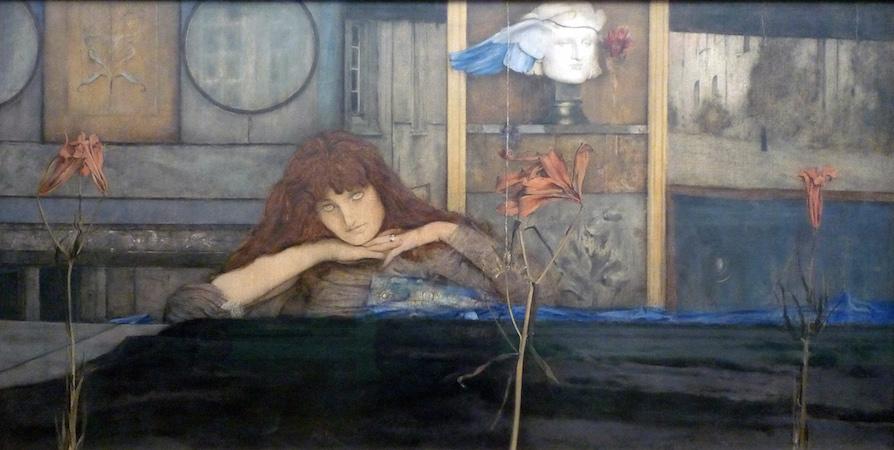
I Lock my Door Upon Myself
Artist | Fernand Khnopff | ||||||||
|---|---|---|---|---|---|---|---|---|---|
Art Movement | Symbolism | ||||||||
Technique | Oil paint | ||||||||
Surface | Canvas | ||||||||
Location | Neue Pinakothek, Munich | ||||||||
Size | Approximately 72 7 × 141 cm | ||||||||
Year of Production | 1891 | ||||||||
I Lock My Door Upon Myself, a painting by Belgian artist Fernand Khnopff, was executed in 1891 using the oil technique on canvas. The work is analyzed within the context of the artist’s symbolist production and is regarded as one of the pieces in symbolist painting that moves away from figurative narrative and emphasizes symbolic structure.【1】
Fernand Khnopff’s artistic output is characterized by a focus on internal and mental states rather than the external world.【2】 His figures are often presented in a timeless and narrative-free manner, a tendency that aligns with the core characteristics of symbolist aesthetics.
The work was completed in 1891 using oil on canvas. It features a horizontal composition. The paint surface employs muted color tones, and a controlled and detailed technique was applied. The painting measures approximately 72.7 × 141 cm.
The female figure at the center of the composition serves as the primary focal point. The spatial arrangement of the work is divided into three main horizontal bands by vertical planes.【3】 This geometric and linear structure imparts a static visual character to the composition. The objects surrounding the figure are presented not as elements of a narrative scene but as part of a symbolic arrangement.【4】 .
I Lock My Door Upon Myself (Smarthistory)
The female figure in the painting is not a portrait of a specific individual but is conceived as a symbolic representation. Her gaze, which avoids direct eye contact with the viewer, conveys a distant and introspective posture. The absence of any explicit identification of the figure leaves its representation open to ambiguity.
The elements present in the work consist of objects associated with the symbolic realm. A bust of Hypnos is positioned on a shelf; this bust is linked to sleep and unconscious states. The red poppy flower in the composition evokes themes of sleep, forgetfulness, or transience; the motif of the door in the background functions as a visual element emphasizing the boundary between inner and outer space.【5】 .
The title of the work is taken from a poem by Christina Georgina Rossetti. It reflects the theme of an individual withdrawing from the external world and turning inward. The use of the original English title preserves the literary and symbolic allusions of the piece.
Khnopff constructs a narrative structure in this work that avoids offering a single, definitive interpretation. The painting generates a multilayered system of meaning through symbols and directs the viewer toward a process of intellectual interpretation. This approach is understood within the framework of what is termed the logographic method in symbolist painting.
The work is currently held in the collection of the Neue Pinakothek in Munich. It is included among the international examples of symbolist painting in the museum’s collection.
I Lock My Door Upon Myself, is among Fernand Khnopff’s works that reflect his symbolist aesthetic. The painting is studied within the context of symbolist art that visually explores themes of introversion, consciousness, and solitude.
Harris, Beth and Steven Zucker. “Fernand Khnopff, I Lock My Door Upon Myself.” Smarthistory. Accessed January 18, 2026.https://smarthistory.org/khnopff-i-lock-my-door-upon-myself/
Klyushina, Elena V. “Fernand Khnopff’s Logogriphic Method: A Case Study of I Lock My Door upon Myself.” *Actual Problems of Theory and History of Art* 6 (2016): 523–531. Accessed January 18, 2026.https://publ.actual-art.org/aptha/en/article/view/10473
Landow, George P. “Fernand Khnopff: I Lock My Door Upon Myself.” The Victorian Web. Accessed January 18, 2026.https://www.victorianweb.org/painting/khnopff/paintings/charania14.html
[1]
Beth Harris ve Steven Zucker, “Fernand Khnopff, I Lock My Door Upon Myself,” Smarthistory, Erişim Tarihi: 18 Ocak 2026, https://smarthistory.org/khnopff-i-lock-my-door-upon-myself/.
[2]
George P. Landow, “Fernand Khnopff: I Lock My Door Upon Myself,” The Victorian Web, Erişim Tarihi: 18 Ocak 2026, https://www.victorianweb.org/painting/khnopff/paintings/charania14.html.
[3]
Beth Harris ve Steven Zucker, “Fernand Khnopff, I Lock My Door Upon Myself,” Smarthistory, Erişim Tarihi: 18 Ocak 2026, https://smarthistory.org/khnopff-i-lock-my-door-upon-myself/
[4]
Elena V. Klyushina, “Fernand Khnopff’s Logogriphic Method: A Case Study of I Lock My Door upon Myself,” Actual Problems of Theory and History of Art 6 (2016): 523–531, Erişim Tarihi: 18 Ocak 2026, https://publ.actual-art.org/aptha/en/article/view/10473
[5]
George P. Landow, “Fernand Khnopff: I Lock My Door Upon Myself,” The Victorian Web, Erişim Tarihi: 18 Ocak 2026, https://www.victorianweb.org/painting/khnopff/paintings/charania14.html

I Lock my Door Upon Myself
Artist | Fernand Khnopff | ||||||||
|---|---|---|---|---|---|---|---|---|---|
Art Movement | Symbolism | ||||||||
Technique | Oil paint | ||||||||
Surface | Canvas | ||||||||
Location | Neue Pinakothek, Munich | ||||||||
Size | Approximately 72 7 × 141 cm | ||||||||
Year of Production | 1891 | ||||||||
No Discussion Added Yet
Start discussion for "I Lock My Door Upon Myself (Painting)" article
The Artist’s Position within Symbolism
Date of Creation and Technical Features
Compositional Structure
Meaning and Representation of the Figure
Iconographic Elements
Title and Literary Connection
Method of Meaning Construction
Exhibition and Current Location
Place in Art History