


This article was automatically translated from the original Turkish version.
Güneş kursu is a symbolic ritual object found among the ancient Anatolian civilizations, particularly in the Hatti and Hittite societies, representing the sun and the cosmos. Typically made of bronze, these objects were used in religious ceremonies and often designed in the shape of a symbol carried atop a bull’s horn. Sun disks are regarded as an essential component of the belief systems of early Anatolian peoples, who sanctified natural phenomena and rendered them symbolic.
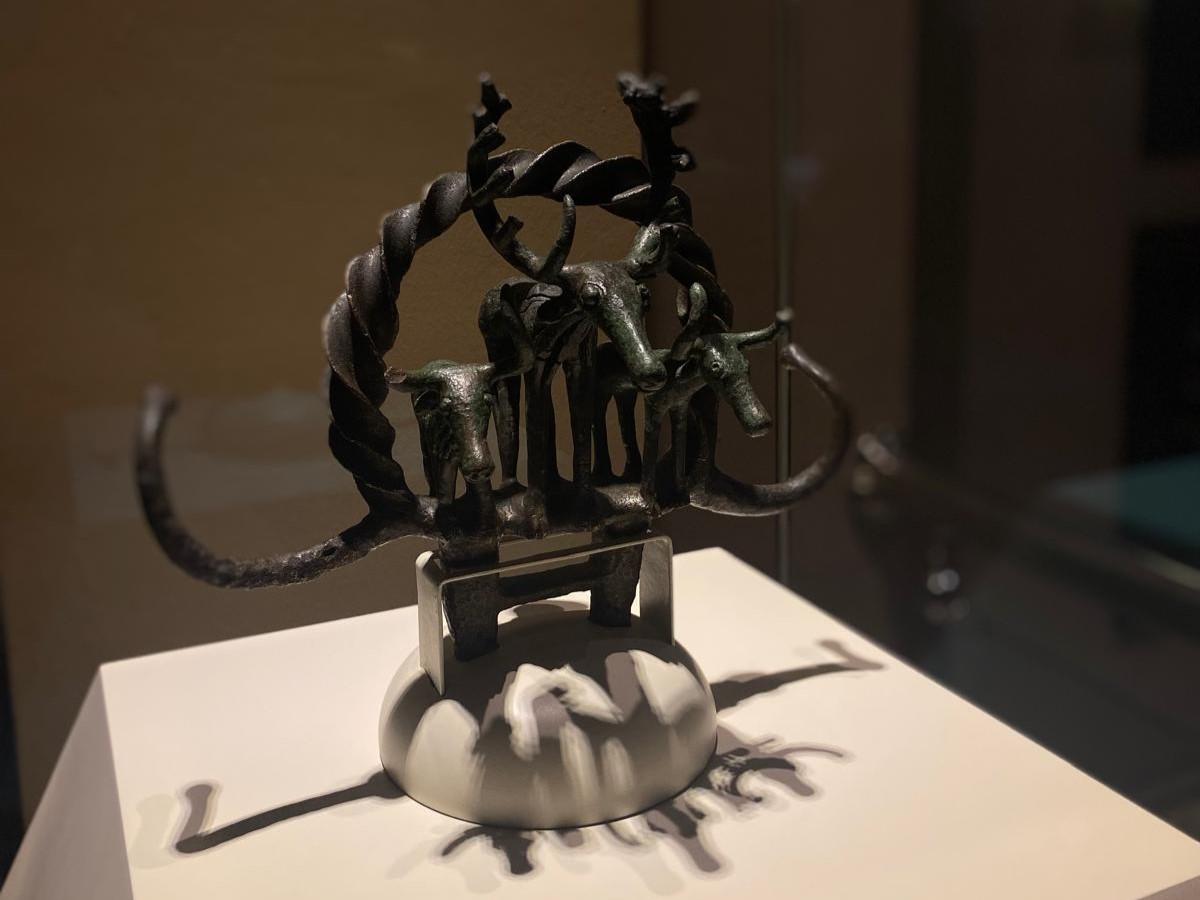
Hitit Güneş Kursu Heykeli, Anadolu Medeniyetleri Müzesi (Emine Erdal)
The origins of the sun disk trace back to the Hattians, an indigenous people who inhabited Anatolia between 2500 and 2000 BCE. The Hittites, a Indo-European group that arrived in Anatolia in the 2000s BCE, were heavily influenced by Hatti culture. This influence is evident in many areas, from religious rituals and mythological elements to court ceremonies. Many elements, including the city of Hattuşa (modern Boğazköy) and royal names, are expressed using Hatti-derived terms.
The Hittite belief system was polytheistic and described as one that worshipped a thousand deities. The sun god held a privileged position within this system. The sun goddess Arinna possessed feminine attributes, yet it was believed that when she descended into the underworld, she acquired masculine qualities. The setting of the sun was not interpreted as death but as the god’s journey to the land of the dead. In this context, the sun’s association with both the earth and the underworld elevated it to the status of one of the supreme deities.
Sun disks exhibit considerable formal diversity. They were constructed in circular, semicircular, square, and rectangular forms and often featured geometric motifs, animal figures (bull, deer, lion), and sometimes swastika-like or star-like decorations. These figures are interpreted as symbols of deities. For instance, the bull represents the sky god Tešup, while the deer symbolizes the protective deity Vurušemu. The small rings on the upper parts of the disks are believed to represent stars, and the bell-like pendulums on the lower parts were thought to produce sound during rituals to ward off evil spirits.
Sun disks were not merely aesthetic objects but also functional ritual instruments. Priests carried them attached to the ends of staffs during religious ceremonies, using them to regulate procession rhythms or to signal the beginning and end of rituals. The presence of some sun disks in graves indicates that they were used as symbols reflecting the identity and social status of the deceased. In this sense, sun disks also served a sociological function akin to identity markers.
Today, the monument erected in Sıhhiye Square in Ankara, known as the "Hittite Sun Disk", is in fact an enlarged version of a sovereignty emblem belonging to the Hatti kings. This monument symbolizes the place of the Hattians and their cultural successors, the Hittites, within the broader Anatolian civilization. Sun disks discovered through archaeological excavations are currently exhibited at the Museum of Anatolian Civilizations, demonstrating the high level of artistic sophistication achieved by the Hatti civilization, one of the earliest cultures in Anatolia.
Akurgal, Ekrem. “Hattiler, Hititler ve Güneş Kursu.” *Belleten* 41, no. 162 (1977): 419–421. Accessed May 30, 2025.https://dergipark.org.tr/en/pub/ttkbelleten/issue/72232/1165179
Emir, İlknur. “Hitit Uygarlığında Güneş Kültü ve Güneş Kursu Simgelerinin Biçimsel Açıdan İncelenmesi.” *Sanat ve Tasarım Dergisi* 20. Yıl Armağan Sayısı, no. 35 (2025): 327–342. Accessed May 30, 2025.https://dergipark.org.tr/tr/pub/sanatvetasarim/issue/91963/1539462
Erdal, Emine. *Alacahöyük’te Güneş Kursu Replikası*. Flickr. Photograph. Date Published May 2025. Accessed May 30, 2025.https://www.flickr.com/photos/202901907@N07/54553662042/in/dateposted-public/
mihalorel. "Hitit Güneşi Heykeli (Ankara)." Flickr. Photograph. Accessed May 30, 2025.https://www.flickr.com/photos/mihalorel/4368513018

The Origins of the Sun Disk in Hatti and Hittite Cultures
The Sun Cult and Belief System
Formal Characteristics of the Sun Disks
Symbolic and Ritual Functions