This article was automatically translated from the original Turkish version.
Celebration Name | Hıdrellez | ||||||||
|---|---|---|---|---|---|---|---|---|---|
Type | Seasonal Holiday (Spring Festival) | ||||||||
Celebration Date | The night connecting May 5 to May 6, on May 6 | ||||||||
Season Period | According to the Gregorian calendar, May 6 corresponds to April 23 in the Rumi calendar | ||||||||
Celebration Geography | Türkiye, Macedonia, Anatolia, the Balkans, Crimea, | ||||||||
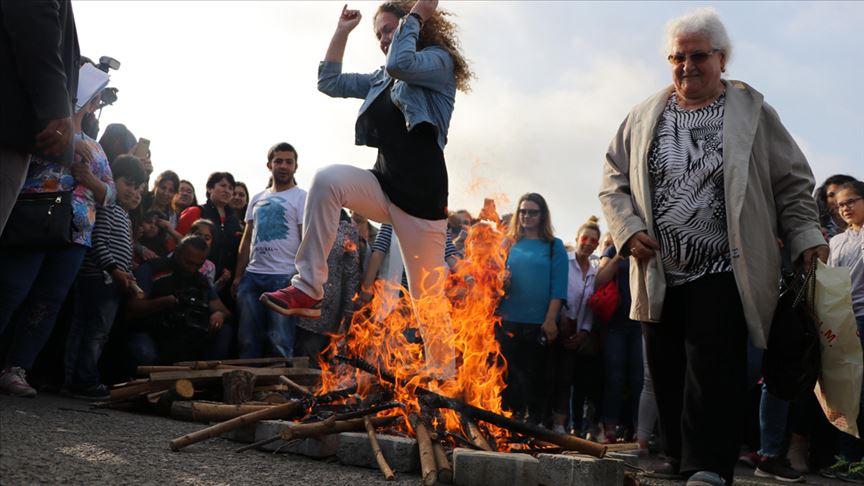
Hıdrellez is a seasonal festival observed across a broad geographical area, primarily in Anatolia and the Balkans, marking the arrival of spring, the renewal of nature, and the beginning of summer. It is celebrated on May 6 according to the Gregorian calendar, which corresponds to April 23 in the Julian calendar.【1】 In folk calendar systems, the year is divided into two parts: the period from May 6 to November 8 is known as Hızır Days and represents summer, while the period from November 8 to May 6 is called Kasım Days and signifies winter. Therefore, the night between May 5 and May 6 is regarded as the end of winter and the arrival of summer.
Hıdırellez (2001) | TRT Archive (TRT Archive)
The historical background of Hıdrellez does not stem from a single culture but from a continuous cultural tradition formed by the accumulation of thousands of years of overlapping belief systems. Consequently, Hıdrellez spans a historical geography extending from ancient Mesopotamia through the steppes of Central Asia, to the ancient societies of Anatolia and the Balkans.
The arrival of spring, the revival of nature, and the rebirth of plants were regarded as sacred periods beginning in Mesopotamia and extending throughout the Eastern Mediterranean world. Ancient civilizations interpreted the cycle of winter’s death and spring’s rebirth as a divine process. This concept became ritualized especially through deities symbolizing the annual renewal of plant life. In Mesopotamia, during the spring months, ceremonies were performed for deities believed to impart life to nature.【2】 This belief endured for millennia and became embedded in the foundational elements of later folk festivals. Indeed, practices such as entering water, gathering in green spaces, and seeking healing from fresh plants in Hıdrellez align with these ancient roots.
Anatolia has historically served as a center for special rites associated with the arrival of spring. It is known that ancient communities regarded the beginning of summer as sacred and offered sacrifices to protective spirits or deities of plants. These rituals generally involved “renewal” ceremonies accompanying nature’s awakening. Many practices still observed today in Hıdrellez resemble those of this era, including gathering in open areas, regarding water and green spaces as sacred, consuming the first spring produce, seeking herbal remedies for illness, and engaging in communal festivities to welcome spring.
In ancient Iran, spring was associated with sacred entities linked to water and vegetation—specifically the deities Haurvatât and Ameretât;【3】 in the steppes of Central Asia, spring marked one of the most significant turning points of the year for Turk communities. In nomadic life, the end of winter, the reproduction of livestock, the greening of pastures, and the movement of herds to open grazing lands were of vital importance. Thus, the April–May period was a time of major celebrations. Water, fire, grass, flowers, and youth were central themes in these festivities. Collective revelries, purification rituals, jumping over fire, and ceremonies welcoming nature’s revival formed a shared structure among many Turkic communities.
These ritual patterns, after the Turks’ arrival in Anatolia, merged with local cultures to form one of the characteristic forms of Hıdrellez. The Turkic folk calendar’s division of the year into two halves is a continuation of Central Asia’s seasonal calendar logic, adapted in Anatolia through Islamic nomenclature. The recognition of May 6 as the beginning of summer is the result of this continuity.
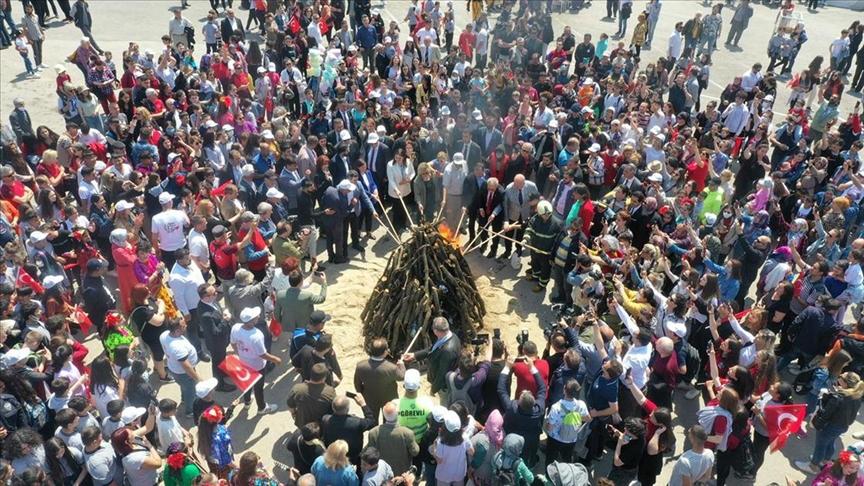
Hıdrellez Fire (Anadolu Agency)
After the adoption of Islam, many of the older spring rites were integrated into the collective memory through new religious figures. In this context, the motifs of Hızır and İlyas played a decisive role. Hızır’s identification as a saint who guides travelers, aids those in distress, and brings abundance and prosperity, along with İlyas’s recognition as the protector of water and life, provided an Islamic interpretation of the spring ritual’s core themes of water, greenery, and fertility. Over time, these two names merged in popular speech to form the term “Hıdrellez,” and the practices of the ancient spring festivals were reinterpreted as acts through which Hızır’s touch would bring blessings.【4】
Due to the multi-religious character of the Balkans and Anatolia, Hıdrellez also interacted with Christian spring celebrations. In the Eastern Christian tradition, the feast day of Saint George was likewise recognized as the beginning of spring. The celebration of this day around May 6 gradually led to the blending of the two traditions at the level of popular culture.【5】 As a result, in the Balkans and certain regions of Anatolia, May 6 is celebrated both by Muslims as the day of Hızır and İlyas and by Christians as the day of Saint George.
During the Ottoman period, May 6 continued to be recognized in the folk calendar as the beginning of summer. Even official affairs divided the year into Hızır Days and Kasım Days. During this era, Hıdrellez celebrations evolved into festive gatherings that brought together large segments of the population. Recreational events held in picnic areas became public spaces that strengthened social bonds. Practices believed to bring blessings through Hızır’s touch—including offerings, spring festivities, and rituals to attract fortune—were widespread across the Ottoman territories.【6】
Today, Hıdrellez is a cultural phenomenon that incorporates elements from Mesopotamian spring rites, Anatolia’s ancient fertility rituals, Iranian and Central Asian spring ceremonies, the Turkic folk calendar’s seasonal divisions, the Islamic Hızır–İlyas cult, and the Eastern Christian tradition of Saint George. Consequently, it forms a shared ritual space across Anatolia, the Balkans, and the Middle East.
The term “Hıdrellez” derives from the fusion of the names “Hızır” and “İlyas” in popular usage. According to belief, Hızır and İlyas are two sacred beings who assist those in distress: Hızır on land and İlyas over water, both bringing abundance and prosperity.【7】 It is believed that they meet only once a year, on May 6, and that their meeting bestows blessings upon the earth.
Hıdrellez is not celebrated only in Türkiye but also in the Balkans, Crimea, Iraq, Syria, Azerbaijan, and various regions of the Middle East. It is known by different local names:
Preparations for Hıdrellez typically begin several days in advance. Because of the belief that Hızır will not visit an unclean home, houses are thoroughly cleaned, food stores are organized, and new clothing is prepared. The primary sites for celebrations are green areas, riversides, picnic grounds, and tombs. In many Anatolian settlements, special picnic areas known as “Hıdırlık” are designated for these festivities. Here, communal meals, entertainment, musical celebrations, and various wish rituals are performed.
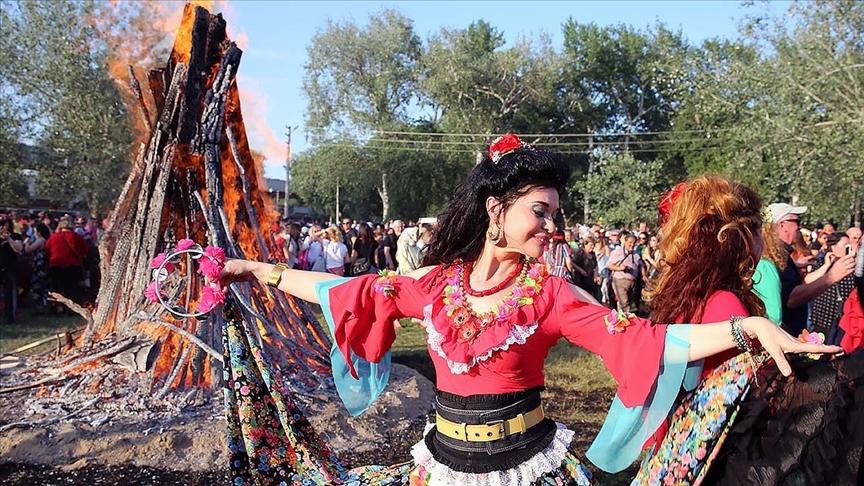
Hıdrellez Celebrations (Anadolu Agency)
Although less observed in large cities, Hıdrellez is still celebrated with ceremonies and preparations in towns and villages. All rituals and traditions associated with Hıdrellez can generally be grouped under four main categories:
It is believed that Hızır’s blessing brings health.
It is accepted that wherever Hızır touches, abundance and prosperity follow.
In some regions, sacks, chests, or wallets are left open, as it is believed that Hızır will leave blessings in the home. Among producer communities, leading livestock out to pasture on the morning of Hıdrellez is considered a tradition that brings prosperity.
Young women’s rituals to attract fortune are among the most widespread Hıdrellez practices. Regional names vary: in Istanbul it is called baht açma, in Balıkesir dağara yüzük atma, in Edirne niyet çıkarma, in Erzurum mani çekme, and among Yörük and Turkmen communities mantıfar.【8】 In this ritual, young women place personal items into a clay pot and leave it beneath a rose tree. The next day, the pot is opened to music, and each object found inside is interpreted as an omen related to its owner.
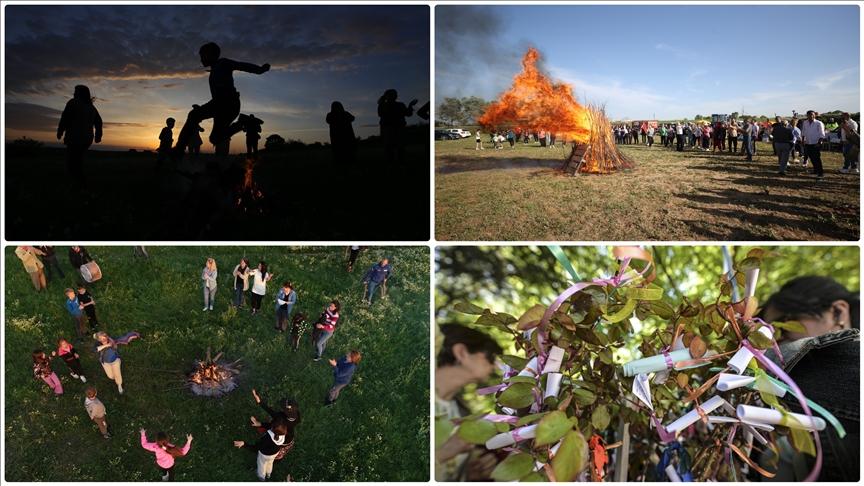
Hıdrellez Practices (Anadolu Agency)
The beliefs and customs of Hıdrellez have also permeated Turkish literature.
The cultural significance of Hıdrellez has been internationally recognized. The United Nations Educational, Scientific and Cultural Organization (UNESCO) inscribed Hıdrellez in 2017 on the “Representative List of the Intangible Cultural Heritage of Humanity,” following a joint nomination by North Macedonia and Türkiye.【13】
Anadolu Ajansı. "Edirne Keşan'da Hıdırellez ateşi yakıldı." Accessed December 10, 2025.https://www.aa.com.tr/tr/yasam/edirne-kesanda-hidirellez-atesi-yakildi/2580137
Anadolu Ajansı. "Hıdırellez yüzlerce yıldır renkli ritüellerle kutlanıyor." Accessed December 10, 2025.https://www.aa.com.tr/tr/yasam/hidirellez-yuzlerce-yildir-renkli-rituellerle-kutlaniyor/2888826
Anadolu Ajansı. "Yaz mevsiminin habercisi ve doğanın yeniden uyanışı: Hıdırellez." Accessed December 10, 2025.https://www.aa.com.tr/tr/yasam/yaz-mevsiminin-habercisi-ve-doganin-yeniden-uyanisi-hidirellez/3557412
BBC News. "Hıdırellez nedir, ne zaman kutlanır?" Accessed December 10, 2025.https://www.bbc.com/turkce/articles/c9353l1yznxo
Ocak, Ahmet Yaşar. "Hıdrellez." İslam Ansiklopedisi. Accessed December 10, 2025.https://islamansiklopedisi.org.tr/hidrellez
T.C. Ministry of Culture and Tourism. "Hıdrellez Kutlamaları." T.C. Ministry of Culture and Tourism. Accessed December 10, 2025.https://yakegm.ktb.gov.tr/TR-12336/hidrellez-kutlamalari.html#:~:text=H%C4%B1drellez%2C%20b%C3%BCt%C3%BCn%20T%C3%BCrk%20d%C3%BCnyas%C4%B1nda%20bilinen,halk%20a%C4%9Fz%C4%B1nda%20h%C4%B1drellez%20%C5%9Feklini%20alm%C4%B1%C5%9Ft%C4%B1r.
TRT Arşiv. "Hıdırellez (2001) | TRT Arşiv." YouTube Video. Date Published: May 6, 2024. Accessed December 10, 2025.https://www.youtube.com/watch?v=OJsSrOyRX6I&t=21s
Turan, Ahsen Fatma. "ANADOLU’DAKİ HIDIRELLEZ KUTLAMALARINA DAİR İNANMALAR, RİTÜELLER, YASAKLAR VE YAPTIRIMLAR." *Gazi Türkiyat*, 1(2), 101-111. Accessed December 10, 2025.https://dergipark.org.tr/tr/pub/gaziturkiyat/issue/6715/90211
Uca, Alaattin. "TÜRK TOPLUMUNDA HIDIRELLEZ - I." *A.Ü. Türkiyat Araştırmaları Enstitüsü Dergisi*, no. 34, pp. 113–138, Erzurum 2007. Accessed December 10, 2025.https://dergipark.org.tr/en/download/article-file/33076
[1]
Ahmet Yaşar Ocak, "Hıdrellez," İslam Ansiklopedisi, erişim 10 Aralık 2025, https://islamansiklopedisi.org.tr/hidrellez
[2]
Ocak, "Hıdrellez," İslam Ansiklopedisi, erişim 10 Aralık 2025,
[3]
Ocak, "Hıdrellez," İslam Ansiklopedisi, erişim 10 Aralık 2025,
[4]
Ocak, "Hıdrellez," İslam Ansiklopedisi, erişim 10 Aralık 2025,
[5]
Ocak, "Hıdrellez," İslam Ansiklopedisi, erişim 10 Aralık 2025,
[6]
Ocak, "Hıdrellez," İslam Ansiklopedisi, erişim 10 Aralık 2025,
[7]
Anadolu Ajansı, "Hıdırellez yüzlerce yıldır renkli ritüellerle kutlanıyor," Anadolu Ajansı, erişim 10 Aralık 2025, https://www.aa.com.tr/tr/yasam/hidirellez-yuzlerce-yildir-renkli-rituellerle-kutlaniyor/2888826
[8]
T.C. Kültür ve Turizm Bakanlığı, "Hıdrellez Kutlamaları," T.C. Kültür ve Turizm Bakanlığı, erişim 10 Aralık 2025, https://yakegm.ktb.gov.tr/TR-12336/hidrellez-kutlamalari.html#:~:text=H%C4%B1drellez%2C%20b%C3%BCt%C3%BCn%20T%C3%BCrk%20d%C3%BCnyas%C4%B1nda%20bilinen,halk%20a%C4%9Fz%C4%B1nda%20h%C4%B1drellez%20%C5%9Feklini%20alm%C4%B1%C5%9Ft%C4%B1r.
[9]
Ocak, "Hıdrellez," İslam Ansiklopedisi, erişim 10 Aralık 2025,
[10]
Ocak, "Hıdrellez," İslam Ansiklopedisi, erişim 10 Aralık 2025,
[11]
Ocak, "Hıdrellez," İslam Ansiklopedisi, erişim 10 Aralık 2025,
[12]
Ocak, "Hıdrellez," İslam Ansiklopedisi, erişim 10 Aralık 2025,
[13]
Anadolu Ajansı, "Hıdırellez yüzlerce yıldır renkli ritüellerle kutlanıyor," Anadolu Ajansı, erişim 10 Aralık 2025, https://www.aa.com.tr/tr/yasam/hidirellez-yuzlerce-yildir-renkli-rituellerle-kutlaniyor/2888826

Celebration Name | Hıdrellez | ||||||||
|---|---|---|---|---|---|---|---|---|---|
Type | Seasonal Holiday (Spring Festival) | ||||||||
Celebration Date | The night connecting May 5 to May 6, on May 6 | ||||||||
Season Period | According to the Gregorian calendar, May 6 corresponds to April 23 in the Rumi calendar | ||||||||
Celebration Geography | Türkiye, Macedonia, Anatolia, the Balkans, Crimea, | ||||||||
Historical Background
Mesopotamian and Near Eastern Fertility Rituals
Ancient Anatolian Ceremonies
Seasonal Rituals in Iran and Central Asia
The Addition of Hızır and İlyas Cults and the Islamization of the Ritual
Interaction with Eastern Christianity
Hıdrellez in the Ottoman Period
Hıdrellez Today
Origin of the Name and Beliefs
Geographical Spread and Local Names
Preparations and Celebration Sites
Practices and Rituals
Healing and Health Rituals
Abundance and Omen Rituals
Practices Related to Property and Livelihood
Rituals for Attracting Fortune and Destiny
Reflections in Literature
UNESCO Intangible Cultural Heritage List