


This article was automatically translated from the original Turkish version.

(Image generated by artificial intelligence.)
Gıyıdan Türküsü
Region | Kastamonu/İnebolu | ||||||||
|---|---|---|---|---|---|---|---|---|---|
Type | Turkish folk song | ||||||||
Source | Folk legends and oral culture | ||||||||
Collector | Muzaffer Sarısözen | ||||||||
Character | Anonymous | ||||||||
Theme | Love Separation Fate and social tradition | ||||||||
Known Performers | Hasan Yılmaz | ||||||||
Gıydıvan Türküsü, Kastamonu region’s oral cultural products, distinguished by its integration with local narratives, regional speech patterns, and anonymous character, is a traditional Turkish folk song that powerfully conveys themes of love, separation, and fate through a compelling expressive language.
Hasan Yılmaz - Gıydıvanın Kızları (Cihan Müzik)
Gıydıvan Türküsü’s origins are rooted in the folk legends widely told in Kastamonu and its surroundings; the song derives its name from the term “Gıydıvan,” which appears in local narratives either as a place name or as a reference to the central figure or event in the story.
The naming of the song reflects regional dialectal features, indicating that the word has evolved over time through oral transmission and aligns with the general character of Kastamonu folklore. 【1】
Gıydıvan’s Girls (Huriye’m)
Each a Bud of Rose (Huriye’m)
Come Slowly, Gently (Huriye’m)
Let the Planks Not Creak (Huriye’m)
My Beautiful One, Shama (Huriye’m)
She Goes to the Bath Every Day (Huriye’m)
While the Young Men Stand Still (Huriye’m)
Why Did You Come to the Mother (Huriye’m)
Gıydıvan’s Girls (Huriye’m)
Each a Bunch of Lilac (Huriye’m)
Come Gently, Slowly (Huriye’m)
Our Mehle Is the Beloved (Huriye’m)
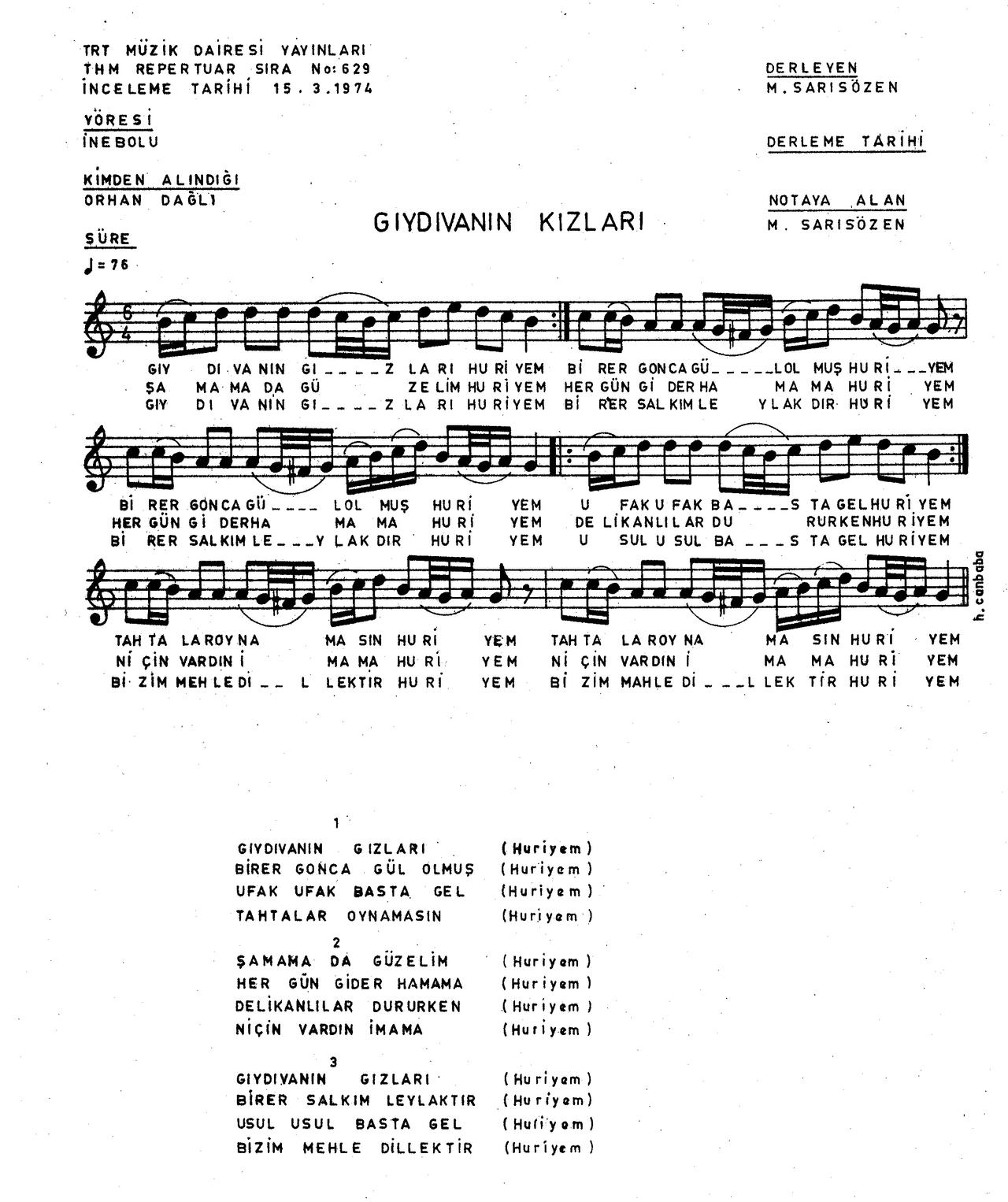
Notation of Gıydıvan Türküsü (Defteriniz)
Gıydıvan Türküsü is directly linked to the tragic legends of Kastamonu, in which the suffering of a young person unable to attain their beloved, alongside social pressures and the weight of fate, takes center stage.
The lyrics serve as a poetic summary of these narratives, holding significance in demonstrating how individual sorrow becomes embedded in collective memory.
The song’s central themes include unrequited love, separation, submission to fate, and inner solitude; these are conveyed to the listener through a simple yet profound narrative style. In this sense, Gıydıvan Türküsü is not merely a musical piece but also a verbal document reflecting the emotional world and life perception of the local people.
Gıydıvan Türküsü exhibits melodic and rhythmic characteristics unique to the Kastamonu region and is typically performed with a free, lyrical flow resembling a long melody.
The melody is dominated by a melancholic contour, which, when fused with the lyrics, enhances the dramatic impact of the narrative. The performance style, regional pronunciation, and emphasis patterns reinforce the song’s place within the anonymous folk music tradition.
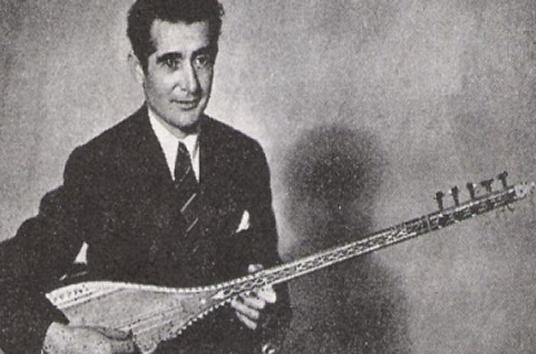
Muzaffer Sarısözen (Türkü Dostları)
Muzaffer Sarısözen played a crucial role in preserving Gıydıvan Türküsü for posterity. Beginning in the 1930s, during state-supported fieldwork expeditions across Anatolia, Sarısözen systematically collected numerous anonymous folk melodies from the Kastamonu region, including Gıydıvan Türküsü, transcribing both lyrics and melody into musical notation and integrating them into official archives. This effort not only prevented the song from being lost within oral tradition alone but also established it as a reliable source for academic research and performers.
Muzaffer Sarısözen’s approach to folk music was grounded in preserving regional styles and maintaining the song’s cultural context, meaning that the version of Gıydıvan Türküsü known today largely reflects his collection methodology. 【2】
Among the artists who performed Gıydıvan Türküsü, Hasan Yılmaz played a significant role in bringing the song to widespread public recognition in the present day.
The legendary background and cultural context of the song are documented in academic and fieldwork studies on Kastamonu legends, revealing that Gıydıvan Türküsü possesses not only musical but also folkloric value. In this regard, the song is regarded as an important example of preserving and transmitting local culture.
As one of the most significant folk music products reflecting the cultural identity of the Kastamonu region, Gıydıvan Türküsü embodies the strong connection between local legends and music. The song has become embedded in the collective memory of the community, functioning both as oral history and as an emotional medium, passed down from generation to generation until the present day. 【3】
Accessed January 19, 2026.
Atatürk Ansiklopedisi. "Muzaffer Sarısözen (1899–1963)." Accessed January 19, 2026.
Cantürk, Güray, and Aslıhan Eruzun Özel. "Kastamonu Türkülerinin Usul Yönünden İncelenmesi." Social Sciences Studies Journal (SSS Journal) 9, no. 112 (2023): 7316–7325.
Defteriniz.com. "Gıydıvan’ın Kızları (Huriye’m) – Tif Türkü Notası ve Sözü." Accessed January 19, 2026.
Hasan Yılmaz. Gıydıvanın Kızları. YouTube video, 3:43. Accessed January 19, 2026.
Karar. "Hasan Yılmaz Kimdir, Kaç Yaşında, Nereli? Kamyon Şoförlüğünden Şarkıcılığa." Accessed January 19, 2026.
Kastamonu İstiklal Gazetesi. "Kastamonu’nun Meşhur Türkü Efsaneleri: Gıydıvan." Accessed January 19, 2026.
Tanrısever Yiğit, Canan, Hüseyin Pamukçu, and Ömer Saraç. Kastamonu Efsaneleri. Kastamonu: Kastamonu Üniversitesi Yayınları, 2019. Accessed January 19, 2026.
[1]
Canan Tanrısever Yiğit, Hüseyin Pamukçu ve Ömer Saraç. Kastamonu Efsaneleri. Kastamonu: Kastamonu Üniversitesi Yayınları, 2019. Erişim tarihi: 19 Ocak 2026.
https://turizm.kastamonu.edu.tr/images/2018/KastamonuEfsanaleri.pdf
[2]
Atatürk Ansiklopedisi. “Muzaffer Sarısözen (1899–1963).” Erişim tarihi: 19 Ocak 2026.
https://ataturkansiklopedisi.gov.tr/detay/364/Muzaffer-Sar%C4%B1s%C3%B6zen-(1899-1963)
[3]
Güray Cantürk ve Aslıhan Eruzun Özel. “Kastamonu Türkülerinin Usul Yönünden İncelenmesi.” Social Sciences Studies Journal (SSSJournal), Vol. 9, Issue 112 (2023) Sayfa: 7316–7325. DOI:10.29228/sssj.70558. Erişim tarihi: 19 Ocak 2026.
https://sssjournal.com/files/sssjournal/b36ad0f2-41d0-4805-bba7-91f493e64515.pdf

(Image generated by artificial intelligence.)
Gıyıdan Türküsü
Region | Kastamonu/İnebolu | ||||||||
|---|---|---|---|---|---|---|---|---|---|
Type | Turkish folk song | ||||||||
Source | Folk legends and oral culture | ||||||||
Collector | Muzaffer Sarısözen | ||||||||
Character | Anonymous | ||||||||
Theme | Love Separation Fate and social tradition | ||||||||
Known Performers | Hasan Yılmaz | ||||||||
Origin and Naming of the Folk Song
Lyrics and Notation
Gıydıva's Girls
Legendary Background and Narrative Elements
Connection to Folk Legends
Themes and Meaning System
Musical Structure and Performance Features
Collection, Performers, and Transmission to the Present
Muzaffer Sarısözen and the Collection
Hasan Yılmaz and the Song’s Popularization
Transition from Oral Tradition to Written Sources
Cultural Value and Folkloric Significance