


This article was automatically translated from the original Turkish version.
+2 More
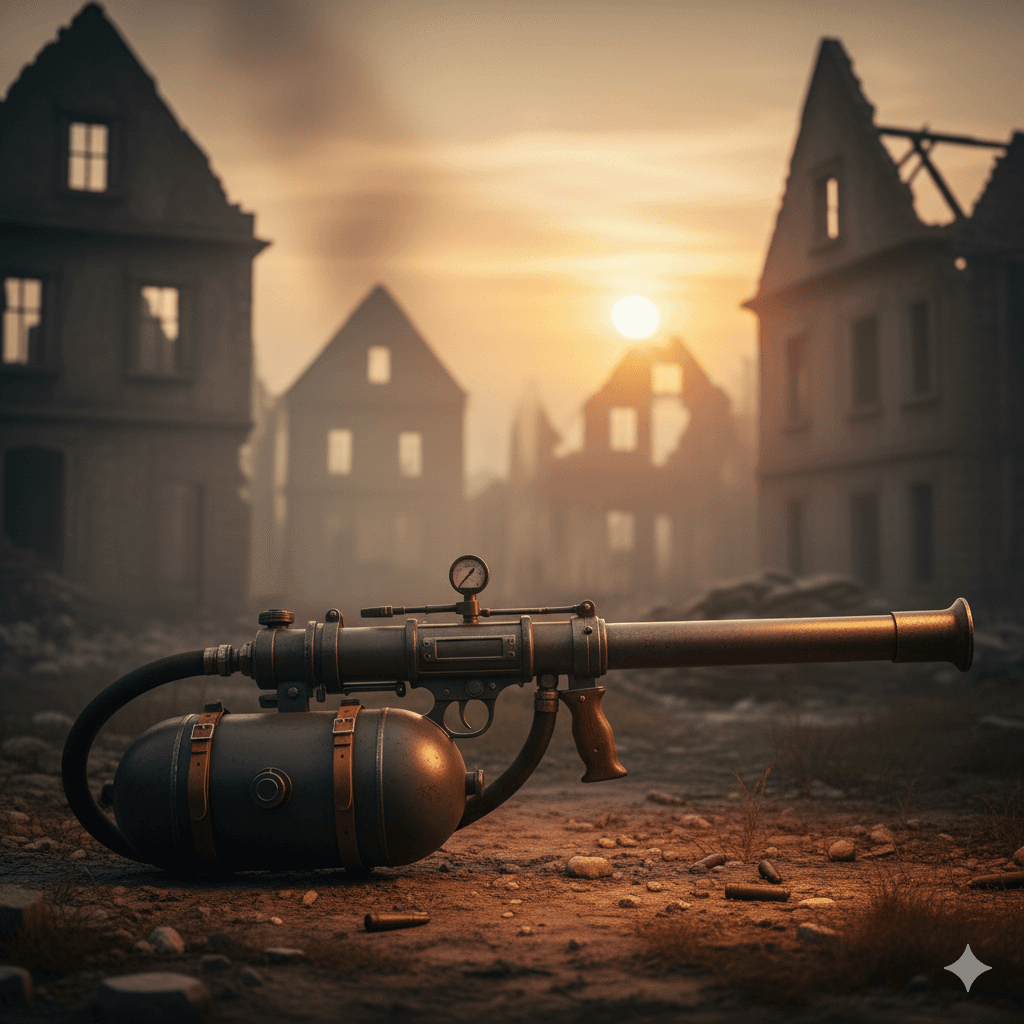
Flammenwerfer (Generated with Artificial Intelligence)
Country | Germany | ||||||||
|---|---|---|---|---|---|---|---|---|---|
Inventor | Richard Fiedler | ||||||||
First Use | Verdun (Western Front) 26 February 1915 | ||||||||
Primary Usage Period | World War I World War II | ||||||||
Used Force | German Army (Wehrmacht) | ||||||||
Fuel Type | Flammöl 19 | ||||||||
Effective Range | 20–35 metres | ||||||||
Fuel Capacity | Approximately 11–12 litres | ||||||||
Continuous Flame Duration | 8–10 seconds | ||||||||
Weight | 28–36 kilograms | ||||||||
Main Models | Einstossflammenwerfer 46 Flammenwerfer 35 Flammenwerfer 41 Flammenwerfer 42 | ||||||||
Application Area | Trench clearing Fortification destruction Building and tunnel warfare | ||||||||
The flamethrower was a portable flame weapon developed in Germany in the early 20th century and widely used during the First and Second World Wars. Designed by German engineer Richard Fiedler in 1901, this weapon operated on the principle of propelling fuel under high pressure and igniting it into flame. When first deployed in 1915 near Verdun its impact was profound not only technically but also psychologically. Second World War models reappeared on the battlefield and became notable weapons for clearing fortifications trenches and buildings in close combat conditions.
Use of the Flamethrower Weapon in the Second World War (Rust Iron Crowe)
The origins of modern flamethrowers trace back to a prototype developed in 1901 by German engineer Richard Fiedler. Fiedler’s invention featured a device powered by compressed gas that propelled a flammable liquid through a nozzle ignited by a firing mechanism. The German Army quickly recognized its potential and supported the project resulting in the rapid development of two models: the stationary and heavy Grossflammenwerfer (Grof) and the portable Kleinflammenwerfer (Kleif).
The weapon was first used on 26 February 1915 at the Malancourt front near Verdun by German units against French trenches. Although the military impact was limited the psychological effect on enemy troops was severe. Throughout First World War flamethrowers were primarily employed by German Sturmpioniere (assault engineers). However the 1919 Treaty of Versailles prohibited Germany from producing such weapons.
With the rise to power of Adolf Hitler in 1933 Germany effectively nullified the treaty’s provisions and restarted Flammenwerfer production. This process culminated in the introduction of modernized models just before the outbreak of the Second World War.
Flammenwerfers consisted fundamentally of a fuel tank a compressed gas reservoir a nozzle and an ignition system. Compressed nitrogen or hydrogen gas propelled the fuel toward the nozzle while a magnesium hydrogen or electric ignition mechanism ignited the flame.
The fuel used Flammöl 19 was a dense liquid composed of 19 percent pitch tar and gasoline. Its advantage lay in its ability to adhere to surfaces and continue burning making it difficult to extinguish.
The system’s operational duration typically ranged from 8 to 12 seconds and its range varied by model between 20 and 35 meters. The operator carried the fuel tank on his back directed the stream via a hose and triggered both fuel flow and ignition simultaneously. However this setup posed a severe risk to the user: if the fuel tank was hit the operator had virtually no chance of survival. Consequently Flammenwerfer teams typically operated as specialized two or three man assault units.
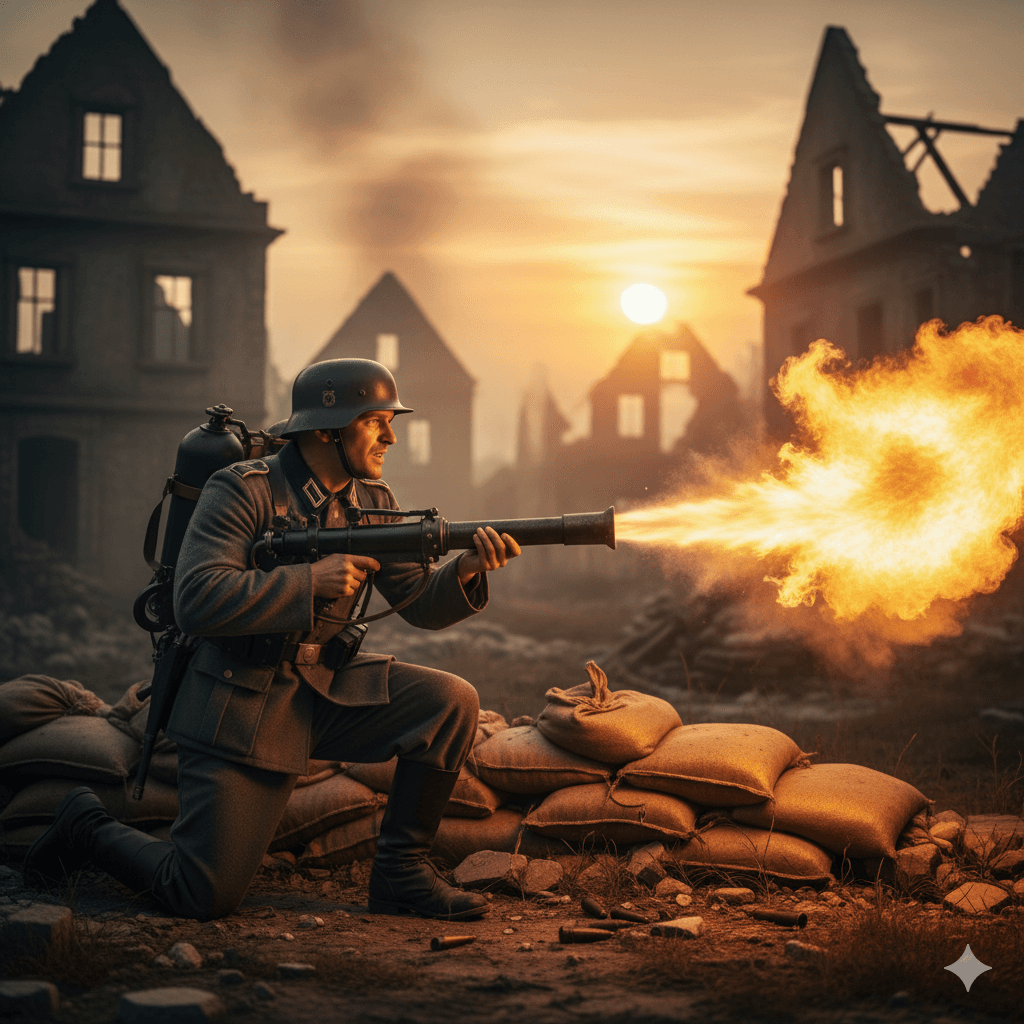
Soldier Using a Flammenwerfer in the Second World War (Generated by Artificial Intelligence)
Introduced in 1935 this model was the first portable flamethrower widely used by Germany during the Second World War. It could carry 11.8 liters of Flammöl 19 had a range of approximately 25 meters and could sustain a continuous flame for 10 seconds.
Weighing 35.8 kilograms the model used a hydrogen ignition system. To prevent the operator from being easily spotted by enemy snipers the weapon’s muzzle was camouflaged to resemble a rifle.
Developed in 1941 this model was a lighter and improved version of the FmW 35. Its weight was reduced to 28.7 kg and its range extended to 32 meters. The same Flammöl 19 fuel was used but the ignition system was enhanced. The FmW 41 was notably employed during the Normandy Invasion and battles on the Eastern Front.
Designed as a fixed defensive weapon this model was single-use and typically buried in positions alongside minefields. It could project flames up to 50 meters when triggered by tripwire or electric command. Approximately 50000 units were produced by 1944 and deployed extensively along the Atlantic Wall.
Developed in the final stages of the war due to shortages of fuel and materials this model was a lightweight single-shot weapon. The system weighed only 3.5–4 kg and could produce a single flame burst of 30 meters. It was specifically manufactured for use by Volkssturm (People’s Army) units.
During the Second World War the Flammenwerfer was primarily used for trench clearing bunker destruction and urban combat. During the 1939 invasion of Poland it played a key role in neutralizing fortified positions and during the 1940 invasions of France and Belgium it was instrumental in disabling concrete fortresses such as Eben-Emael.
On the Eastern Front during street battles in Stalingrad and Warsaw flamethrowers became standard equipment for engineer units in close-range assault operations. They were also used under scorched earth policies to destroy enemy positions.
The German Army also experimented with mechanized versions mounted on tanks known as Flammpanzer. However these vehicles achieved limited success due to high fuel consumption and weak armor protection.
Use of the Flammenwerfer (The Flamethrower Experts)
The most prominent advantage of the Flammenwerfer was its ability to deliver intense destructive power at close range. Concrete fortifications trenches and machine gun nests could be destroyed within seconds. It also created profound psychological fear among enemy troops; the terror of being burned alive often led soldiers to surrender or abandon their positions.
However the weapon posed lethal risks to its operator. The soldier carrying the fuel tank on his back was exposed to enemy fire. If the tank was struck an explosion was inevitable. Additionally if the fuel ignited the operator could be killed by his own weapon. As a result flamethrower operators were typically selected from specially trained engineer units and operated under protective fire.
The success of the Flammenwerfer quickly attracted the attention of other armies. The British developed a tank-based model called the Churchill Crocodile with a range of 100 yards (approximately 90 meters) using petroleum jelly as fuel. The U.S. Army produced the M1 and M1A1 portable flamethrowers and deployed them extensively against Japanese positions in the Pacific Theater.
Japan Italy the Soviet Union and Finland also developed similar systems. However none organized flamethrower units as systematically as Germany did.
With Germany’s defeat in 1945 Flammenwerfer production ceased. The weapon became one of the symbols of the inhumane aspects of war. In 1978 the U.S. Department of Defense officially retired flamethrowers; many countries followed suit and existing stockpiles were destroyed.
Nevertheless the technology of the Flammenwerfer continued to exert an indirect influence on modern military and engineering practices such as fire suppression forest control and specialized engineering exercises. The weapon is remembered in history as a turning point that reshaped the psychological dimension of modern warfare by bringing the element of fear through fire to the forefront.
D-Day Overlord. "Flammenwerfer 41." Accessed October 12, 2025.https://www.dday-overlord.com/en/material/weaponry/flammenwerfer-41
Franco, Samantha. “The German Flammenwerfer Forever Changed Warfare – And Not for the Better.” War History Online. Accessed October 12, 2025.https://www.warhistoryonline.com/weapons/german-flammenwerfer-wwi.html
Fratus, Matt. “A Brief and Violent History of the Modern Flamethrower.” *Coffee or Die*. Accessed October 12, 2025.https://www.coffeeordie.com/article/violent-history-flamethrower
Garson, Paul. “WWII Weapons: Flamethrowers of the Wehrmacht.” Warfare History Network. Accessed October 12, 2025.https://warfarehistorynetwork.com/article/wwii-weapons-flamethrowers-of-the-wehrmacht/
Heatherington, Brandt. “Military Weapons: The Origin of the Combat Flamethrower.” Warfare History Network. Accessed October 12, 2025.https://warfarehistorynetwork.com/article/military-weapons-the-flamethrower/
NZHistory (New Zealand History). "Flamethrower Action." Accessed October 12, 2025.https://nzhistory.govt.nz/media/photo/flamethrower-action
Nevington War Museum. “Germany — Portable Flamethrowers — Flammenwerfer 35.” Accessed October 12, 2025.https://www.nevingtonwarmuseum.com/germany-portable-flamethrowers---flammenwerfer-35.html
Rust Iron Crowe. “Flammenwerfer 35 in action.” YouTube. Accessed October 12, 2025.https://www.youtube.com/watch?v=K26uTS35lZA
Sweeting, C. G. “Arms & Men: Flammenwerfer.” HistoryNet. Accessed October 12, 2025.https://www.historynet.com/arms-men-flammenwerfer/
The Flamethrower Experts. “WWII Marine flamethrower shooting Napalm.” YouTube. Accessed October 12, 2025.https://www.youtube.com/watch?v=tQsjcB2SIko
War History Online. "Flammenwerfer." Accessed October 12, 2025.https://warhistory.org/@msw/article/flammenwerfer

Flammenwerfer (Generated with Artificial Intelligence)
Country | Germany | ||||||||
|---|---|---|---|---|---|---|---|---|---|
Inventor | Richard Fiedler | ||||||||
First Use | Verdun (Western Front) 26 February 1915 | ||||||||
Primary Usage Period | World War I World War II | ||||||||
Used Force | German Army (Wehrmacht) | ||||||||
Fuel Type | Flammöl 19 | ||||||||
Effective Range | 20–35 metres | ||||||||
Fuel Capacity | Approximately 11–12 litres | ||||||||
Continuous Flame Duration | 8–10 seconds | ||||||||
Weight | 28–36 kilograms | ||||||||
Main Models | Einstossflammenwerfer 46 Flammenwerfer 35 Flammenwerfer 41 Flammenwerfer 42 | ||||||||
Application Area | Trench clearing Fortification destruction Building and tunnel warfare | ||||||||
Development and Historical Background
Design and Engineering Features
Models and Variants
Flammenwerfer 35 (FmW 35)
Flammenwerfer 41 (FmW 41)
Flammenwerfer 42 (Abwehrflammenwerfer 42)
Einstossflammenwerfer 46
Operational Use and Tactical Role
Advantages Threats and Operational Risks
Similar Weapons in Other Countries
Postwar and Legacy