
This article was automatically translated from the original Turkish version.

“Within the human being, there is a call of love’s truth that no simulation can fully silence.”
The Truman Show is a powerful metaphysical allegory that illustrates not only how modern humanity is enclosed by media alone but also how the ontological status of the human being is transformed in a world where representation has replaced reality. The film is often read in the context of television culture, the surveillance society, or media manipulation; yet these readings frequently miss the deeper question at the film’s core: Does the human being possess an intuitive sense of love’s truth capable of detecting the simulation presented to him
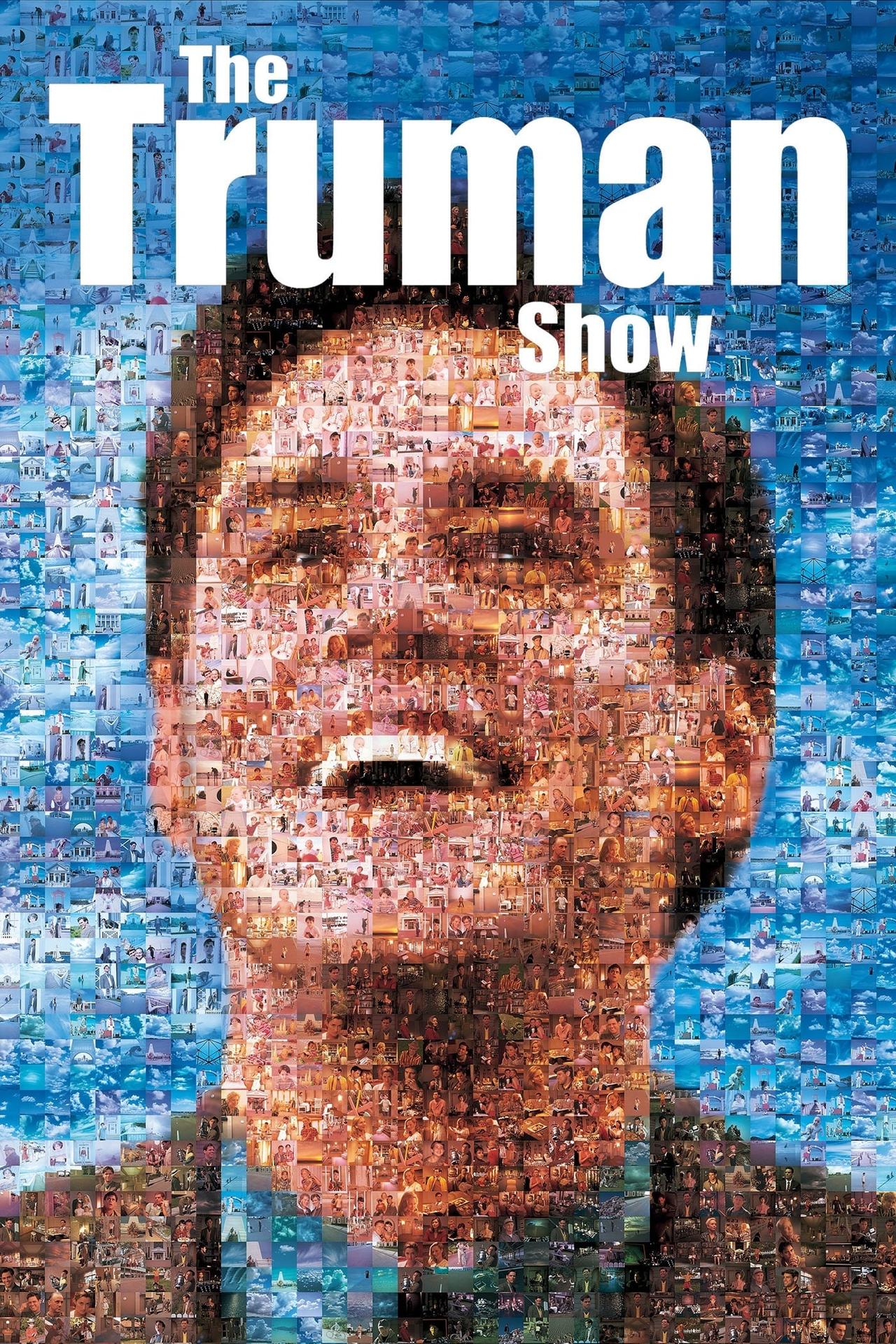
Truman Show (IMDb)
Seahaven at the center of the film appears at first glance as the prototype of an ideal modern society. It is clean, safe, aesthetic, orderly, and predictable. There is no crime, no chaos, no uncertainty. Yet precisely for this reason it is ontologically deficient. Nothing here possesses its own truth. Relationships are not spontaneous; emotions are not organic; memory is not natural. People are not individuals but reduced to roles. The world has become not a realm where truth is revealed but a perfectly organized set.
Therefore Truman’s problem is not merely that he is deceived. The real issue is that the ontological order of the world he lives in is built entirely upon simulation. The film here exposes one of modernity’s greatest crises: the substitution of representation for being. Modern society increasingly produces not experience itself but the circulated images of experience. Human beings now consume not love but the representation of love, not community but the simulation of community, not spirituality but the aesthetics of spirituality, not truth but the feeling of truth. Seahaven is therefore not merely a television studio; it is the ontological model of the postmodern world.
The character of Christof in the film embodies the false claim of technical reason to transcendence. He is not a tyrant in the classical sense. On the contrary he appears as a protective father and a regulating creator. He determines Truman’s fears, controls the weather, organizes his social relationships, and constructs a “safe” world on his behalf. But here lies a crucial rupture: Christof creates but does not give being. The world he constructs is based not on truth but on control. Thus Christof represents the theology of the modern secular world without God; the realm of love’s truth has been replaced by technical management.
The film’s epistemological dimension deepens here. Truman does not merely hold false beliefs; the entire system that produces knowledge has been manipulated. His family, education system, media, daily repetitions, and even his fears have been organized. Thus Truman’s access to knowledge has been entirely eliminated. This differs from classical propaganda. Propaganda distorts truth; Seahaven erases its alternative entirely. The film offers a powerful critique of how modern epistemological regimes function. In today’s algorithmic world people are not told directly what to think; rather they are shown which world to see. Thus the individual is surrounded not merely by false information but by controlled reality domains. Seahaven’s closed cosmos therefore becomes a metaphor for contemporary digital culture.
Yet the film does not surrender to nihilism at this point. If truth were merely social consensus, if reality were entirely fictional, and if the human being were entirely constructed, Truman’s escape would be meaningless. Christof might even be right. After all, a comfortable simulation might be preferable to a painful reality. But the film rejects this. Truman’s unease reveals that the human being is not merely an organism seeking pleasure and security. For the human being is not simply a creature capable of existing through biological needs alone; he is a being who demands meaning direction and truth.
Here the film’s metaphysical layer emerges. There is within Truman an indefinable absence. This absence is not psychological but ontological. For the human soul cannot be fully satisfied without contact with truth. The film places at its center this longing for transcendence that modern immanence cannot silence. Sylvia therefore is not merely a romantic figure; she is an ontological sign that awakens the suppressed call for truth within Truman. The moment of his encounter with Sylvia generates his first doubt about the perfection of the system. For love here functions not merely emotionally but metaphysically.
In this respect the film resonates strongly with the thought of Mevlânâ Celâleddîn-i Rûmî and Sufism. Truman’s crisis recalls the Sufi concept of “exile” as the human being’s estrangement from his original truth. In the Sufi tradition the human being often forgets himself within forms habits roles and egoic repetitions. Hence in Mevlânâ’s works metaphors of “sleep” “veil” “negligence” and “awakening” appear frequently. Truman is in fact the modern human being in a state of negligence. He believes everything is normal because he has been deprived of the possibility of questioning the order in which he lives.
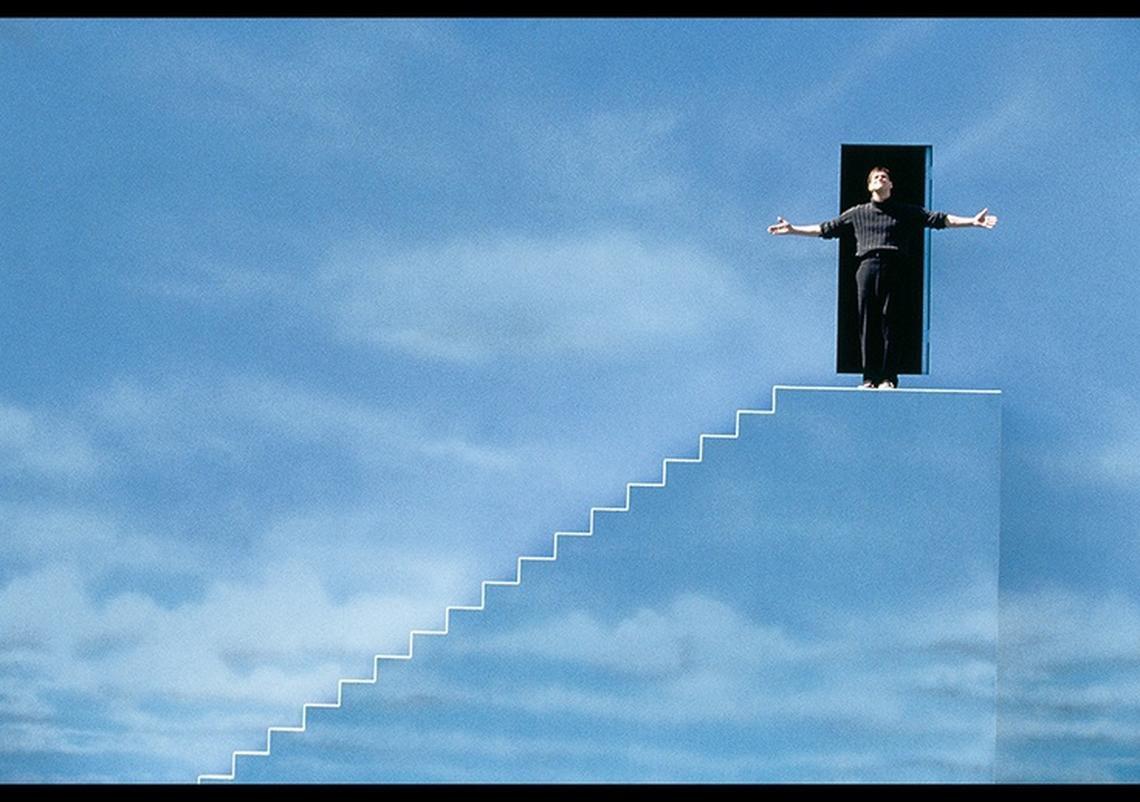
Truman Show (IMDb)
Here Mevlânâ’s metaphor of the reed flute is especially meaningful. The reed moans because it has been severed from its source. The sense of absence within the human being is not merely a psychological void but the ontological echo of being distanced from its origin. Truman’s restlessness is precisely this. In Seahaven everything is present but the feeling of belonging is absent. For the human soul is not satisfied by order and security alone; it yearns for contact with truth.
The film also intersects with Islamic thought on an epistemological level. Modern secular epistemology often reduces knowledge to what is measurable and useful whereas in Islamic thought knowledge is a mode of perception that draws the human being closer to truth. In Sufism marifah is not merely acquiring information but transforming one’s existence to align with truth. Truman’s problem is thus revealed here: He does not merely possess false knowledge; he has been deprived of the possibility of living in accordance with truth.
But at this point the issue is not merely a critique of the modern secular world. The film also offers a powerful opportunity to reflect on the epistemological crisis of the Muslim subject. In the modern period Islam has often been defended not within its own ontological wholeness but according to the acceptability criteria of secular epistemology. Religion has been reduced from a truth regime to cultural identity moral motivation psychological comfort or historical nostalgia. Thus Islam has been presented not as a holistic existential order that reorients human knowledge being and meaning around revelation but as a “value system” that can be inserted into the modern world. Yet Islam’s fundamental claim is not to carve out a secure space for itself within modern secular epistemology but to realign human conceptions of knowledge being and meaning around revelation. Therefore an Islamic reading through The Truman Show must not merely critique the secular simulation world; it must also question the tendency among Muslims to epistemologically domesticate Islam and soften its metaphysical claims.
Because today the Muslim subject living within the modern secular epistemological order often relates not to truth itself but to its circulated representations. Religion sometimes ceases to be an ontological orientation and becomes a form of content consumption. Short “spiritual fragments” circulating on social media aestheticized religious images performative forms of religiosity sectarian and traditional emphases turned into identity displays sloganized uses of Quranic verses and hadith or nostalgic Islamic narratives that merely produce cultural belonging all amplify not truth itself but its representation economy. In such a condition the Muslim individual may unconsciously live within an epistemological comfort zone similar to Seahaven: He feels close to religion but does not genuinely confront the transformative weight of revelation; he constantly speaks about Islam but does not truly enter the ontological world Islam establishes.
Therefore the crisis of the contemporary Muslim is not merely “secularization.” The deeper crisis is the integration of religion into the modern regime of representation. Islam has increasingly become not a lived truth but a consumed aesthetic a displayed identity a cultural heritage to be preserved or a content format suited for digital circulation. Yet revelation claims not only to transform human behavior but also to transform the perception of reality itself. The Quran’s fundamental call is not merely ethical but ontological: to reteach humanity what is truly real. Just as Truman strikes the wall of his set the modern Muslim subject must at some point ask how much of his religiosity is grounded in truth and how much in represented forms of religion. For sometimes human beings distance themselves from truth not because they oppose it but because they settle for its simulation.
Yet here a critical danger emerges: This questioning itself may be conducted according to the criteria of modern secular epistemology. That is the Muslim subject while criticizing represented religion may unknowingly employ the same secular epistemic whip. In this case the metaphysical dimension of religion is read as “myth” the unseen as “irrational realm” miracle as “symbolic narrative” and worship as merely psychological or sociological functions. Thus while the individual believes he is critiquing simulation he may actually further narrow the ontological claim of revelation. The issue is not to reduce religion to the boundaries acceptable to modern reason but to develop a theo-ontological perspective capable of questioning modern secular epistemology itself.
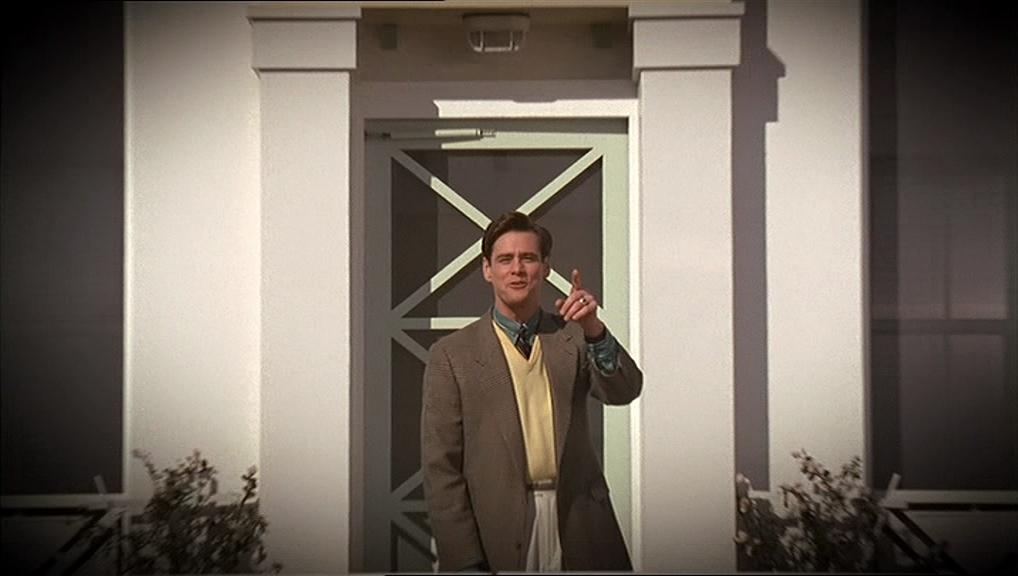
Truman Show (IMDb)
Therefore the goal here is not to transform Islam into a cultural identity object to be defended against modernity. Rather it is to rethink human understanding of knowledge being and truth from a revelation-centered perspective. What Truman does is not merely to recognize that the set is fake; he also intuitively grasps that the truth beyond the set cannot be understood through the set’s own rules. The fundamental issue for the modern Muslim subject lies here: While attempting to exit the simulation of truth he continues to define the exit using the epistemology of simulation itself.
The climax of the film is Truman’s boat striking the horizon line. For at that moment it becomes clear that the infinite sky he believed in is merely a painted surface. The greatest tragedy of modern simulation becomes visible here: Even the horizon can be manufactured even transcendence can be imitated. But the human soul cannot be satisfied with an imitated infinity. Truman’s exit through the door is not merely individual liberation; it is the transition from a represented life to the unknowability of truth. He does not know what lies outside yet he departs. For sometimes human beings choose truth over certainty. At this point the film places against modern utilitarianism a very ancient metaphysical principle: Truth is more valuable than comfort.
What The Truman Show tells the person of today is not merely that the media watches us but that we have grown accustomed to living with simulations that increasingly replace truth. Human beings now experience not only consumption but also identity spirituality politics love and even the search for truth primarily through representational forms. Social media profiles algorithmic guidance performative affiliations aestheticized spirituality and the constant desire for visibility draw the modern human being closer to Seahaven with each passing day. Yet the film does not surrender to pessimism at this point. It reminds us that within the human being there still remains an unquenchable restlessness an indefinable absence and a call toward the transcendent. Perhaps the most important question for the person of today is this: To live securely within comfortable simulations or to walk toward the risky openness of truth The Truman Show does not offer a theoretical answer to this question; but through Truman’s walk toward the door it suggests this: Human beings are not created to forget truth entirely. Even within the most perfect simulations a crack sometimes opens; the human being looks through that crack toward the sky and senses that his world is not all there is. Perhaps the return to truth begins precisely there.
IMDb. "The Truman Show". Accessed May 26, 2026. https://www.imdb.com/title/tt0120382/mediaviewer/rm1906994176/
IMDb. "The Truman Show." Accessed May 26, 2026. https://www.imdb.com/title/tt0120382/mediaviewer/rm2831878657/
IMDb. "The Truman Show." IMDb. Accessed May 26, 2026. https://www.imdb.com/title/tt0120382/?ref_=mv_close
IMDb. "Truman Show (1998)." Accessed May 26, 2026. https://www.imdb.com/title/tt0120382/mediaviewer/rm3109225728/
Konuk, Ahmed Avni. Mesnevî-i Şerîf Şerhi. İstanbul: İbn Haldun Üniversitesi Yayınları, 2026.
Küçükalp, Kasım. Fizik, Metafizik, Gayb: Dinin Ontolojik Teklifi. İstanbul: Ketebe Yayınları, 2026.
The Truman Show. dir. Peter Weir. Paramount Pictures, 1998.
Yiğit, Zehra. 2009. “MEDYAYA ELEŞTİREL BİR BAKIŞ ve THE TRUMAN SHOW”. Humanities Sciences 4, no. 4: 258–270. Accessed May 26, 2026. https://dergipark.org.tr/tr/pub/nwsahuman/article/213364
Metaphysical Absence and the Search for Truth
Islamic Thought and the Crisis of Representation