


This article was automatically translated from the original Turkish version.
Deer has stood out in Turkish culture since ancient times as an animal imbued with sacred, guiding, protective, and symbolic meanings. Beyond being a hunting animal, it is a symbolic figure in mythological narratives, rituals, art, and folk literature. In ancient Turkish belief systems, particularly in the shamanic tradition, the deer is seen as an expression of the bond between humanity and nature. Sometimes it serves as a guide leading humans to other realms; at other times, it appears as a terrestrial manifestation of a sacred being.
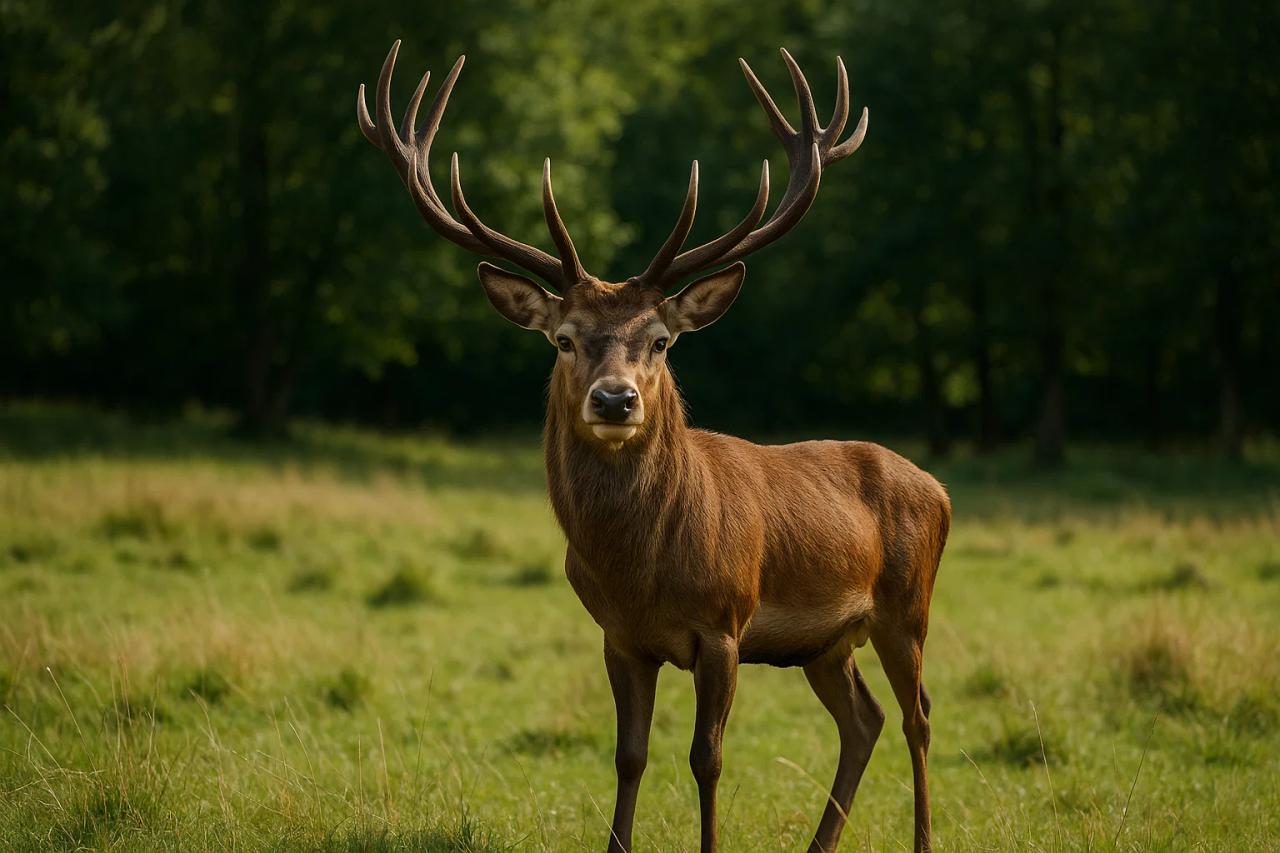
Geyik Görseli (Yapay Zekâ ile Oluşturulmuştur)
The deer figure has established itself throughout history as a sacred and meaning-laden entity within various layers of Turkish culture. For the earliest Turkic communities living in the Central Asian steppes, nature was not merely a habitat but the very center of cosmic order and spiritual understanding. In this context, the deer carried meanings beyond its physical attributes; its elegance, agility, and harmony with nature led to its recognition as a spiritual being.
Throughout history, the deer attained a central position in both daily life and belief systems of Turkic communities who practiced a nomadic lifestyle. Deer depictions found in archaeological remains demonstrate that this animal was not merely associated with hunting but also regarded as part of a symbolic connection to the afterlife. The frequent appearance of deer motifs on grave stones, rock surfaces, and stone carvings further reveals its significance in the cycle of death and life.
In a mythological context, the deer emerges as a mediator between heaven and earth, sometimes guiding humans, sometimes carrying sacred messages. In this sense, the deer acquires the character of an intermediary or transitional object, becoming a symbol of spiritual transitions and cosmic connections. In social narratives, its trace persists as a guide appearing at the foot of sacred mountains, a being opening the gates to unknown lands, or a representative of supernatural powers.
One of the early belief systems of the Turks, shamanism is a worldview centered on the relationship between nature and humanity. Within this belief system, the deer holds an important place both through its physical characteristics and symbolic meanings. Shamans, during trance states, envision the deer as a tool or companion for their journeys into the spirit world. In this context, the deer functions as a bridge between the sky and the earth.
The deer figure frequently appears in shamanic rituals. Deer motifs are commonly used on drum surfaces, clothing, and ceremonial objects. This usage underscores the deer’s sacredness and its importance in rituals. Additionally, deer antlers are found as symbolic elements on the handles of shamanic drums or within ritual spaces. These antlers are associated with both fertility and spiritual power.
In shamanic belief, the deer is also regarded as a protective spirit. Some narratives hold that deer protect people from evil spirits and guide them.
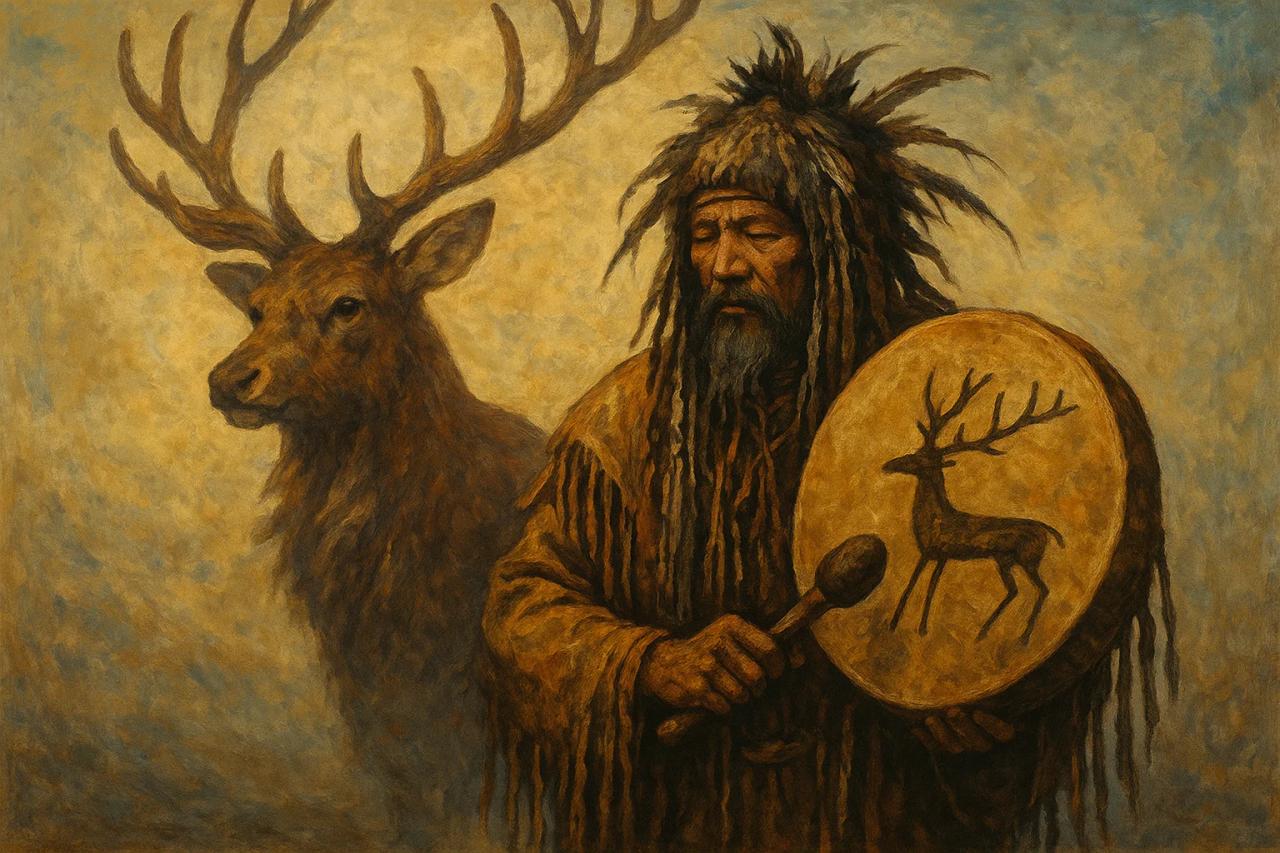
Şaman ve Geyik Tasviri (Yapay Zekâ İle Oluşturulmuştur)
In Turkish epics and oral narrative traditions, the deer emerges as a being endowed with supernatural qualities, serving as a guide and identified with sacredness. In these narratives, the deer often appears briefly and then vanishes, directing individuals toward a specific path and triggering mystical events. Particularly in Turkic mythological thought, the deer becomes a symbol of fate and divine guidance.
Epics and legends often portray the deer figure as a harbinger of transformation or a spiritual journey. In some narratives, a hero, following the trail of a deer, reaches a sacred cave, mountain, or the place where he will encounter a lofty being. This journey is not merely physical but represents the hero’s inner transformation. This aspect of the deer demonstrates that it is not only a natural creature but also a cultural guide.
Altai, Siberian, and Central Asian Turkic tribes’ narratives (Uyghur Epic, The Woman with the Deer, The Legend of the Deer Hunt, The Sacred Deer Legend, The Poet’s Dream of the Deer) emphasize the extraordinary qualities of the deer. In these stories, the deer is sometimes the embodiment of a spirit descending from the heavens; at other times, it serves as the figure initiating a sacred lineage. In some versions, the hero who pursues the deer reaches the land where he will establish a new homeland and fulfill his destiny. Thus, the deer finds its place in mythological consciousness as a representative of sacredness and fate.
Moreover, the deer figure occupies a broad space in oral culture, spanning from folk tales to popular beliefs. Sometimes it is a divine being seen in a poet’s dream; at other times, it symbolizes a sacred taboo hunt. These narratives reveal that the deer is not merely perceived as an animal but as a deep symbol preserved within the collective memory of society.
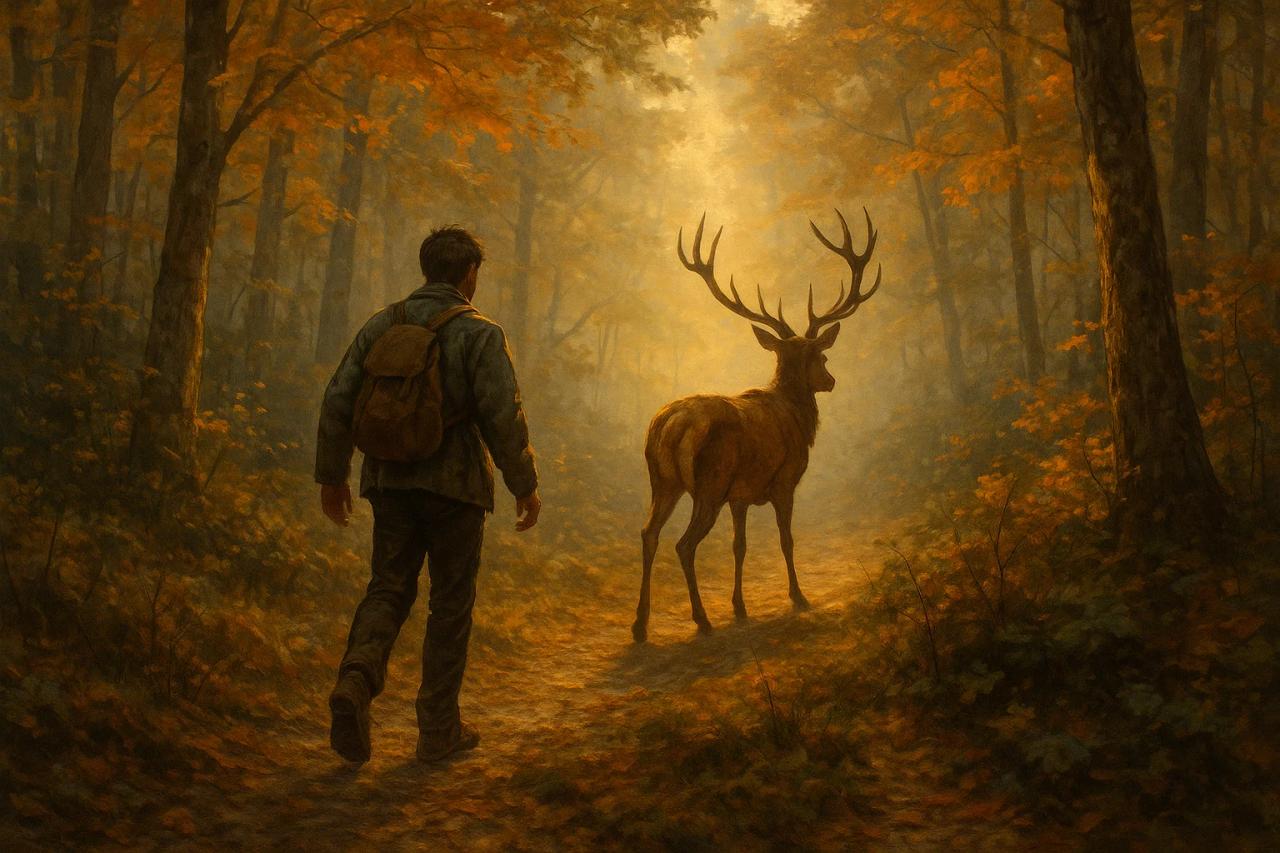
Bahsi Geçen Destanlarda Geyiği Takip Eden İnsanın Temsili Görseli (Yapay Zeka İle Oluşturulmuştur)
In Central Asian steppe cultures and Turkic nomadic communities, the deer figure is most commonly found in rock paintings and kurgan artifacts. The deer’s antlers are associated with concepts such as power, fertility, and abundance. Objects bearing deer motifs unearthed from the Pazyryk Kurgans clearly illustrate how this animal was transformed into an aesthetic form in art.
Turkic communities settling in Anatolia carried these motifs into fields such as weaving, metalwork, wood carving, and ceramics. Stylized deer figures frequently appear in kilim and carpet designs, sometimes depicted alongside the Tree of Life, thereby emphasizing both the continuity of life and the sacred bond with nature. Similarly, the symbolic meanings of the deer are reflected in grave stones, mosque decorations, and woodwork.
The deer figure has retained its presence in post-Islamic artistic forms. Although figurative art was limited within Islamic aesthetics, the deer was used as an elegant narrative element in depictions of nature and in miniature painting. Particularly in Ottoman miniatures, the deer appears as an aesthetic figure in hunting scenes or pastoral settings.
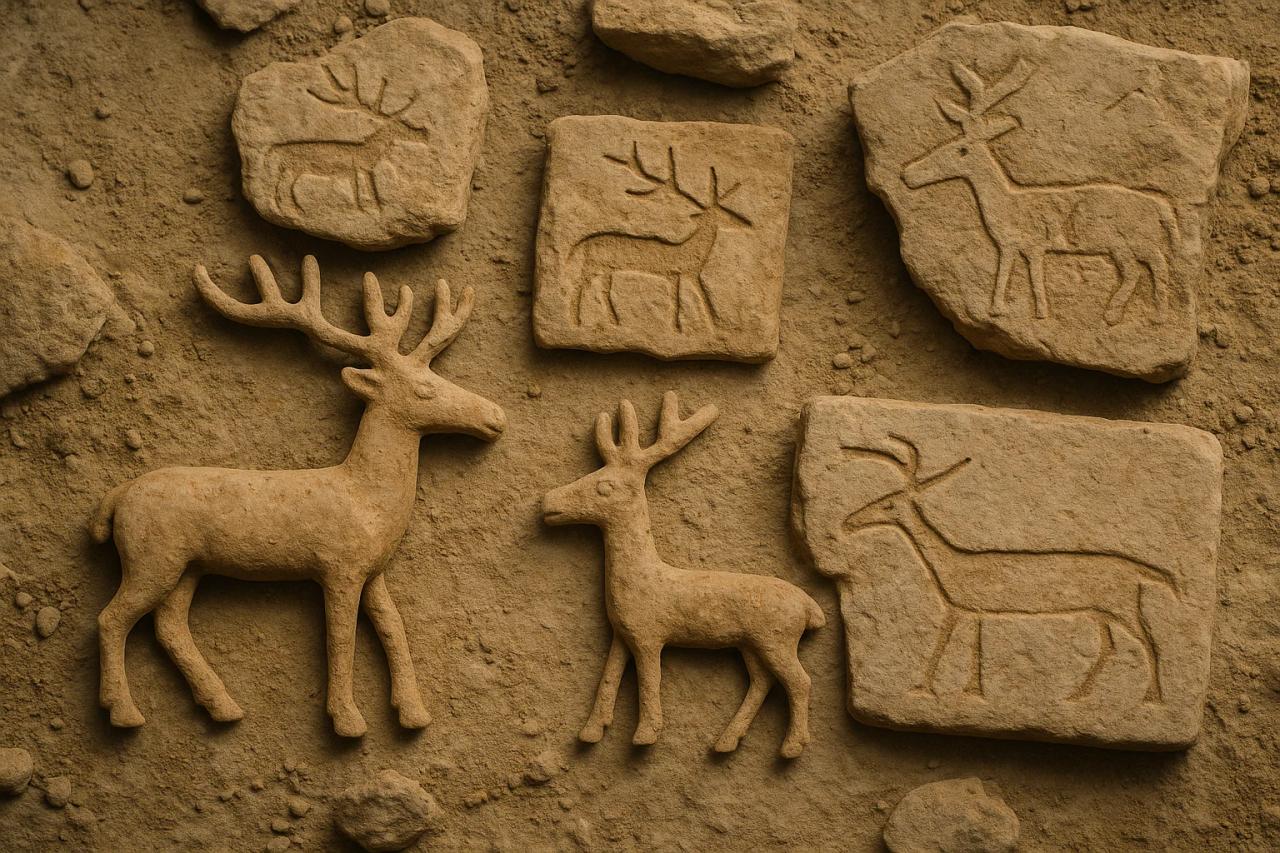
Kalıntılarda Bulunan Taş Üzerinde Geyik Sembolleri (Yapay Zekâ ile Üretilmiştir)
Hunting, which has held an important place in Turkish culture since ancient times, has been regarded as both an economic and symbolic activity. The deer is not merely a game animal; it occupies a central position in hunting rituals, social status indicators, and religious-cultural symbols. In steppe societies where hunting culture developed, the deer was viewed as a measure of skill due to its difficulty to hunt and swift nature, and at times it became a symbol of a sacred taboo hunt.
For ancient Turkic communities practicing a nomadic lifestyle, hunting was not merely an activity for securing food but also an educational tool for developing military skills. Within this cultural framework, deer hunting gained importance as part of both individual bravery and collective hunting organization. The meanings attributed to the deer varied in special ceremonies where hunters displayed their abilities. Some sources directly link the pursuit of a deer during a hunt to the discovery of sacred sites or new settlement areas.
In Turkish culture after the Islamic period, hunting activities continued, but the deer figure acquired a symbolic character. In some folk narratives, deer are regarded as “animals that must not be hunted” and considered sacred.
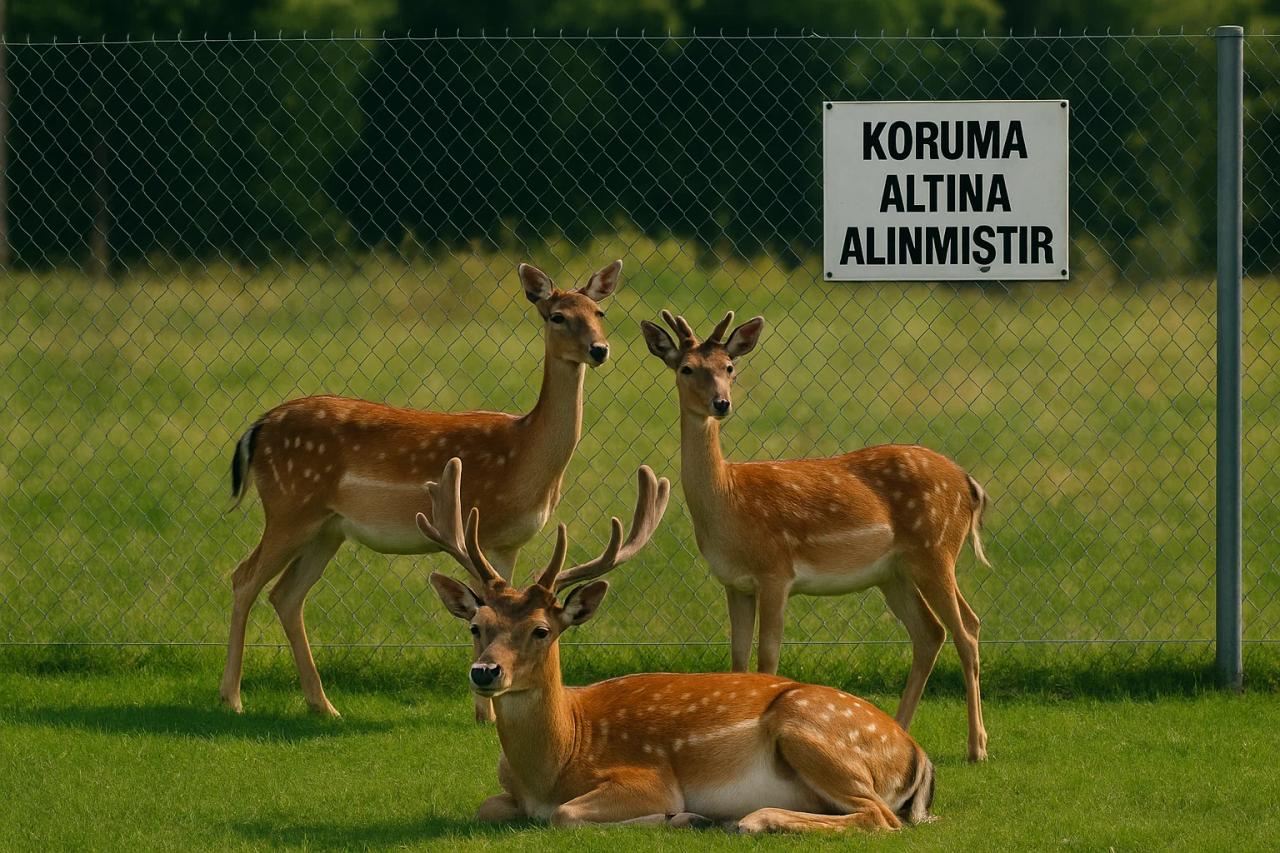
Koruma Altına Alınan Geyikleri Yansıtan Bir Görsel (Yapay Zekâ ile Oluşturulmuştur)
In the modern era, the deer continues to exist in Turkish culture as a symbol that preserves its historical and mythological meanings while gaining biological and ecological significance. In today’s society, the deer also plays a critical role in the preservation of nature and biodiversity. In this regard, the deer is recognized both as part of cultural heritage and as an important indicator of the natural environment.
Efforts in Turkey to sustain deer populations within various national parks, natural habitats, and protected areas make significant contributions to biodiversity conservation. Species such as the roe deer (Capreolus capreolus) and red deer (Cervus elaphus) are monitored for their importance to ecological balance and ecosystem health. These conservation initiatives are carried out with the participation of biologists, environmentalists, and local communities, and are also viewed as opportunities for nature tourism and the revitalization of cultural heritage.
Culturally speaking, deer symbolism remains present in art, literature, and folklore. In Turkish art, deer figures represent power, elegance, and harmony with nature.
Beşkardeş, Vedat, Yaşar Uslu, and Burçin Uslu. “Geyik ile İlgili Bazı Türkçe Terimler Üzerine Düşünceler.” Avrasya Terim Dergisi, Volume 2, Issue 1, 2014, pp. 17–24. Accessed May 17, 2025.https://dergipark.org.tr/tr/pub/ejatd/issue/5151/70135
Dalkesen, Nilgün. “Orta Asya’dan Anadolu’ya Türk Kültüründe Geyik Kültü.” *Milli Folklor*, no. 106, 2015, pp. 58–69. Accessed May 17, 2025.https://acikerisim.mu.edu.tr/xmlui/handle/20.500.12809/6929
Mandaloğlu, Mehmet. “Türk Mitolojisinden Anadolu’ya Taşınan Kültür: Geyik Motifi.” *Journal of International Social Research*, Volume 6, no. 27, 2013, pp. 382–383. Accessed May 17, 2025.https://openurl.ebsco.com/EPDB%3Agcd%3A12%3A29635260/detailv2?sid=ebsco%3Aplink%3Ascholar&id=ebsco%3Agcd%3A90578814&crl=c&link_origin=scholar.google.com
Mirzaoğlu-Sıvacı, F. Gülay. “Türkülerde Mitolojik Unsurlar.” *Türkbilig*, no. 10, 2005, pp. 34–53. Accessed May 17, 2025.https://dergipark.org.tr/tr/pub/turkbilig/issue/52787/697043
Sayın, Alsan, Şeyma, and Akın, Sinem. “Türk Kültür ve Sanatında Geyik Sembolizmi.” *Ulakbilge Sosyal Bilimler Dergisi*, Volume 8, no. 45, 2020, pp. 215–226. Accessed May 17, 2025.https://www.ceeol.com/search/article-detail?id=971206
Ögel, Bahattin. *Türk Mitolojisinde Geyik*. 1st ed. Istanbul: Kitabevi Yayınları, 2013. ISBN 978-605-5397-35-7. Accessed May 17, 2025.https://actaturcica.wordpress.com/wp-content/uploads/2019/12/geyik.kitabc4b1.pdf#page=35
Özhancı, Elif, and Candan, Elif. “Türklerde Geyik Miti ve Geyikler Lanetler Oyununda Geyik Motifinin İzleklerinin Belirlenmesi.” Art Vision, Volume 31, no. 54, March 27, 2025, pp. 82–90. Accessed May 17, 2025.https://dergipark.org.tr/en/pub/artvision/issue/91088/1583847

No Discussion Added Yet
Start discussion for "Deer in Turkish Culture" article
Historical and Mythological Background
Shamanism and Deer Symbolism
Deer in Turkish Epics and Oral Culture
Deer Symbolism in Art
Hunting Culture and the Deer
Deer Symbolism and Conservation Efforts Today