


This article was automatically translated from the original Turkish version.
+1 More
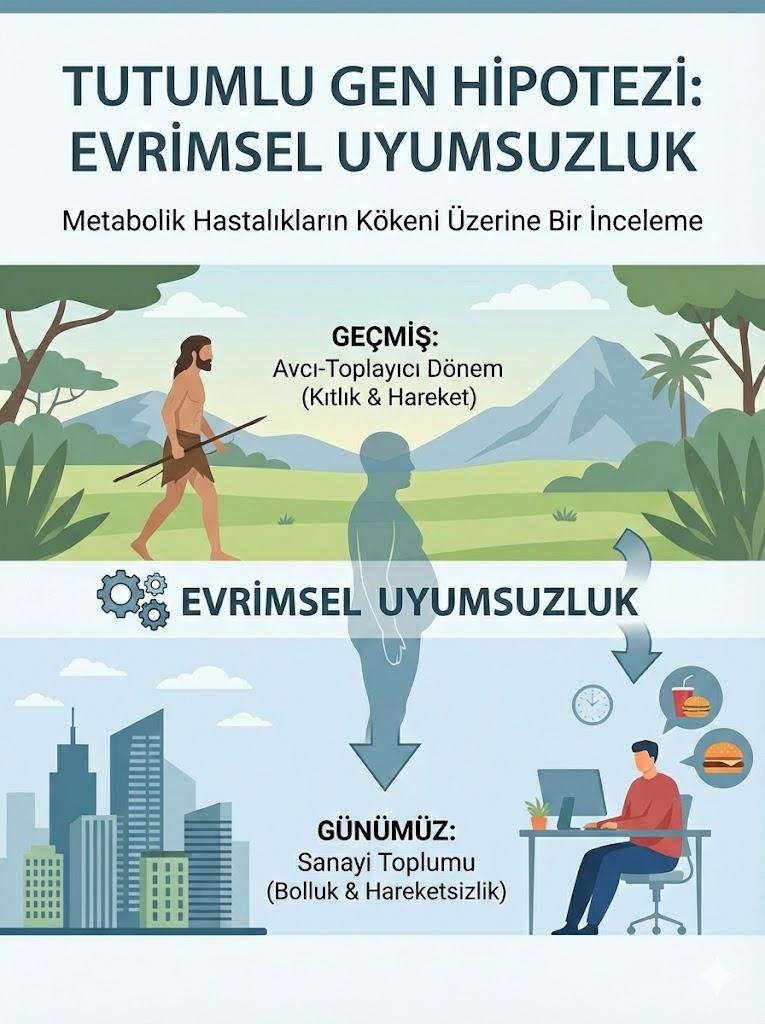
Conservative Gen Hypothesis (Generated with Artificial Intelligence.)
History | 1962 | ||||||||
|---|---|---|---|---|---|---|---|---|---|
Proposed | James V. Neel (Geneticist) | ||||||||
Fundamental Theory | Evolutionary Medicine, Metabolic Adaptation, Obesity, Type 2 Diabetes Origin | ||||||||
Thrifty Gene Hypothesis (thrifty gene hypothesis) is a biological model that attributes the prevalence of obesity and type 2 diabetes in modern human populations to evolutionary adaptations. It was first introduced in 1962 by American geneticistJames V. Neel to explain the evolutionary basis of diabetes.【1】 The theory posits that during ancestral cycles of famine, mechanisms promoting insulin resistance and fat storage conferred a survival advantage. This genetic legacy is now considered a risk factor for metabolic disorders in modern environments characterized by constant access to food.
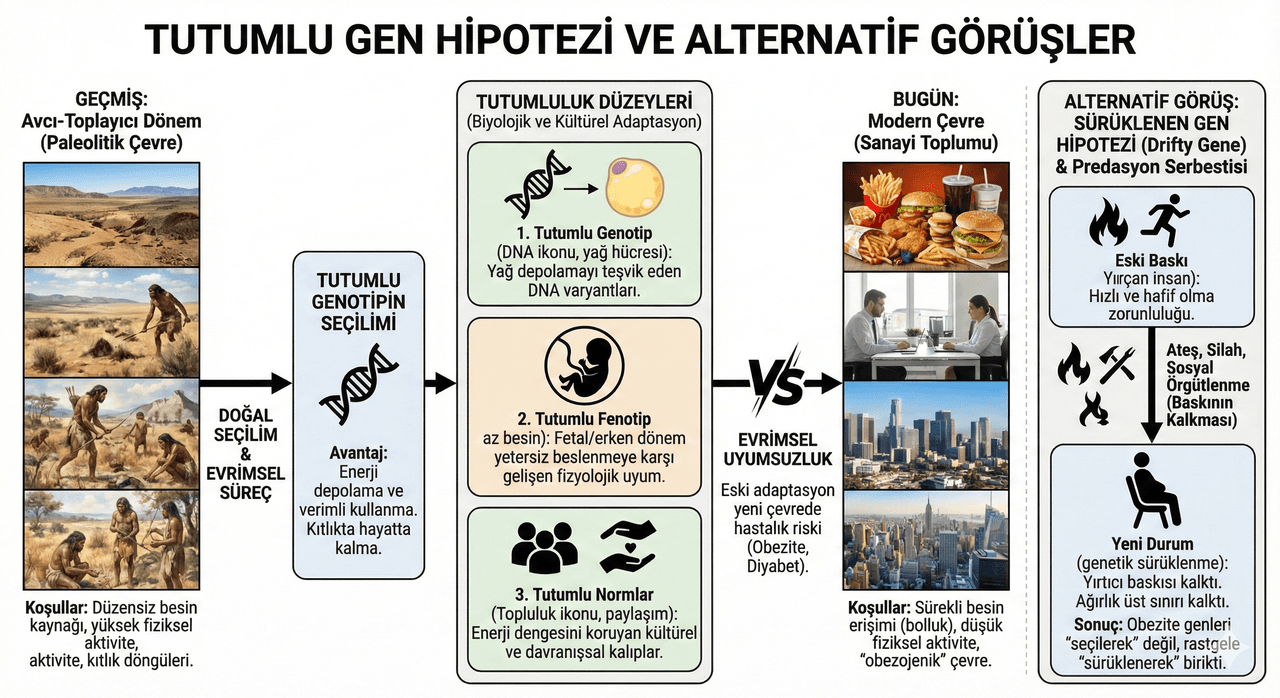
Tutumlu Gen Hipotezini Anlatan Şema (Yapay Zeka İle Oluşturulmuştur.)
In the literature, the concept of thriftiness is examined at different layers of biological and cultural adaptation. This classification is grouped under three main categories.
The hypothesis is analyzed within the framework of evolutionary mismatch (evolutionary mismatch). Human physiology evolved under Paleolithic environmental conditions characterized by irregular food availability and high physical activity demands. Modern industrial societies, by contrast, present an environment rich in energy-dense foods and low in physical activity.
This temporal mismatch between the genome and the environment forms the basis of variation in cardiometabolic disease risk. Anabolic processes that once ensured survival during historical periods of famine now lead to pathological conditions in today’s “obesogenic” environment. This phenomenon is linked to differences in diabetes and obesity rates among populations undergoing transitions to modern lifestyles.【3】
The core assumptions of the thrifty gene hypothesis are being questioned in light of genetic and historical evidence. Criticisms focus on the following points:
An alternative model for the evolutionary origins of obesity is the drifty gene hypothesis (drifty gene hypothesis). This model argues that susceptibility to obesity is not the product of active natural selection but rather of passive genetic drift.
This process is grounded in the theory of predation release (predation release). Around two million years ago, developments such as the use of fire, social organization, and weapon-making reduced the risk of humans being preyed upon by carnivores. The selective pressure favoring high mobility and low body weight for evading predators was thus eliminated.
Mutations in genes that previously constrained upper limits of body weight were no longer eliminated because they no longer conferred a survival disadvantage. Over the course of approximately two million years, these mutations accumulated randomly in the gene pool. The current prevalence of obesity and individual variation in body weight are explained not as products of natural selection but as the result of the relaxation of upper weight limits.【4】
Warning: The content in this article is provided solely for general encyclopedic informational purposes. The information here should not be used for diagnosis, treatment, or medical advice. Always consult a physician or qualified healthcare professional before making decisions regarding your health. The author and KÜRE Encyclopedia accept no responsibility for any consequences arising from the use of this information for diagnostic or therapeutic purposes.
Brassington, Layla, Audrey M. Arner, Marina M. Watowich, Jane Damstedt, Kee Seong Ng, Yvonne A. L. Lim, Vivek V. Venkataraman, Ian J. Wallace, Thomas S. Kraft, and Amanda J. Lea. “Integrating the Thrifty Genotype and Evolutionary Mismatch Hypotheses to Understand Variation in Cardiometabolic Disease Risk.” *Evolution, Medicine, and Public Health* 12, no. 1 (2024): 214–226. Accessed January 14, 2026.https://doi.org/10.1093/emph/eoae014
Prentice, A. M., B. J. Hennig, and A. J. Fulford. “Evolutionary Origins of the Obesity Epidemic: Natural Selection of Thrifty Genes or Genetic Drift Following Predation Release?” *International Journal of Obesity* 32. (2008): 1607–1610. Accessed January 14, 2026.https://doi.org/10.1038/ijo.2008.147
Speakman, J. R. “Thrifty Genes for Obesity, an Attractive but Flawed Idea, and an Alternative Perspective: The ‘Drifty Gene’ Hypothesis.” *International Journal of Obesity* 32. (2008): 1611–1617. Accessed January 14, 2026.https://doi.org/10.1038/ijo.2008.161
Wells, J.C. K. “Thrift: A Guide to Thrifty Genes, Thrifty Phenotypes and Thrifty Norms.” *International Journal of Obesity* 33. (2009): 1331–1338. Accessed January 14, 2026.https://doi.org/10.1038/ijo.2009.175
[1]
Layla Brassington vd., “Integrating the Thrifty Genotype and Evolutionary Mismatch Hypotheses to Understand Variation in Cardiometabolic Disease Risk,” Evolution, Medicine, and Public Health 12, no. 1 (2024): 214, erişim tarihi 14 Ocak 2026, https://doi.org/10.1093/emph/eoae014.
[2]
J. C. K. Wells, “Thrift: A Guide to Thrifty Genes, Thrifty Phenotypes and Thrifty Norms,” International Journal of Obesity 33 (2009): 1335–1336, erişim tarihi 14 Ocak 2026, https://doi.org/10.1038/ijo.2009.175.
[3]
J. C. K. Wells, “Thrift: A Guide to Thrifty Genes, Thrifty Phenotypes and Thrifty Norms,” International Journal of Obesity 33 (2009): 1334. erişim tarihi 14 Ocak 2026, https://doi.org/10.1038/ijo.2009.175.
[4]
J. R. Speakman, “Thrifty Genes for Obesity, an Attractive but Flawed Idea, and an Alternative Perspective: The ‘Drifty Gene’ Hypothesis,” International Journal of Obesity 32 (2008): 1614–1615, erişim tarihi 14 Ocak 2026, https://doi.org/10.1038/ijo.2008.161.

Conservative Gen Hypothesis (Generated with Artificial Intelligence.)
History | 1962 | ||||||||
|---|---|---|---|---|---|---|---|---|---|
Proposed | James V. Neel (Geneticist) | ||||||||
Fundamental Theory | Evolutionary Medicine, Metabolic Adaptation, Obesity, Type 2 Diabetes Origin | ||||||||
No Discussion Added Yet
Start discussion for "Conservative Gen Hypothesis" article
Classification of Thriftiness and Its Biological Levels
Evolutionary Mismatch and Environmental Change
Criticisms of the Hypothesis
Drifty Gene Hypothesis and Predation Release