This article was automatically translated from the original Turkish version.
+2 More
Place of Foundation | University of Chicago Department of Sociology | ||||||||
|---|---|---|---|---|---|---|---|---|---|
Year of Foundation | 1892 (by Albion Small) | ||||||||
Most Influential Period | 1915 – 1940 (First Chicago School) | ||||||||
Founding Figures | Robert E. Park, Ernest W. Burgess, Louis Wirth, William I. Thomas, George Herbert Mead | ||||||||
Basic Approach | Urban Ecology (Human Ecology), Symbolic Interactionism | ||||||||
Primary Methodology | Qualitative Research, Ethnography, Participant Observation, Life History | ||||||||
Central Concepts | Center-Periphery Theory, Social Disorganization, Invasion/Succession, Urbanism | ||||||||
Primary Area of Study | Urban Sociology, Social Psychology, Criminology, Urban Pathology | ||||||||
Important Legacy | To direct American sociology toward empirical research, To lay the foundations of the Symbolic Interactionism tradition | ||||||||
Chicago School of Sociology is an academic movement recognized for its foundations in the Department of Sociology established at the University of Chicago in 1892 and especially for the urban sociology research and theoretical approaches it produced during the 1920s and 1930s. This process began with the institutionalization of sociology as an academic discipline in the United States at this university by Albion Small and reached its peak through the work of pioneering figures such as Robert E. Park, Ernest W. Burgess, and Louis Wirth.
The emergence and development of the school are closely linked to the rapid growth and social transformation experienced by the city of Chicago at the end of the 19th century and the beginning of the 20th century. The city served as a "social laboratory". The school brought the city and its inhabitants to the center of sociological inquiry and provided a framework for understanding the complex dynamics of modern urban life.
Chicago School of Sociology's institutional origins lie in the University of Chicago, where sociology was formally established as an academic discipline in the United States. The department was founded in 1892 by Albion Small. Small guided the process by which sociology became independent from philosophy and oriented itself toward scientific methodologies; he was also among the founding members of the American Sociological Association (ASA). Under Small's early leadership, the discipline was influenced by Pragmatist philosophy and social reform initiatives.
The period during which the school achieved its most productive and original research identity began with the arrival of Robert E. Park at the department in 1914 and corresponds to the years 1915–1940, known as the First Chicago School.【1】 Park transferred his empirical observation and field research skills, acquired during his journalism career, into sociology. Park and his colleague Ernest W. Burgess treated the Chicago metropolitan area as a "social laboratory" for studying rapid growth, mass migration, and social disorganization.【2】 During this period, the city exhibited high levels of ethnic and racial heterogeneity due to waves of immigration from Europe and internal migration from the southern states.
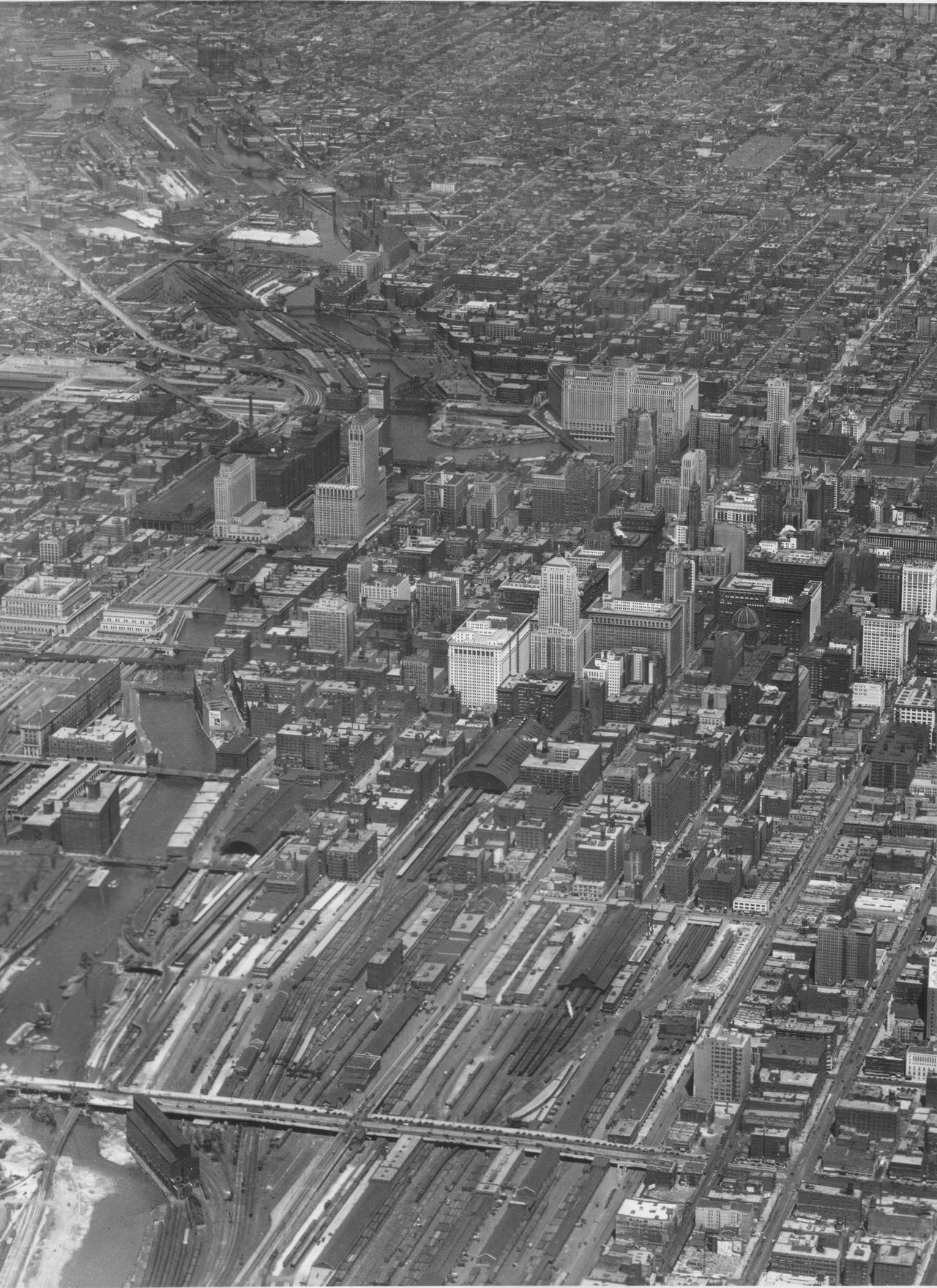
A View of the City of Chicago in 1930 (Flickr)
The school's theoretical and methodological framework was built on the synthesis of American Pragmatism (particularly the contributions of John Dewey and George Herbert Mead), which brought sociology closer to empirical studies, and the Human Ecology approach, which analyzed the city as a biological system. These perspectives directed scholars to examine urban problems such as criminology, poverty, and marginal subcultures not through abstract theories but through direct fieldwork using ethnographic methods.
Louis Wirth and other second-generation figures advanced the school's urban analysis into a theoretical synthesis during the 1930s. Wirth's 1938 article "Urbanism as a Way of Life" (Urbanization as a Way of Life) strengthened the school's contribution to urban sociology in academic literature by examining how the fundamental dimensions of urban life—size, density, and heterogeneity—shaped individual personality and the nature of social relations.【3】 The collective and interdisciplinary empirical research conducted by these pioneers alongside their students played a central role in shaping the standards of sociological research in the United States.
The school's core theoretical framework is the Urban Ecology approach developed by Robert E. Park and Ernest W. Burgess. This approach treats the city as a dynamic organism in which populations and groups compete for living space, much like a biological ecosystem.
An essential pillar of the Chicago School's theoretical foundations is the Symbolic Interactionism approach, nourished by the pioneering work of George Herbert Mead in social psychology. This perspective places the meanings individuals assign to objects, actions, and other people—and the reciprocal interactions formed through these meanings—at the center of social life and human behavior. Mead's concepts of the "I" and the "Me" explain how the individual perceives and develops themselves within social processes: the "Me" represents the internalized norms and generalized other, while the "I" denotes the spontaneous response to these expectations. This process links the formation of self-awareness and social personality to social interaction.
Symbolic interactionism shifted sociology's focus from large structural forces to the small-scale, face-to-face interactions of everyday life. This philosophical stance provided the theoretical basis for the Chicago School's adoption of ethnographic and qualitative research methods when studying urban problems such as crime, poverty, and marginalization, aiming to understand the individual experiences, life stories, and subcultures' internal dynamics. For example, Howard S. Becker's labeling theory in his studies on deviance, as an extension of this meaning-making process, argues that deviant behavior does not arise inherently but emerges when society labels an individual through social interaction.
Podcast Episode on the Chicago School ( Istanbul University Faculty of Communication )
The Chicago School of Sociology's greatest contribution to the discipline was initiating a tradition of qualitative, empirical, and ethnographic research examining different facets of urban life. Students and scholars of the school used methods such as participant observation and life history to bring the experiences of marginalized groups in the city into sociological literature.
The theoretical and methodological legacy of the Chicago School of Sociology continues to be active in sociology, criminology, and urban studies. In criminology, the Social Disorganization Theory developed by Clifford Shaw and Henry D. McKay remains a foundational basis for contemporary crime research and urban safety policies. This theory argues that neighborhood-level social disorganization—such as low economic status, high immigrant concentration, and housing instability—plays a decisive role in rising crime rates; these principles underpin modern police practices and urban planning tools such as crime mapping and data-driven modeling.【5】
Moreover, the school's ethnographic legacy enriched the Symbolic Interactionism tradition through figures such as "Second Chicago School" scholars Erving Goffman, Howard S. Becker, and Herbert Gans.【6】 In current research areas, methods such as Digital Ethnography successfully adapt the Chicago School's principles of participant observation and deep understanding to analyze online communities and social media interactions.
The school's debates on the city and ecology were critically examined by later Marxist urban theorists such as David Harvey and Manuel Castells and contributed to the development of Global Urban Studies. The Chicago School of Sociology is regarded as a central school that developed both macro-level (ecological order) and micro-level (interactional meaning) analytical tools to understand the social impacts of urbanization, transforming sociology into a richly empirical and methodological discipline.
While the Chicago School of Sociology made significant contributions to the discipline, it has been subject to various critiques, particularly regarding its theoretical assumptions and methodological preferences. Central to these critiques is the school's emphasis on human ecology and micro-level analysis.
The human ecology perspective sought to explain the distribution and relationships of social groups in urban space by analogy with competition and adaptation processes in natural ecosystems. However, this approach has been criticized for risking the detachment of social inequalities from their historical, economic, and political contexts. Presenting spatial segregation within the city as "natural" processes has been seen as rendering class-based inequalities, racial discrimination, and structural power relations invisible. This tendency has reinforced the inclination to reduce the causes of urban poverty and exclusion to individual or environmental factors.【7】
Another major critique directed at the Chicago School is its focus on micro-level interactions. While the daily practices, face-to-face interactions, and symbolic meaning-making of individuals were examined in detail, the macro structures shaping these interactions were often treated as secondary. Factors such as capitalist production relations, state policies, institutional power structures, and global economic processes were insufficiently analyzed. Consequently, it has been argued that the school offered only limited consideration of structural determinants in explaining social order.
From a methodological standpoint, the Chicago School of Sociology's emphasis on qualitative research methods has also been debated. Fieldwork and case studies enabled the production of rich, contextual knowledge; however, criticisms have been raised regarding the limited generalizability of these studies. Additionally, methodological concerns have been expressed that the close relationship between researchers and their field settings might compromise objectivity and lead to subjective interpretations.
These critiques did not eliminate the influence of the Chicago School of Sociology; rather, they paved the way for the emergence of new theoretical approaches. In particular, critical urban theories, political economy-based approaches, and Marxist urban analyses emerged precisely to overcome the limitations of the Chicago School. In this context, the Chicago School of Sociology continues to serve as a vital reference point in the development of urban sociology and sociological thought more broadly, recognized for both its contributions and its shortcomings.【8】
Chicago Transit Authority. "Downtown Chicago from Above (1930) Fotoğraf." Flickr. Accessed December 13, 2025.https://flic.kr/p/dRpaRT
Goffman, Erving. The Presentation of Self in Everyday Life. New York: Anchor Books, 1959.
Kaya, Tülay. "CHICAGO OKULU: A PERSPECTIVE SPECIFIC TO CHICAGO." *Sosyoloji Dergisi*, 3, no. 22 (2011): 367-383. Accessed December 13, 2025.https://dergipark.org.tr/tr/download/article-file/4051
Kern, Justin. "The Castle Courtyard, Predawn, Reynolds Club, University of Chicago Fotoğraf." Flickr. Accessed December 13, 2025.https://flic.kr/p/ci1AuN
Koyuncu, Ahmet. "Sosyoloji Kuramlarında Kent." *Edebiyat Fakültesi Dergisi* 25, (2011): 31-56. Accessed December 13, 2025.https://dergipark.org.tr/tr/download/article-file/151702
Morva, Oya. "Chicago Sosyoloji Okulu ve Sosyal Teoride İletişimin Keyfi." PhD thesis, İstanbul Üniversitesi Sosyal Bilimler Enstitüsü, 2011. Accessed December 13, 2025. https://www.academia.edu/86977014/Chicago_Okulu_Pragmatik_Sosyal_Teoride_%C4%B0leti%C5%9Fimin_Ke%C5%9Ffi
Park, Robert Ezra, Ernest Watson Burgess, and Roderick Duncan McKenzie. *The City: Suggestions for Investigation of Human Behavior in the Urban Environment*. Chicago: University of Chicago Press, 1925.https://www.academia.edu/35847233/The_City_Suggestions_for_Investigation_of_Human_Behavior_in_the_Urban_Environment
Serter, Gencay. "Şikago Okulu Kent Kuramı: Kentsel Ekolojik Kuram." *Planlama Dergisi* 23, no. 2 (2013): 67–76. Accessed December 13, 2025.https://jag.journalagent.com/planlama/pdfs/PLAN-98608-RESEARCH_ARTICLE-SERTER.pdf
Wirth, Louis. "Urbanism as a Way of Life." The American Journal of Sociology 44, no. 1 (1938): 1–24. Accessed December 13, 2025.https://www.journals.uchicago.edu/doi/abs/10.1086/217913
Çobangil, Orçun. "Pozitivizm, Chicago Kent Ekolojisi Okulu ve Kent Güvenliği." *Kent Akademisi* 11, no. 36 (2018): 673–682. Accessed December 13, 2025.https://dergipark.org.tr/tr/download/article-file/639875
İstanbul Üniversitesi İletişim Fakültesi. "İletişim Podcast - Doç. Dr. Oya Morva ile Chicago Okulu Üzerine." YouTube, 37:57. Accessed December 13, 2025.https://www.youtube.com/watch?v=fHQnOFhS4Zw
[1]
Tülay Kaya, "CHICAGO OKULU: CHiCAGO'YA ÖZGÜ BİR PERSPEKTİF", Sosyoloji Dergisi, 3. no. 22 (2011): syf 374-375, https://dergipark.org.tr/tr/download/article-file/4051
[2]
Park, Robert Ezra, Ernest Watson Burgess, ve Roderick Duncan McKenzie, The City: Suggestions for Investigation of Human Behavior in the Urban Environment, Chicago: University of Chicago Press, 1925. syf 8-9, https://www.academia.edu/35847233/The_City_Suggestions_for_Investigation_of_Human_Behavior_in_the_Urban_Environment
[3]
Louis Wirth, "Urbanism as a Way of Life", The American Journal of Sociology 44, no. 1 (1938): 1–5, https://www.journals.uchicago.edu/doi/abs/10.1086/217913
[4]
Orçun Çobangil, "Pozitivizm, Chicago Kent Ekolojisi Okulu ve Kent Güvenliği," Kent Akademisi 11, no. 36 (2018): syf 679, https://dergipark.org.tr/tr/download/article-file/639875
[5]
A.e., 676-677,
[6]
Erving Goffman, The Presentation of Self in Everyday Life, New York: Anchor Books, 1959, syf 72.
[7]
Gencay Serter, “Şikago Okulu Kent Kuramı: Kentsel Ekolojik Kuram”, Ankara Üniversitesi, Kamu Yönetimi Bölümü, Sosyal Bilimler Enstitüsü, Kent ve Çevre Bilimleri Anabilim Dalı, Ankara, Planlama Dergisi 23, no. 2 (2013): 70–75, https://jag.journalagent.com/planlama/pdfs/PLAN-98608-RESEARCH_ARTICLE-SERTER.pdf
[8]
Ahmet Koyuncu, ''Sosyoloji Kuramlarında Kent,'' Selçuk Üniversitesi Edebiyat Fakültesi Dergisi 25, (2011): 31-56,

Place of Foundation | University of Chicago Department of Sociology | ||||||||
|---|---|---|---|---|---|---|---|---|---|
Year of Foundation | 1892 (by Albion Small) | ||||||||
Most Influential Period | 1915 – 1940 (First Chicago School) | ||||||||
Founding Figures | Robert E. Park, Ernest W. Burgess, Louis Wirth, William I. Thomas, George Herbert Mead | ||||||||
Basic Approach | Urban Ecology (Human Ecology), Symbolic Interactionism | ||||||||
Primary Methodology | Qualitative Research, Ethnography, Participant Observation, Life History | ||||||||
Central Concepts | Center-Periphery Theory, Social Disorganization, Invasion/Succession, Urbanism | ||||||||
Primary Area of Study | Urban Sociology, Social Psychology, Criminology, Urban Pathology | ||||||||
Important Legacy | To direct American sociology toward empirical research, To lay the foundations of the Symbolic Interactionism tradition | ||||||||
No Discussion Added Yet
Start discussion for "Chicago School of Sociology" article
Historical Development and Founding Figures
Urban Ecology and the Concentric Zone Theory
Symbolic Interactionism and Social Psychology
Ethnographic and Pioneering Field Studies
Contemporary Influence and Legacy
Critiques and Limitations