

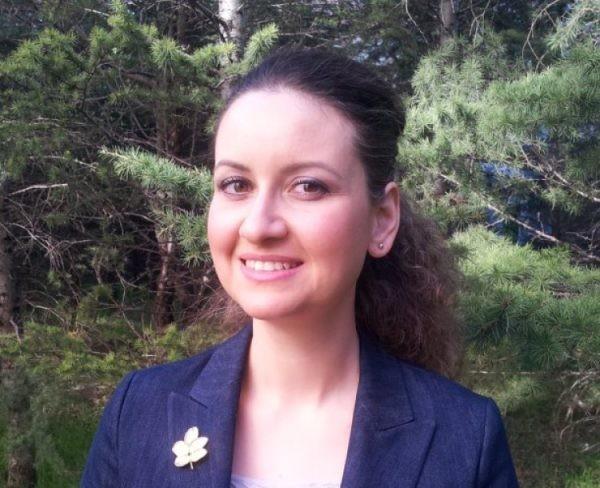

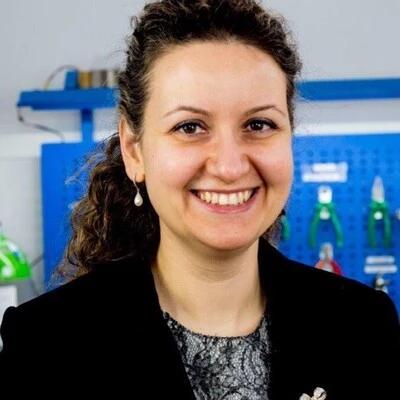
Bilge Demirköz – Astro-particle physicist
Year of Birth | 1980 | ||||||||
|---|---|---|---|---|---|---|---|---|---|
Areas of Expertise | Space technologies Particle physics Dark matter Space radiation Cosmic rays | ||||||||
Education | High school: Robert College Doctorate: University of Oxford – Physics (2007) Graduate: MIT – Physics (2004) Minor: Mathematics and Music Undergraduate: MIT – Physics (2001) | ||||||||
Areas of Work | High-energy cosmic rays, Dark matter research, Effects of space radiation on electronic systems, Development of radiation-resistant materials | ||||||||
Notable Projects | AMS-02 Experiment (International Space Station): Investigation of the cosmic particle spectrum, Analysis of experimental data regarding dark matter, METU Beam Line (METU-SDH): Establishment of a space radiation testing infrastructure in Türkiye, Testing according to ESA standards | ||||||||
Bilge Demirköz is a Turkish physicist renowned for her pioneering research in cosmic rays, space radiation, and astroparticle physics. A faculty member in the Department of Physics at Middle East Technical University (METU), Demirköz has made significant scientific contributions at both national and international levels. She is particularly recognized for her work on high-energy space particles, dark matter research, and space technologies.
Bilge Demirköz’s interest in science intensified during her high school years, especially in mathematics. A pivotal moment in her career came after attending a mathematics competition in Geneva, where she visited CERN. “I want to work here one day,” she declared, setting her goal. Guided by this ambition, she graduated from the Department of Physics at the Massachusetts Institute of Technology (MIT) in 2001, completing a double minor in music and mathematics during her undergraduate studies. She earned her master’s degree at MIT in 2004 and completed her PhD at the University of Oxford in 2007.
Demirköz’s research encompasses the study of high-energy cosmic rays, investigations into dark matter, and the measurement of space radiation effects on electronic systems. After working at international centers including CERN, University of Cambridge, and the Institut de Física d'Altes Energies (IFAE) in Barcelona, she returned to METU in 2011 to continue her research there.
She contributed to the Alpha Magnetic Spectrometer (AMS-02) experiment installed on the International Space Station, analyzing the spectra of high-energy particles from space—such as protons, electrons, and positrons. These studies provide clues about the nature of dark matter. She developed hypotheses to explain the unexpected increase in positron flux and has worked on experimental validations of these models.
Demirköz has also played a vital role in advancing Türkiye’s infrastructure for space research. She leads the METU Scattered Beam Line (METU-SDH) project, one of the first laboratories in Türkiye capable of conducting space radiation tests. The facility performs tests compliant with the ESA-ESCC 25100 standard established by the European Space Agency. This system enables the testing of components of Turkish satellites against space radiation, thereby enhancing their reliability and safety.
Additionally, Demirköz has participated in research on boron-containing composite materials for neutron shielding, working on the development of protective materials against harmful radiation effects in nuclear facilities and particle accelerators.
In 2017, Demirköz became the first woman from Türkiye to receive the L’Oréal-UNESCO For Women in Science International Rising Talent Award. This award, given to only 15 scientists worldwide each year, aims to support the scientific achievements of women researchers. Demirköz has highlighted the challenges women face in science and emphasized that such recognition serves as a crucial source of motivation for female academics.
In addition to her scientific work, Demirköz strives to raise scientific awareness among high school students in Türkiye. Through science cafés, lectures, and various science communication events, she seeks to inspire young people, especially female students. In her own words, teaching and conversing with youth are the activities that energize her the most.
Ak, Özlem. "Doç. Dr. Bilge Demirköz ile CERN Üzerine Bir Söyleşi." TÜBİTAK Bilim ve Teknik Dergisi. Accessed June 4, 2025.
Albaroudi, Abdul Rahman, Pelin Uslu Kiçeci, Selcen Uzun Duran, and M. Bilge Demirköz. "Monte-Carlo (MC) Analysis of Borated Materials for Neutron Shielding Applications." *Eurasian Journal of Science Engineering and Technology* 3, no. 2 (2022): 63–70. https://dergipark.org.tr/en/download/article-file/2369792.
Demirköz, Melahat Bilge. "Melahat Bilge Demirköz." World Economic Forum. June 4, 2025. https://www.weforum.org/people/m-bilge-demirkoz/.
Global Young Academy. "Bilge Demirköz." Accessed June 4, 2025.
Uzun Duran, Selcen, M. Bilge Demirköz, and Pelin Uslu Kiçeci. "Radioactivation Measurement of a Protective Collimator and Comparisons with Simulation After METU-Defocusing Beamline Pretest Irradiation." *Gazi University Journal of Science* 36, no. 4 (2023): 1786–1793. https://dergipark.org.tr/en/download/article-file/2061320.
Yunus Emre Enstitüsü. "Bilim Kurulu Üyemiz Prof. Dr. Demirköz, Genç Küresel Liderlerden Biri Seçildi." Accessed June 4, 2025.

Bilge Demirköz – Astro-particle physicist
Year of Birth | 1980 | ||||||||
|---|---|---|---|---|---|---|---|---|---|
Areas of Expertise | Space technologies Particle physics Dark matter Space radiation Cosmic rays | ||||||||
Education | High school: Robert College Doctorate: University of Oxford – Physics (2007) Graduate: MIT – Physics (2004) Minor: Mathematics and Music Undergraduate: MIT – Physics (2001) | ||||||||
Areas of Work | High-energy cosmic rays, Dark matter research, Effects of space radiation on electronic systems, Development of radiation-resistant materials | ||||||||
Notable Projects | AMS-02 Experiment (International Space Station): Investigation of the cosmic particle spectrum, Analysis of experimental data regarding dark matter, METU Beam Line (METU-SDH): Establishment of a space radiation testing infrastructure in Türkiye, Testing according to ESA standards | ||||||||
Life and Education
Scientific Research
Contributions to Infrastructure Development in Türkiye
International Recognition and Awards
Public Engagement and Science Communication