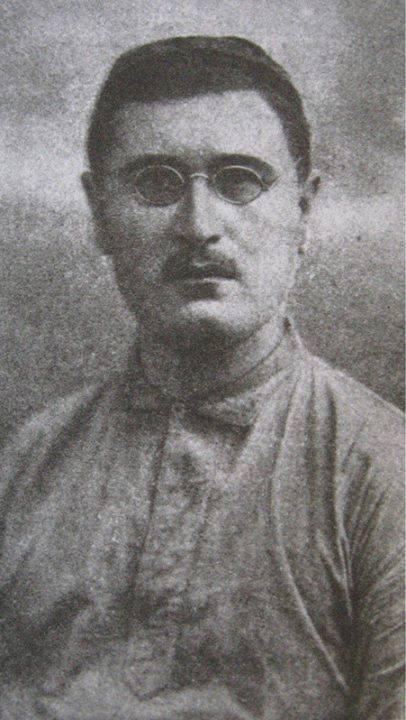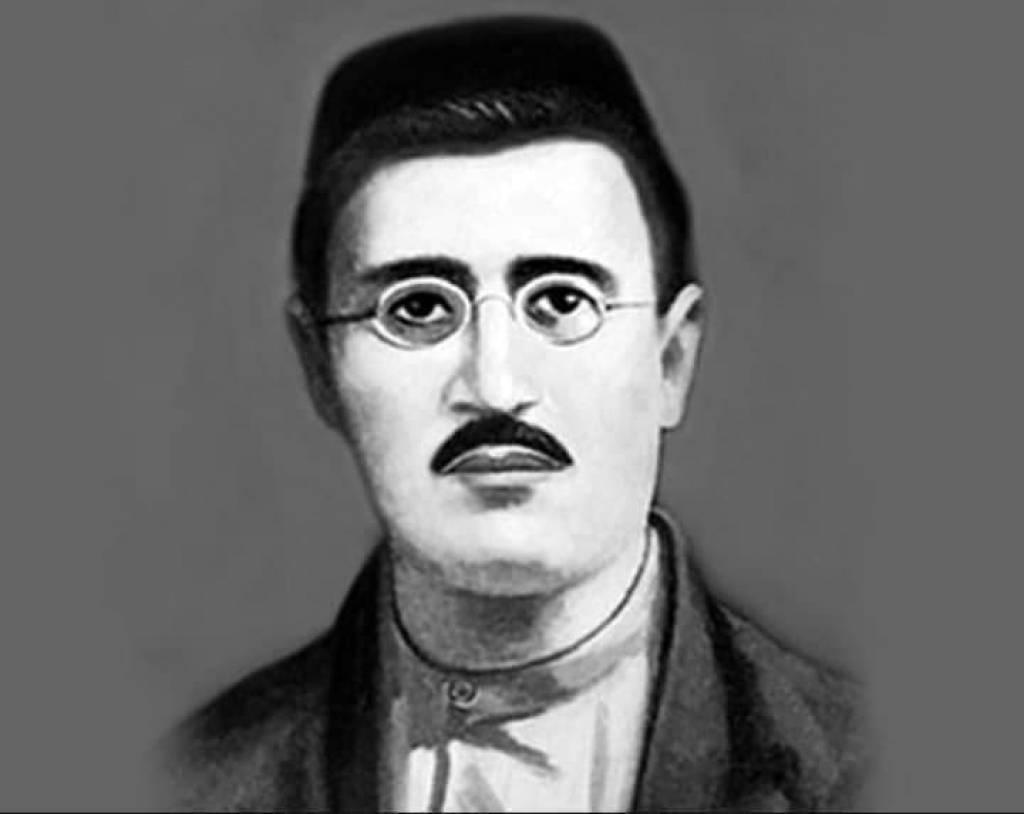
+1 More

Place of Birth | Uzbekistan (Fergana Vilayeti) Andican | ||||||||
|---|---|---|---|---|---|---|---|---|---|
Achievements and Awards | Uzbekistan Independence Medal: 1999 Ali Shir Nava'i State Award: 1991 Restoration of Reputation: 1957 | ||||||||
Languages Known | German Turkish Russian Persian Arabic English | ||||||||
Education | Tashkent Medreses Andican Russian school Tashkent University | ||||||||
Year and Cause of Death | 4 October 1938 (executed) | ||||||||
Year of Birth | 1897 | ||||||||
Full Name | Abdülhamid Süleymanoğlu | ||||||||
Abdülhamit Süleyman Çolpan, one of the founding figures of modern Uzbek literature, was a poet and writer who played a central role in the independence struggle of Turkistan through his ideas and works.【1】
Abdülhamid Süleymanoğlu was born in 1897 in the city of Andijan, Uzbekistan. His father was Süleymankul Molla Muhammed Yunusoğlu, a renowned scholar and educator of his time, known for his own divans and poetry. He completed his early education in traditional madrasas and later studied at madrasas in Andijan and Tashkent. He continued his education at a school opened by the Russians and completed his higher education at Tashkent University.【2】
During his education, he acquired advanced proficiency in Arabic, Persian, and Russian, and developed a strong interest in Turkish, German, and English, achieving fluency in these languages as well. He reached a level of mastery that enabled him to translate works from Russian and Western literature and closely examine these literary traditions. Thanks to these linguistic skills, he was able to read Eastern literature directly from its original sources such as Ferdowsi, Saadi, Hafez, and Omar Khayyam.【3】
After 1905, he was influenced by the Jadid movement that emerged in Turkistan and drew inspiration from the intellectual worlds of Ismail Gasprinski, Mahmudkhoca Behbudi, and Münevver Kari.【4】 At the age of 16, he read Zeki Velidi Togan’s Türk ve Tatar Tarihi and began following Turkish nationalist publications. He studied the works of Ottoman Turkish writers such as Tevfik Fikret, Cenap Şahabettin, Mehmet Emin Yurdakul, Ziya Gökalp, and Mehmet Akif Ersoy. He began his literary career in 1913–1914 under the pen names Kalender, Mirza Kalender, and Endicanlı. The pen name “Çolpan” was given to him by the educator Münevver Gari Abdureşidhanov. In his 4 June 1914 article titled “What Is Literature?”, he argued the view that “If literature lives, the nation lives.”【5】
Between 1917 and 1918, he served as secretary to Zeki Velidi Togan, head of the Bashkir National Republic, in Orenburg.【6】 He participated in the congress in Kokand where the Turkistan National Autonomous Republic was proclaimed and composed the march for the Free Turk Festival on behalf of this government. After the Russian authorities abolished this autonomy in February 1918, he intensified his literary activities aimed at raising public awareness against colonialism.【7】
Çolpan voluntarily joined the Korbash Movement that began in Turkistan and served at the Red Crescent hospital established to treat the wounded during conflicts. In July 1918, he participated in advisory meetings held in Orenburg with Kazakh and Alaş intellectuals. In 1919, he returned to Tashkent and continued his literary and social activities there.【8】
In his poetry, he expressed critiques of Russian and British colonialism, reactions to the fragmentation of Turkistan, the people’s poverty, and hopes for independence through metaphorical language.【9】
In theater, he authored original plays such as Bay, Temirçi, Öldirgüçi, Yarkınay, Halil Fereng, Çörining İsyanı, and Çopan Sevgisi.【10】 During his years in Moscow, he wrote a two-act comedy titled Zamane Hatini on women’s rights. He collaborated with Vasili Yan to prepare the play Hücum and published critical essays on staged works, actively engaging with the theater community.【11】
His first short story, Kurbani Cehalet, was published in 1914 in the newspaper Sada-i Türkistan. He demonstrated his mastery of prose through stories such as Dohtur Muhammedyar, Kar Koynunda Lale, Kleopatra, Aydın Keçelerde, and Seni Köb Körmesun.【12】
He undertook a comprehensive novel project aiming to portray the life of the Turkistan people through the metaphors of “night” and “day.” While the first part of the novel, Keçe (Night), which depicts the dark period at the beginning of the 20th century, has survived to the present, the second part, Kündüz (Day), has been lost. This novel is regarded as a continuation of Abdullah Qadiri’s work Ötken Künler.【13】
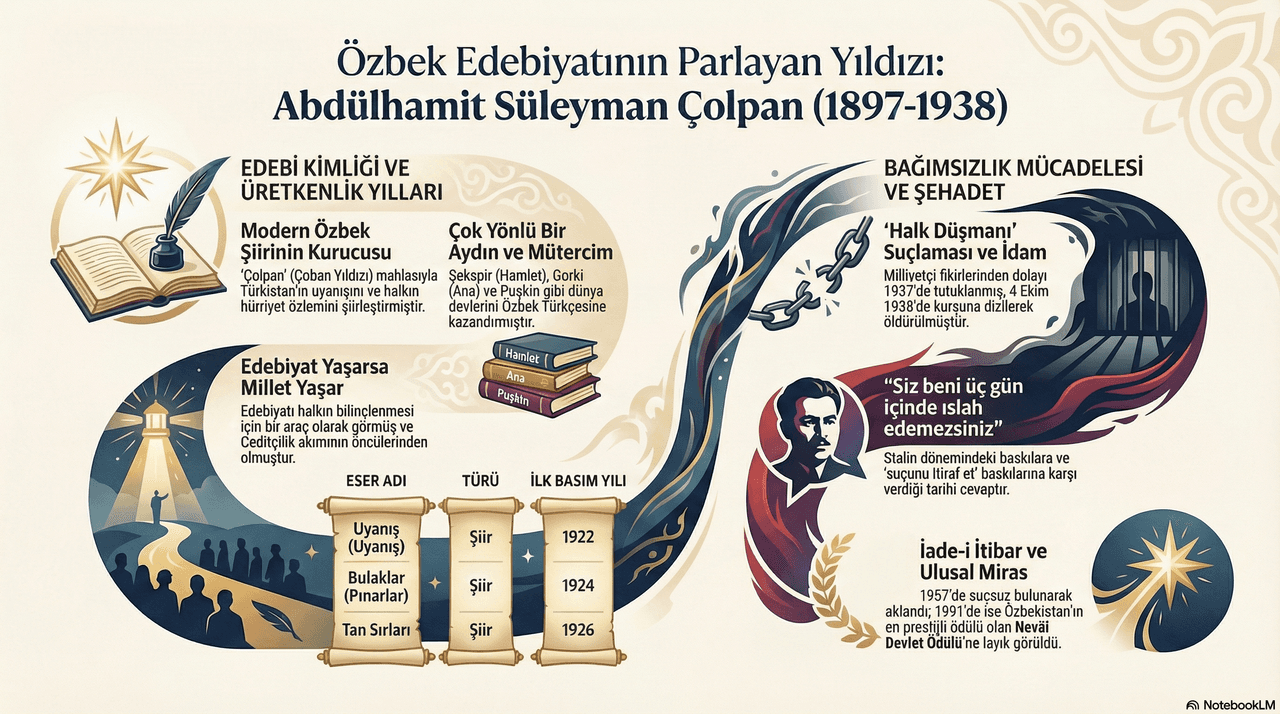
Abdülhamit Süleyman Çolpan Infographic (Generated by Artificial Intelligence)
He undertook extensive translation efforts to introduce classical works of world literature into Uzbek Turkish. He translated Shakespeare’s Hamlet as well as works by Pushkin, Gogol, Turgenev, Chekhov, Maxim Gorky, and Rabindranath Tagore.【14】
During the 1930s, he faced severe political pressure as a result of Stalin’s policies of the “Great Terror” and “Revolution from Above.” Accused of nationalism, Çolpan was interrogated repeatedly. In 1925, he expressed his forced artistic adaptation with the verse “muhit güçlü olduğu için boyun eğdim” (I bowed my neck because the environment was powerful). During this period, his artistic output entered a phase of stagnation, and traces of ideological pressure became evident in his works.【15】
As a result of political repression, he was arrested for the seventh time on 13 June 1937 and subjected to torture during a trial lasting more than a year. On 4 October 1938, he was executed by firing squad on charges of anti-regime activities and being an “enemy of the people.” His execution and death were not communicated to his family for many years.【16】
In 1957, he was officially declared innocent and rehabilitated. With Uzbekistan’s independence in 1991, the bans on his works were lifted and his legacy was reevaluated. In the same year, he was awarded the Navaî State Prize, and in 1999, the Uzbekistan Independence Medal. Awards have been established in his name, and streets and libraries have been named after him.【17】
Biyografya. "Abdulhamit Süleyman Çolpan." Accessed April 2, 2026. https://www.biyografya.com/tr/biographies/abdulhamit-suleyman-colpan-3856bd95
Türk Dünyası Ansiklopedisi. "Abdülhamit Süleyman Çolpan." Accessed April 2, 2026. https://turkdunyasiansiklopedisi.gov.tr/detay/1205/Abd%C3%BClhamit-S%C3%BCleyman-%C3%87olpan-
Türk Edebiyatı İsimler Sözlüğü. "Abdülhamid Süleymanoğlu." Accessed April 2, 2026. https://teis.yesevi.edu.tr/madde-detay/suleymanoglu-abdulhamid
[1]
Türk Dünyası Ansiklopedisi. "Abdülhamit Süleyman Çolpan." Erişim Tarihi 2 Nisan 2026. https://turkdunyasiansiklopedisi.gov.tr/detay/1205/Abd%C3%BClhamit-S%C3%BCleyman-%C3%87olpan-
[2]
Türk Edebiyatı İsimler Sözlüğü. "Abdülhamid Süleymanoğlu." Erişim Tarihi 2 Nisan 2026. https://teis.yesevi.edu.tr/madde-detay/suleymanoglu-abdulhamid
[3]
Türk Dünyası Ansiklopedisi. "Abdülhamit Süleyman Çolpan." Erişim Tarihi 2 Nisan 2026. https://turkdunyasiansiklopedisi.gov.tr/detay/1205/Abd%C3%BClhamit-S%C3%BCleyman-%C3%87olpan-
[4]
Türk Edebiyatı İsimler Sözlüğü. "Abdülhamid Süleymanoğlu." Erişim Tarihi 2 Nisan 2026. https://teis.yesevi.edu.tr/madde-detay/suleymanoglu-abdulhamid
[5]
Türk Dünyası Ansiklopedisi. "Abdülhamit Süleyman Çolpan." Erişim Tarihi 2 Nisan 2026. https://turkdunyasiansiklopedisi.gov.tr/detay/1205/Abd%C3%BClhamit-S%C3%BCleyman-%C3%87olpan-
[6]
Biyografya. "Abdulhamit Süleyman Çolpan." Erişim Tarihi 2 Nisan 2026. https://www.biyografya.com/tr/biographies/abdulhamit-suleyman-colpan-3856bd95
[7]
Türk Dünyası Ansiklopedisi. "Abdülhamit Süleyman Çolpan." Erişim Tarihi 2 Nisan 2026. https://turkdunyasiansiklopedisi.gov.tr/detay/1205/Abd%C3%BClhamit-S%C3%BCleyman-%C3%87olpan-
[8]
Türk Dünyası Ansiklopedisi. "Abdülhamit Süleyman Çolpan." Erişim Tarihi 2 Nisan 2026. https://turkdunyasiansiklopedisi.gov.tr/detay/1205/Abd%C3%BClhamit-S%C3%BCleyman-%C3%87olpan-
[9]
Türk Edebiyatı İsimler Sözlüğü. "Abdülhamid Süleymanoğlu." Erişim Tarihi 2 Nisan 2026. https://teis.yesevi.edu.tr/madde-detay/suleymanoglu-abdulhamid
[10]
Türk Edebiyatı İsimler Sözlüğü. "Abdülhamid Süleymanoğlu." Erişim Tarihi 2 Nisan 2026. https://teis.yesevi.edu.tr/madde-detay/suleymanoglu-abdulhamid
[11]
Türk Dünyası Ansiklopedisi. "Abdülhamit Süleyman Çolpan." Erişim Tarihi 2 Nisan 2026. https://turkdunyasiansiklopedisi.gov.tr/detay/1205/Abd%C3%BClhamit-S%C3%BCleyman-%C3%87olpan-
[12]
Türk Edebiyatı İsimler Sözlüğü. "Abdülhamid Süleymanoğlu." Erişim Tarihi 2 Nisan 2026. https://teis.yesevi.edu.tr/madde-detay/suleymanoglu-abdulhamid
[13]
Türk Dünyası Ansiklopedisi. "Abdülhamit Süleyman Çolpan." Erişim Tarihi 2 Nisan 2026. https://turkdunyasiansiklopedisi.gov.tr/detay/1205/Abd%C3%BClhamit-S%C3%BCleyman-%C3%87olpan-
[14]
Türk Dünyası Ansiklopedisi. "Abdülhamit Süleyman Çolpan." Erişim Tarihi 2 Nisan 2026. https://turkdunyasiansiklopedisi.gov.tr/detay/1205/Abd%C3%BClhamit-S%C3%BCleyman-%C3%87olpan-
[15]
Türk Dünyası Ansiklopedisi. "Abdülhamit Süleyman Çolpan." Erişim Tarihi 2 Nisan 2026. https://turkdunyasiansiklopedisi.gov.tr/detay/1205/Abd%C3%BClhamit-S%C3%BCleyman-%C3%87olpan-
[16]
Türk Dünyası Ansiklopedisi. "Abdülhamit Süleyman Çolpan." Erişim Tarihi 2 Nisan 2026. https://turkdunyasiansiklopedisi.gov.tr/detay/1205/Abd%C3%BClhamit-S%C3%BCleyman-%C3%87olpan-
[17]
Türk Edebiyatı İsimler Sözlüğü. "Abdülhamid Süleymanoğlu." Erişim Tarihi 2 Nisan 2026. https://teis.yesevi.edu.tr/madde-detay/suleymanoglu-abdulhamid
Place of Birth | Uzbekistan (Fergana Vilayeti) Andican | ||||||||
|---|---|---|---|---|---|---|---|---|---|
Achievements and Awards | Uzbekistan Independence Medal: 1999 Ali Shir Nava'i State Award: 1991 Restoration of Reputation: 1957 | ||||||||
Languages Known | German Turkish Russian Persian Arabic English | ||||||||
Education | Tashkent Medreses Andican Russian school Tashkent University | ||||||||
Year and Cause of Death | 4 October 1938 (executed) | ||||||||
Year of Birth | 1897 | ||||||||
Full Name | Abdülhamid Süleymanoğlu | ||||||||
No Discussion Added Yet
Start discussion for "Abdülhamit Süleyman Çolpan" article
Birth, Family, and Early Education
Linguistic Proficiency and Exposure to Eastern and Western Literature
The Jadid Movement and Intellectual Influences
Political Activities and the Turkistan National Autonomous Republic Period
Years of National Struggle: The Korbash Movement and Social Activities
Poetic Career and Poetry Collections
Theater Works and Dramatic Plays
Short Story Writing and Themes in Prose Works
Novel Writing: Keçe and Kündüz
Translation Activities and the Introduction of World Literature into Uzbek Turkish
Stalinist Repression and Forced Changes in His Art
Arrest and Execution
Restoration of Reputation and Legacy After Independence