

 Recently Added:
This article was automatically translated from the original Turkish version.
2026 Canadian Wildfires are a series of massive wildfires that swept across Canada in July 2026, encompassing thousands of fires and triggering a severe air quality crisis as smoke spread across the Midwestern Great Lakes and Northeastern regions of the United States affecting tens of millions of people. The fires affected numerous regions of the country, primarily in British Columbia, Northwest Territories, Ontario, Quebec and Manitoba. Particularly dense smoke originating from the Ontario fire complex caused air quality in major U.S. cities such as Detroit, Chicago, Washington D.C. and New York to plummet to some of the worst levels ever recorded globally.【1】 In addition to environmental impacts, the fires contributed to diplomatic tensions between the two countries following U.S. President Donald Trump’s threat to impose new tariffs on Canada.
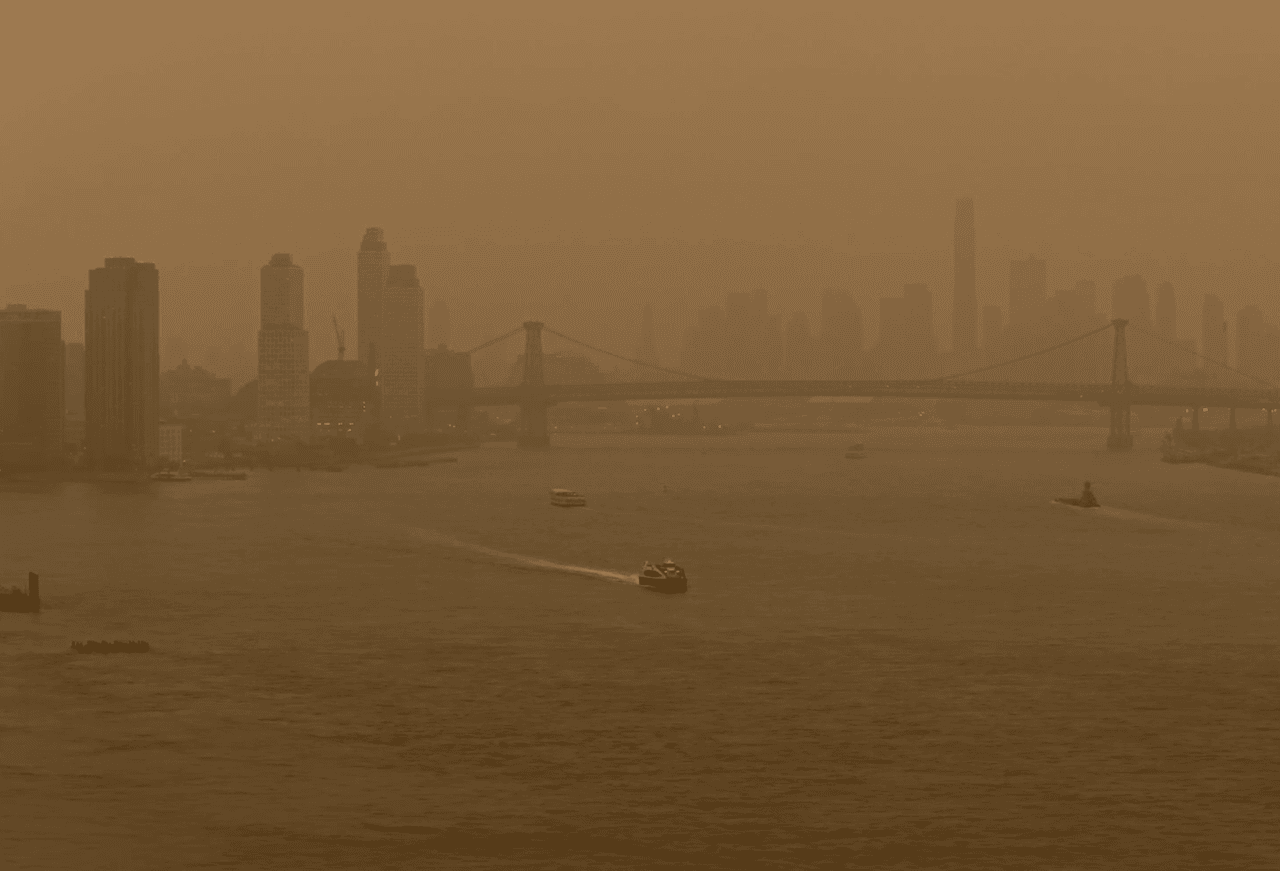
Canadian wildfires that blanketed New York with smoke, July 17 2026 - (Anadolu Ajansı)
At the beginning of July 2026, new wildfires emerged in western British Columbia and Northwest Territories. Shortly thereafter, fires ignited in Quebec, and the resulting dense smoke moved eastward across Canada and into the United States. On July 13 2026, simultaneous growth of numerous fires around northern Minnesota and western Ontario created risks for communities on both sides of the border.
According to the Government of Canada’s July 9 2026 update, there were 796 active wildfires nationwide, 60 of which were uncontained. By that date in the 2026 fire season, a total of 3,137 fires had been recorded, and approximately 1.4 million hectares had burned. For comparison, during the same period in 2025, 2,913 fires occurred, but the area burned was significantly larger at approximately 4.6 million hectares.
As of July 15 2026, over 800 wildfires were reported active across Canada. According to data from the Canadian Wildland Fire Information System (CWFIS) on July 17 2026, there were approximately 955 active fires in the country, most of which remained uncontained. More than 190 of these fires occurred in Ontario. On the same date, the Canadian Interagency Forest Fire Centre (CIFFC) reported approximately 888 active fires nationwide, about 200 of them in Ontario. According to CWFIS data, by this date in 2026, approximately 3 million hectares had been affected by wildfires.
The wildfire threat continues in British Columbia, on Canada’s Pacific coast. According to the British Columbia Wildfire Service, there are 59 active wildfires in the region, 39 of which started within the past 24 hours, and 31 remain uncontained. According to CNN, approximately 3,500 wildfires occurred across Canada during the 2026 summer season, burning more than 6 million acres (approximately 2.4 million hectares).
The Namaygoosisagagun First Nation, also known as Collins First Nation, located in northern Ontario, has been one of the hardest-hit communities. Residents were forced to evacuate using small boats due to the approaching fires.
According to seasonal forecasts by Environment and Climate Change Canada, above-normal temperatures are expected across much of the country during July and August 2026. Particularly dry conditions are projected in Manitoba and northwestern Ontario. The ministry’s fire danger modeling indicates the highest risk in July is expected in Northwest Territories, Nunavut, northern Manitoba and the Hudson Bay region, with increased fire potential also anticipated in northern Ontario and Quebec. While fire danger remains low to moderate across most of western Canada, localized high risk is forecast in the interior of British Columbia. In August, fire danger in southern interior British Columbia is expected to exceed seasonal norms.
To enhance preparedness and response capacity, Natural Resources Canada has announced funding of CAD 1.25 million. This support includes projects with the Métis Nation of British Columbia, Métis Nation of Alberta, Métis Nation of Saskatchewan and Métis Nation of Ontario focused on risk mapping, emergency planning, evacuation coordination and integrating Indigenous traditional knowledge into fire management. Additionally, in collaboration with the Délı̨nę Got’ı̨nę Government and Chipewyan Prairie First Nation, training for up to 38 Indigenous wildfire firefighters is planned.
As of July 17 2026, hazardous smoke from Canadian wildfires has affected more than 100 million Americans in over a dozen U.S. states. According to CNN, over 100 million people in 18 states and the District of Columbia are under air quality alerts, with “very unhealthy” and “hazardous” levels extending from northern Minnesota to southeastern Virginia. Another CNN report states that smoke has exposed over 120 million people in the Midwest and Northeast to hazardous air quality.【2】
On the afternoon of Friday, July 17, smoke stretched from Duluth, Minnesota to Richmond, Virginia, impacting the states of Wisconsin, Michigan, Ohio, New York, Pennsylvania, New Jersey, Maryland and Delaware.
According to data from the Swiss air quality monitoring organization IQAir on the morning of July 17, the cities with the worst air quality globally included Detroit at 435, Chicago at 330, Washington D.C. at 242 and New York at 160; for comparison, Jakarta recorded 152, New Delhi 151 and Beijing 65 on the same day. In the United Kingdom, Birmingham measured 82 and London 56, while Auckland, New Zealand, with a score of 8, was ranked as the city with the best air quality globally.
In an afternoon update on the same Friday, Detroit remained the most polluted city globally at 222, while Washington D.C. at 175 tied for second place with Kinshasa in the Democratic Republic of the Congo. Chicago’s air quality deteriorated to 136 (“Orange Code,” unhealthy for sensitive groups) later in the day, and New York’s air quality improved with the dispersion of smoke to 88 (“Yellow Code,” moderate).
In Philadelphia, officials declared July 17 a “Purple Code Air Quality Emergency Day”, warning that “everyone may experience adverse health effects from airborne particles, and sensitive groups may experience more serious health impacts.”
Washington D.C. Mayor Muriel Bowser urged residents, “If you must go outside, wear a mask,” noting the city was under “Purple Code” (very unhealthy) conditions and advising sensitive groups to stay indoors while others should limit outdoor time and strenuous activity. Bowser also confirmed that all government operations in the city had been suspended and that outdoor swimming pools and water parks had been closed.
The City of Chicago Office announced it was experiencing the worst air quality in its recorded history, urging residents to remain indoors and, if they must go outside, to wear a well-fitting N95 or KN95 mask.【3】
The Major League Baseball game scheduled for Friday evening, July 17, between the Cleveland Guardians and Pittsburgh Pirates was postponed; it will be rescheduled as part of a doubleheader on Saturday. The Milwaukee Brewers offered ticket holders for their July 17 evening game the option to exchange their tickets for another home game during the season due to hazardous air quality.
The RowFest National Championship in Flint, Michigan, a baby shower in Flint, a rock concert in Herndon, Virginia, and the America’s Mile marathon in Pittsburgh were also canceled due to smoke. Entertainment venues including Kennywood and Sandcastle Water Park in Pennsylvania were closed due to poor air quality.
On July 17 2026, U.S. President Donald Trump targeted Canada in a post on Truth Social, writing: “We hold Canada responsible for failing to properly manage its forests and brush, and the United States is being invaded by unnecessarily dirty, polluted and unhealthy air — air quality that is hazardous and completely unacceptable!”
Trump asserted that the cost of this pollution must be “added on top of Canada’s existing tariffs” and stated he would call Canadian Prime Minister Mark Carney to demand an explanation for what he described as Canada’s “deliberate neglect.”【4】
On July 15 2026, four Republican members of Congress from Michigan — John James, Jack Bergman, John Moolenaar and Lisa McClain — sent a joint letter to Prime Minister Carney. The letter stated, “American lungs are paying the price for Canada’s inaction,” adding, “If Canada does not manage its forests to prevent these fires, the United States will look elsewhere and act on its own to protect its people. This means exploring direct involvement in our own institutions’ cross-border fuel reduction and firefighting capacity.”【5】
Prime Minister Mark Carney, instead of directly responding to the criticism, stated in a French-language address that combating climate change is “the responsibility of everyone, including the United States,” and emphasized that his government is in close communication with provincial and local communities.
Ontario Premier Doug Ford responded to U.S. lawmakers by saying “Perhaps what you should do is not complain but send support, send help; because we have done exactly the same for our American friends.” Ford recalled Canada’s assistance during previous U.S. disasters, including California wildfires in August 2025 and hurricanes in North Carolina. Ford also noted that Democratic-led states Michigan and Massachusetts had offered assistance in water bombers, firefighters and rescue operations. Ford also noted that Democratic-led states Michigan and Massachusetts had offered assistance in water bombers, firefighters and rescue operations.【6】
Following Trump’s statements, Carney’s minister responsible for emergency management noted that the two countries remain in constant communication and have a long history of cooperation during such disasters, citing the 1982 mutual firefighting agreement and another assistance accord stemming from the 2025 G7 summit.
ABC News. “Canada Wildfire Smoke Brings Unhealthy Air Quality to Over a Dozen States in Midwest, Northeast: Latest.” Accessed July 18, 2026.https://abcnews.com/US/canada-wildfire-smoke-brings-unhealthy-air-quality-dozen/story?id=134845214
BBC News. “Trump Says US Being ‘Invaded by Filthy Air’ as He Threatens Canada with Tariffs over Wildfires.” Accessed July 18, 2026.https://www.bbc.com/news/live/cd9w8xk75ndt
BBC News. “Trump Threatens New Canada Tariffs over Fires Sending ‘Filthy’ Air into US Cities.” Accessed July 18, 2026.https://www.bbc.com/news/articles/cwyq93j34lgo
BBC News. “What to Know About the Canadian and US Wildfires and Their Impact.” BBC News. Accessed July 18, 2026.https://www.bbc.com/news/articles/c5ywdl9ne3yo
CBC News. “Tracking the 2026 Wildfires in Canada.” Accessed July 18, 2026.https://www.cbc.ca/news/canada/wildfires-canada-2026-tracker-9.7272270
CNN. "Wildfire Smoke Is Driving Terrible Air Quality in Major Cities, but Relief Is Coming." Accessed July 18, 2026.https://edition.cnn.com/2026/07/17/weather/smoke-forecast-northeast-midwest
CNN. “Wildfire Smoke Is Driving Terrible Air Quality as New Wildfire Plumes Arrive from Canada.” Accessed July 18, 2026.https://edition.cnn.com/2026/07/14/weather/canada-wildfire-smoke-northeast-midwest-air-quality
Colorado State University CIRA Satellite Library. “Canada Wildfires of 2026.” CIRA Satellite Library. Accessed July 18, 2026.https://satlib.cira.colostate.edu/event/canada-wildfires-of-2026/
Government of Canada. “The Government of Canada Provides an Update Regarding the 2026 Wildfire Season – July Update.” Government of Canada. Accessed July 18, 2026.https://www.canada.ca/en/public-safety-canada/news/2026/07/the-government-of-canada-provides-an-update-regarding-the-2026-wildfire-season--july-update.html
NBC News. “Wildfires Expose Millions in the Midwest and Northeast to Dangerous Smoke.” Accessed July 18, 2026.https://www.nbcnews.com/weather/wildfires/wildfires-smoke-canada-minnesota-expose-millions-dangerous-air-rcna587684
Reuters. “Explainer: Why Is Canada’s Wildfire Smoke Blanketing Parts of North America?” Reuters. Accessed July 18, 2026.https://www.reuters.com/business/environment/why-is-canadas-wildfire-smoke-blanketing-parts-north-america-2026-07-17/
[1]
BBC News, “What to Know About the Canadian and US Wildfires and Their Impact,” erişim 18 Temmuz 2026, https://www.bbc.com/news/articles/c5ywdl9ne3yo
[2]
CNN, “Wildfire Smoke Is Driving Terrible Air Quality in Major Cities, but Relief Is Coming,” erişim 18 Temmuz 2026, https://edition.cnn.com/2026/07/17/weather/smoke-forecast-northeast-midwest
[3]
CNN, “Wildfire Smoke Is Driving Terrible Air Quality in Major Cities, but Relief Is Coming,”
[4]
BBC News, “Trump Threatens New Canada Tariffs Over Fires Sending ‘Filthy’ Air into US Cities,” erişim 18 Temmuz 2026, https://www.bbc.com/news/articles/cwyq93j34lgo
[5]
BBC News, “Trump Threatens New Canada Tariffs Over Fires Sending ‘Filthy’ Air into US Cities,”
[6]
BBC News, “Trump Threatens New Canada Tariffs Over Fires Sending ‘Filthy’ Air into US Cities,”

In July 2026, thousands of forest fires broke out across Canada, exposing tens of millions of people in the Midwestern and Northeastern regions of the United States to hazardous air quality. The crisis triggered diplomatic tensions after U.S. President Trump threatened tariffs on Canada.
No Discussion Added Yet
Start discussion for "2026 Canada Forest Fires" article
July 18, 2026
Origin and Geographic Spread of the Fires
July 18, 2026
Regional Situation Across Canada
July 18, 2026
Smoke Spread Across the United States and Air Quality Crisis
July 18, 2026
Cancellation of Sports Events and Activities
July 18, 2026
Diplomatic Tensions Between the United States and Canada