


This article was automatically translated from the original Turkish version.
Proposal for Eastern and Western Bulgarian Vilayets of 1876, presented during the Istanbul Conference (Shipyard Conference)【1】, was an administrative reform proposal calling for the reorganization of existing provincial boundaries in Ottoman Rumelia by establishing an Eastern Vilayet with its center in Tırnova and a Western Vilayet with its center in Sofya. This proposal emerged within the context of European powers’ diplomatic interventions and reform efforts concerning Ottoman Rumelia between 1876 and 1877 but was never adopted by the Ottoman government and therefore never became a legal regulation. Its historical significance lies not only in the design of two new administrative units but also in the fact that it brought together on a single negotiation platform key issues of Ottoman territorial integrity, central authority, local representation, security, and international oversight.【2】
The proposal, prepared by the European powers, was included in the “Projet de Règlement Organique” or “Draft Organic Regulation,” which appeared under the heading “Bulgaria” in the conference documents. The draft envisioned the creation of two new vilayets by reorganizing certain sanjaks and kazas from the existing Ottoman administrative divisions of the Danube, Edirne, Salonica, and Manastır vilayets. This reorganization did not entail the complete abolition of existing provinces but rather the redistribution of specific territorial units into new administrative groupings.
According to the proposal, the center of the Eastern Vilayet would be Tırnova. It was suggested that this vilayet include the sanjaks of Rusçuk, Tırnova, Tulça, Varna, İslimiye, and Kırkkilise, along with the kazas of Cisr-i Mustafa Paşa and Kızılağaç, excluding Sultanyeri and Ahiçelebi from the Filibe sanjak. The center of the Western Vilayet was designated as Sofya. This vilayet was intended to encompass the sanjaks of Sofya, Vidin, Niş, and Üsküp, the northern part of the Manastır sanjak excluding its two southern kazas, the three northern kazas of the Serez sanjak, and the kazas of Usturumca, Tikveş, Veleş, and Kesriye. Thus, the proposal constituted a broad administrative reorganization extending beyond the Danube Vilayet and the newly proposed Sofya Vilayet, incorporating territories from Edirne, Salonica, and Manastır vilayets.【3】 The territory covered by the two proposed vilayets nearly coincided with the boundaries of the Bulgarian Exarchate.
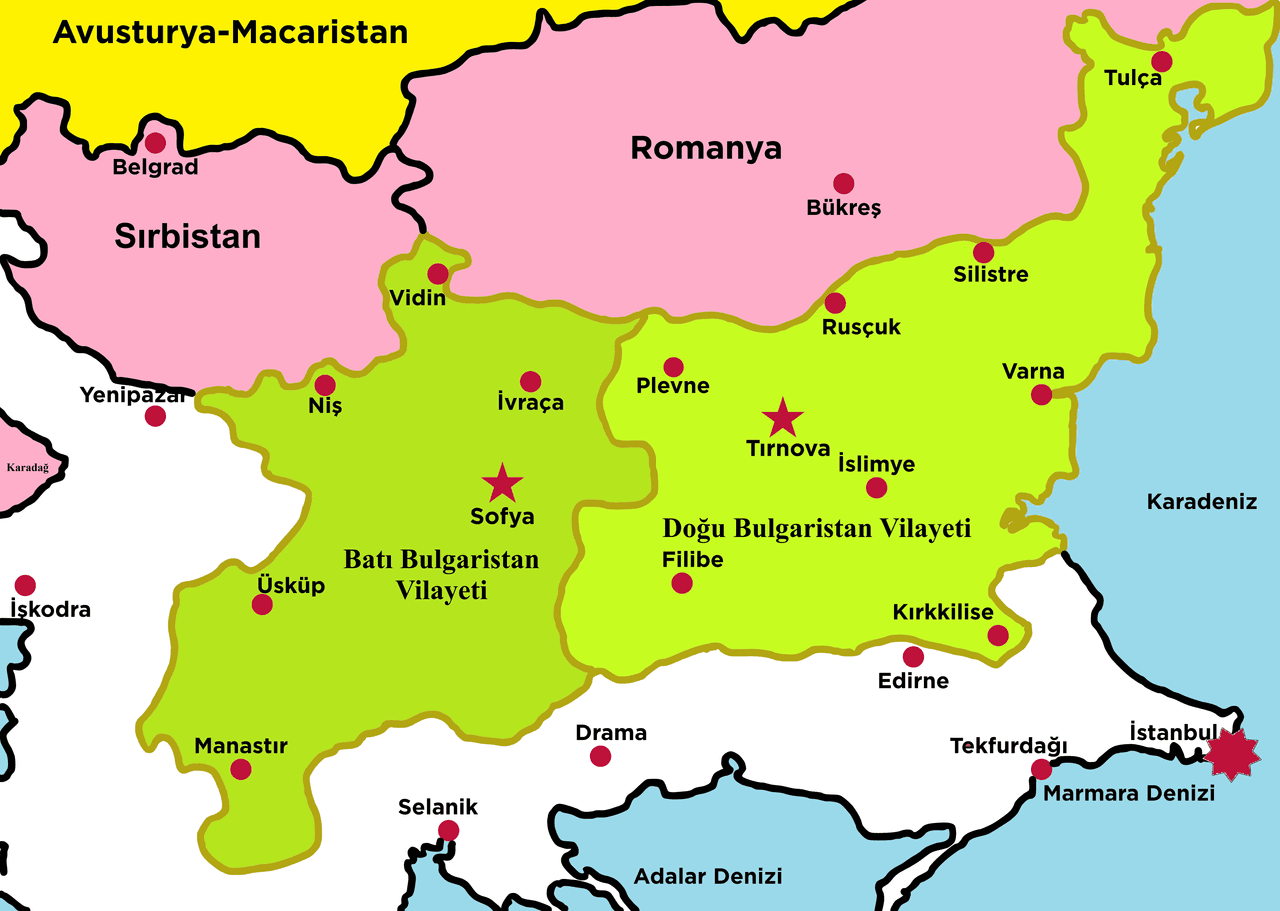
Map Showing the Proposed Eastern and Western Bulgarian Autonomous Vilayets at the 1876 Istanbul Conference (Drawing: Mehmet Salih Çoban)
The proposal did not only define the boundaries of the two vilayets but also outlined their administrative structure. Under this plan, the smallest administrative unit would be the nahiye, with a population ranging from at least five thousand to no more than ten thousand. While maintaining as much as possible the existing administrative divisions, the proposal stipulated that Christian and Muslim populations should be grouped into separate nahiyes. The nahiye director was to be elected by the nahiye council from among its members for a four-year term, and the councils themselves were to be composed of representatives elected from each district regardless of religious affiliation. Similar administrative councils were proposed for cities and towns with populations exceeding ten thousand.
Sanjak administration was to be entrusted to kaymakams, who were to be appointed by the Sublime Porte for four-year terms based on their religious affiliation—Christian or Muslim—according to the demographic composition of the sanjak and upon the recommendation of the governor. Each vilayet was to be headed by a governor-general appointed by the Ottoman government for a five-year term and subject to approval by the European powers. It was suggested that the governor-general could be either a subject of the Ottoman Empire or a foreign Christian. Furthermore, the vilayet council was to be elected by the nahiye councils without direct intervention from the Sublime Porte. These provisions demonstrate that the proposal aimed not only to redefine administrative boundaries but also to restructure the distribution of authority, representative mechanisms, and center-periphery relations.【4】
One of the key elements of the proposal was the establishment of an international commission to supervise the implementation of the reforms. The commission was to monitor the application of the regulations, the functioning of administrative and judicial institutions, and electoral processes, as well as participate in defining the boundaries of vilayets, sanjaks, and nahiyes. The draft also provided for the commission to collect demographic data, determine local boundary lines, and, if necessary, add or remove kazas from nahiyes in border regions. Additionally, the proposal included provisions for the equal official status of Bulgarian and Turkish in courts and administrative affairs, guarantees of religious freedom, the restriction of Ottoman regular military units to fortresses and major cities, and the establishment of militia and gendarmerie forces within the new vilayets. In this respect, the draft addressed both local administration and security concerns simultaneously.【5】
The Ottoman government rejected the proposal and grounded its objections primarily on the principles of state territorial integrity and independence. According to Safvet Paşa’s statements during the conference negotiations, the Sublime Porte was not fundamentally opposed to administrative reforms at the local level but viewed the proposal as undermining the existing administrative structure, institutionalizing foreign oversight, and restricting Ottoman sovereignty. The main points of Ottoman objection included the establishment of an international commission, the creation of a gendarmerie composed of foreign elements, the restriction of Ottoman military units to fortresses only, the method of appointing governors and other officials, the proposed administrative division, legal and economic regulations, and the relocation of Circassian populations to Anatolia.【6】
Ottoman representatives also declared that they could not accept the proposed administrative division for the two new vilayets. Edhem Paşa emphasized that existing provincial boundaries were the product of time and experience and that the new arrangement might not be accepted by the local population. Upon Lord Salisbury’s assertion that the proposed division aimed to separate “faiths and races” as far as possible, the Ottoman side stated that it could not endorse an administrative system based on the principle of separating nations.【7】
Ottoman representatives also objected to the proposal’s presentation of the two new vilayets under the heading “Bulgaria.” According to Safvet Paşa, it was unacceptable to designate a region that did not yet exist administratively and was not officially recognized by the Ottoman state under the name “Bulgaria.” The European representatives, however, clarified that the heading was used merely to distinguish this section from other draft documents.【8】
In subsequent sessions of the conference, the European envoys prepared a revised text that softened their initial proposals; this final version did not explicitly recommend the creation of two new Bulgarian vilayets. Nevertheless, they continued to insist on the appointment of governors and the establishment of an international commission. The Ottoman side made clear that it could not accept foreign intervention in the administration and oversight of the Rumelian vilayets. At the final session on 20 January 1877, Ottoman representatives conveyed their conclusion, based on the evaluation of the extraordinary Şûra, that the proposals were incompatible with the independence of the Ottoman state. As a result, the Istanbul Conference ended without any binding decision, signed agreement, or ratified regulation.【9】
Therefore, the 1876 Proposal for Eastern and Western Bulgarian Vilayets was not a legally enacted administrative reform but rather a reform project submitted to and rejected by the Ottoman state within the framework of the Istanbul Conference. The use of the term “Projet” in the conference documents further confirms that it was understood as a proposal, draft, or suggestion rather than a formal decision. Although the proposal was later recalled in discussions concerning the Bulgarian question and the formation of administrative boundaries in the Balkans, it never acquired the status of a lasting international decision adopted at the 1876 Istanbul Conference.【10】
Aydın, Mithat. “İstanbul Konferansı.” *TDV İslâm Ansiklopedisi*. 2nd ed., vol. Ek-1, Ankara, 2020, pp. 671-672. Accessed June 4, 2026. https://islamansiklopedisi.org.tr/istanbul-konferansi
Hacıoğlu, Sevim. “1876 İstanbul Konferansı’na Sunulan Doğu ve Batı Bulgaristan Vilayetleri Önerisi.” Troyacademy 5, no. 2 (2020): 187-217. Accessed June 4, 2026. https://doi.org/10.31454/usb.666562
Republic of Turkey Ottoman State Archives (BOA), Ministry of Foreign Affairs, Political Section Documents (HR.SYS.), 1289/1 p. 181-182.
Republic of Turkey Ottoman State Archives (BOA),Yıldız Perakende Documents, Ministry of Foreign Affairs Memoranda (Y.PRK.HR.), 1/18.
[1]
Mithat Aydın, “İstanbul Konferansı,” TDV İslâm Ansiklopedisi, Access: 4 June 2026, https://islamansiklopedisi.org.tr/istanbul-konferansi.
[2]
Sevim Hacıoğlu, “1876 İstanbul Konferansı’na Sunulan Doğu ve Batı Bulgaristan Vilayetleri Önerisi,” Troyacademy 5, no. 2 (2020): pp. 188-189, Access: 4 June 2026, https://doi.org/10.31454/usb.666562.
[3]
Republic of Türkiye Ottoman State Archives (BOA), Yıldız Perakende Evrakı Hariciye Nezareti Maruzatı (Y.PRK.HR.), 1/18.
[4]
BOA, Y.PRK.HR, 1/18.
[5]
Hacıoğlu, pp. 201-203; BOA, HR.SYS, 1289/1, pp. 181-182.
[6]
Hacıoğlu, pp. 201-203.
[7]
Hacıoğlu, pp. 201-204.
[8]
Hacıoğlu, pp. 204-206.
[9]
Hacıoğlu, pp. 208-209.
[10]
Hacıoğlu, pp. 209-210.

No Discussion Added Yet
Start discussion for "1876 Proposal for the Vilayets of Eastern and Western Bulgaria" article
Scope of the Proposal
Principles of Administrative Reorganization
International Oversight and Security Dimensions
Ottoman Government Objections
Outcome of the Negotiations