



Köse Gelin Oyunu
Imagine this: on the coldest days of winter, when everyone has retreated indoors, sudden jingling sounds and laughter rise from outside. These noises announce the arrival of the Köse Gelin game, a tradition that has been practiced for centuries in the villages of Anatolia. Have you ever imagined a giant, furry figure and a beautifully dressed bride knocking on your door and dancing in the freezing air? This game is one of our most joyful traditions, played to celebrate the end of winter and the approach of spring.
Who Are the Characters in This Game?
The main character is the Köse, portrayed by a young villager. The Köse’s appearance is both slightly frightening and highly comical. He wears a very wide white robe stuffed with grass to make it look puffed out. On his head he places a hat adorned with horns made of reeds, paints his face white with flour, and dons a long white beard made of wool. The bells around his waist create loud noises with every movement.
Alongside the Köse is the Gelin, who is also in fact a young person dressed as a bride. She wears a red veil on her head, places a small mirror on her forehead, and carries a small pin in her hand for protection.
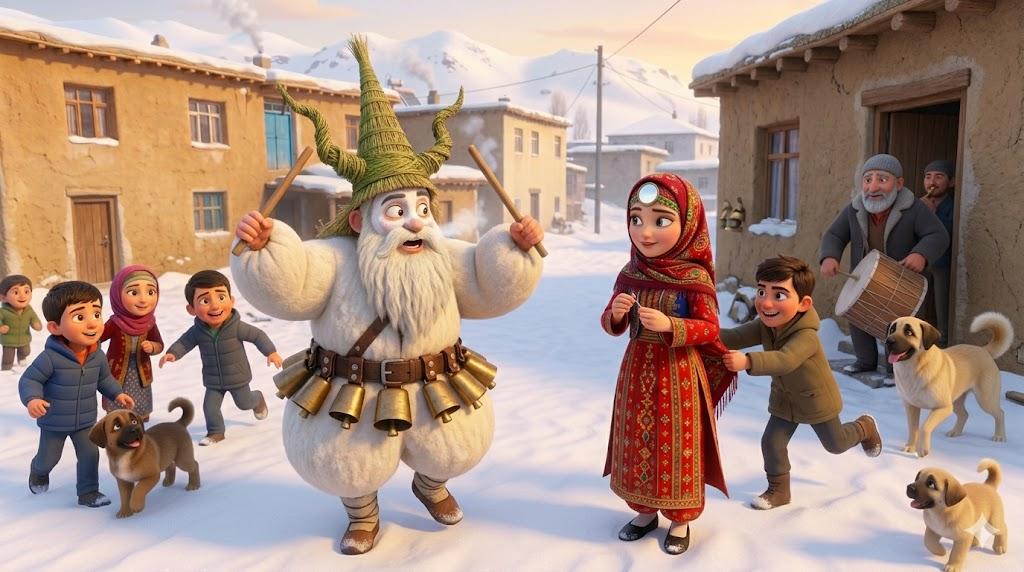
Representative Image of the Köse Gelin Game (This Image Was Generated by Artificial Intelligence.)
How Is the Game Played?
Shepherds and young people form a group and begin visiting houses one by one, accompanied by drums, zurnas, or bagpipes. When they arrive at a door, the Köse and the Gelin dance facing each other. During this dance, the Köse keeps rhythm by clapping two sticks together and making peculiar “pırr pırr” sounds with his breath. The most exciting moment comes when the Köse suddenly collapses to the ground and pretends to die. Here, the Köse represents the harsh winter and its hardships. When the Gelin, playing the role of his wife, begins to cry and grieve over him, the Köse suddenly comes back to life and stands up. This revival symbolizes nature awakening—the arrival of spring and joy.
Don’t Let the Bride Escape!
The game does not end with dancing alone. Other young people in the village try to steal the bride during the performance to add excitement. The Köse chases after them with his sticks to protect her. During this chase, children are both a little afraid of the Köse and run after him, joining in the merriment.
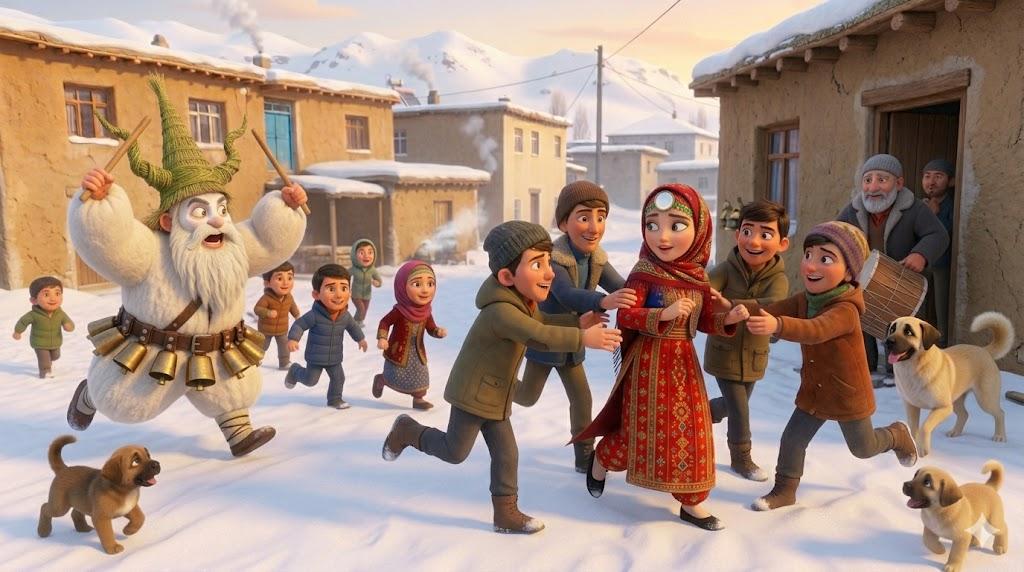
Representative Image of Children Trying to Steal the Bride and the Köse (This Image Was Generated by Artificial Intelligence.)
The Beauty of Sharing
When the game ends, the homeowners of the visited houses give gifts to the group. These gifts are usually food items such as flour, oil, sugar, and eggs, or sometimes money. Sometimes the collected items are used to prepare a large feast; other times they are distributed to families in need in the neighborhood. Thus, as spring arrives, not only does nature awaken, but people’s hearts also warm through acts of generosity.
A Journey Through Time
The Köse game is a “village spectacle game” whose roots stretch back thousands of years, to ancient times when people believed in the powers of nature.





