This article was automatically translated from the original Turkish version.
Importance | A transportation corridor connecting Azerbaijan to Türkiye and Central Asia via Nakhchivan | ||||||||
|---|---|---|---|---|---|---|---|---|---|
Legal Basis | Article 9 of the Tripartite Declaration of 10 November 2020 | ||||||||
Purpose | Continuous land and energy connectivity within the Turkic world Trade and cultural integration | ||||||||
Party | (cautious due to reduced transit importance) Russia (opposed to special status transit) Armenia (supports) Azerbaijan and Türkiye (supports transport integration) The United States and the European Union Iran (guarantor and mediator) | ||||||||
Current Status (2025) | Construction progress on the Azerbaijani side, ongoing disputes over route and status on the Armenian side, and planned peace talks at the White House on 8 August 2025 | ||||||||
Zengezur Corridor is a logistical route planned to pass through the Zengezur (Syunik) region in southern Armenia, aiming to directly connect western regions of Azerbaijan with the Nakhchivan Autonomous Republic.
The implementation of the corridor came to the agenda within the framework of the Tripartite Declaration signed on 10 November 2020. This route holds strategic importance due to its potential to establish an uninterrupted land connection between Azerbaijan and Türkiye.
On 8 August 2025, in Washington, the Azerbaijan–Armenia Peace Agreement designated the Zengezur Corridor as the “Trump Route for International Peace and Prosperity” (TRIPP), defining it as a multifaceted route encompassing road and rail networks, energy pipelines, and communication infrastructure.
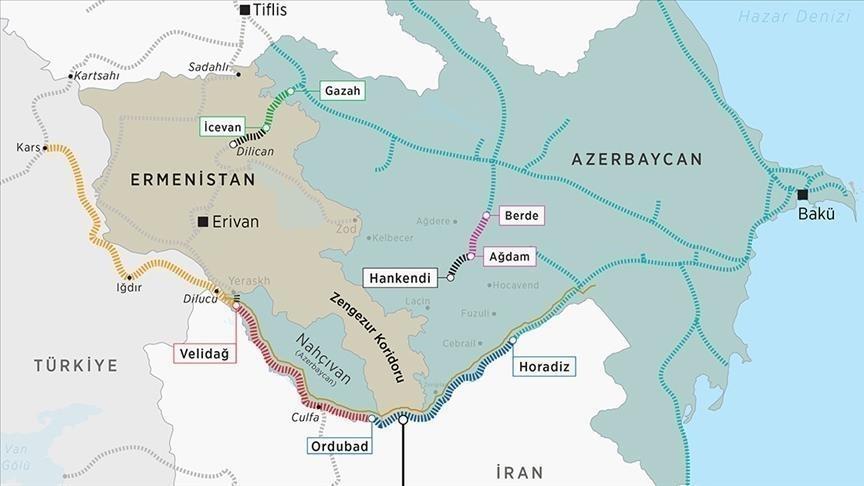
Zengezur Koridoru (AA)
The Zengezur region has historically emerged as one of the most strategic geographies in southern Transcaucasia. Following the Russian Empire’s takeover of the region in the early 19th century, Zengezur became a site of ethnic, political, and military disputes between Azerbaijan and Armenia. During the border conflicts between the Azerbaijan Democratic Republic and the Republic of Armenia between 1918 and 1920, Zengezur was among the most contentious areas between the two sides.
With the Soviet Union’s consolidation of control over southern Transcaucasia in the early 1920s, the Moscow administration redrew regional boundaries. During this process, the Zengezur region was assigned to the Armenian Soviet Socialist Republic, severing the direct land connection between western Azerbaijan and the Nakhchivan Autonomous Soviet Socialist Republic. This decision forced all transit between Azerbaijan and Nakhchivan to pass exclusively through Armenian territory or via Iran.
Although railway and road connections between Azerbaijan and Nakhchivan via Zengezur existed during the Soviet period, these routes operated under centralized Soviet control and were treated as internal borders between the two republics, preventing political crises. However, with the dissolution of the USSR in 1991, diplomatic relations between Armenia and Azerbaijan were severed, and the conflicts in Karabakh and surrounding areas led to the complete closure of the land connection through Zengezur.
This situation resulted in Nakhchivan being completely cut off from the main territory of Azerbaijan, accessible only via Iran and Türkiye. Since the 1990s, Azerbaijan has consistently prioritized reestablishing connectivity through Zengezur as a strategic objective. From the late 2000s onward, growing political and economic cooperation between Azerbaijan and Türkiye strengthened the idea of reviving this route. However, Armenia opposed the proposal, viewing the granting of a special corridor status through Zengezur as a violation of its sovereignty. This historical context laid the groundwork for the inclusion of the Zengezur Corridor in the 10 November 2020 Tripartite Declaration signed after the Second Karabakh War, once again making the region a focal point of international attention.
The Second Karabakh War, which took place between 27 September and 10 November 2020 and lasted 44 days, ended with Azerbaijan’s military superiority. Azerbaijan regained control of a large territory that had been under Armenian control since the 1990s. The Tripartite Declaration signed on 10 November 2020 by Azerbaijan, Armenia, and Russia fundamentally altered the regional power balance.
Article 9 of the Declaration foresaw the reestablishment of transport links between western Azerbaijan and the Nakhchivan Autonomous Republic. According to this article, the security of these transport connections was to be guaranteed by border units under the Russian Federal Security Service (FSB). Azerbaijan interpreted this article as the legal basis for implementing the Zengezur Corridor.
Following the war, Azerbaijan emphasized the need for rapid action to open road and rail routes. President Ilham Aliyev stated that the Zengezur Corridor would not only connect Azerbaijan with Nakhchivan but also establish a direct link between Türkiye and the countries of Central Asia. In this context, the notion emerged that the corridor would serve as a “strategic route uniting the Turkic world”.
Armenia, however, argued that the term “corridor” did not appear in the Declaration and that it contained only a general provision regarding the opening of regional transport links. The Yerevan administration viewed the granting of special transit rights through Zengezur to Azerbaijan as a violation of its sovereignty. Consequently, Armenia insisted that customs and border controls in the region remain under its own authority.
Although progress was occasionally made during negotiations between the parties in 2021 and 2022, disagreements over the border demarcation, customs procedures, and security issues remained unresolved. Russia continued to act as an intermediary to facilitate implementation of the transport clause in the Tripartite Declaration; however, Moscow’s influence in the region diminished somewhat after the outbreak of the war in Ukraine.
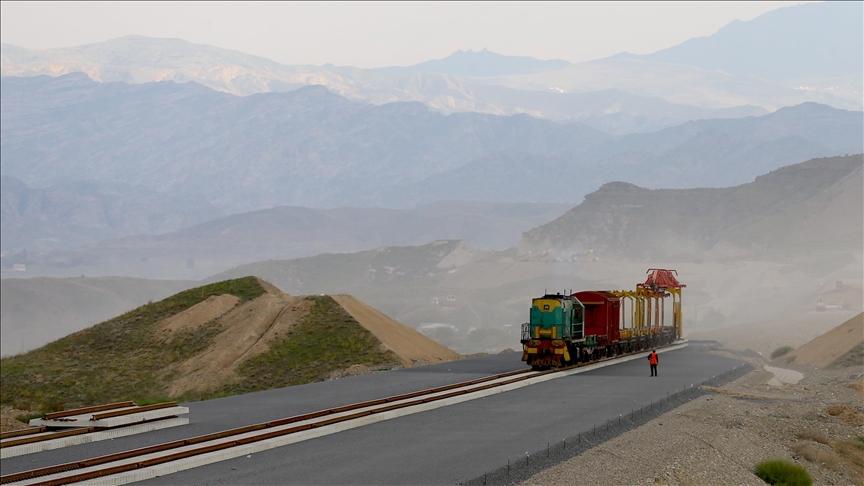
Meanwhile, Azerbaijan accelerated infrastructure projects on its own territory designed to connect with the Zengezur Corridor. Railway and highway projects were launched, starting from Horadiz and extending along the Aras River to the Nakhchivan border. These projects demonstrated both logistical and political commitment to implementing the corridor.
In Armenia, a significant portion of public opinion expressed concerns that granting a special transit status through Zengezur could threaten the country’s territorial integrity in the future. As a result, the Yerevan administration continued to approach the project strictly within the framework of “opening regional transport links”.
Zengezur Corridor: Armenia or Iran? (GZT)
Türkiye views the Zengezur Corridor as a strategic project essential for regional integration, economic cooperation, and the establishment of an uninterrupted land connection with the Turkic world. Ankara argues that opening the corridor will reduce transit times between Azerbaijan and Türkiye and enhance the security of trade and energy routes extending to Central Asia.
Russia, as a guarantor of the Tripartite Declaration, plays a central role in the Zengezur Corridor process. Moscow anticipates that the corridor’s security will be ensured by Russian border guards. However, shifting power dynamics in the region and increased Western interest have compelled Russia to maintain a careful and balanced position.
Iran is concerned that the implementation of the corridor may diminish the importance of its territory as a regional trade route. Tehran considers the preservation of its land border with Armenia—and by extension with Russia—as a strategic priority and therefore adopts a cautious approach toward the corridor plan.
The USA evaluates the process based on its own interests and closely monitors the corridor’s impact on regional balances. Washington believes that diversifying transport and energy routes in the region could reduce the influence of Russia and Iran. According to some sources, the USA has proposed leasing the Zengezur region for 100 years, a proposal that received mixed reactions from Azerbaijan and Armenia.
The EU generally regards transport projects in southern Transcaucasia as opportunities to enhance economic integration but supports a solution in the Zengezur Corridor that respects the sovereignty sensitivities of the parties involved.
The Zengezur Corridor is a strategic project aimed at strengthening economic, energy, cultural, and political integration within the Turkic world by connecting Azerbaijan with Türkiye and Central Asia via Nakhchivan. As a logistical alternative route, it not only accelerates trade but also occupies a central position in regional cooperation and integration goals.
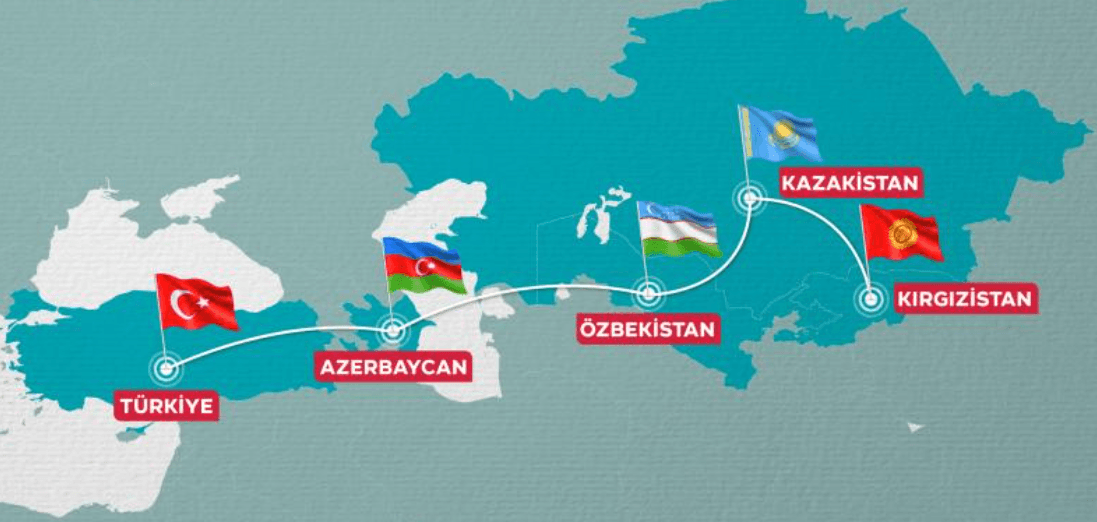
Zenzegur Koridoruyla Türk Dünyası Birbirine Bağlanmış Olacak (TRT)
The Zengezur Corridor has the potential to reshape Eurasian power balances by establishing uninterrupted land and rail connections among Turkic world countries. Creating a direct logistical network between Türkiye, Azerbaijan, Kazakhstan, Uzbekistan, Kyrgyzstan, and Turkmenistan offers an alternative to traditional transit routes passing through Russia and Iran. This development expands the geopolitical maneuvering space of Turkic states and strengthens their regional independence.
Upon implementation, the corridor is expected to reduce transportation costs, shorten logistics times, and increase trade volume among Turkic world countries. Trade between Türkiye and the Turkic Republics of Central Asia via this route is anticipated to be more advantageous than current routes, both in terms of cost and security. A broad spectrum of trade flows—from agricultural products to industrial goods, energy equipment to defense industry products—is projected to accelerate significantly.
The corridor also serves as a strategic route for energy transmission lines. Experience gained from projects such as TANAP and the Baku–Tbilisi–Ceyhan crude oil pipeline under the Türkiye–Azerbaijan energy cooperation framework could facilitate the construction of new energy lines through Zengezur. This would enable Turkic Republics of Central Asia to deliver their energy resources to Europe via Türkiye more quickly, providing a regional advantage in terms of energy security.
The Zengezur Corridor is one of the most important projects not only for delivering commercial and logistical advantages but also for strengthening physical integration among Turkic world countries. This integration constitutes a concrete pillar of the multidimensional cooperation strategy pursued under the framework of the Organization of Turkic States (OTS). With the corridor’s opening, direct road and rail connections between capital cities across the Turkic world will become feasible. This will accelerate not only economic relations but also human mobility.
Culturally, the corridor will make student and academic exchange programs between Turkic states more accessible and less costly, enabling the expansion of existing joint undergraduate, master’s, and doctoral programs currently conducted by OTS and its member institutions.
Moreover, the corridor will enable more regular and widely attended cultural and artistic events. Improvements in transportation infrastructure are expected to increase participation in activities such as music festivals, theater tours, exhibitions, and literary days. Thus, participation in events such as Nowruz celebrations, Turkish poetry festivals, and traditional sports competitions across different regions of the Turkic world will strengthen both qualitatively and quantitatively.
From a political integration perspective, the Zengezur Corridor provides an infrastructure that facilitates diplomatic engagement and high-level visits among Turkic states, deepening institutional cooperation.
The Zengezur Corridor transforms the “one nation, two states” concept, which has been part of the official rhetoric in Azerbaijan–Türkiye relations since the 1990s, into a tangible and sustainable infrastructure project. Following Azerbaijan’s independence in 1991, political, cultural, and economic ties between the two countries rapidly developed and evolved into a strategic partnership by the 2000s. The 2010 Strategic Partnership and Mutual Assistance Agreement formalized cooperation in security, defense, energy, and transportation; the Zengezur Corridor has since emerged as the most concrete manifestation of these agreements.
Opening the corridor will directly connect Nakhchivan Autonomous Republic to the main territory of Azerbaijan via road, granting Türkiye significant geostrategic advantages. Through this route, Türkiye will be able to reach Azerbaijan and from there the Turkic Republics of Central Asia without relying on transit through Armenia or Iran. This will establish a continuous and secure transport link for both commercial and political relations.
During Ilham Aliyev’s presidency, Türkiye has been positioned as Azerbaijan’s primary geopolitical partner, a partnership reinforced not only through diplomatic declarations but also through infrastructure, energy, and defense projects. The Zengezur Corridor is viewed as the “infrastructure foundation” of this cooperation and is regarded as a factor increasing mutual dependence between the two countries.
Economically, trade through the corridor will expand the existing bilateral trade volume between the two countries and increase Türkiye’s share in the Central Asian market. The corridor’s implementation is expected to reduce logistics costs, shorten transit times, and lower security risks. While Türkiye’s exports include textiles, machinery, electronics, and food, Azerbaijan’s energy and petrochemical exports to Türkiye will become faster and more efficient through the corridor.
In the military and security dimension, the corridor will strengthen the logistical infrastructure of defense industry cooperation between the two countries. The Shusha Declaration, signed after the 2020 Karabakh War, deepened Türkiye–Azerbaijan military cooperation and elevated the corridor’s security to a shared strategic objective. This security cooperation is considered a mechanism contributing to overall stability in southern Transcaucasia.
In the energy sector, the Zengezur Corridor plays a critical role. Integrated with existing energy projects such as TANAP and the Baku–Tbilisi–Ceyhan pipeline, the corridor can enhance the energy transmission capacity between Türkiye and Azerbaijan. This will strengthen the energy security of both countries and facilitate access for Turkic Republics of Central Asia to Western markets.
The Zengezur Corridor remains one of the most critical issues in ongoing negotiations between the parties. While Azerbaijan and Türkiye advocate for its immediate implementation, Armenia seeks to shape the project according to its own sovereignty framework. As of 2025, construction work on the Azerbaijani side is progressing rapidly, but no concrete agreement has been reached on the corridor’s route and administrative status within Armenian territory. Diplomatic talks continue in various formats under the mediation of the European Union and the USA, yet trust deficits and geopolitical competition continue to complicate the process.
U.S. President Trump announced that he would host Azerbaijani President Ilham Aliyev and Armenian Prime Minister Nikol Pashinyan at the White House on 8 August 2025 and bring an end to the decades-long conflict between the two nations. On that date, a peace agreement was signed at the White House in Washington, D.C., between the Republic of Azerbaijan and the Republic of Armenia. The signing ceremony was attended by Azerbaijani President Ilham Aliyev, Armenian Prime Minister Nikol Pashinyan, and U.S. President Donald Trump. The agreement aims to definitively resolve territorial and border disputes, restore diplomatic relations, and strengthen transport and economic cooperation in southern Transcaucasia.
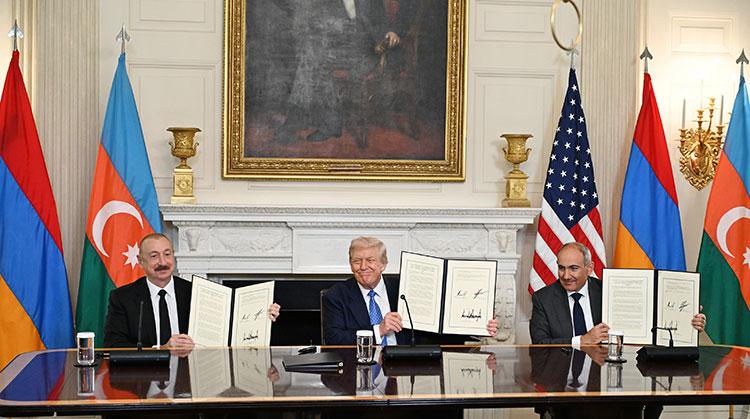
At the summit at the White House, Azerbaijan and Armenia signed a joint declaration "For Peace" (AA)
The Zengezur Corridor has acquired a new identity in both name and operation through the Azerbaijan–Armenia Peace Agreement signed in Washington. Under the agreement, the corridor has been officially named by the USA as the “Trump Route for International Peace and Prosperity” (TRIPP) and redefined as a multifaceted transport and energy corridor encompassing not only road and rail transit but also oil and natural gas pipelines and fiber-optic communication infrastructure. As part of this new arrangement, operational rights for the corridor have been granted to a U.S.-based company for a specified period, with provisions allowing the subleasing of operational privileges to third parties. Thus, the Zengezur Corridor has transformed from a technical dispute into a political and economic project aimed at international investment, energy integration, and trade unification.
Anadolu Ajansı. "Aliyev,Zengezur Koridoru açılmazsa Ermenistan'la sınırları açmayacaklarını söyledi." Accessed August 8, 2025.https://www.aa.com.tr/tr/dunya/aliyev-zengezur-koridoru-acilmazsa-ermenistanla-sinirlari-acmayacaklarini-soyledi/3105586
Anadolu Ajansı. "Azerbaycan ve Ermenistan, barış anlaşmasını parafladı." Accessed August 10, 2025.https://www.aa.com.tr/tr/dunya/azerbaycan-ve-ermenistan-baris-anlasmasini-parafladi/3654523
Anadolu Ajansı. "Azerbaycan-Ermenistan barış süreci kapsamında Washington'daki üçlü zirvede barış anlaşmasının paraflanması bekleniyor." Accessed August 8, 2025.https://www.aa.com.tr/tr/dunya/azerbaycan-ermenistan-baris-sureci-kapsaminda-washingtondaki-uclu-zirvede-baris-anlasmasinin-paraflanmasi-bekleniyor/3653097
Anadolu Ajansı. "GÖRÜŞ - İran Zengezur Koridoru'na neden karşı?" Accessed August 8, 2025.https://www.aa.com.tr/tr/analiz/gorus-iran-zengezur-koridoruna-neden-karsi/3001011
Anadolu Ajansı. "Kafkasya’da jeopolitik satranç: Zengezur Koridoru ve değişen dengeler." Accessed August 8, 2025.https://www.aa.com.tr/tr/analiz/kafkasya-da-jeopolitik-satranc-zengezur-koridoru-ve-degisen-dengeler/3641707
Anadolu Ajansı. "Nahçıvan halkı, Zengezur Koridoru'yla hayatlarının değişeceğine inanıyor." Accessed August 8, 2025.https://www.aa.com.tr/tr/dunya/nahcivan-halki-zengezur-koridoruyla-hayatlarinin-degisecegine-inaniyor/3105815
Anadolu Ajansı. "Trump, Aliyev ile Paşinyan'ın Beyaz Saray'da 'barış anlaşması' imzalayacaklarını açıkladı." Accessed August 8, 2025.https://www.aa.com.tr/tr/dunya/trump-aliyev-ile-pasinyanin-beyaz-sarayda-baris-anlasmasi-imzalayacaklarini-acikladi/3653520
Anadolu Ajansı. "Zengezur Koridoru'na uzanan kara ve demir yollarının inşaatı aralıksız sürüyor." Accessed August 8, 2025.https://www.aa.com.tr/tr/dunya/zengezur-koridoruna-uzanan-kara-ve-demir-yollarinin-insaati-araliksiz-suruyor/3103794
Anadolu Ajansı. "Zengezur Koridoru: Güney Kafkasya'da yeni jeopolitik denge mi?" Accessed August 8, 2025.https://www.aa.com.tr/tr/analiz/zengezur-koridoru-guney-kafkasyada-yeni-jeopolitik-denge-mi/3638101
Balcı, Lokman. *Türk Dünyasının Zengezur Koridoru’na Bakışı: Olası Avantajları Üzerine Bir Analiz.* Master's thesis,Selçuk Üniversitesi, Institute of Social Sciences, Department of Political Science and Public Administration, 2025.https://tez.yok.gov.tr/UlusalTezMerkezi/TezGoster?key=htlyhJG97gjBTPjAeWRhPvM3k5Zsrjo0tafg_50o8tYwvWyMJBFZrbEj0amKe99h
DW. "Azerbaycan'la Türkiye'yi bağlayacak koridor ABD'ye veriliyor." Accessed August 8, 2025.https://www.dw.com/tr/azerbaycanla-t%C3%BCrkiyeyi-ba%C4%9Flayacak-koridor-abdye-devrediliyor/a-73560541
Karakoç, Edanur. "Azerbaycan–Ermenistan Barış Anlaşması (2025)." KÜRE Ansiklopedi. Accessed August 10, 2025.https://kureansiklopedi.com/tr/detay/azerbaycanermenistan-baris-anlasmasi-2025-80f3e
Kurnaz, Ali. *Zengezur Koridoru’nun Türkiye ile Türkî Cumhuriyetler Arasındaki Dış Ticarete Olası Etkileri.* Master's thesis, Ankara Yıldırım Beyazıt Üniversitesi, Sosyal Bilimler Enstitüsü, Uluslararası Ticaret ve Finans Anabilim Dalı, 2024.https://tez.yok.gov.tr/UlusalTezMerkezi/TezGoster?key=LY6e5xGA7WWUpEdrBmEPLrrLzohvgoDawZzjQPSiJoavF3d9v6K-ub4iHjXMw9bZ
Pashayev, İlkin. *Küresel Rekabetçi Üstünlüğün Bir Aracı Olarak Zengezur Koridorunun Türkiye–Azerbaycan Ekonomik İlişkilerindeki Rolü ve Stratejik Yönelimleri: İlham Aliyev Dönemi Üzerine Bir Araştırma.* Master's thesis, Süleyman Demirel University, Institute of Social Sciences, Interdisciplinary European Union Studies Program, 2024.https://tez.yok.gov.tr/UlusalTezMerkezi/TezGoster?key=usXiZIM9Lp0wk-YzRoaT-zX45mlVJYN_TLp76qXRCBL6vfkhTc9cvlnNUDRN-b7-
Polat, Doğan Şafak. Zengezur Koridoru: Türkiye-Azerbaycan İlişkileri Bağlamında Stratejik, Ekonomik ve Bölgesel Çıkarımlar. İstanbul Kent Üniversitesi Siyasal, Sosyal Ve Stratejik Araştırmalar Dergisi, (2025), 144-173.
Stratejic Düşünce Enstitüsü. "Tom Barrack: “ABD, Zengezur Koridoru’nu 100 Yıllığına Kiralamak İstiyor.” Accessed [Date].https://www.sde.org.tr/haber/tom-barrack-abd-zengezur-koridoru-nu-100-yilligina-kiralamak-istiyor-haberi-59252
Üste, Ahmet Nazmi, and Aydın, Ulviyye. Güney Kafkaslarda Bölgesel Güvenlik Kompleksi Teorisi Bağlamında Zengezur Koridoru’nun Önemi. Manisa Celal Bayar Üniversitesi Sosyal Bilimler Dergisi, 20 (2022), 261-274.

Importance | A transportation corridor connecting Azerbaijan to Türkiye and Central Asia via Nakhchivan | ||||||||
|---|---|---|---|---|---|---|---|---|---|
Legal Basis | Article 9 of the Tripartite Declaration of 10 November 2020 | ||||||||
Purpose | Continuous land and energy connectivity within the Turkic world Trade and cultural integration | ||||||||
Party | (cautious due to reduced transit importance) Russia (opposed to special status transit) Armenia (supports) Azerbaijan and Türkiye (supports transport integration) The United States and the European Union Iran (guarantor and mediator) | ||||||||
Current Status (2025) | Construction progress on the Azerbaijani side, ongoing disputes over route and status on the Armenian side, and planned peace talks at the White House on 8 August 2025 | ||||||||
Historical Background
Developments After the 2020 Karabakh War
Attitudes of Regional and International Actors
Türkiye
Russia
Iran
United States of America (USA)
European Union (EU)
Significance of the Corridor for the Turkic World
Geopolitical Dimension
Economic and Commercial Impacts
Energy and Infrastructure Connections
Cultural and Political Integration
Context of Azerbaijan–Türkiye Relations
Current Status
Azerbaijan–Armenia Peace Agreement (2025) and the Zengezur Corridor