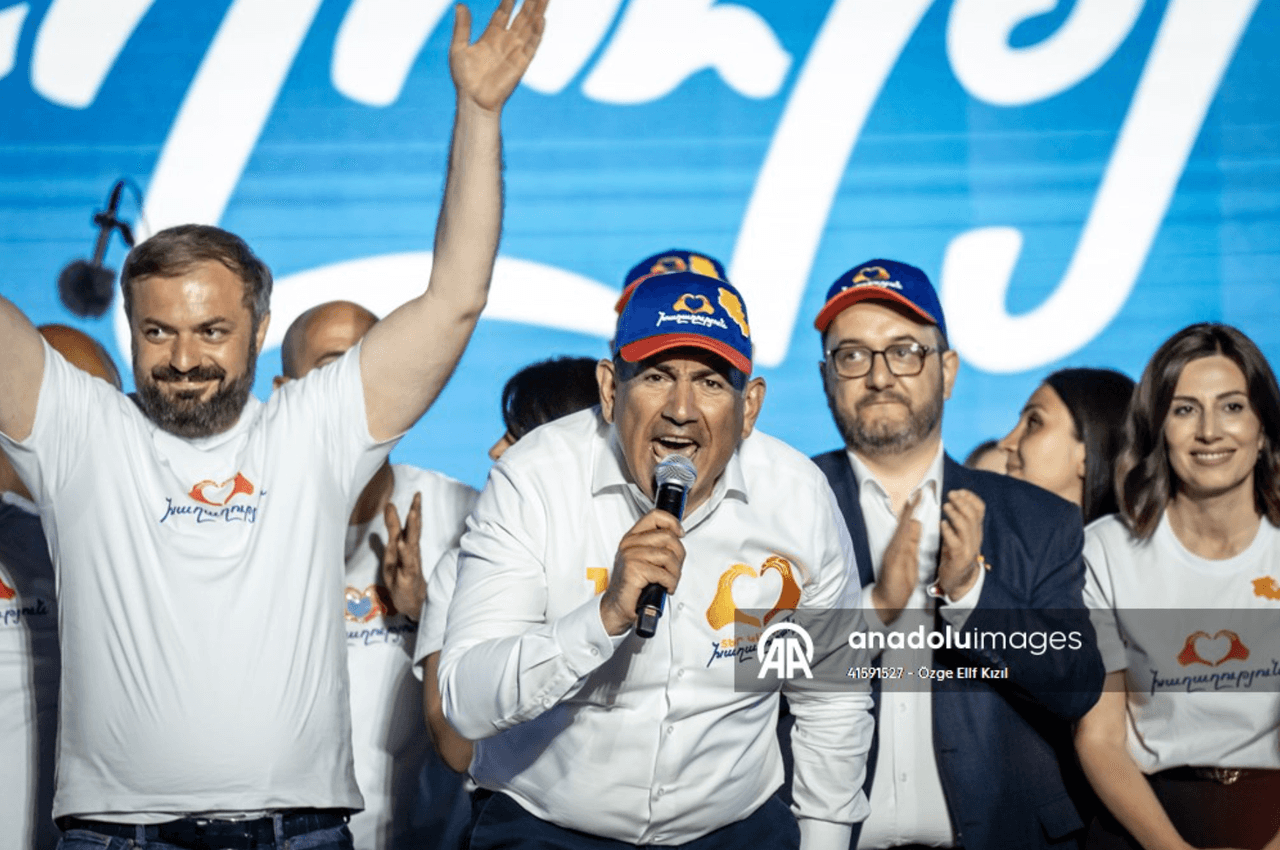

Çocuk | Mariam Shushan Arpi Ashot | ||||||||
|---|---|---|---|---|---|---|---|---|---|
Doğum tarihi | 1975-06-01 | ||||||||
Place of Birth | Ijevan, Armenian SSR, Soviet Union | ||||||||
Position(s) | Prime Minister of Armenia (in office) | ||||||||
Education | Yerevan State University journalism | ||||||||
Start of Term | 2018-05-08 | ||||||||
Party | Civil Contract (Civil Contract, 2013–) | ||||||||
Profession(s) | Politician Journalist | ||||||||
Nikol Pashinyan was born on 1 June 1975 in the Ijevan district of Armenia. Pashinyan graduated from Ijevan Secondary School No. 1 and studied journalism at Yerevan State University between 1991 and 1995, but was expelled from the university in his final year for political reasons.【1】
The Armenian people support Nikol Pashinyan (AA)
Pashinyan began his professional career as a journalist and gradually became one of Armenia’s most controversial and transformative political figures. In 2018 he came to power through peaceful mass protests; he is regarded as a symbol of an extraordinary political journey that took him from journalism to opposition, from prison to head of state. Despite the defeat in the 2020 Karabakh War, Pashinyan retained public support and remains a central figure in Armenia’s realignment process through his stance of breaking away from traditional pro-Russian foreign policy and advocating closer ties with the West. Pashinyan is married and has three daughters and one son.【2】
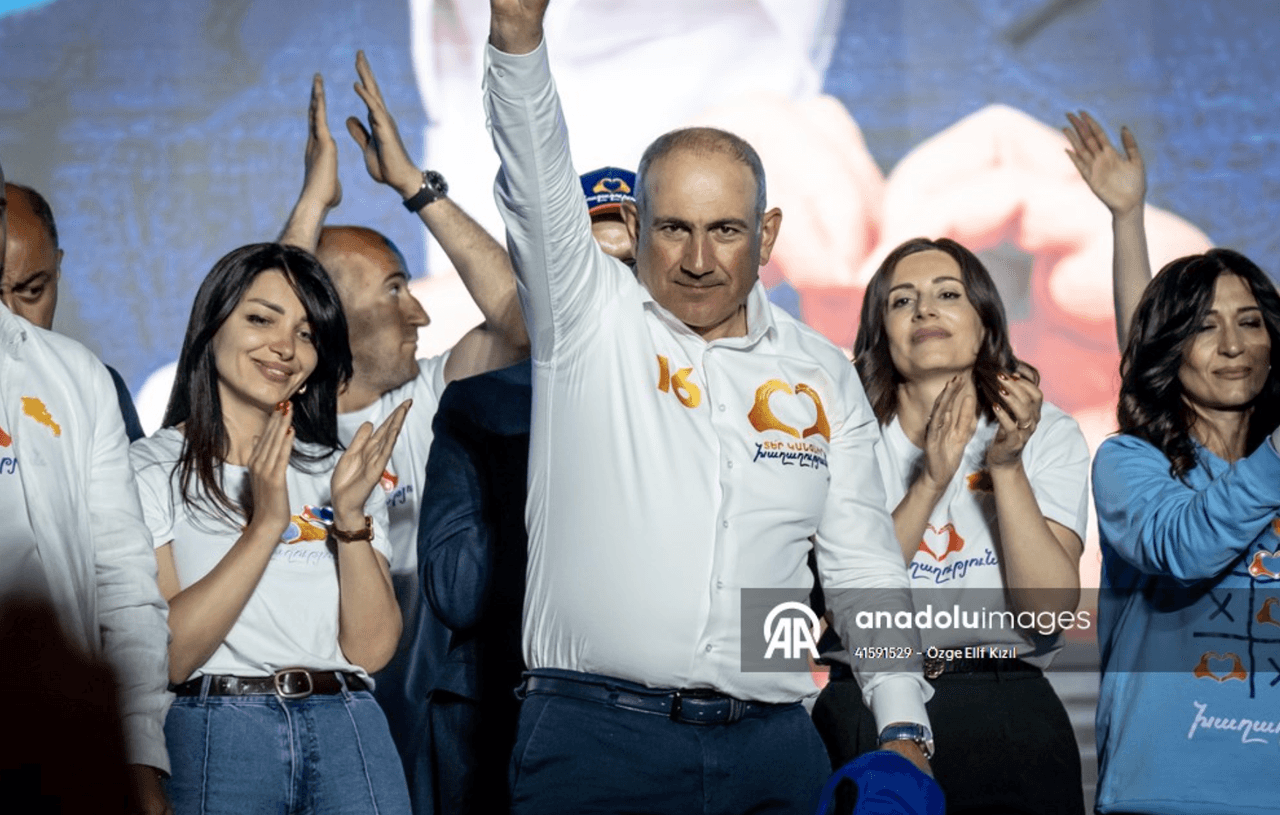
Nikol Pashinyan at the 2026 elections (AA)
Pashinyan actively engaged in journalism from 1992 onward, working for publications such as Dprutyun, Hayastan, Lragir, Lragir-Or and Molorak. In 1998 he founded the daily newspaper Oragir, but the publication was shut down by court order in 1999. In the same year he was appointed general director of the newspaper Haykakan Zhamanak, a position he held until 2012.【3】
At the age of thirteen, Pashinyan participated in activities supporting the separatist movement of the Armenians of Nagorno-Karabakh. His role in political opposition was equally notable. In August 1999 he was sentenced to one year in prison on politically motivated charges; following appeals from international and Armenian journalist organizations, the sentence was suspended and never enforced.【4】
Pashinyan served in the campaign team of opposition candidate Levon Ter-Petrosyan during the 2008 presidential election. After 1 March 2008, he was wanted by police and remained in hiding for four months. On 1 July 2009, Pashinyan surrendered to the Prosecutor General’s Office and in January 2010 was sentenced to seven years in prison for organizing mass unrest during the 1 March events. [8] Recognized internationally and within Armenia as a prisoner of conscience, Pashinyan was released on 27 May 2011 under a general amnesty declared by authorities.【5】
Elected to parliament in the 2012 parliamentary elections on the list of the Armenian National Congress alliance, Pashinyan served as chair of the National Assembly Ethics Committee from 2012 to 2013. In 2013 he founded the political-civic unity Civil Contract and has remained a member of its central committee since 2015. In the general elections of 2 April 2017 he was elected as a member of parliament on the Yelk bloc list.【6】
Following Armenia’s 2015 constitutional referendum, which transitioned the country from a presidential to a parliamentary system, most executive powers were transferred to the prime minister.【7】 The tensions created by this shift in governance structure manifested in street protests from 2016 onward, during which Pashinyan gained the support of a segment of the population.【8】 After Serj Sargsyan’s presidential term ended, 17 April 2018, Pashinyan was elected prime minister and launched a popular movement composed of peaceful protests.【9】
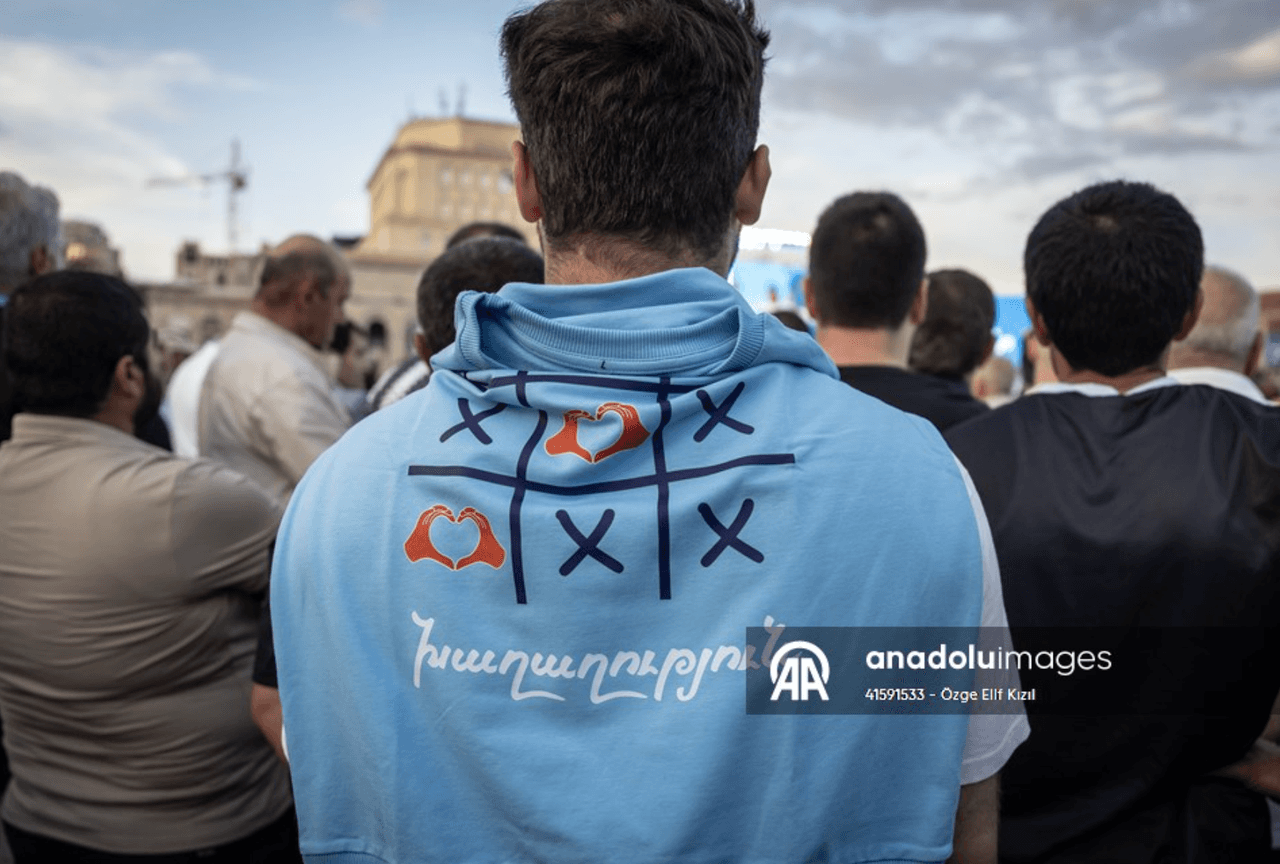
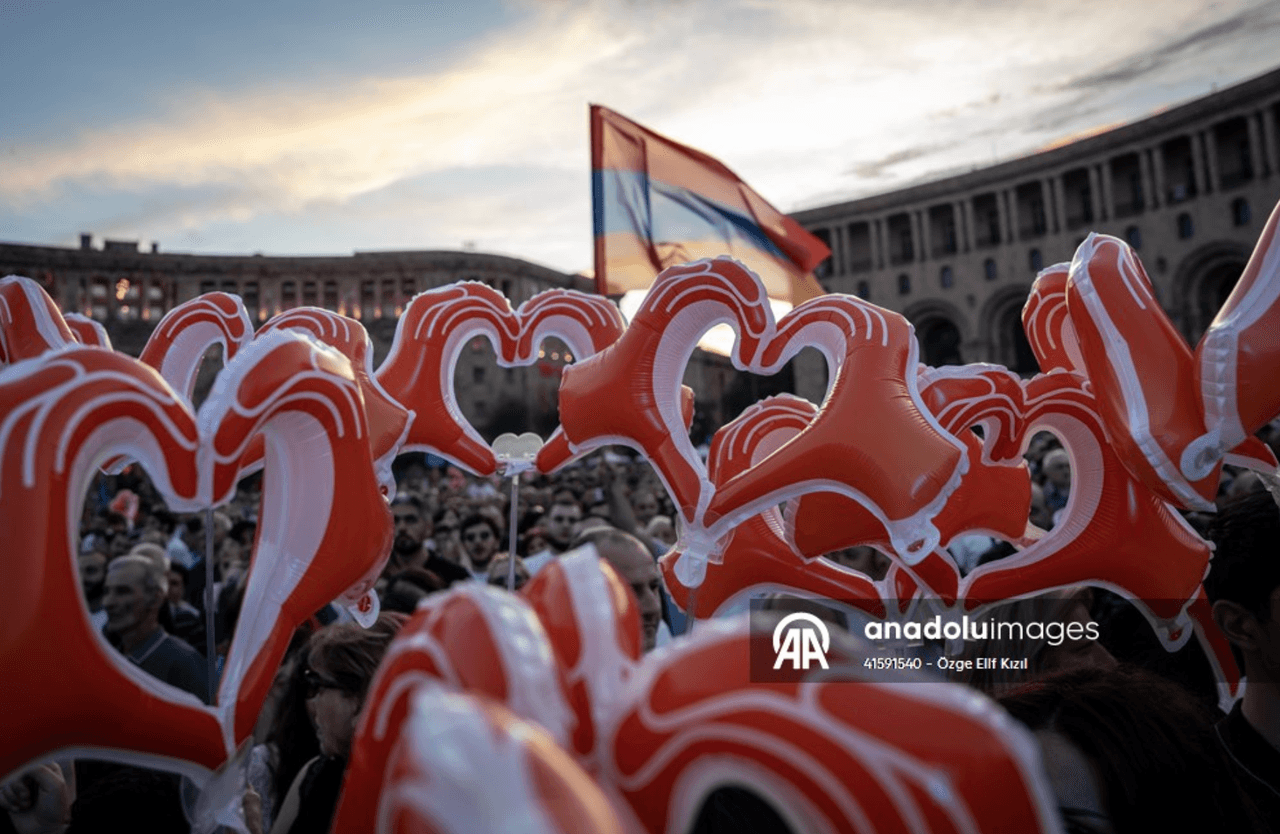
A citizen supporting Pashinyan from the public (AA)
31 March 2018 marked the beginning of the “My Step” movement at Vardanants Square in Gyumri. This movement evolved into a nonviolent popular revolution, historically known as the Velvet Revolution, between April and May 2018. On 8 May 2018, the National Assembly elected Pashinyan as Prime Minister of the Republic of Armenia at the demand of the popular movement, making him the architect of a process that dismantled the “Karabakh clan” and the extremist nationalist Dashnaktsutyun structure, which had dominated Armenian politics since the 1990s.
On 16 October 2018, Pashinyan resigned from office to fulfill his pre-election pledge, while continuing to serve as acting prime minister to enable early elections. In the early general elections of 9 December 2018, Pashinyan led the My Step alliance’s proportional list and, following its victory with approximately 70 percent of the vote, was reappointed prime minister on 14 January 2019 under Articles 149 and 89 of the Constitution of the Republic of Armenia.【10】
Upon assuming office, Pashinyan moved to diversify Armenia’s traditionally Russia-dependent foreign policy and strengthened ties with the West.【11】 In Armenia, where all heads of state since independence have come from either Karabakh or diaspora backgrounds, Pashinyan’s rise to power as a native Armenian and his dismantling of the Karabakh clan, closely linked to Russia, were viewed negatively by Moscow. Moreover, Pashinyan’s decision to shift the commemoration of Russia’s victory over Nazi Germany from 9 May to 8 May, labeling it the “Day of Sorrow and Peace,” caused significant discontent in Russia.【12】
Pashinyan rejected signing the Madrid Principles and the terms of the Kazan Agreement, which had been agreed upon during the Sarkisyan and Kocharyan administrations. This decision paved the way for the collapse of negotiations between Armenia and Azerbaijan and increased the likelihood of war. Pashinyan’s statement during the inauguration of Araik Harutyunyan, the self-proclaimed president of the so-called Republic of Karabakh, that “Artsakh is Armenia. Period,” is regarded as the most decisive statement that derailed peace talks with Azerbaijan. Defense Minister David Tonoyan explicitly stated during a visit to the United States that the formula “peace for territory” had been replaced by “war for new territory.” Pashinyan announced in April 2020 that Armenia was withdrawing from the Madrid Proposals offered by the OSCE Minsk Group after a decade of peace efforts; this decision led to the complete closure of dialogue channels.【13】
Two years after assuming office, the Armenian armed forces engaged in border clashes with Azerbaijan on 12 July 2020 in the Tovuz region, where both armies accused each other of firing the first shots; eleven Azerbaijani soldiers, including one general, were killed in the clashes.【14】 Tovuz, located approximately 200 kilometers north of Karabakh, lies along the Baku-Supsa oil pipeline route and serves as the intersection point of the Baku-Tbilisi-Ceyhan oil pipeline, the Baku-Tbilisi-Kars railway, and the Trans-Anatolian Natural Gas Pipeline (TANAP).【15】
Following the Armenian army’s withdrawal from Tovuz, on 27 September 2020 a new offensive was launched against Azerbaijani territories surrounding Karabakh, targeting the regions of Terter, Agdam, Fuzuli and Jabrayil.【16】 In this offensive, civilian settlements were targeted alongside military objectives. Azerbaijan’s response to Armenian attacks expanded the conflict; despite calls from the UN Security Council for an end to hostilities, the war lasted 44 days.【17】
Pashinyan’s military advisor, Vagharshak Harutyunyan, stated on 6 October 2020 in an interview with a Russian television channel that the Armenian army’s objective was to instill panic among the Azerbaijani population by using heavy weapons against civilian targets.【18】 After Armenia repeatedly violated ceasefire agreements, a Tripartite Declaration was accepted on the night of 8–9 November 2020 under Russian mediation between Nikol Pashinyan, Azerbaijani President Ilham Aliyev, and Russian Federation President Vladimir Putin.【19】
Under the Tripartite Declaration, the Armenian armed forces were required to withdraw from occupied territories according to a specified timetable; a peacekeeping force composed of equal numbers of Turkish and Russian troops was to be deployed in the region; the Lachin corridor was to be opened to Armenia; and the Zangezur corridor was to be opened by Armenia to establish a connection between Azerbaijan and Nakhchivan.【20】
During this period, in which the Armenian armed forces were forced to relinquish Azerbaijani territories they had held for thirty years, Pashinyan faced severe criticism and calls for resignation. Nevertheless, in the extraordinary parliamentary elections on 20 June 2021, he led the Civil Contract party to victory.【21】 After the party received 53.91 percent of the vote in the elections, Pashinyan was reappointed prime minister on 2 August 2021 under Article 149/1 of the Constitution.
Under Pashinyan’s leadership, Armenia has significantly distanced itself from its traditional ally Russia; relations with the West have come to the forefront. Armenia has gradually withdrawn from military exercises under the Collective Security Treaty Organization (CSTO) and is questioning the foundations of its alliance with Russia.【22】 As a reflection of this shift, Armenia has taken steps to deepen its relations with the European Union.
Shortly after assuming office, Pashinyan reduced the number of ministries from seventeen to twelve; among the abolished ministries was the Ministry of Diaspora. Although the diaspora strongly opposed this decision, Pashinyan did not reverse it. This move aimed to reduce the diaspora’s pressure on Armenia’s decision-makers.【23】
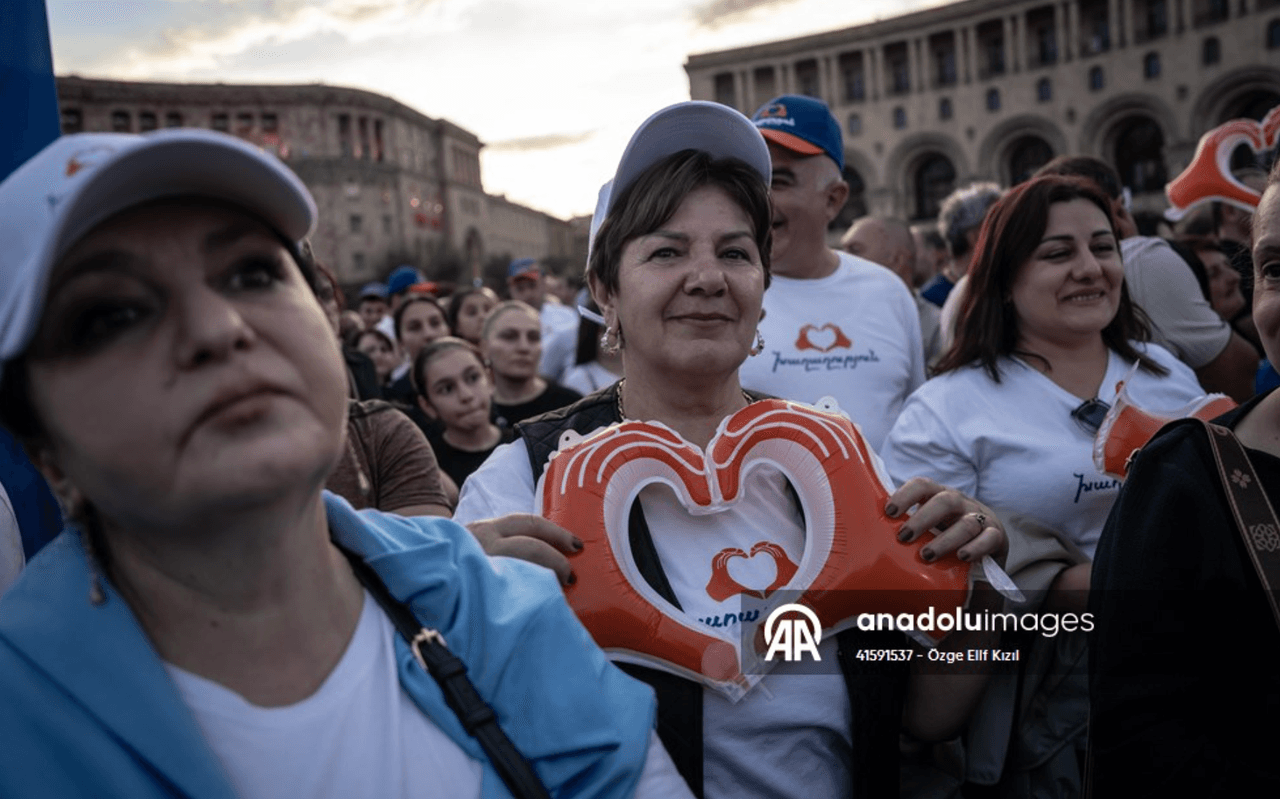
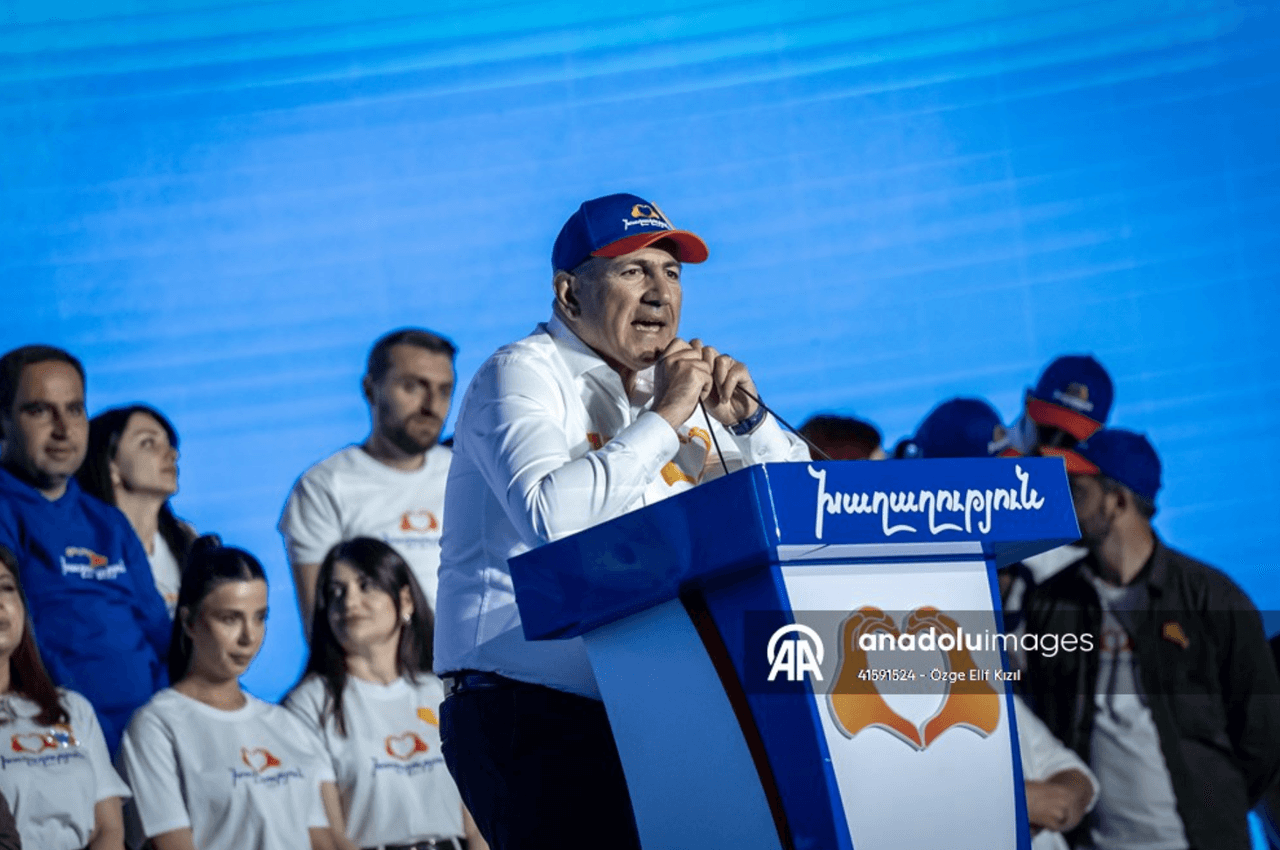
2026 elections (AA)
During Pashinyan’s tenure, Armenia has continued negotiations aimed at laying the groundwork for a potential peace agreement with Azerbaijan. This process remains a major domestic political issue during the parliamentary elections held in June 2026.【24】
Anadolu Images. "Ermenistan'da 7 Haziran Seçimleri" (Visual No: 31848531). Accessed June 6, 2026. https://www.anadoluimages.com/p/ermenistanda-7-haziran-secimleri/31848531.
Anadolu Images. "Ermenistan'da 7 Haziran Seçimleri" (Visual No: 31848536). Accessed June 6, 2026. https://www.anadoluimages.com/p/ermenistanda-7-haziran-secimleri/31848536.
Anadolu Images. "Ermenistan'da 7 Haziran Seçimleri" (Visual No: 31848540). Accessed June 6, 2026. https://www.anadoluimages.com/p/ermenistanda-7-haziran-secimleri/31848540.
Anadolu Images. "Ermenistan'da 7 Haziran Seçimleri" (Visual No: 31848544). Accessed June 6, 2026. https://www.anadoluimages.com/p/ermenistanda-7-haziran-secimleri/31848544.
Anadolu Images. "Ermenistan'da 7 Haziran Seçimleri" (Visual No: 31848547). Accessed June 6, 2026. https://www.anadoluimages.com/p/ermenistanda-7-haziran-secimleri/31848547
Bozaslan, B. Mehmet, and M. Burak Kocamış. "Bağımsız Ermenistan ve Ermeni Diasporası." *Ermeni Araştırmaları*, no. 79 (2026): 107–142. Accessed June 6, 2026. https://dergipark.org.tr/tr/download/article-file/4799980
Prime Minister of the Republic of Armenia. "Biography." Accessed June 6, 2026. https://www.primeminister.am/en/pm-pashinyan
Taşcıoğlu, Ömer Lütfi. "İkinci Karabağ Savaşı ve Sonuçları." Trakya Üniversitesi Sosyal Bilimler Dergisi 25, no. 2 (December 2023): 543–566. https://doi.org/10.26468/trakyasobed.1185429
[1]
Prime Minister of the Republic of Armenia. "Biography." Erişim tarihi: 6 Haziran 2026. https://www.primeminister.am/en/pm-pashinyan
[2]
Prime Minister of the Republic of Armenia. "Biography." Erişim tarihi: 6 Haziran 2026. https://www.primeminister.am/en/pm-pashinyan
[3]
Prime Minister of the Republic of Armenia. "Biography." Erişim tarihi: 6 Haziran 2026. https://www.primeminister.am/en/pm-pashinyan
[4]
Prime Minister of the Republic of Armenia. "Biography." Erişim tarihi: 6 Haziran 2026. https://www.primeminister.am/en/pm-pashinyan
[5]
Prime Minister of the Republic of Armenia. "Biography." Erişim tarihi: 6 Haziran 2026. https://www.primeminister.am/en/pm-pashinyan
[6]
Prime Minister of the Republic of Armenia. "Biography." Erişim tarihi: 6 Haziran 2026. https://www.primeminister.am/en/pm-pashinyan
[7]
Taşcıoğlu, Ömer Lütfi. "İkinci Karabağ Savaşı ve Sonuçları." Trakya Üniversitesi Sosyal Bilimler Dergisi 25, Sayı 2 (Aralık 2023): 543–566. DOI: 10.26468/trakyasobed.1185429. Erişim tarihi: 6 Haziran 2026. https://tujss.org/pdf/f69f6526-3e5c-4123-aafc-55402bd6a6ec/articles/trakyasobed.1185429/10.26468-trakyasobed.1185429-2693446.pdf
[8]
Taşcıoğlu, Ömer Lütfi. "İkinci Karabağ Savaşı ve Sonuçları." Trakya Üniversitesi Sosyal Bilimler Dergisi 25, Sayı 2 (Aralık 2023): 543–566. DOI: 10.26468/trakyasobed.1185429. Erişim tarihi: 6 Haziran 2026. https://tujss.org/pdf/f69f6526-3e5c-4123-aafc-55402bd6a6ec/articles/trakyasobed.1185429/10.26468-trakyasobed.1185429-2693446.pdf
[9]
Taşcıoğlu, Ömer Lütfi. "İkinci Karabağ Savaşı ve Sonuçları." Trakya Üniversitesi Sosyal Bilimler Dergisi 25, Sayı 2 (Aralık 2023): 543–566. DOI: 10.26468/trakyasobed.1185429. Erişim tarihi: 6 Haziran 2026. https://tujss.org/pdf/f69f6526-3e5c-4123-aafc-55402bd6a6ec/articles/trakyasobed.1185429/10.26468-trakyasobed.1185429-2693446.pdf
[10]
Taşcıoğlu, Ömer Lütfi. "İkinci Karabağ Savaşı ve Sonuçları." Trakya Üniversitesi Sosyal Bilimler Dergisi 25, Sayı 2 (Aralık 2023): 543–566. DOI: 10.26468/trakyasobed.1185429. Erişim tarihi: 6 Haziran 2026. https://tujss.org/pdf/f69f6526-3e5c-4123-aafc-55402bd6a6ec/articles/trakyasobed.1185429/10.26468-trakyasobed.1185429-2693446.pdf
[11]
Taşcıoğlu, Ömer Lütfi. "İkinci Karabağ Savaşı ve Sonuçları." Trakya Üniversitesi Sosyal Bilimler Dergisi 25, Sayı 2 (Aralık 2023): 543–566. DOI: 10.26468/trakyasobed.1185429. Erişim tarihi: 6 Haziran 2026. https://tujss.org/pdf/f69f6526-3e5c-4123-aafc-55402bd6a6ec/articles/trakyasobed.1185429/10.26468-trakyasobed.1185429-2693446.pdf
[12]
Taşcıoğlu, Ömer Lütfi. "İkinci Karabağ Savaşı ve Sonuçları." Trakya Üniversitesi Sosyal Bilimler Dergisi 25, Sayı 2 (Aralık 2023): 543–566. DOI: 10.26468/trakyasobed.1185429. Erişim tarihi: 6 Haziran 2026. https://tujss.org/pdf/f69f6526-3e5c-4123-aafc-55402bd6a6ec/articles/trakyasobed.1185429/10.26468-trakyasobed.1185429-2693446.pdf
[13]
Taşcıoğlu, Ömer Lütfi. "İkinci Karabağ Savaşı ve Sonuçları." Trakya Üniversitesi Sosyal Bilimler Dergisi 25, Sayı 2 (Aralık 2023): 543–566. DOI: 10.26468/trakyasobed.1185429. Erişim tarihi: 6 Haziran 2026. https://tujss.org/pdf/f69f6526-3e5c-4123-aafc-55402bd6a6ec/articles/trakyasobed.1185429/10.26468-trakyasobed.1185429-2693446.pdf
[14]
Taşcıoğlu, Ömer Lütfi. "İkinci Karabağ Savaşı ve Sonuçları." Trakya Üniversitesi Sosyal Bilimler Dergisi 25, Sayı 2 (Aralık 2023): 543–566. DOI: 10.26468/trakyasobed.1185429. Erişim tarihi: 6 Haziran 2026. https://tujss.org/pdf/f69f6526-3e5c-4123-aafc-55402bd6a6ec/articles/trakyasobed.1185429/10.26468-trakyasobed.1185429-2693446.pdf
[15]
Taşcıoğlu, Ömer Lütfi. "İkinci Karabağ Savaşı ve Sonuçları." Trakya Üniversitesi Sosyal Bilimler Dergisi 25, Sayı 2 (Aralık 2023): 543–566. DOI: 10.26468/trakyasobed.1185429. Erişim tarihi: 6 Haziran 2026. https://tujss.org/pdf/f69f6526-3e5c-4123-aafc-55402bd6a6ec/articles/trakyasobed.1185429/10.26468-trakyasobed.1185429-2693446.pdf
[16]
Taşcıoğlu, Ömer Lütfi. "İkinci Karabağ Savaşı ve Sonuçları." Trakya Üniversitesi Sosyal Bilimler Dergisi 25, Sayı 2 (Aralık 2023): 543–566. DOI: 10.26468/trakyasobed.1185429. Erişim tarihi: 6 Haziran 2026. https://tujss.org/pdf/f69f6526-3e5c-4123-aafc-55402bd6a6ec/articles/trakyasobed.1185429/10.26468-trakyasobed.1185429-2693446.pdf
[17]
Taşcıoğlu, Ömer Lütfi. "İkinci Karabağ Savaşı ve Sonuçları." Trakya Üniversitesi Sosyal Bilimler Dergisi 25, Sayı 2 (Aralık 2023): 543–566. DOI: 10.26468/trakyasobed.1185429. Erişim tarihi: 6 Haziran 2026. https://tujss.org/pdf/f69f6526-3e5c-4123-aafc-55402bd6a6ec/articles/trakyasobed.1185429/10.26468-trakyasobed.1185429-2693446.pdf
[18]
Taşcıoğlu, Ömer Lütfi. "İkinci Karabağ Savaşı ve Sonuçları." Trakya Üniversitesi Sosyal Bilimler Dergisi 25, Sayı 2 (Aralık 2023): 543–566. DOI: 10.26468/trakyasobed.1185429. Erişim tarihi: 6 Haziran 2026. https://tujss.org/pdf/f69f6526-3e5c-4123-aafc-55402bd6a6ec/articles/trakyasobed.1185429/10.26468-trakyasobed.1185429-2693446.pdf
[19]
Taşcıoğlu, Ömer Lütfi. "İkinci Karabağ Savaşı ve Sonuçları." Trakya Üniversitesi Sosyal Bilimler Dergisi 25, Sayı 2 (Aralık 2023): 543–566. DOI: 10.26468/trakyasobed.1185429. Erişim tarihi: 6 Haziran 2026. https://tujss.org/pdf/f69f6526-3e5c-4123-aafc-55402bd6a6ec/articles/trakyasobed.1185429/10.26468-trakyasobed.1185429-2693446.pdf
[20]
Taşcıoğlu, Ömer Lütfi. "İkinci Karabağ Savaşı ve Sonuçları." Trakya Üniversitesi Sosyal Bilimler Dergisi 25, Sayı 2 (Aralık 2023): 543–566. DOI: 10.26468/trakyasobed.1185429. Erişim tarihi: 6 Haziran 2026. https://tujss.org/pdf/f69f6526-3e5c-4123-aafc-55402bd6a6ec/articles/trakyasobed.1185429/10.26468-trakyasobed.1185429-2693446.pdf
[21]
Biography." Prime Minister of the Republic of Armenia. Erişim tarihi: 6 Haziran 2026. https://www.primeminister.am/en/pm-pashinyan
[33–35] Additional Source: Bozaslan, B. Mehmet and M. Burak Kocamış. "Independent Armenia and the Armenian Diaspora." Armenian Studies, Issue 79 (2026): 107–142. Erişim tarihi: 6 Haziran 2026. https://dergipark.org.tr/tr/download/article-file/4799980
[22]
Prime Minister of the Republic of Armenia. "Biography." Erişim tarihi: 6 Haziran 2026. https://www.primeminister.am/en/pm-pashinyan
[33–35] Additional Source: Bozaslan, B. Mehmet and M. Burak Kocamış. "Independent Armenia and the Armenian Diaspora." Armenian Studies, Issue 79 (2026): 107–142. Erişim tarihi: 6 Haziran 2026. https://dergipark.org.tr/tr/download/article-file/4799980
[23]
Bozaslan, B. Mehmet and M. Burak Kocamış. "Independent Armenia and the Armenian Diaspora." Armenian Studies, Issue 79 (2026): 107–142. Erişim tarihi: 6 Haziran 2026. https://dergipark.org.tr/tr/download/article-file/4799980https://dergipark.org.tr/tr/download/article-file/4799980
[24]
Prime Minister of the Republic of Armenia. "Biography." Erişim tarihi: 6 Haziran 2026. https://www.primeminister.am/en/pm-pashinyan
[33–35] Additional Source: Bozaslan, B. Mehmet and M. Burak Kocamış. "Independent Armenia and the Armenian Diaspora." Armenian Studies, Issue 79 (2026): 107–142. Erişim tarihi: 6 Haziran 2026. https://dergipark.org.tr/tr/download/article-file/4799980
Çocuk | Mariam Shushan Arpi Ashot | ||||||||
|---|---|---|---|---|---|---|---|---|---|
Doğum tarihi | 1975-06-01 | ||||||||
Place of Birth | Ijevan, Armenian SSR, Soviet Union | ||||||||
Position(s) | Prime Minister of Armenia (in office) | ||||||||
Education | Yerevan State University journalism | ||||||||
Start of Term | 2018-05-08 | ||||||||
Party | Civil Contract (Civil Contract, 2013–) | ||||||||
Profession(s) | Politician Journalist | ||||||||
Professional and Political Career
Journalism and Political Opposition Period
Velvet Revolution and Rise to Prime Ministership
Armenia’s Foreign Policy Under Pashinyan
Strained Relations with Russia and Closer Ties with the West
Rejection of the Madrid Principles and Breakdown of Dialogue Channels
Second Karabakh War and the Tripartite Declaration
Tovuz Attack
Karabakh War
Post-War Period and Domestic Policy
Election Victory Despite Karabakh Defeat
Fundamental Shift in Foreign Policy: Distance from Russia
Tensions with the Diaspora
2026 Elections and Recent Developments