+2 More

Full Name | Muhammad Abdurrauf al-Kudwi al-Husayni | ||||||||
|---|---|---|---|---|---|---|---|---|---|
Birth | 24 August 1929 | ||||||||
Place of Birth | Cairo, Egypt | ||||||||
Education | Cairo University Civil Engineering | ||||||||
Movement Founded | Fatah (Palestinian National Liberation Movement) | ||||||||
Position | President of the Palestine Liberation Organization (PLO) (1969–2004) | ||||||||
State Position | President of the Palestinian National Authority (1996–2004) | ||||||||
Award | Nobel Peace Prize (1994) | ||||||||
Death | 11 November 2004 | ||||||||
Place of Death | Clamart France | ||||||||
Burial Place | Ramallah Mukataa Complex | ||||||||
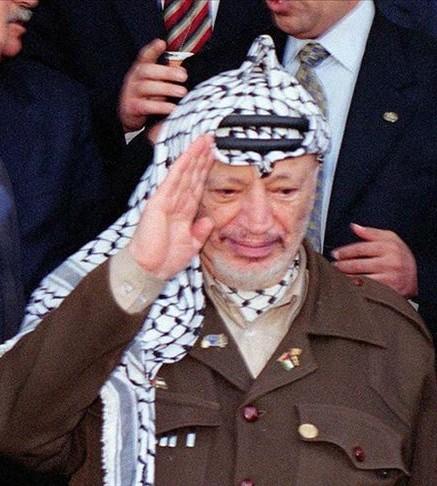
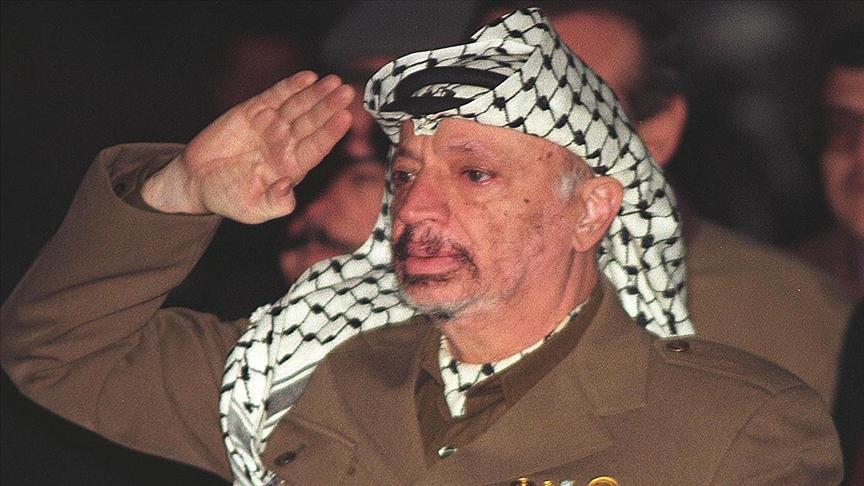
Yasser Arafat【1】 (full name: Muhammad Abd al-Rauf al-Qudwa al-Husseini; 24 August 1929, Cairo – 11 November 2004, Clamart) was a leading figure in the Palestinian national movement during the second half of the 20th century and one of the founders of Fatah (Palestinian National Liberation Movement) and the Palestine Liberation Organization (PLO). Arafat shifted the Palestinian cause from armed struggle to diplomatic negotiation and became one of the defining figures in both regional and international politics during this process. In 1994 he was awarded the Nobel Peace Prize for his role in the Oslo Accords.
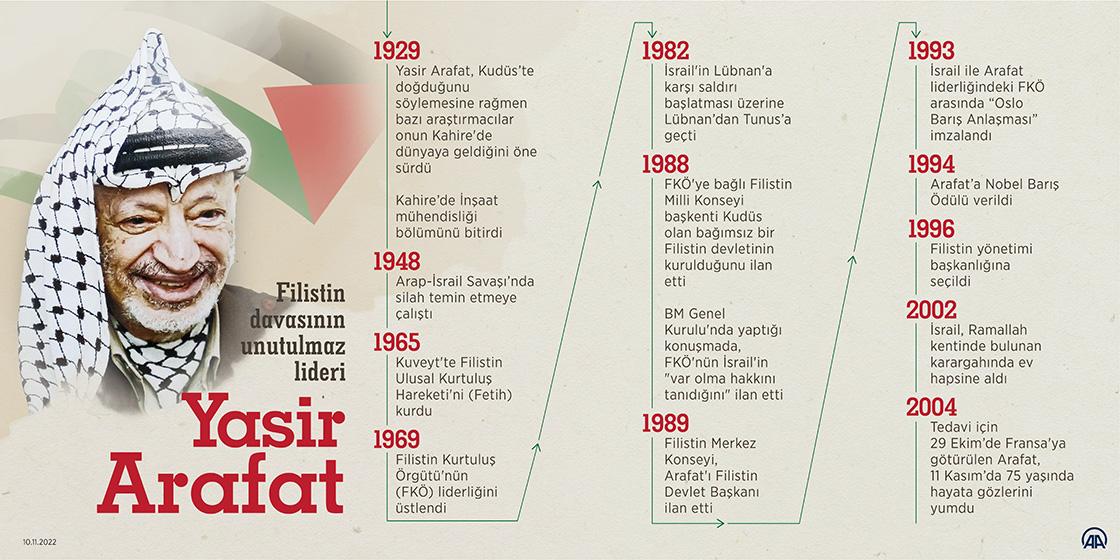
Infographic of Yasser Arafat (Anadolu Ajansı)
Yasser Arafat (ياسر عرفات), whose full name is Muhammad Abd al-Rauf al-Qudwa al-Husseini, was born on 24 August 1929 in Cairo. Although there are differing views regarding his place of birth, many biographical sources record that he was born in Egypt’s capital. Arafat’s family belonged to the prominent Gaza family of al-Qudwa. His father, Abd al-Rauf al-Qudwa, was a merchant engaged in trade, while his mother, Zahva Khalil Abu Suud, came from a Jerusalem-origin family.
After losing his mother at the age of four, Arafat lived with his uncle in Jerusalem. He spent several years in the home of Salim Abu’s-Suud before returning to his father in Cairo to continue his education. Although information about his childhood is limited, the British Mandate administration in Palestine and the increasing Jewish immigration were among the historical events he witnessed during his early years.
He began his education at Farouk I High School in Cairo, where he completed his secondary studies. In 1946, while still a high school student, he met Palestinian politician Haj Amin al-Husseini. This encounter sparked his interest in Palestinian political issues. Following the United Nations’ 1947 decision to partition Palestine, Arafat volunteered with groups directed by the Arab Higher Committee during the escalating conflicts in the region; these groups aimed to collect weapons left over from World War II and deliver them to Palestinian fighters.
When the Arab-Israeli War broke out in 1948, Arafat briefly volunteered with the “Army of the Holy War” (Jaysh al-Jihad al-Muqaddas) in Gaza. After the war, he returned to Cairo and enrolled in the Faculty of Civil Engineering at Cairo University (Fuad I University) in 1949.
In 1951 he led the establishment of the Palestinian Students Union, formed by Palestinian students, and was elected its president the same year. This role provided him with continuous contact with the younger generation of the Palestinian diaspora and enabled him to develop his political views. During this time, Arafat remained engaged with political movements across the Arab world while continuing his studies.
He graduated from Cairo University in 1956 with a degree in civil engineering. That same year, during the Suez Crisis, he joined the Egyptian army as a reserve officer, serving in technical roles due to his engineering background.
After graduation, he worked briefly for the Egyptian Cement Company before moving to Kuwait in 1957. There he continued his engineering career while strengthening political ties with Palestinian workers, students, and refugees.
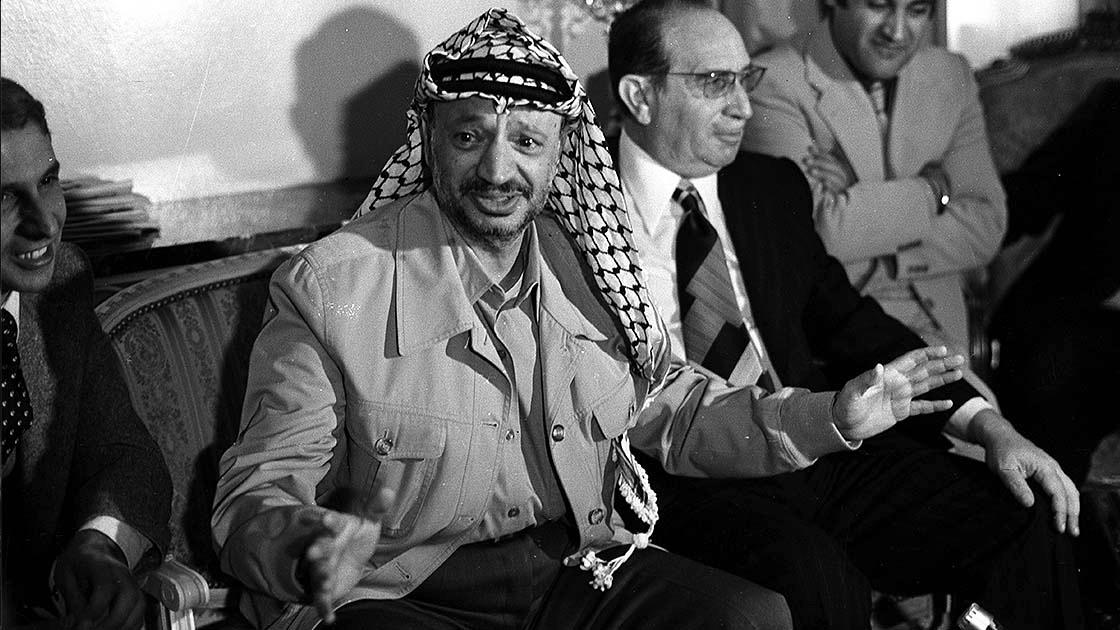
Yaser Arafat. Ankara - 6 October 1979 (Anadolu Ajansı)
The founding of the Palestinian Students Union was viewed within the context of the prevailing Arab nationalism and anti-colonial movements in the Arab world during that era. The union was not merely a student solidarity organization; it also conducted awareness-raising and public opinion-building activities focused on the Palestinian cause. During his presidency, Arafat established contacts with similar student groups in Arab capitals and worked to bring the Palestinian issue onto the agenda of international student forums.
The political changes in Cairo in 1952, particularly the rise to power of the Free Officers Movement in Egypt, had a profound impact on Arafat’s activities. The new regime emphasized Arab unity and anti-imperialist policies, providing an ideological foundation for Palestinian student movements. Arafat was re-elected president of the student union that year and held the position until 1956.
During this period, Arafat did not limit his political activities to student movements alone. During a visit to Gaza in 1955, he came into contact with small-scale Palestinian resistance groups. There he met Khalil al-Wazir (Abu Jihad), with whom he began laying the intellectual groundwork for an armed resistance movement in the coming years. Both men advocated the view that Palestinian freedom could not be achieved solely through external support but required organization and initiative from the Palestinian people themselves.
Arafat’s political activities during university years helped develop his organizational capacity and leadership skills. His work among Palestinian students in Cairo served as a precursor to the broader organizations he would later establish, particularly Fatah. The experience he gained during this period became one of the key elements shaping his political vision.
After graduating from Cairo University in 1956 as a civil engineer, his involvement in student movements gave way to professional work and organizational preparations. Following a brief period of engineering work, his relocation to Kuwait in 1957 paved the way for a new phase in his political activities. The organizational experience he acquired in Cairo became the foundation for the political structure he would later build among Palestinian refugees.
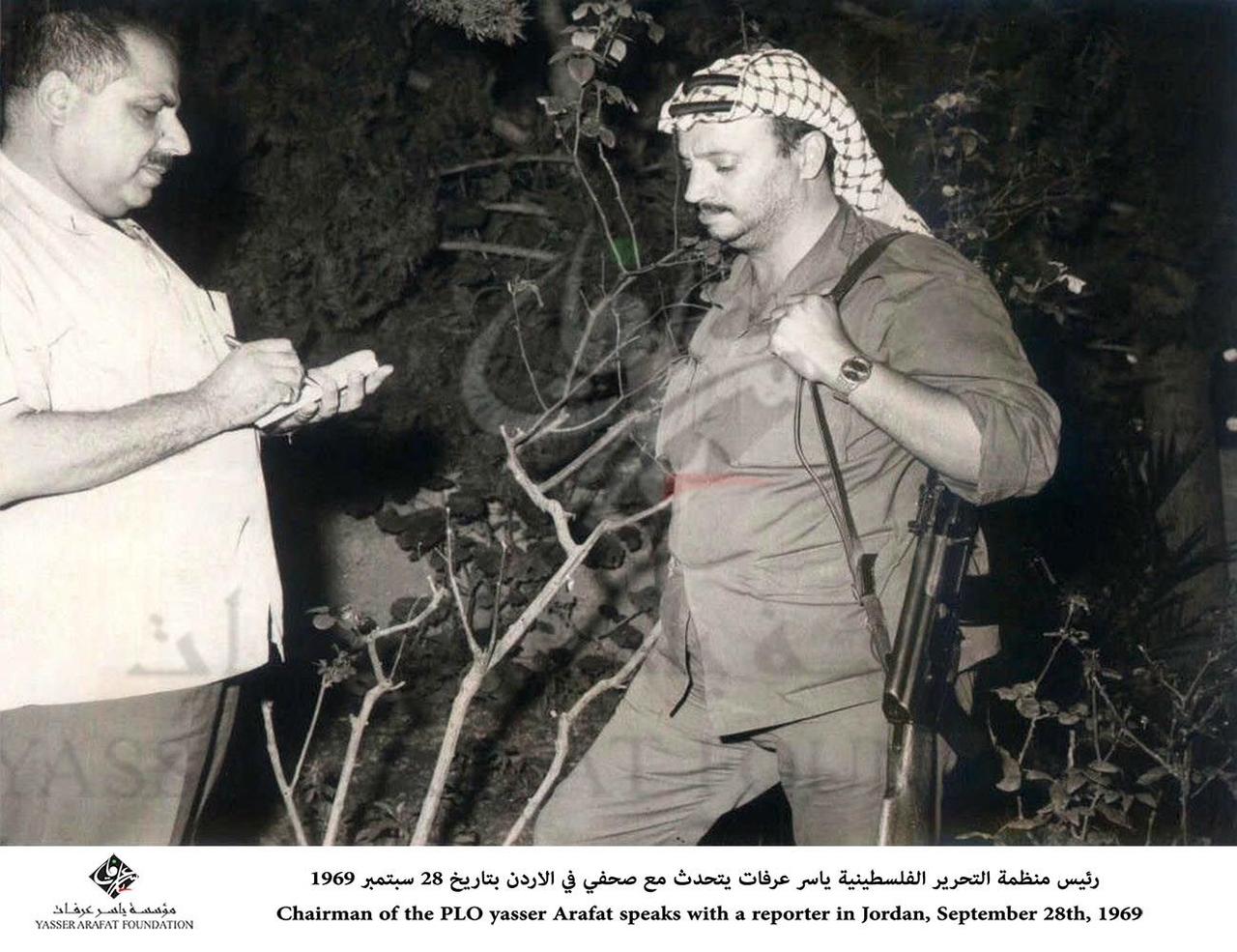
Yaser Arafat. Jordan - 28 September 1969 (Yasser Arafat Foundation)
One of the defining turning points in Yasser Arafat’s political career was the founding process of the Palestinian National Liberation Movement (Fatah). In the late 1950s, the need for an independent popular movement, separate from the policies of Arab states toward the Palestinian issue, began to be discussed among Arafat and other Palestinian intellectuals. After relocating to Kuwait in 1957, Arafat established close contact with Palestinian refugees, workers, and engineers living there; the group that formed around him soon began developing the idea of a new organization.
By the end of 1958, Arafat, together with Khalil al-Wazir (Abu Jihad), laid the foundations of an organization aimed at liberating Palestine. The structure they created sought to operate independently of official Arab state institutions and armies, advocating direct struggle initiated by the Palestinian people rather than waiting for decisions from Arab governments. This approach represented a departure from the dominant political trends of the time.
Arafat and his associates named the organization “Harakat Tahrir al-Watani al-Filastini”, using the abbreviation “Fatah”. The name “Fatah,” derived from the Arabic root “f-t-h” meaning “to open” or “to liberate,” symbolized the goal of restoring freedom to Palestinian lands. In 1959, Arafat and his associates began publishing a magazine titled “Falestinuna” (Our Palestine) to publicize the organization’s ideas. The magazine shaped the movement’s ideological framework, emphasizing independence, self-defense, and national responsibility.
The founding documents of Fatah emphasized that the primary instrument of struggle would be armed resistance. Arafat and the founding leadership rejected reliance on international diplomacy, instead focusing on guerrilla warfare within the occupied territories to achieve Palestinian liberation. This approach directly responded to the failures of Arab armies in the late 1950s. Fatah’s ideological framework was built around principles of nationalism, patriotism, and popular mobilization.
The organization operated secretly in its early years. Arafat directed much of his engineering income toward funding the movement and maintained contact with Palestinians in various Arab countries. On 10 October 1959, during a meeting in Kuwait attended by young Palestinians from various Arab countries, the Palestinian National Liberation Movement (Fatah) was formally established. The meeting emphasized the movement’s independent and popular character and declared that no Arab government would be permitted to interfere in its decision-making processes.
Fatah began preparing for its first operations in the early 1960s. On the night of 1 January 1965, its military wing, al-Asifa (Storm Forces), carried out a small-scale sabotage targeting an Israeli water pipeline in the Aylabun region. This operation is widely regarded as the beginning of the modern Palestinian resistance. Two Israeli soldiers were injured in the attack, and the Palestinian participant, Ahmed Musa Selameh, was killed. The symbolic significance of this operation lay in its demonstration of Fatah’s strategic approach: Palestinian liberation would be achieved through a gradual, popular guerrilla war.
Following this operation, Arafat built Fatah’s political discourse on the principle that Palestinians must determine their own fate rather than rely on Arab armies. This first operation also led to 1 January being commemorated by Palestinians as the “Day of the Modern Revolution.”
Fatah’s organizational structure expanded rapidly in the early 1960s. Within a short time, representative offices were established among Palestinian communities across the Arab world, and the movement developed a dual structure of military and political wings. During this period, Arafat was responsible for the movement’s external relations and military planning. By 1967, Fatah had become one of the most effective Palestinian resistance organizations operating in Jordan, Syria, and Lebanon.
The founding of Fatah marked the institutional formation of Arafat’s political identity. The organizational structure he developed during this period laid the foundation for the leadership role he would later assume within the Palestine Liberation Organization (PLO).
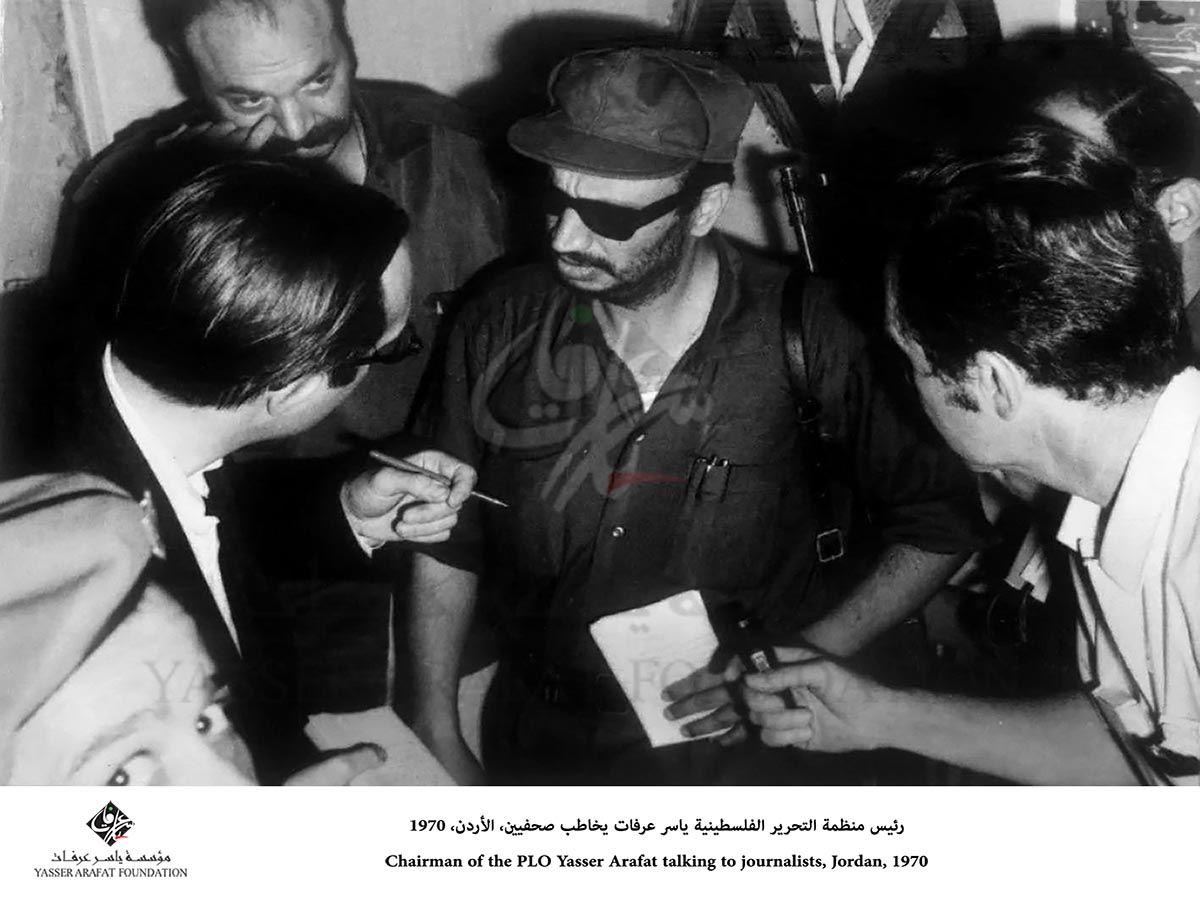
Yaser Arafat. Jordan - 1970 (Yasser Arafat Foundation)
The early 1960s marked a period of organizational restructuring for the Palestinian national movement. In 1964, under the initiative of the Arab League, the Palestine Liberation Organization (PLO) was established. Initially, the PLO was conceived as a coordinating umbrella organization under the influence of Egyptian President Gamal Abdel Nasser, designed to align with Arab states. Its first president was Ahmad al-Shuqayri, and its headquarters were located in Cairo. The organization’s purpose was to represent the Palestinian people on international platforms and to develop a joint strategy with Arab countries for the liberation of Palestinian lands.
Yasser Arafat and his associates, who had founded Fatah in 1959, approached the establishment of the PLO with caution. Fatah leaders argued that an organization under the control of Arab states could not genuinely represent the independent will of the Palestinian people. Consequently, Fatah continued its armed operations independently of the PLO, launching operations against Israeli targets from 1965 onward. During this period, Fatah’s influence grew among Palestinian youth, while the PLO remained largely a diplomatic entity.
The 1967 Six-Day War, which ended in the defeat of Arab armies and the Israeli occupation of Palestinian territories (the West Bank, Gaza, and East Jerusalem), created the conditions for the PLO’s restructuring. This defeat caused a morale crisis across the Arab world and strengthened the belief among Palestinians that an independent national resistance was essential. After the war, Arafat intensified Fatah’s military activities, establishing clandestine resistance cells in the West Bank and increasing guerrilla operations against Israel from Jordanian territory.
The 1968 battle in the Jordanian town of al-Karameh was a turning point that strengthened Arafat’s position within the Palestinian national movement. An Israeli military raid on the area was repelled by a joint defense of Palestinian resistance fighters and the Jordanian army; the event was perceived across the Arab world as a moral victory following the 1967 defeat. Under Arafat’s leadership, Fatah gained large numbers of new volunteers and became the symbolic organization of the Palestinian resistance.
The balance within the PLO shifted after this development. In 1968, the organization underwent structural reforms, and Fatah’s influence grew. In 1969, the Palestinian National Council (PNC), meeting in Cairo, elected Yasser Arafat as chairman of the PLO Executive Committee. Arafat thus became the second official leader of the organization after Ahmad al-Shuqayri. This election transformed the PLO from a platform directed by Arab states into a movement grounded in the political will of the Palestinian people.
During Arafat’s chairmanship, the PLO transformed into a multi-layered structure. Political, military, and diplomatic units were established, and social service networks were expanded to maintain contact with Palestinian refugees. The PLO’s military wing, the “Palestine Liberation Army,” and its political body, the “Palestinian National Council,” became institutionalized during this period. Arafat located the organization’s headquarters in Amman, Jordan’s capital; however, following the events of “Black September” in 1970, he was forced to relocate the PLO’s headquarters to Lebanon.
Arafat’s rise coincided with a critical phase in the international recognition of the Palestinian cause. From the early 1970s, the PLO ceased to be merely an organization conducting military operations and became a structure representing the Palestinian people diplomatically. During this period, Arafat emerged not only as the military leader of the movement but also as a political figure embodying Palestinian national identity.
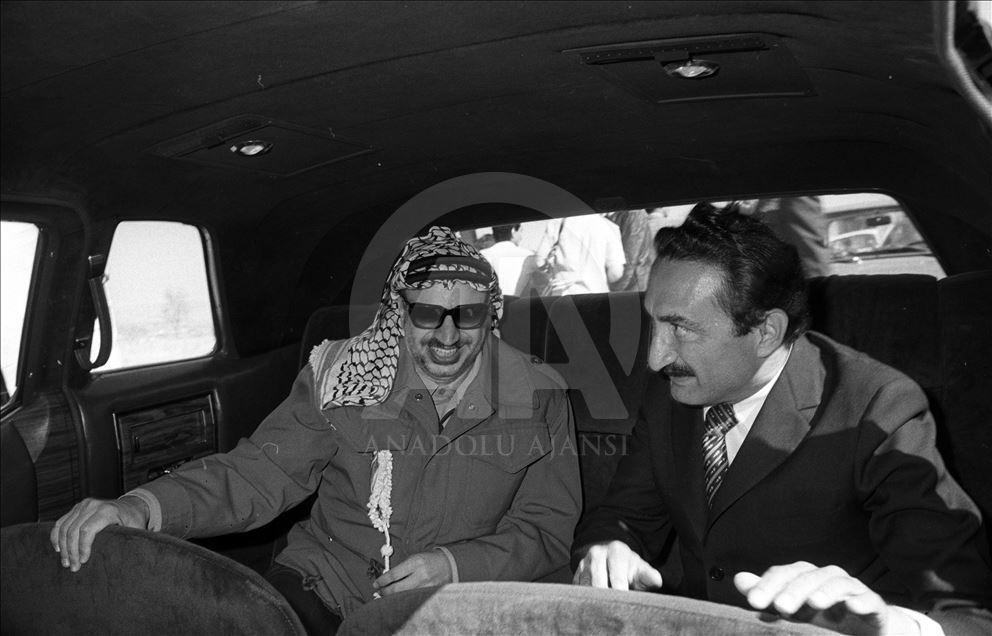
Yaser Arafat and Bulent Ecevit. Ankara - 5 October 1979 (Anadolu Ajansı)
The early 1970s marked the beginning of a shift in the international standing of the Palestine Liberation Organization (PLO). Following its military activities in the late 1960s and the events of Black September (1970) in Jordan, the PLO relocated its headquarters to Lebanon and entered a process of political and diplomatic reorganization. During this period, the organization’s leader, Yasser Arafat, began arguing that the Palestinian issue could not be resolved through armed struggle alone and that international diplomatic channels must also be utilized.
The PLO’s diplomatic orientation in the early 1970s was linked to changing political balances in the Arab world. After the 1973 Arab-Israeli War, Arab countries began placing greater emphasis on negotiations with Israel. This encouraged the Palestinian national movement to turn toward diplomacy. Arafat focused on strengthening the PLO’s relations with Arab states and securing recognition of the organization as the “sole legitimate representative” of the Palestinian people. In pursuit of this goal, at the Arab League Summit in Rabat in October 1974, the PLO was officially recognized as the sole legitimate representative of the Palestinian people. This decision fundamentally altered the PLO’s diplomatic status and granted Arafat new opportunities on international platforms.
Following these developments, Arafat delivered a historic speech before the United Nations General Assembly on 13 November 1974. This speech is recognized as the first direct representation of the Palestinian national movement at the UN level. In his address, Arafat emphasized the Palestinian people’s right to self-determination and famously declared, “I have come bearing an olive branch and a freedom fighter’s gun. Do not let the olive branch fall from my hand.”【2】 These words drew attention to the dual balance between peace and resistance. The statements significantly increased the visibility of the Palestinian cause in international public opinion and became a symbol of Arafat’s diplomatic transformation.
Following the speech, the UN General Assembly adopted a resolution on 22 November 1974 recognizing the Palestinian people’s right to self-determination and independence and granting the PLO observer status at the United Nations. This decision enhanced the PLO’s formal recognition under international law and transformed it into a direct party in the diplomatic resolution process of the Palestinian issue.
The year 1974 is regarded as a turning point when the Palestinian national movement shifted from a structure centered on armed action to one focused on diplomatic representation and international recognition. Arafat’s UN speech contributed to the global recognition of the Palestinian cause as a political issue and laid the institutional foundation for the PLO’s future negotiations.
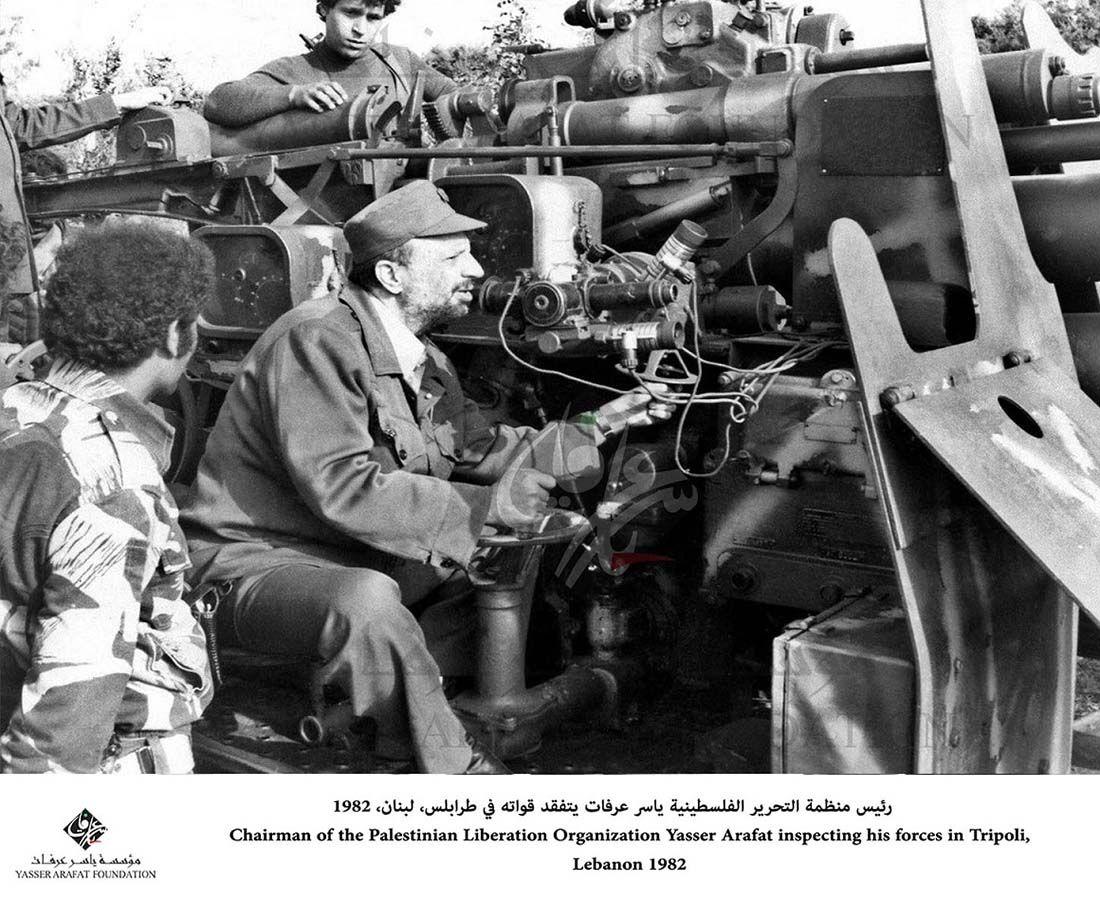
Yaser Arafat. Lebanon - 1982 (Yasser Arafat Foundation)
The late 1970s and early 1980s were a period of intensified activity for the Palestine Liberation Organization (PLO) in Lebanon. After being expelled from Jordan, the PLO relocated its political and military center to Lebanon in 1971, establishing military bases and becoming an influential actor in Lebanon’s political balance. The organization demonstrated a strong presence, particularly in Palestinian refugee camps in Southern Lebanon. However, this presence contributed to increased tensions with certain Lebanese factions and Israel.
The Lebanese Civil War, which began in 1975, further complicated the PLO’s position within the country. During this period, Arafat supported the formation of an alliance between the PLO and leftist and nationalist groups in Lebanon. However, the growing armed presence of the organization intensified opposition to it among certain Lebanese sectors. Meanwhile, Israel intensified its military operations along its border with Lebanon, citing cross-border clashes as justification.
In 1982, the Israeli army launched a large-scale military operation named “Operation Peace for Galilee” into Lebanon. The operation’s objective was to eliminate the PLO’s military and political presence in Lebanon. Israeli forces quickly besieged Beirut, heavily bombing the PLO headquarters and areas where Palestinian militias were stationed. During the siege, Arafat engaged in negotiations with international mediators and agreed to a plan for the evacuation of the organization.
On 30 August 1982, under the mediation of U.S. Ambassador Philip Habib, an agreement was reached for Arafat and PLO members to leave Beirut. Arafat departed Lebanon in a convoy secured by French and U.S. warships and relocated the organization’s headquarters to Tunis. Thus, the PLO’s military presence in Lebanon ended, and the movement’s focus shifted to diplomatic and political activities.
The Tunis period (1982–1993) marked a phase in which the PLO moved from military action to diplomatic representation. Arafat managed the reorganization of the organization in Tunis, establishing diplomatic contacts with various Arab and Western countries. The PLO’s political offices continued operating in Tunis, and the organization was represented before the Arab League and the United Nations. Although direct contact with grassroots movements within Palestine remained limited, the PLO’s external representation network expanded significantly.
The PLO’s activities in Tunis occasionally became targets for Israel. On 1 October 1985, the Israeli Air Force bombed the PLO headquarters in the Hammam al-Shatt area near Tunis, killing organization members and civilians. Arafat escaped unharmed, and the incident drew international condemnation. This event demonstrated that the PLO’s presence in Tunis remained under constant threat.
Throughout his years in Tunis, Arafat maintained the view that the Palestinian national movement needed to advance toward a political solution. The outbreak of the First Intifada in 1987 prompted the PLO to redefine its international diplomatic role. The strategies developed during this period laid the groundwork for the 1988 declaration of the State of Palestine and the 1993 Oslo process.
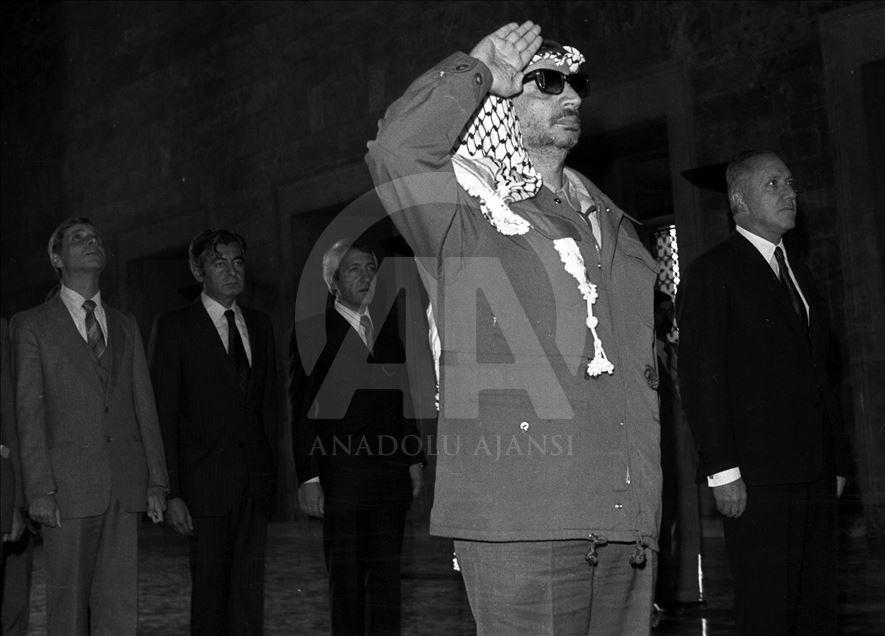
Yaser Arafat. Anıtkabir - 6 October 1979 (Anadolu Ajansı)
The second half of the 1980s was a period of intensified diplomatic activity and significant strategic change for the Palestine Liberation Organization (PLO). After relocating its headquarters to Tunis in 1982, the PLO intensified its efforts to gain international recognition and sustain the Palestinian cause through diplomacy. During this period, the First Intifada, which began in 1987, rekindled global public interest in the Palestinian issue and accelerated internal debates within the organization regarding the declaration of a state.
On 15 November 1988, the Palestinian National Council (PNC), meeting in Algiers, the capital of Algeria, declared the establishment of the State of Palestine. The Declaration of Independence was read by Yasser Arafat, Chairman of the PLO Executive Committee. The declaration asserted that the state was founded on the natural, historical, and legal rights of the Palestinian people. “East Jerusalem (Al-Quds al-Sharif)” was designated as the capital of Palestine, although its borders were not explicitly defined. The declaration invoked international law and United Nations resolutions to affirm the state’s legitimacy.
Arafat’s declaration represented a major shift in the PLO’s political line. While in the 1960s the organization’s priority had been the complete liberation of all Palestinian lands and the establishment of a single democratic state, the 1988 declaration reflected a more limited approach: the recognition of an independent Palestinian state based on the 1967 borders. This change signaled a gradual transition from the PLO’s long-standing “armed resistance” strategy to a diplomatic solution.
Immediately following the declaration of independence, over 100 countries recognized the State of Palestine. In the same period, the United Nations General Assembly, on 15 December 1988, adopted a decision recognizing the PLO’s representation as the “State of Palestine,” granting the organization observer status at the UN under the title of “state.” This development enhanced Palestine’s international recognition, although its actual sovereignty remained unimplemented due to ongoing Israeli occupation.
Another significant outcome of the 1988 declaration was the initiation of diplomatic contacts between the United States and the PLO. The U.S. administration set as a precondition for dialogue the PLO’s recognition of Israel’s right to exist and its rejection of violence. On 14 December 1988, at a press conference in Geneva, Arafat announced his acceptance of these conditions, enabling the United States to begin formal talks with the PLO. This step strengthened the PLO’s position within the international system.
The declaration of the State of Palestine carried symbolic meaning for the Palestinian people. This step was regarded as a legal expression of a long-standing national identity and statehood aspiration; however, actual independence was not achieved due to the continued Israeli occupation and internal political divisions. Nevertheless, the 1988 decision is recognized as the starting point of Palestine’s transition to the status of a “state” under international law.
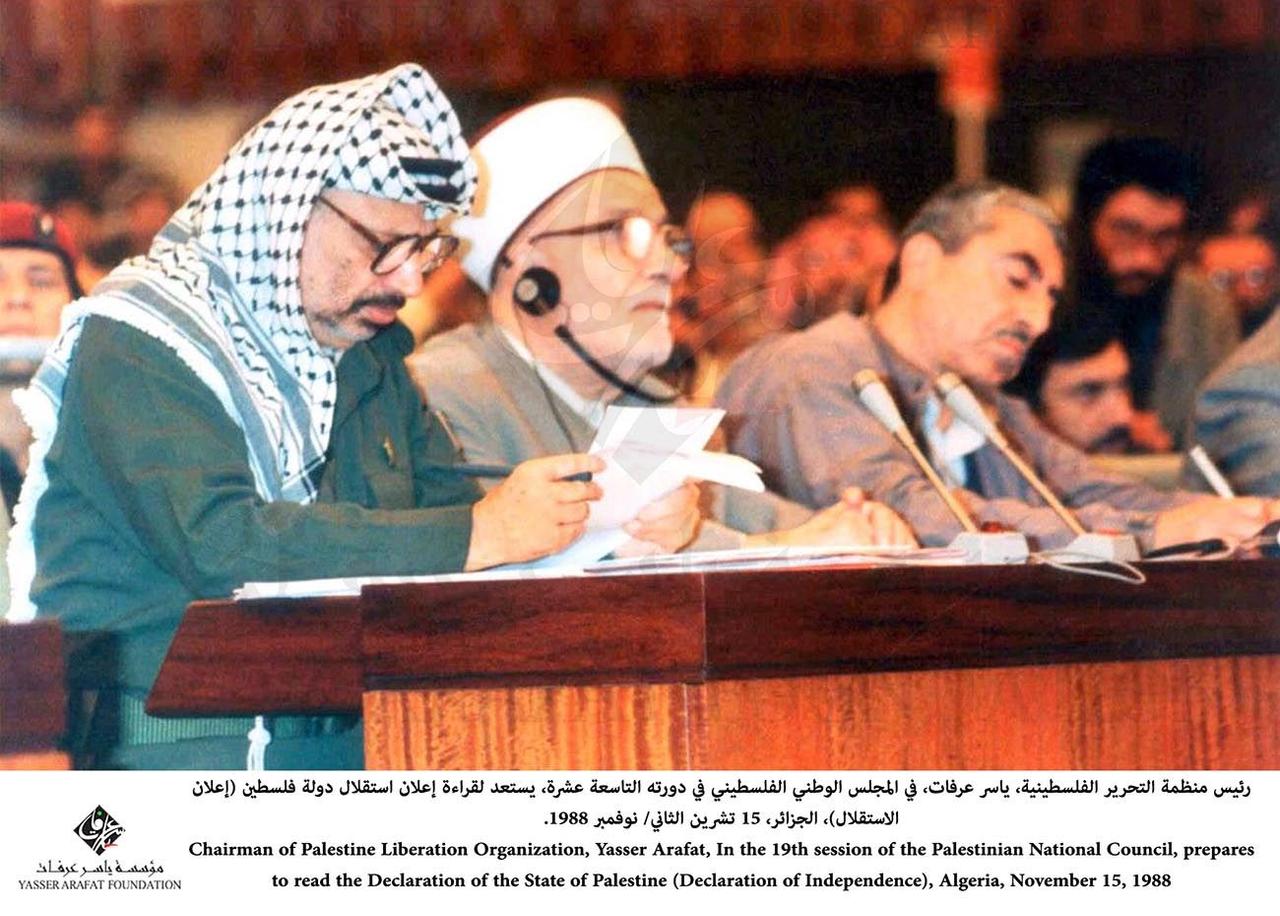
Yaser Arafat Preparing to Read the Declaration of Independence of the State of Palestine. Algiers - 15 November 1988 (Yasser Arafat Foundation)
Following the 1988 declaration of the State of Palestine, indirect contacts began between the Palestine Liberation Organization (PLO) and Israel. The new international environment shaped by the collapse of the Soviet Union and the aftermath of the Gulf War in 1991 accelerated efforts to find a diplomatic solution to the Arab-Israeli conflict. In this context, the Madrid Peace Conference (1991), jointly initiated by the United States and the Soviet Union, was the first comprehensive meeting to include the Palestinian issue in formal negotiations. At Israel’s insistence, the PLO did not participate directly; instead, the Palestinian delegation was represented as part of a joint delegation with Jordan.
As no concrete results emerged from the talks following the Madrid Conference, secret negotiations were initiated between PLO and Israeli representatives in Oslo, Norway. Beginning in January 1993, these talks culminated in an agreement recognizing each other’s legitimacy. On 13 September 1993, at a ceremony held in the White House garden in Washington, PLO Chairman Yasser Arafat and Israeli Prime Minister Yitzhak Rabin, in the presence of U.S. President Bill Clinton, signed the Declaration of Principles (Oslo Accords). This document constituted the first mutual recognition agreement in the history of the Palestinian issue.

Yitzhak Rabin, Bill Clinton and Yasser Arafat during the Oslo Accords. Washington - 13 September 1993 (Store Norske Leksikon)
Under the agreement, the Israeli government agreed to withdraw from the Gaza Strip and Jericho, while the Palestinian side agreed to recognize Israel’s existence and end acts of violence. A five-year transitional period was foreseen, during which final-status negotiations on the future of Palestinian territories would be conducted. The agreement also planned for the establishment of an autonomous administrative authority in Palestinian territories, leading to the creation of the Palestinian National Authority (PNA).
Arafat entered Gaza on 1 July 1994 after returning from exile and assumed office as the first president of the Palestinian National Authority. That same year, he was awarded the Nobel Peace Prize alongside Israeli Prime Minister Yitzhak Rabin and Foreign Minister Shimon Peres for their contributions to the peace process. The Oslo process was met with great hope by the international public, but significant challenges emerged during its implementation.
Israel’s continued expansion of Jewish settlements in the West Bank undermined Palestinian confidence in the agreement. The assassination of Israeli Prime Minister Yitzhak Rabin in 1995 by an Israeli extremist negatively affected the process. The subsequent Israeli Prime Minister, Benjamin Netanyahu, slowed down or suspended implementation of certain provisions of the agreement. Nevertheless, the Wye River Memorandum, signed in 1998 under U.S. mediation, achieved a partial agreement between the parties; however, it was never fully implemented.
Although the Oslo process established limited self-rule in Palestinian territories, it failed to produce a lasting solution toward the establishment of an independent state. The Camp David Summit in 2000, hosted by U.S. President Bill Clinton, ended in failure due to the parties’ inability to reach agreement on final-status issues (Jerusalem, refugees, borders). The Second Intifada, which began in late 2000, effectively marked the end of the diplomatic era initiated by the Oslo process.
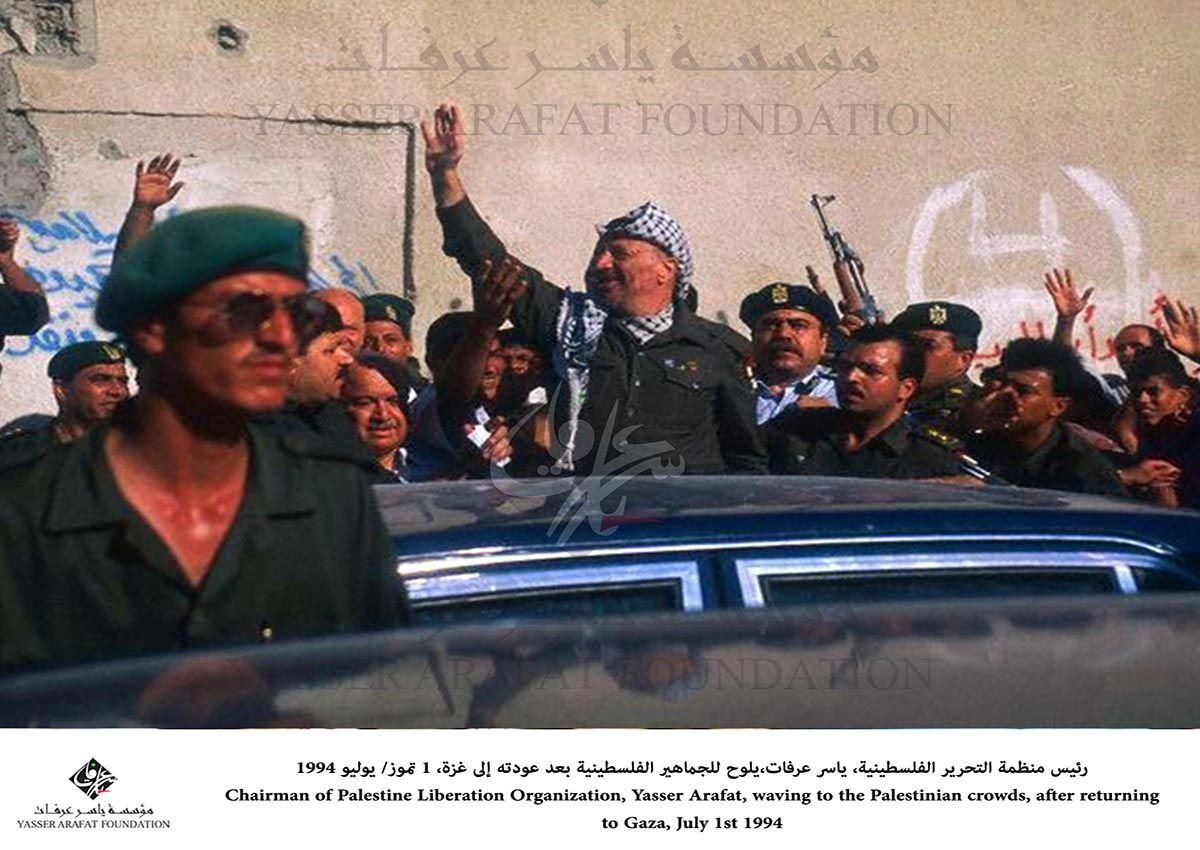
Yaser Arafat Entering Gaza After His Years in Exile. Gaza - 1 July 1994. (Yasser Arafat Foundation)
Following the Oslo process, the Palestinian National Authority (PNA), established in Palestinian territories, began gradually assuming functions from 1994 onward. This administration was a temporary governing structure designed to provide limited autonomy in specific areas of the Israeli-occupied West Bank and Gaza Strip. Following the transitional period outlined in the Oslo Agreement, the first general elections were held on 20 January 1996, in which Yasser Arafat won approximately 83 percent of the vote and was elected the first president of the Palestinian National Authority.
Arafat’s presidency began with the establishment and institutionalization of the new administration. The Palestinian National Authority was structured with ministries, security forces, courts, and local administrations, operating in coordination with the Palestine Liberation Organization (PLO). However, economic resource shortages, administrative confusion, and security problems limited the effectiveness of governance. International aid was frequently disrupted due to Israeli border controls and commercial restrictions.
During this period, Arafat attempted to maintain a balancing policy among different Palestinian political groups. While Fatah was the dominant force within the PNA, organizations such as Hamas and Islamic Jihad maintained their opposition to the Oslo process. Arafat sought to integrate these groups into the political system, but comprehensive reconciliation was not achieved.
The Second Intifada, which began in the autumn of 2000, brought an end to the diplomatic process shaped by the Oslo era. Protests triggered by the controversial visit of Israeli opposition leader Ariel Sharon to the Al-Aqsa Mosque compound on 28 September 2000 quickly escalated into a widespread resistance movement, resulting in hundreds of Palestinian and dozens of Israeli deaths. The peace process was effectively suspended.
The Israeli government held the Palestinian National Authority, and particularly Arafat, responsible for the Intifada. In 2001, Prime Minister Ariel Sharon labeled Arafat an “obstacle to peace” and largely halted diplomatic contacts. In spring 2002, the Israeli army launched a large-scale military operation named “Operation Defensive Shield,” entering Palestinian cities and targeting government institutions and security infrastructure. In March of the same year, Arafat’s headquarters in Ramallah, the Muqataa, was besieged; the compound was surrounded by tanks and communication lines were cut. This siege, intermittently maintained, lasted approximately two years, effectively isolating Arafat.
During the Second Intifada, the institutional structure of the Palestinian administration weakened significantly, and the economy came to a standstill. Attacks carried out by Hamas and Islamic Jihad generated divergent views in international public opinion regarding Palestinian resistance. Arafat struggled to maintain his authority internally and attempted to balance between different factions.
In 2003, the “Roadmap for Peace” initiative, led by the United States and Britain, further undermined Arafat’s political position. The U.S. administration demanded reforms within the Palestinian side and the limitation of Arafat’s powers. In line with this, Mahmoud Abbas was appointed Prime Minister of Palestine. This development signified a practical reduction in Arafat’s governing authority.
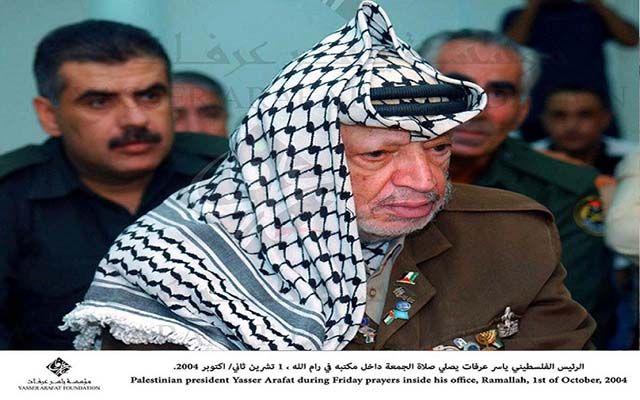
Yaser Arafat at Friday Prayer One Month Before His Death. Ramallah - 1 October 2004. (Yasser Arafat Foundation)
By 2004, Yasser Arafat had been under de facto siege in the Muqataa headquarters in Ramallah for an extended period. The siege initiated by the Israeli army in 2002 had severely restricted Arafat’s direct contact with the outside world. During this time, he was largely confined to the ruins of the headquarters building, and both physical conditions and constant stress negatively affected his health. In October 2004, it was announced that Arafat was suffering from fatigue, loss of appetite, and gastrointestinal problems, and his condition rapidly deteriorated.
The Israeli government initially refused to allow Arafat to leave Ramallah, but under international pressure due to the worsening of his health, it granted permission on 29 October 2004 for him to travel abroad. On the same day, Arafat was flown via Jordan to France and admitted to the Percy Military Hospital in Clamart, near Paris. Throughout his treatment, conflicting statements were made regarding his health; French authorities, citing confidentiality, did not release detailed information. On 11 November 2004, at the age of 75, his death was officially announced. French authorities stated the cause of death as a cerebral hemorrhage.
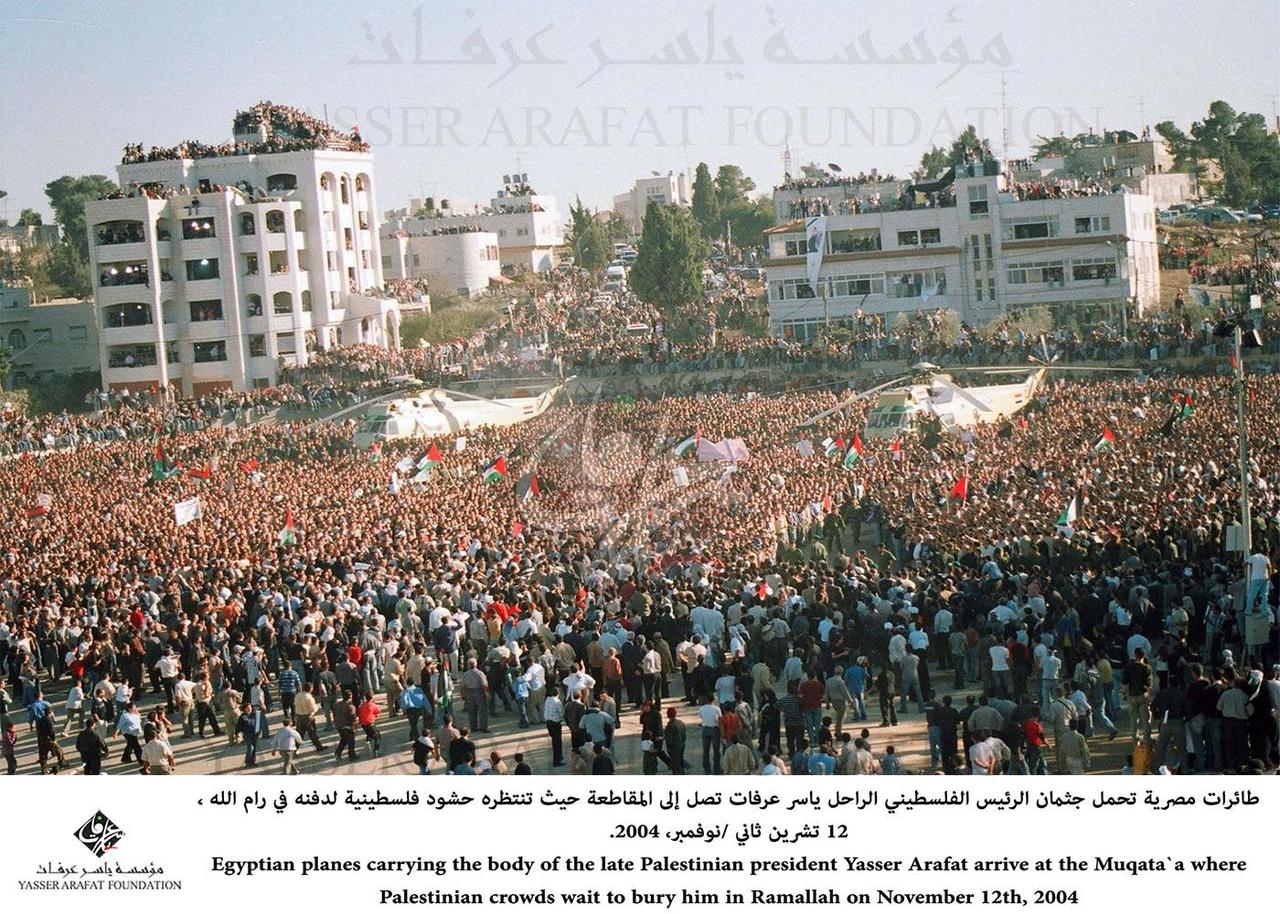
Transport of Yasser Arafat’s Body to Ramallah After the Official Ceremony in Cairo (Yasser Arafat Foundation)
The funeral process generated widespread reactions in Palestine and the Arab world. In accordance with Arafat’s will, he had requested to be buried in Jerusalem, but the Israeli government refused permission. Consequently, his body was transported to Ramallah after an official ceremony in Cairo on 12 November 2004 and buried within the Muqataa compound. Numerous state representatives and international organization officials attended the funeral. His grave was later transformed into a symbolic mausoleum and incorporated into the “Yasser Arafat Memorial and Museum” complex in Ramallah.
After Arafat’s death, debates emerged regarding the definitive cause of death. The Palestinian side, asserting that the circumstances of his death were unusual, called for an investigation. In 2012, Arafat’s grave in Ramallah was exhumed, and samples were analyzed by an international team of experts. A report by Swiss scientists revealed elevated levels of polonium-210 in Arafat’s remains, strengthening the possibility of poisoning. In 2013, Swiss researchers announced that there was an 83 percent probability that the Palestinian leader had been poisoned. However, reports from Russian and French laboratories yielded different results, and no definitive conclusion was reached regarding the cause of death. In November 2016, Palestinian President Mahmoud Abbas stated that the investigation into Arafat’s death was ongoing and promised to reveal the perpetrators, but no official findings have been released to date.
Following Arafat’s death, a period of temporary uncertainty emerged in Palestinian politics. Following emergency meetings within the Palestine Liberation Organization and the Palestinian National Authority, Mahmoud Abbas assumed the roles of interim chairman of the PLO Executive Committee and president of the Palestinian Authority. In the January 2005 elections, Abbas was formally elected president, marking the beginning of a new leadership era in Palestinian politics after Arafat.
Yasser Arafat’s death marked a turning point for the Palestinian national movement, both symbolically and institutionally. After his death, competition between Fatah and Hamas within Palestinian politics became increasingly pronounced, leading to administrative divisions in subsequent years. Nevertheless, Arafat retained his central position in Palestinian political history as a leader who contributed significantly to the international recognition of Palestinian identity.
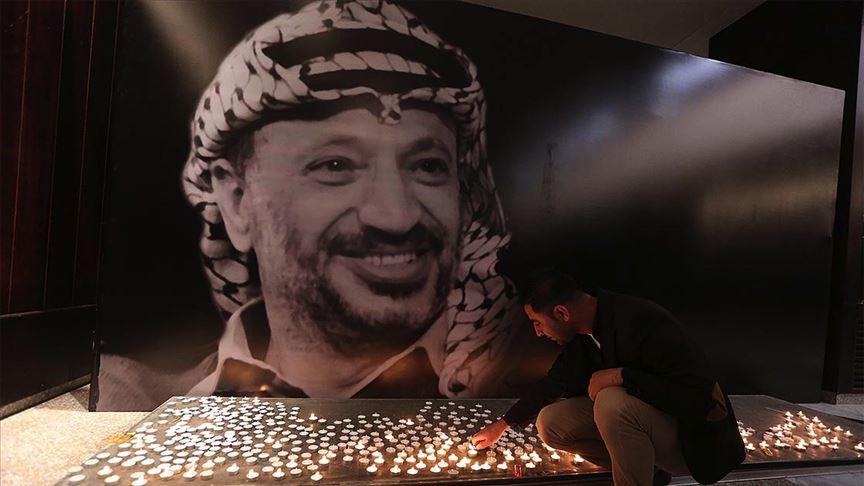
Commemoration of Yasser Arafat After His Death (Anadolu Ajansı)
Following Yasser Arafat’s death in 2004, a significant transformation occurred in Palestinian political life and collective memory. Arafat had been the most visible figure in the Palestinian national movement for nearly forty years; after his death, he continued to be remembered as a historical symbol of Palestinian identity and statehood. His political legacy occupies a prominent place both in the institutional structure of the Palestinian national struggle and in the collective memory of Palestinian society.
Arafat’s legacy continued to shape the subsequent policies of the Palestine Liberation Organization (PLO) and Fatah. With the assumption of leadership of the PLO and the Palestinian National Authority by Mahmoud Abbas in 2005, the political and administrative structures inherited from the Arafat era were maintained. However, a clear division emerged in Palestinian politics; following the 2006 elections, disagreements between Fatah and Hamas led to the de facto division of Palestinian territories into two separate administrations: the West Bank (under Fatah administration) and Gaza (under Hamas administration). This division became the most prominent structural outcome of the post-Arafat era.
Arafat’s memory is kept alive through various cultural and institutional initiatives in Palestine and internationally. Opened in Ramallah in 2016, the Yaser Arafat Museum is one of the most concrete examples of this effort. The museum, built under the theme of “Palestinian Memory,” houses Arafat’s personal belongings, documents, diplomatic correspondence, and archival materials related to the Palestinian national movement. The museum complex is located adjacent to the Muqataa compound where Arafat is buried and also functions as a research and documentation center.
Outside Palestine, Arafat’s name has been given to various public spaces, educational institutions, and cultural structures. Streets, squares, and institutions named after Arafat in Arab countries are regarded as indicators of his symbolic influence at the regional level. Additionally, research and archival work conducted by the Yaser Arafat Foundation in Ramallah plays a vital role in documenting Palestinian history and transmitting it to future generations.
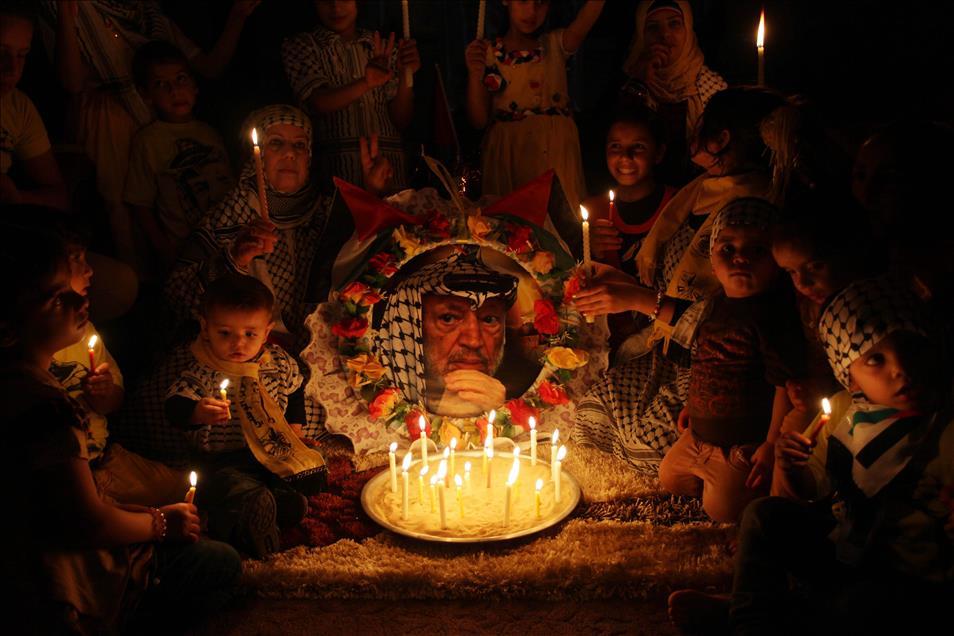
Demonstration Marking the 9th Anniversary of Yaser Arafat’s Death. Jerusalem - 2013 (Anadolu Ajansı)
Aksünger, Selman. “Filistin’in 1988’deki Bağımsızlık İlanı, Devlet Olma Mücadelesinin Dönüm Noktası Oldu.” Anadolu Ajansı. Accessed November 9, 2025.https://www.aa.com.tr/tr/dunya/filistinin-1988deki-bagimsizlik-ilani-devlet-olma-mucadelesinin-donum-noktasi-oldu/3393559
Al Jazeera. "Profile: Yasser Arafat." Accessed November 9, 2025.https://www.aljazeera.com/news/2013/11/6/profile-yasser-arafat
BBC Türkçe. "Portre: Yaser Arafat." Accessed November 9, 2025.https://www.bbc.co.uk/turkish/indepth/story/2004/10/041028_arafat_profile.shtml
Biography.com. “Yasser Arafat.” Biography. Accessed November 9, 2025.https://www.biography.com/political-figures/yasser-arafat
Canlı, Enes, and Esat Fırat. “Filistin Davasının Unutulmaz Lideri Yasir Arafat.” Anadolu Ajansı. Accessed November 9, 2025.https://www.aa.com.tr/tr/dunya/filistin-davasinin-unutulmaz-lideri-yasir-arafat/2734420
Charif, Maher. “Yasir Arafat.” *Interactive Encyclopedia of the Palestine Question*. Accessed November 9, 2025.https://www.palquest.org/en/biography/6562/yasir-arafat
Demirci, Yasin. “Direniş Hareketinden Filistin İktidar Partisine Fetih Hareketi.” Anadolu Ajansı. Accessed November 9, 2025.https://www.aa.com.tr/tr/dunya/direnis-hareketinden-filistin-iktidar-partisine-fetih-hareketi-/695445
Feinstein, Stephen C. “Yasir Arafat.” EBSCO Research Starters. Accessed November 9, 2025.https://www.ebsco.com/research-starters/biography/yasir-arafat
Fırat, Esat. “Filistin Direnişinin Efsane Lideri Yasir Arafat.” Anadolu Ajansı. Accessed November 9, 2025.https://www.aa.com.tr/tr/dunya/filistin-direnisinin-efsane-lideri-yasir-arafat/2039629
Jensehaugen, Jørgen and Dag Leraand. “Yasir Arafat.” *Store Norske Leksikon*. Accessed November 9, 2025.https://snl.no/Yasir_Arafat
Karaman, M. Lutfullah. "Arafat, Yâsir." *TDV İslâm Ansiklopedisi*. Accessed November 9, 2025.https://islamansiklopedisi.org.tr/arafat-yasir
Kemiksiz, Dr. Neşe. “El Aksa İntifadası ve Yol Haritası.” Anka Enstitüsü. Accessed November 9, 2025.https://ankaenstitusu.com/el-aksa-intifadasi-ve-yol-haritasi/
Koşak, Çağrı, Avad er-Recub, and İbrahim el-Hazin. “Türkiye, Filistin Arşivlerini Arafat’ın Uyarısıyla Korudu.” Anadolu Ajansı. Accessed November 9, 2025.https://www.aa.com.tr/tr/dunya/turkiye-filistin-arsivlerini-arafatin-uyarisiyla-korudu/2039788
Meşe, Ertuğrul. “Filistin Direnişinde Tarihsel Bir Aktör: Filistin Kurtuluş Örgütü.” *Karadeniz Sosyal Bilimler Dergisi* 16, no. 31 (2024): 474–492. Accessed November 9, 2025.https://dergipark.org.tr/tr/download/article-file/3863794
Nobel Peace Summit. "Yasser Arafat." Nobel Peace Summit. Accessed November 9, 2025.https://www.nobelpeacesummit.com/project/yasser-arafat/
Qaq, Saeed. “Arafat’ın 9’uncu Ölüm Yıl Dönümü.” Anadolu Ajansı. Accessed November 9, 2025.https://www.aa.com.tr/tr/pg/foto-galeri/arafatin-9uncu-olum-yil-donumu/0
TRT Haber. "Filistin Davasının Unutulmaz Lideri Yaser Arafat." Accessed November 9, 2025.https://www.trthaber.com/foto-galeri/filistin-davasinin-unutulmaz-lideri-yaser-arafat/51778/sayfa-1.html
TRT Haber. “Filistin Davasının Unutulmaz Lideri: Yaser Arafat.” Accessed November 9, 2025.https://www.trthaber.com/foto-galeri/filistinin-efsane-lideri-yaser-arafat/40312/sayfa-1.html
The Nobel Prize. "Yasser Arafat – Biographical." The Nobel Prize. Accessed November 9, 2025.https://www.nobelprize.org/prizes/peace/1994/arafat/biographical/
Yasir Arafat Foundation. “Yâsir Arafat Müzesi: Filistin Hafızası.” Anadolu Ajansı. Accessed November 9, 2025.https://www.aa.com.tr/tr/pg/foto-galeri/yasir-arafat-muzesi-filistin-hafizasi-/4
Yasser Arafat Foundation. “100 Years of Struggle Narrative.” Yasser Arafat Foundation. Accessed November 9, 2025.https://www.yaf.ps/page-1432-en.html
Yasser Arafat Foundation. “Photos.” Accessed November 9, 2025.https://www.yaf.ps/page-1547-en.html
Çalıkoğlu, Kubilay. “Filistin’in Efsane Lideri Arafat’ın Vefatının Üzerinden 15 Yıl Geçti.” Anadolu Ajansı. Accessed November 9, 2025.https://www.aa.com.tr/tr/pg/foto-galeri/filistinin-efsane-lideri-arafatin-vefatinin-uzerinden-15-yil-gecti/4
İbicioğlu, Said, and Qais Omar Darwesh Omar. “Yasir Arafat’ın Zehirlendiğine Dair İlk Şüpheler Ölümünün Hemen Ardından Ortaya Çıktı.” Anadolu Ajansı. Accessed November 9, 2025.https://www.aa.com.tr/tr/dunya/yasir-arafatin-zehirlendigine-dair-ilk-supheler-olumunun-hemen-ardindan-ortaya-cikti/2040525
[1]
Arafat'ın ismini bazı kaynaklar "Yasir" bazı kaynaklar ise "Yaser" olarak ele almıştır. Ekseriyetle bilinen isim "Yaser" olmasından dolayı maddede bu isim kullanılmıştır.
[2]
Enes Canlı ve Esat Fırat. “Filistin Davasının Unutulmaz Lideri Yasir Arafat.” Anadolu Ajansı. Erişim 9 Kasım 2025. https://www.aa.com.tr/tr/dunya/filistin-davasinin-unutulmaz-lideri-yasir-arafat/2734420

Full Name | Muhammad Abdurrauf al-Kudwi al-Husayni | ||||||||
|---|---|---|---|---|---|---|---|---|---|
Birth | 24 August 1929 | ||||||||
Place of Birth | Cairo, Egypt | ||||||||
Education | Cairo University Civil Engineering | ||||||||
Movement Founded | Fatah (Palestinian National Liberation Movement) | ||||||||
Position | President of the Palestine Liberation Organization (PLO) (1969–2004) | ||||||||
State Position | President of the Palestinian National Authority (1996–2004) | ||||||||
Award | Nobel Peace Prize (1994) | ||||||||
Death | 11 November 2004 | ||||||||
Place of Death | Clamart France | ||||||||
Burial Place | Ramallah Mukataa Complex | ||||||||
Early Life and Education
Early Political Activities and Palestinian Student Movements
Founding of Fatah and Early Operations
The Palestine Liberation Organization (PLO) and Arafat’s Rise
Diplomatic Transformation and United Nations Speech (1974)
Departure from Lebanon and the Tunis Years
Declaration of the State of Palestine (1988)
The Oslo Process and Peace Initiatives (1993–2000)
Presidency of the Palestinian National Authority and the Second Intifada Years (1996–2004)
Illness, Death, and Aftermath
Legacy and Institutions Established in His Memory