This article was automatically translated from the original Turkish version.
+1 More
Purpose / Function | Provide religious education and scientific instruction as a madrasa | ||||||||
|---|---|---|---|---|---|---|---|---|---|
Location | Türkiye Tokat province Niksar district | ||||||||
Founder | Emir Ahmet Yağıbasan | ||||||||
Architectural Feature | Classroom and student rooms around a rectangular courtyard Stone craftsmanship and stone carving decorations Two-story structure and sunken courtyard feature | ||||||||
Foundation | 13th century, Danişmend period | ||||||||
Yağıbasan Medresesi, Danişmendlilers period, constructed in the 12th century as an educational structure. The medrese was commissioned by Danişmendli emir Nizameddin Yağıbasan. It is represented by two distinct examples: one located in the center of Tokat within Tokat’s provincial boundaries and known as “Çukur Medrese,” and the other in Niksar.
The Yağıbasan Medreses belong to the period of the Danişmendlid Beylik, which ruled northern and central Anatolia during the 11th and 12th centuries. The Danişmendlids were among the Turkmen principalities that established political dominance in Anatolia after the Battle of Manzikert and were active in the regions around Tokat, Niksar, Sivas and Amasya. During this period, Niksar emerged as one of the principal centers of the beylik.【1】
Educational structures during the Danişmendlid period were constructed in relation to urban centers and administrative areas. Medreses functioned as institutions for religious and scientific education within the beylik’s governance framework. The Yağıbasan Medreses are among the early examples of the medrese institution taking root in Anatolia during this era.【2】
The Yağıbasan Medreses were commissioned by Nizameddin Yağıbasan, a ruler of the Danişmendlid Beylik. The structures are named after their patron. No original foundation inscription has survived to the present day. The medrese in Tokat is dated to 1151–1152, while the one in Niksar is dated to 1157–1158.【3】
Yağıbasan Medresesi (Niksar Municipality)
The Yağıbasan Medrese in Tokat is known today as “Çukur Medrese.” This name derives from the gradual rise in the surrounding street level over time. The structure is situated within the historic urban fabric.【4】
The Niksar Yağıbasan Medrese was built within the inner citadel of Niksar Castle, adjacent to the fortification walls. Its location was determined in accordance with the existing settlement layout within the castle.【5】
The Tokat Yağıbasan Medrese is recorded in 16th-century waqf documents as “Vakf-ı Medrese-i Yağıbasan.” This record confirms that the structure operated within the waqf system.【6】
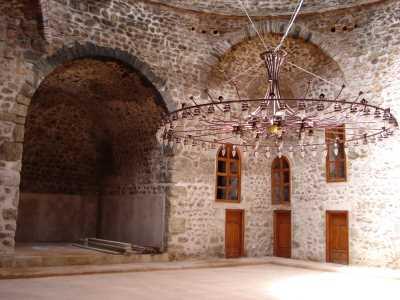
The Tokat Yağıbasan Medrese is a single-story structure with a nearly square plan. The central courtyard is covered by a circular dome with a large opening at its center. The spaces surrounding the courtyard consist of iwan and vaulted volumes. Two iwans open into the courtyard from the south and west, but they do not align precisely with the main axes.【7】
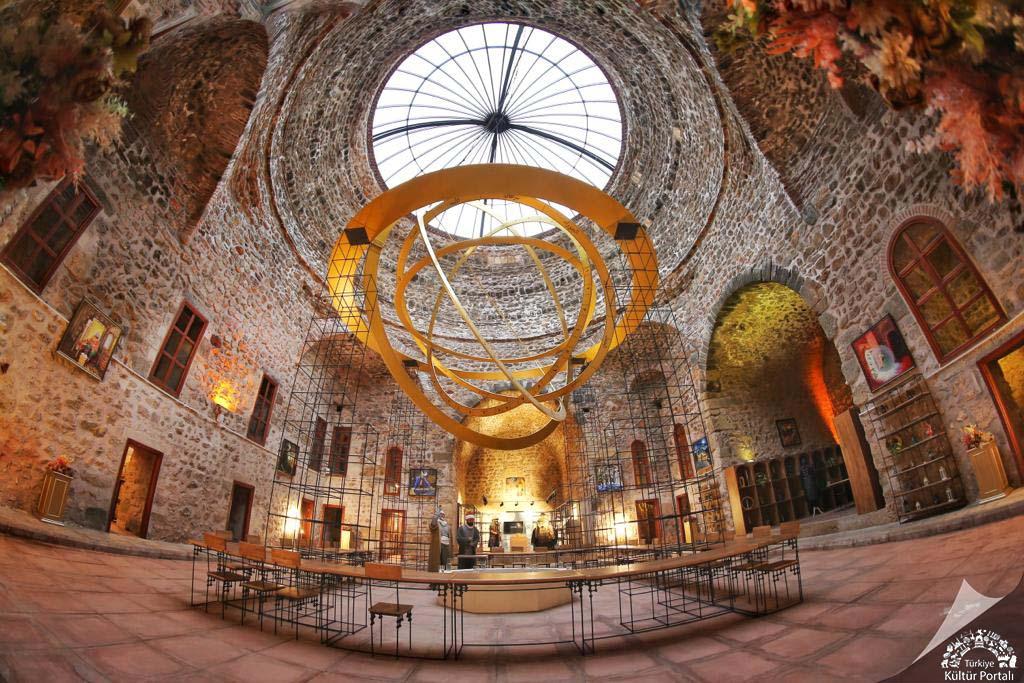
Interior of Yağıbasan Medresesi (Culture Portal)
There is no perfect symmetry between the entrance axis and the dome axis. This asymmetry is also evident in the placement of the iwans and other spaces. On the southern wall of one of the iwans opening into the courtyard, a semi-circular mihrab niche made of brick is present. The floor of the structure lies approximately 1.25 meters below the current street level.【8】
The Niksar Yağıbasan Medrese also follows a closed courtyard plan. The courtyard is covered by a dome, and the surrounding spaces are arranged around it. Due to its location adjacent to the castle walls, the plan was constrained by limited space, and the rooms were shaped accordingly.
In both Yağıbasan Medreses, rubble stone was the primary building material. The stone walls form the structural system of the buildings. Brick was used for the dome, squinches, and certain transitional elements. Cut stone was employed for door openings and some arches.【9】
The architectural decoration is minimal. The scarcity of ornamental elements reflects a functional approach to construction. The material use and architectural arrangement are consistent with the building techniques of the period.【10】
The Yağıbasan Medreses served as institutions for religious and scientific education during the Danişmendlid period. Islamic sciences were taught in the medreses, alongside subjects such as mathematics and astronomy. Educational activities were conducted within a structured framework consistent with the medrese tradition of the time.【11】
Lectures were delivered by mudarris, and students pursued their education within the medrese complex. These institutions also provided accommodation and met daily needs, functioning as residential educational centers. In this regard, the Yağıbasan Medreses were integral to the educational institutions of the Danişmendlid period.【12】
The Yağıbasan Medreses operated during a period when the medrese institution was beginning to spread across Anatolia. Their existence demonstrates that education in the Danişmendlid Beylik was systematically organized through formal institutions.
The Yağıbasan Medrese in Tokat is situated within the historic urban fabric. Over time, the rise in surrounding street and building levels has caused the structure to lie below current street elevation. This has affected the medrese’s spatial relationships within the city.
The Niksar Yağıbasan Medrese is located within the inner citadel of Niksar Castle, adjacent to the fortification walls. The medrese is directly related to the military and administrative structures within the castle. Its placement was determined with consideration of the castle boundaries and existing urban development.
Both medreses are situated in areas with high concentrations of historic structures and have retained their original locations throughout the urban development process.
The Yağıbasan Medreses have been registered by the Ministry of Culture and Tourism as immovable cultural heritage requiring protection. The structures are currently under public ownership and preserved under cultural heritage status.
Restoration works have been carried out on the Tokat Yağıbasan Medrese in various periods. These interventions were conducted to preserve the building’s current condition and maintain its physical integrity. The medrese is among the historic structures open to visitors and is evaluated as part of the cultural heritage.
The Niksar Yağıbasan Medrese also holds registered cultural heritage status. Due to its location within the castle, it has been partially protected from environmental influences, but maintenance and restoration needs have arisen over time. Interventions undertaken at the medrese have aimed to ensure its structural survival.
Both medreses are currently used for purposes other than their original function but continue to exist as part of the cultural heritage, preserved under their historic identity.
Aliy, Abdurrahman. “Yağıbasan Medresesi.” *Türk Maarif Ansiklopedisi*. Accessed January 26, 2026.https://turkmaarifansiklopedisi.org.tr/yagibasan-medresesi
Boy, Emel Şener. “Niksar Yağıbasan Medresesi.” Türkiye Turizm Ansiklopedisi. Accessed January 26, 2026.https://turkiyeturizmansiklopedisi.com/niksar-yagibasan-medresesi
Kültür Portalı. "Yağıbasan Medresesi - Tokat." T.C. Kültür ve Turizm Bakanlığı. Accessed January 26, 2026.https://www.kulturportali.gov.tr/turkiye/tokat/gezilecekyer/yagibasan-medreses-cukur-medrese
Niksar Belediyesi. "Yağıbasan Medresesi 4K seslendirmeli video." YouTube. Accessed January 26, 2026.https://youtu.be/Ndn4knEgezM
Tokat İl Directorate of Culture and Tourism. "Medreseler." T.C. Kültür veTurizm Bakanlığı. Accessed January 26, 2026.https://tokat.ktb.gov.tr/TR-231606/medreseler.html
[1]
Abdurrahman Aliy. “Yağıbasan Medresesi.” Türk Maarif Ansiklopedisi. Erişim tarihi: 26 Ocak 2026. https://turkmaarifansiklopedisi.org.tr/yagibasan-medresesi
[2]
Abdurrahman Aliy. “Yağıbasan Medresesi.” Türk Maarif Ansiklopedisi. Erişim tarihi: 26 Ocak 2026. https://turkmaarifansiklopedisi.org.tr/yagibasan-medresesi
[3]
Kültür Portalı. “Yağıbasan Medresesi - Tokat.” T.C. Kültür ve Turizm Bakanlığı. Erişim tarihi: 26 Ocak 2026. https://www.kulturportali.gov.tr/turkiye/tokat/gezilecekyer/yagibasan-medreses-cukur-medrese
[4]
Kültür Portalı. “Yağıbasan Medresesi - Tokat.” T.C. Kültür ve Turizm Bakanlığı. Erişim tarihi: 26 Ocak 2026. https://www.kulturportali.gov.tr/turkiye/tokat/gezilecekyer/yagibasan-medreses-cukur-medrese
[5]
Kültür Portalı. “Yağıbasan Medresesi - Tokat.” T.C. Kültür ve Turizm Bakanlığı. Erişim tarihi: 26 Ocak 2026. https://www.kulturportali.gov.tr/turkiye/tokat/gezilecekyer/yagibasan-medreses-cukur-medrese
[6]
Kültür Portalı. “Yağıbasan Medresesi - Tokat.” T.C. Kültür ve Turizm Bakanlığı. Erişim tarihi: 26 Ocak 2026. https://www.kulturportali.gov.tr/turkiye/tokat/gezilecekyer/yagibasan-medreses-cukur-medrese
[7]
Kültür Portalı. “Yağıbasan Medresesi - Tokat.” T.C. Kültür ve Turizm Bakanlığı. Erişim tarihi: 26 Ocak 2026. https://www.kulturportali.gov.tr/turkiye/tokat/gezilecekyer/yagibasan-medreses-cukur-medrese
[8]
Tokat İl Kültür ve Turizm Müdürlüğü. “Medreseler.” T.C. Kültür ve Turizm Bakanlığı. Erişim tarihi: 26 Ocak 2026.
[9]
Kültür Portalı. “Yağıbasan Medresesi - Tokat.” T.C. Kültür ve Turizm Bakanlığı. Erişim tarihi: 26 Ocak 2026. https://www.kulturportali.gov.tr/turkiye/tokat/gezilecekyer/yagibasan-medreses-cukur-medrese
[10]
Kültür Portalı. “Yağıbasan Medresesi - Tokat.” T.C. Kültür ve Turizm Bakanlığı. Erişim tarihi: 26 Ocak 2026. https://www.kulturportali.gov.tr/turkiye/tokat/gezilecekyer/yagibasan-medreses-cukur-medrese
[11]
Abdurrahman Aliy. “Yağıbasan Medresesi.” Türk Maarif Ansiklopedisi. Erişim tarihi: 26 Ocak 2026. https://turkmaarifansiklopedisi.org.tr/yagibasan-medresesi
[12]
Abdurrahman Aliy. “Yağıbasan Medresesi.” Türk Maarif Ansiklopedisi. Erişim tarihi: 26 Ocak 2026. https://turkmaarifansiklopedisi.org.tr/yagibasan-medresesi
Purpose / Function | Provide religious education and scientific instruction as a madrasa | ||||||||
|---|---|---|---|---|---|---|---|---|---|
Location | Türkiye Tokat province Niksar district | ||||||||
Founder | Emir Ahmet Yağıbasan | ||||||||
Architectural Feature | Classroom and student rooms around a rectangular courtyard Stone craftsmanship and stone carving decorations Two-story structure and sunken courtyard feature | ||||||||
Foundation | 13th century, Danişmend period | ||||||||
No Discussion Added Yet
Start discussion for "Yağıbasan Medresesi" article
Historical Context
Construction and Patronage
Architectural Features
Plan Layout
Construction Materials
Educational Function and Institutional Role
Urban Location
Conservation Status