


This article was automatically translated from the original Turkish version.

When a nuclear power plant shuts down its doors or a medical laboratory finishes using a radioactive device, where do those tiny but powerful materials go? It’s not as simple as “putting them in a corner and forgetting about them.” Because nuclear waste is entirely different from the types of trash we encounter in daily life. Some lose their potency within days, while others remain radioactive for thousands of years.
Nuclear waste conjures images of glowing green liquid in barrels (thank you, popular culture). But the reality is far more mundane—and far more delicate. According to the official definition, nuclear waste refers to radioactive materials that are no longer usable. The IAEA classifies it as follows:
And here is an interesting fact:
By total volume, approximately 95% of existing radioactive waste has very low-level (VLLW) or low-level (LLW) radioactivity, about 4% is intermediate-level waste (ILW), and less than 1% is high-level waste (HLW) 【1】
So the problem is not volume; the problem is energy, heat, and radiation.
Freshly discharged fuel from a reactor is literally a heat monster. The fission products inside continue to generate high levels of heat. If not cooled, it can self-ignite. That is why every nuclear power plant has a giant, brilliantly blue-lit “nuclear swimming pool” at its heart. This is called a fuel pool. Here, the fuel:
This stage is essentially the “quarantine period” for nuclear waste. The IAEA’s explanation is clear: Spent fuel is most dangerous in its first years, but it also decays fastest during this time.
Therefore, pools are the first stop.【3】
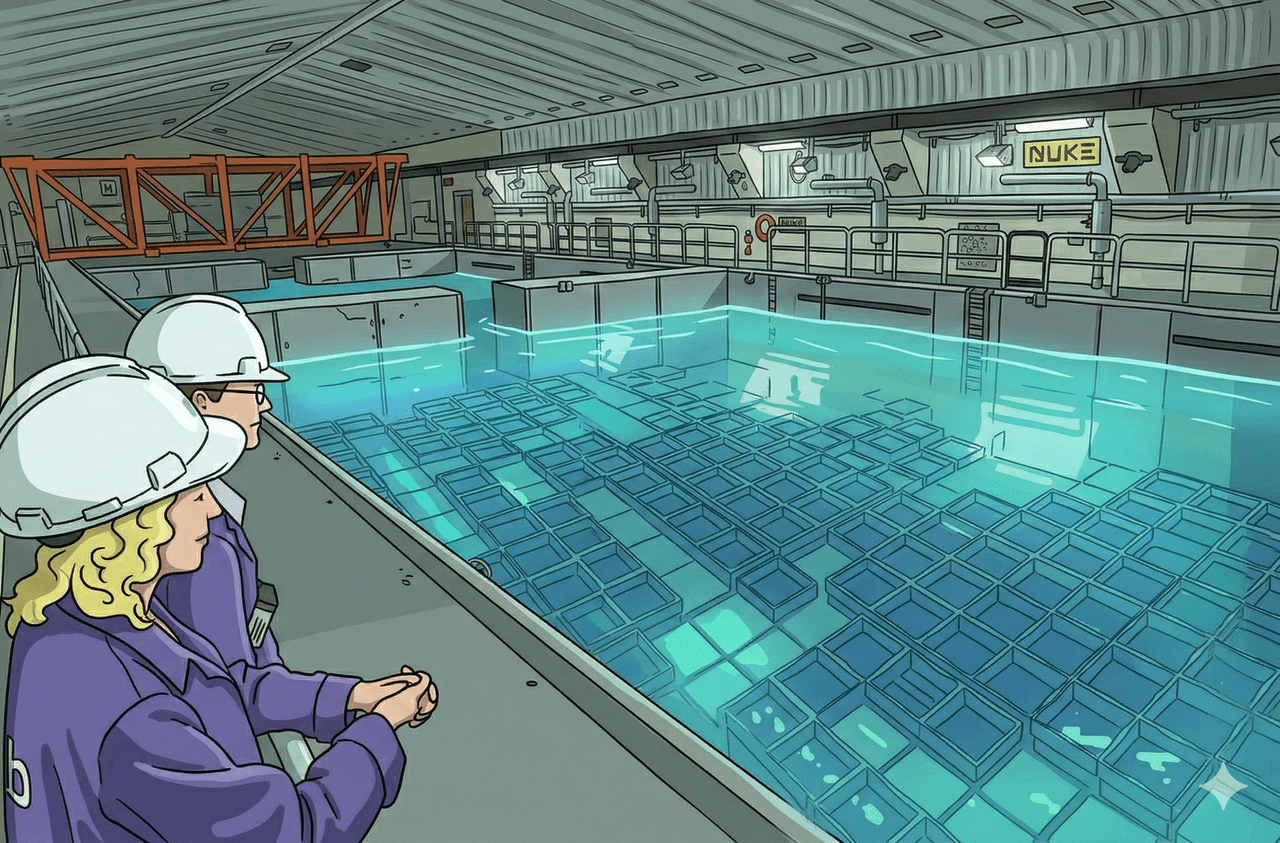
Temporary Storage Pool (Generated by Artificial Intelligence)
Once the fuel has sufficiently cooled in the pool, it is moved to a longer-term home: dry storage containers (dry casks). Why are these containers so favored? Because:
According to an NRC report in the United States: To date, there has been no radiation leak from dry storage casks that has affected the public. This stage is like a “waiting room until the final solution arrives.”【4】
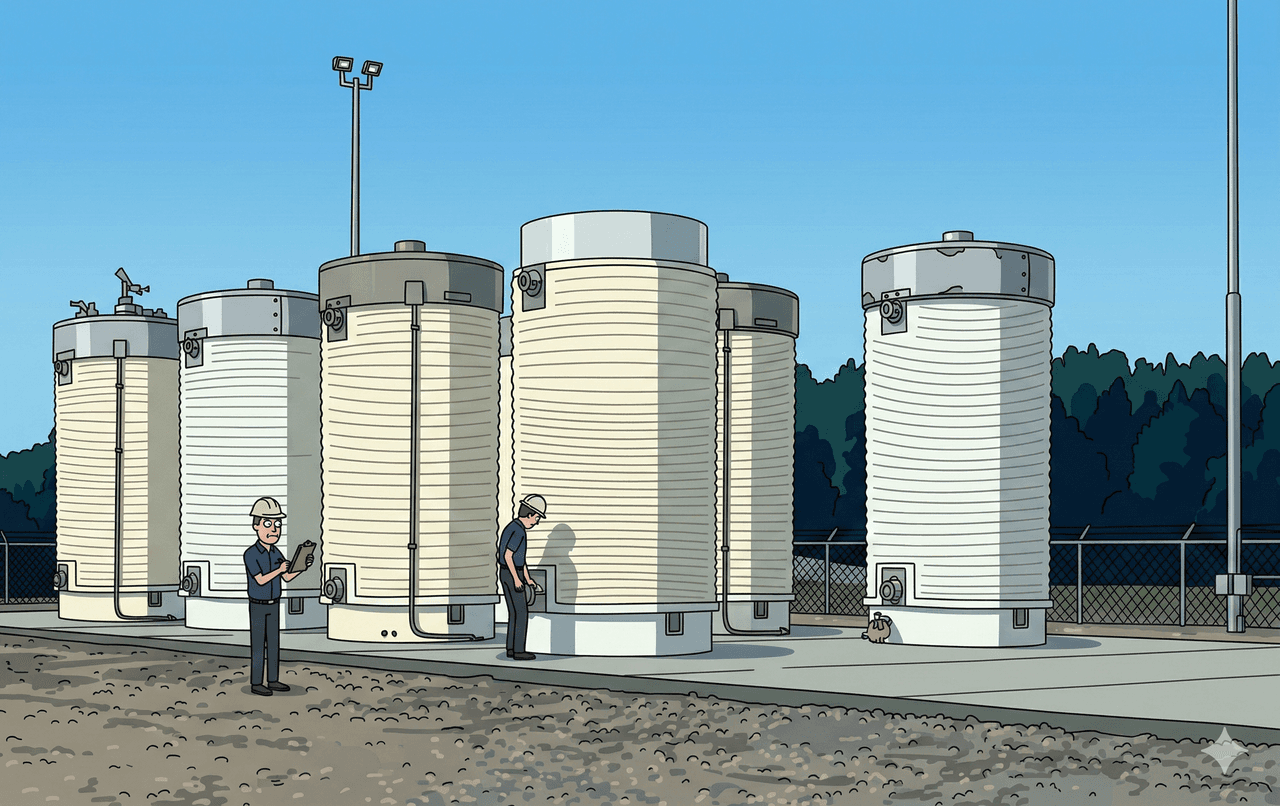
Vertical Dry Storage Containers (Generated by Artificial Intelligence)
A Nuclear Cemetery 500 Meters Underground: Deep Geological Repository.
Now the matter becomes serious: high-level waste. Human civilization only learned to make pottery 10,000 years ago, so the timescale is immense. Therefore, the only permanent solution agreed upon by all scientific institutions today is:
To bury waste deep within stable rock formations 400 to 600 meters underground, where it will remain secure even if no one ever disturbs it again. It is not wrong to think of this as a “nuclear cemetery,” but the level of technology and safety involved is extraordinary.
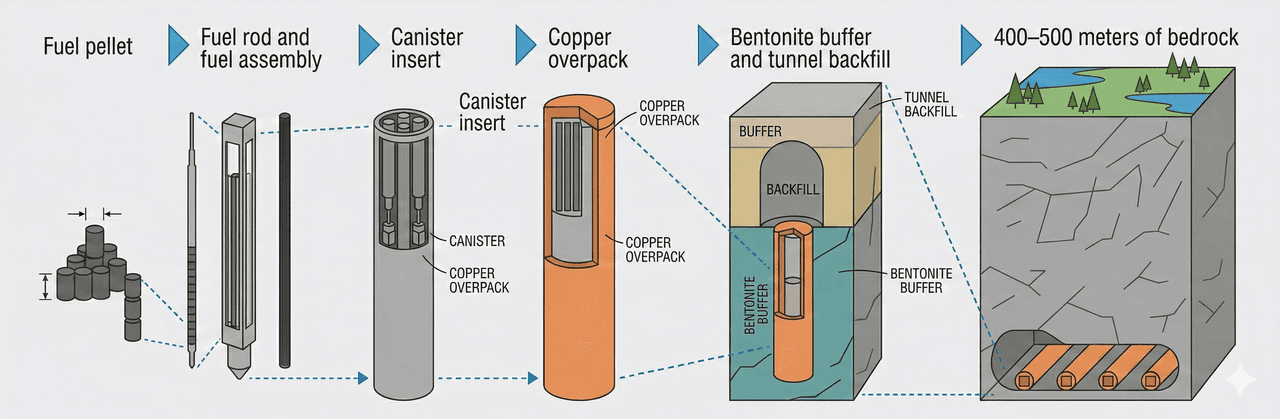
Multi-Barrier Disposal Concept (Generated by Artificial Intelligence)
Finland’s Onkalo facility is the first example of this. In this project:
Onkalo’s opening is planned for between 2025 and 2030. When this facility opens, humanity will witness a historic first: a nuclear-powered nation will officially activate a cemetery designed to isolate its waste for eternity.
A deep repository is not simply “digging a hole and burying.” On the contrary, safety is designed in layers. The IAEA calls this the multi-barrier system:
In this system, if one barrier fails, others are designed to take over. Reviews in Nature Geoscience highlight a consistent point:
“Geological barriers last far longer than human-made barriers.”
When the right rock is selected, an environment that has remained stable for millions of years will continue to remain stable for the foreseeable future.
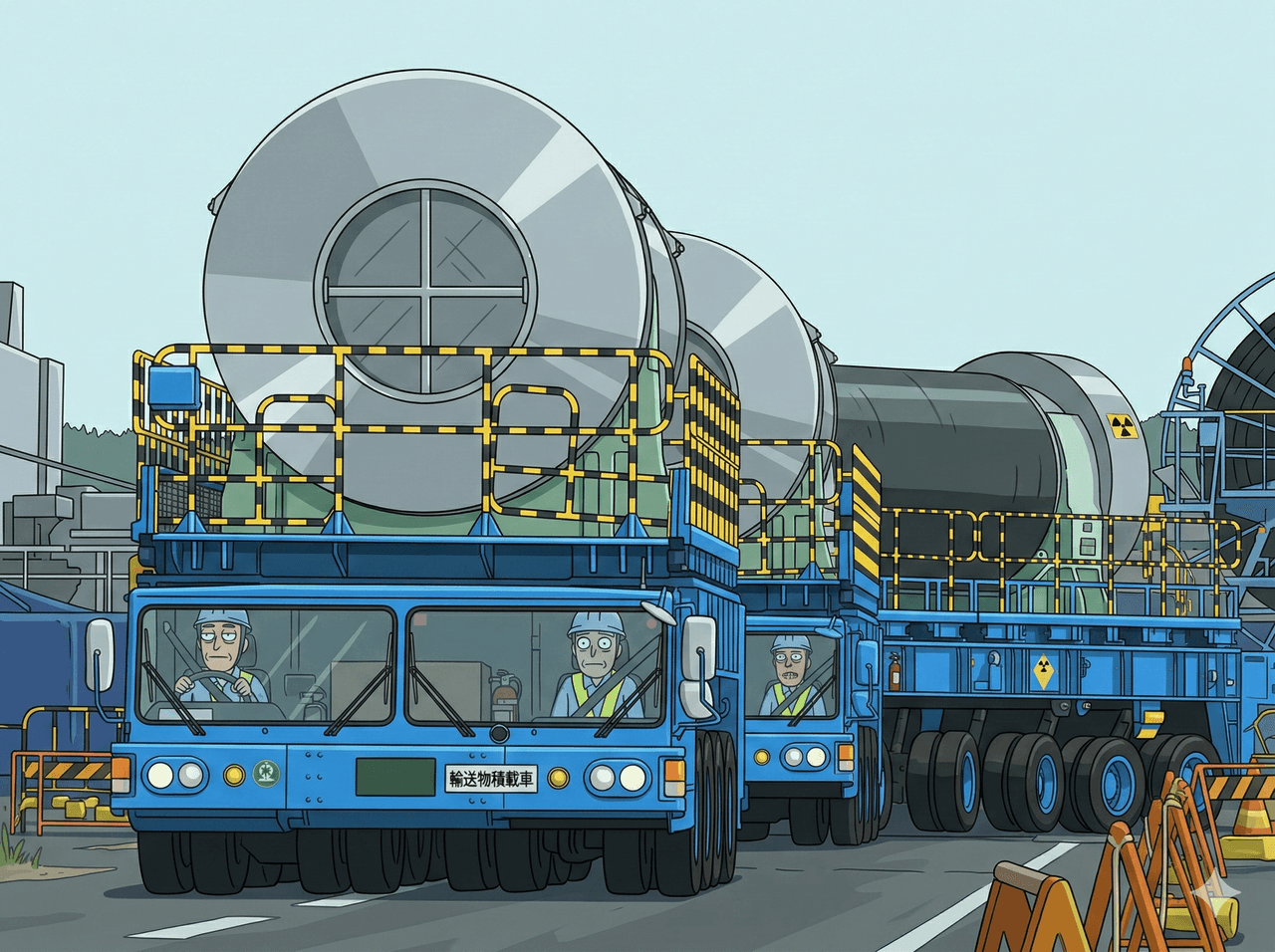
Road Transport of Spent Nuclear Fuel (Generated by Artificial Intelligence)
(NIMBY Syndrome: “Not in My Backyard”) According to OECD/NEA social science reports, most people harbor three primary concerns about nuclear waste:
These concerns are natural. However, an interesting finding emerges: community studies in Finland and Sweden show that transparent communication significantly reduces fear.
From a scientific and technical perspective, the picture is clear:
Telling people they are safe is harder than designing engineering barriers. But projects like Onkalo represent a turning point. Humanity may, for the first time, successfully isolate a high-tech waste product for longer than the lifespan of our civilization. This is not only a scientific leap but also a cultural one. And perhaps it prompts this question:
“What will future generations say about the legacy we leave behind?” If done correctly, perhaps they will say: “Our ancestors knew how to limit danger with knowledge and overcome time with engineering.”
International Atomic Energy Agency. *Guidebook on Spent Fuel Storage Options and Systems*. 3rd ed. Technical Reports Series No. 240. Vienna: International Atomic Energy Agency, 2024. Accessed March 30, 2026. https://www-pub.iaea.org/MTCD/Publications/PDF/DOC_010_240_web.pdf
International Atomic Energy Agency. “New IAEA Report Presents Global Overview of Radioactive Waste and Spent Fuel Management.” January 21, 2022. Accessed March 30, 2026. https://www.iaea.org/newscenter/news/new-iaea-report-presents-global-overview-of-radioactive-waste-and-spent-fuel-management
Posiva. “Introducing ONKALO and Its Principle of Operation.” July 3, 2024. Accessed March 30, 2026. https://www.posiva.fi/onkalo-how-it-works
U.S. Nuclear Regulatory Commission. 2023. “Backgrounder on Dry Cask Storage of Spent Nuclear Fuel.” *U.S. NRC Fact Sheet*, January 2023. Last reviewed/updated June 12, 2023. Accessed December 16, 2025. https://www.nrc.gov/reading-rm/doc-collections/fact-sheets/dry-cask-storage
Vattenfall. “One of the World’s First Final Repositories for Spent Nuclear Fuel Is Being Built in Forsmark.” *THE EDIT*, November 3, 2025. Accessed March 30, 2026. https://group.vattenfall.com/press-and-media/newsroom/2025/one-of-the-worlds-first-final-repositories-for-spent-nuclear-fuel-is-being-built-in-forsmark/
World Nuclear Association. “Storage and Disposal of Radioactive Waste.” World Nuclear Association Information Library. Accessed December 16, 2025. https://world-nuclear.org/information-library/nuclear-fuel-cycle/nuclear-waste/storage-and-disposal-of-radioactive-waste
[1]
International Atomic Energy Agency. “New IAEA Report Presents Global Overview of Radioactive Waste and Spent Fuel Management.” 21 Ocak 2022. Erişim 30 Mart 2026. https://www.iaea.org/newscenter/news/new-iaea-report-presents-global-overview-of-radioactive-waste-and-spent-fuel-management
[2]
International Atomic Energy Agency. Guidebook on Spent Fuel Storage Options and Systems. 3rd ed. Technical Reports Series No. 240. Vienna: International Atomic Energy Agency, 2024. Erişim 30 Mart 2026. https://www-pub.iaea.org/MTCD/Publications/PDF/DOC_010_240_web.pdf
[3]
World Nuclear Association. “Storage and Disposal of Radioactive Waste.” World Nuclear Association Information Library. Updated April 30, 2024. Accessed December 16, 2025. https://world-nuclear.org/information-library/nuclear-fuel-cycle/nuclear-waste/storage-and-disposal-of-radioactive-waste
[4]
U.S. Nuclear Regulatory Commission. 2023. “Backgrounder on Dry Cask Storage of Spent Nuclear Fuel.” U.S. NRC Fact Sheet, January 2023. Last reviewed/updated June 12, 2023. Accessed December 16, 2025. https://www.nrc.gov/reading-rm/doc-collections/fact-sheets/dry-cask-storage
[5]
Posiva. “Introducing ONKALO and Its Principle of Operation.” 3 Temmuz 2024. Erişim 30 Mart 2026. https://www.posiva.fi/onkalo-how-it-works
[6]
Vattenfall. “One of the World’s First Final Repositories for Spent Nuclear Fuel Is Being Built in Forsmark.” THE EDIT, 3 Kasım 2025. Erişim 30 Mart 2026. https://group.vattenfall.com/press-and-media/newsroom/2025/one-of-the-worlds-first-final-repositories-for-spent-nuclear-fuel-is-being-built-in-forsmark/
What Exactly Is Nuclear Waste? (More Than Just Fear)
“The Atomic Coffee Thermos”: Nuclear Fuel Pools
Next Stage: “The Thermos’s Outer Shell” – Dry Storage Casks
So Where Is the Final Destination?
Deep Geological Repository
Onkalo – The World’s First Real Deep Repository
Safety Barriers: “Onion-Skin Engineering”
Global Examples: What Are Different Countries Doing?
Why Do People Generally Fear It?
Conclusion: Is Nuclear Waste Something to Fear, or a Manageable Reality?