


This article was automatically translated from the original Turkish version.

A restaurant’s name can sometimes be more than just a commercial choice; it can be a small but meaningful sign reflecting the political and social atmosphere of its time. The NATO Restaurant, operating in Karaköy since 1952, can therefore be seen as something beyond an ordinary local eatery. A lunchtime venue bearing the name “NATO” illustrates how Turkey’s political, social and international transformations during the 1950s permeated everyday life.
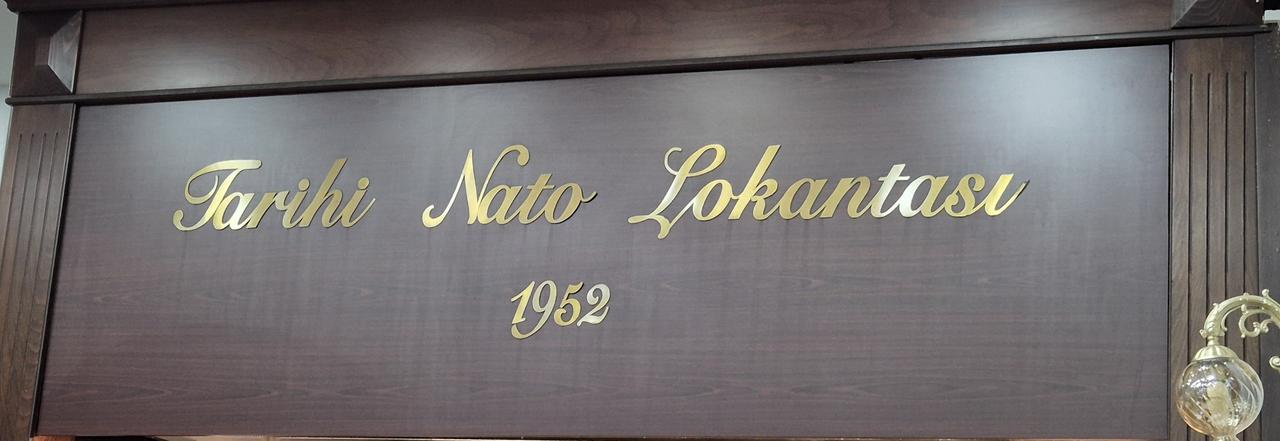
Nato Restaurant Sign (Source: Mehmet Salih Çoban)
The year the restaurant opened, 1952, was the same year Turkey joined NATO. Turkey’s membership was shaped by post-World War II security concerns regarding the Soviet Union, a desire to align with the Western bloc, and the evolving strategic relationship with the United States of America. Thus, NATO membership did not merely mean joining a military alliance; it signified a redefinition of Turkey’s place in the international system, its foreign policy language, and its political identity. To understand how NATO was received in Turkey, one must look not only at parliamentary records, diplomatic correspondence and military agreements but also at signs, advertisements, shop names, consumer goods and the objects people desired. History concerns not only the top-down order established by the state but also how society interpreted and lived that order in daily life.
The NATO Restaurant’s name is one striking example of this process of interpretation. The name of a military alliance was given to a place where meals were served. Thus, NATO ceased to be merely an abbreviation in diplomatic documents; it became an everyday word alongside soup, stews, boiled dishes, desserts and the midday crowd. This does not prove that politics was fully and directly embraced by the public; but it does reveal one of the symbolic expressions of the era’s orientation toward the West, its notions of prestige and its vision of modernization in urban life.
The history of everyday life enters precisely at this point. This approach investigates how major political decisions seeped into people’s lives. Turkey’s entry into NATO did not merely reflect a shift in foreign policy; it was part of a period in which American economic, cultural and consumer influence became more visible. Academic studies indicate that during the 1950s Turkey’s position within the capitalist bloc was closely linked to American consumer goods, lifestyle imagery and conceptions of modernity. The American way of life came to be seen not only as the culture of a political ally but also as an ideal associated with prosperity, progress, technology and new consumer possibilities. One tangible manifestation of this economic influence in the city was the memory of the American Market along the Karaköy–Tophane–Salıpazarı corridor.
In local narratives from the 1960s and later, this market is remembered as a shopping area lined with stalls selling American jeans, sports shoes and imported goods. Memories of the market suggest it was not merely a place to buy things; it was a space where the idea of “American goods” merged with desire, prestige and the sense of something hard to attain. My grandfather used to tell how he wanted to buy a pair of American jeans from the American Market. At the time, these pants were not just clothing to him. American jeans were desirable because of their durability, appearance, distinctiveness and the associations they carried. Yet their price was high.
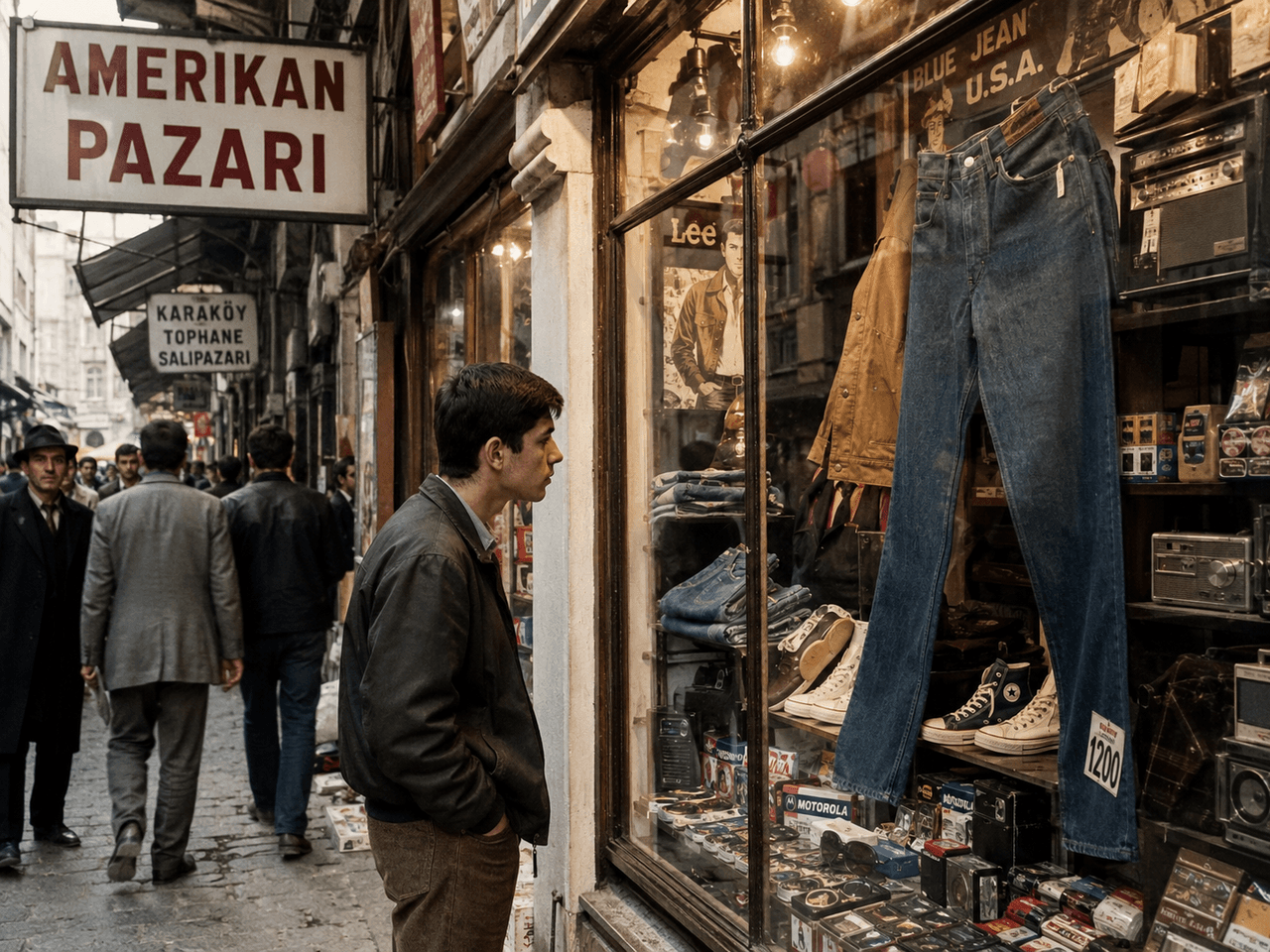
Clothing Shop in the American Market (Generated with AI Assistance)
At first glance, this story may seem unrelated to grand history—a simple childhood or youth memory. Yet from the perspective of microhistory, this small desire reveals much about the social structure of the era. A pair of jeans became an object at the intersection of the Cold War, American influence, consumer culture and economic inequality. The Western alliance established at the state level through NATO membership later reappeared in the form of a pair of American jeans a young person saw in a shop window but could not afford. This anecdote is not, of course, definitive proof of the exact prices at the American Market or the full spectrum of consumption trends in society. Its true value, from the standpoint of the philosophy of history, lies elsewhere: personal memory is not an absolute document that explains the whole; rather, it is a window into experiences easily lost within grand historical narratives. The pants my grandfather could not buy also show that American influence was not experienced uniformly across Turkish society. Indeed, during the same period, a leftist, anti-American political stance known as the 68 Generation also spread among youth. For some, America meant an accessible world of consumption, innovation and modernity; for others, it was a distant, admired but economically unattainable object of desire, and for yet another segment, a symbol of hostile foreign power.
Therefore, explaining American influence solely through one-dimensional concepts such as “ostentation” or Westernization is also insufficient. People did not desire American products merely out of political allegiance. Many factors—durability, fashion, distinctiveness, youth culture, the desire to appear urban and social status—were part of this desire. Likewise, interest in these products does not indicate that Turkey’s own culture was being erased. The NATO Restaurant, serving traditional dishes, and the American Market, where American jeans were sought after, coexisted within the same neighborhood. On one side: lentil soup, white beans and rice; on the other: Levi’s, American shoes and the idea of imported goods. Turkey’s experience of modernization was often lived within this duality.
In this sense, Karaköy is more than just a neighborhood. With its port, customs house, trade, banking, commercial buildings and transportation links, Karaköy was one of Istanbul’s primary points of contact with the outside world. Throughout history, this area had been a conduit for goods, people, news and cultural influences; during the 1950s and 1960s, it became one of the visible urban manifestations of Turkey’s relationship with the Western world. It is no coincidence that both the NATO Restaurant and the American Market are remembered in the same broader area. One reflects politics inscribed on a sign; the other reflects global consumer culture displayed in shop windows.
In conclusion, microhistory and the history of everyday life remind us that grand history does not live only in treaties, wars and state archives. Sometimes it is hidden in a restaurant’s sign, in the shop windows of a market, in a pair of jeans desired but unaffordable in youth, and in family stories recounted years later. The NATO Restaurant and the American Market are two small yet meaningful historical focal points that show Turkey’s position within the Western alliance and the impact of American influence were not merely political orientations—they were matters of desire, consumption, prestige, access and memory.