

 Recently Added:
This article was automatically translated from the original Turkish version.
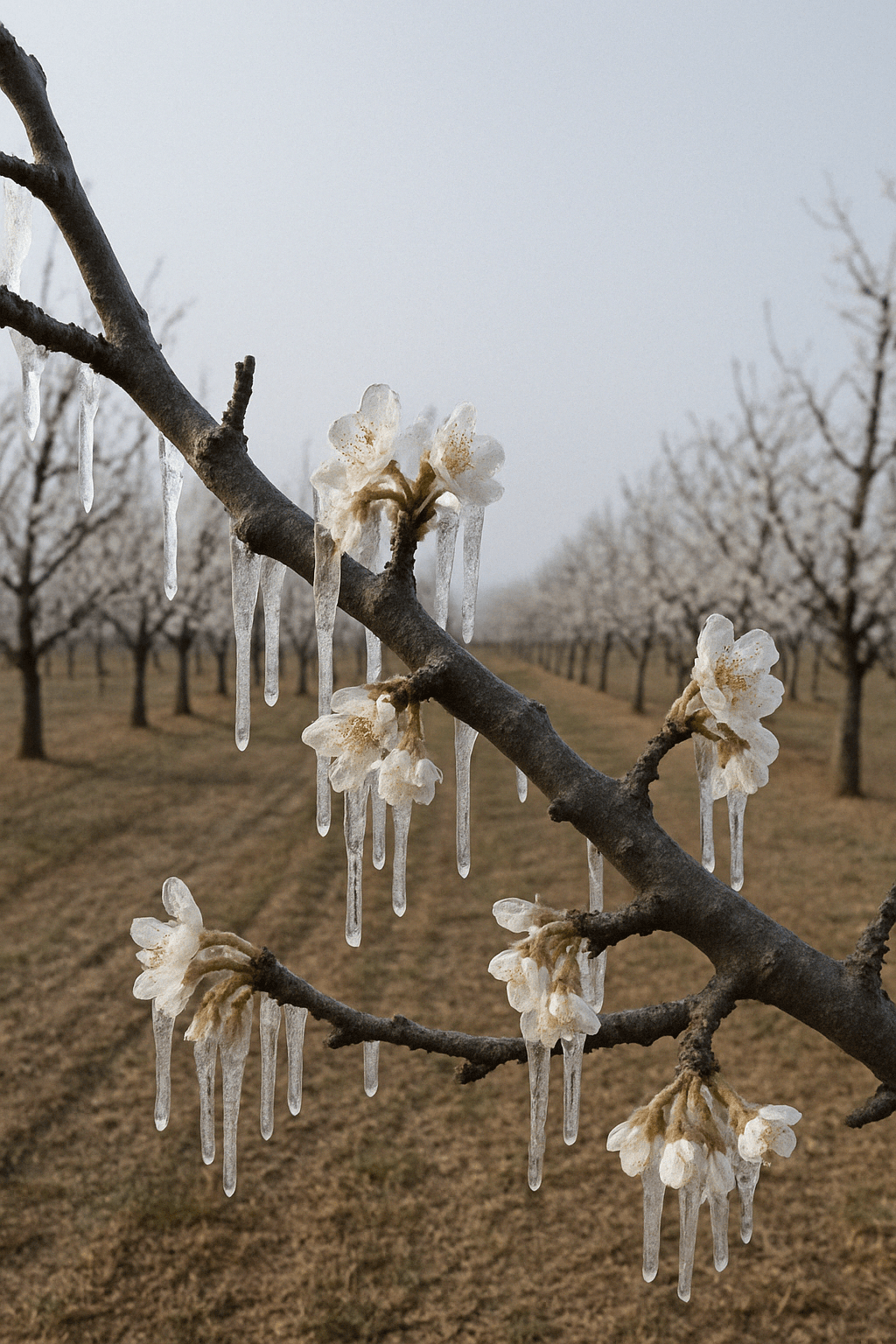
Türkiye Agricultural Pest Disaster (2025)
Type | Meteorological Disaster | ||||||||
|---|---|---|---|---|---|---|---|---|---|
Dates of Greatest Impact | 9-13 April 2025 | ||||||||
Main Affected Provinces | Aksaray Niğde Denizli Isparta Konya Karaman Bolu Afyonkarahisar Kayseri Yozgat Sivas Tokat Nevşehir Amasya Manisa Bursa | ||||||||
Affected Agricultural Products | Apple Apricot Cherry Peach Nectarine Plum Almond | ||||||||
Highest Yield Loss | 85% | ||||||||
The agricultural frost disaster that occurred across Türkiye in April 2025 has been recorded as one of the most extensive and destructive agricultural disasters in the last thirty years. Sudden temperature drops between 9 and 13 April, with air temperatures falling below zero especially during nighttime hours, directly affected agricultural production in 36 provinces. This frost event coincided with the flowering and bud development period of fruit trees, causing severe damage to numerous crop groups, particularly apricot, cherry, apple, walnut, hazelnut, and grape.
Despite warnings from the General Directorate of Meteorology, the intensity of the temperature drops caught many local producers unprepared; in some provinces, the combination with snowfall led to even heavier damage. According to preliminary assessments based on statements from the Ministry of Agriculture and Forestry and local observation reports, the economic and social impacts of the disaster are expected to extend beyond 2025, with long-term consequences anticipated for food supply and prices.
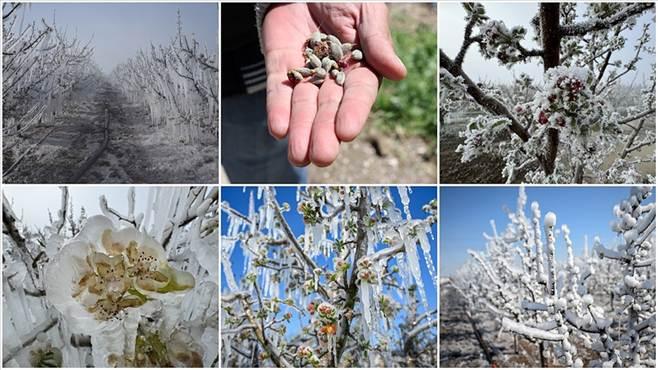
Images of the frost disaster (AA)
The agricultural frost has had significant effects not only on agricultural production but also on insurance systems, agricultural policies, and disaster management processes. A parliamentary research commission has been established; the participation of the Agricultural Insurance Pool (TARSİM) and local administrations in the response process has been reopened for debate. In this context, the disaster has once again brought to the forefront the issue of vulnerability to climate-based agricultural risks.
The agricultural frost event in Türkiye in April 2025 caused high levels of damage across numerous crops due to its timing coinciding with a critical phase in fruit production. This frost disaster, affecting 36 provinces, spread geographically across different regions of Türkiye, resulting in production losses in both Eastern and Western Anatolian provinces.
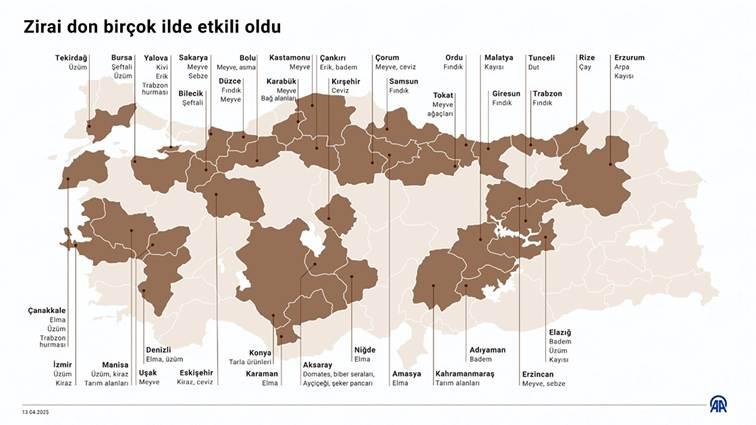
Provinces and crops affected by the frost (AA).
The most severe damage was recorded in apricots. Apricot trees, intensively cultivated in Malatya and Elazığ, suffered approximately 85% damage due to low temperatures during their flowering period. Similarly, cherry trees in Konya and Isparta reported losses of up to 70%. Apple and walnut, among other stone fruits, were damaged in Tokat and Amasya; hazelnut production in Ordu and Samsun; grape production in Manisa and Denizli; and tea production in Rize were all adversely affected by this extreme weather event.
The following table summarizes the main affected products, their rates of damage, and geographic distribution:
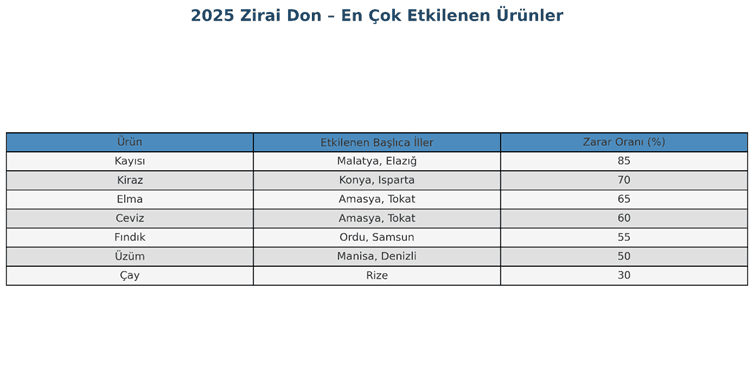
Most affected provinces and crops (generated by artificial intelligence).
The disaster is expected to have notable consequences not only for domestic consumption but also for Türkiye’s agricultural exports. Compared with 2024 data, apricot exports are projected to decline by 72% in 2025. Losses of 35% and 32% are anticipated for hazelnut and grape respectively, while tea exports are expected to drop by 17%.
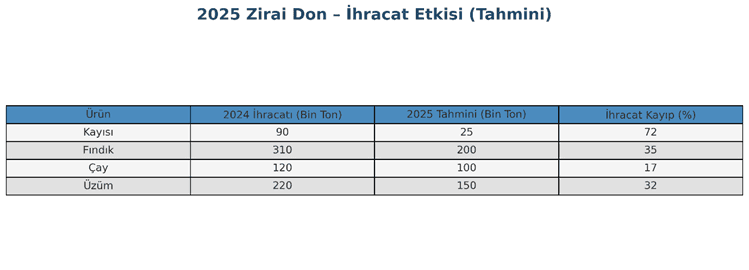
Impact of the agricultural frost on exports (generated by artificial intelligence).
In this context, the 2025 disaster, when compared to the major agricultural frost of 2014 that affected 18 provinces, has not only doubled the affected area but also reached a more destructive economic scale. While estimated damages in 2014 were around 1.8 billion TL, the 2025 disaster is projected to cause losses of 5.2 billion TL. At the same time, the increase in the proportion of insured producers indicates a shift in farmers’ perception of risk.
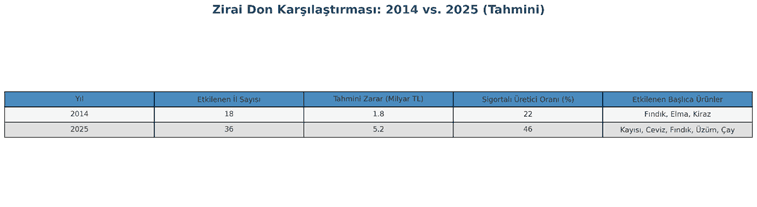
Comparison of 2014 and 2025 frosts (generated by artificial intelligence).
The agricultural frost event that affected Türkiye in the second week of April 2025 resulted from atmospheric systems bringing sudden and more severe cold air waves than anticipated. The General Directorate of Meteorology (MGM) had forecasted that nighttime temperatures would drop below zero across much of the country between 9 and 13 April and designated high-risk areas under its “agricultural frost warning system.”
Agricultural frost is considered one of the most dangerous natural events for agricultural production. According to MGM’s classification, these events are evaluated under three main categories:
The 2025 frost was classified as “severe frost” in many regions due to temperatures falling below -5°C. During this period, characterized by calm and clear nights, heat rapidly dissipated near the earth’s surface, causing surface frosts that led to widespread crop losses in fruit trees during their flowering and bud development stages.
According to meteorological data, temperatures remained below critical levels for three to four consecutive days in many parts of Central Anatolia, the interior Aegean region, Eastern Anatolia, and the Black Sea region. MGM’s frost maps indicated that on the night of 10 April, a broad corridor stretching from Marmara to Eastern Anatolia registered “high” risk levels.
Below is a summary of the general functioning of MGM’s warning systems:
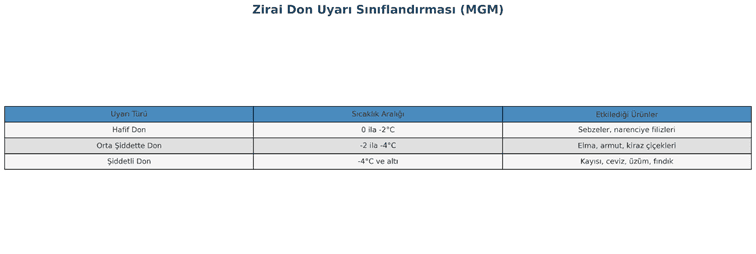
Agricultural frost warning classification (generated by artificial intelligence).
This frost disaster has been assessed not only as the result of instantaneous meteorological conditions but also as an outcome of increasingly unstable weather patterns linked to climate change. Experts suggest that recent increases in seasonal shifts and temperature imbalances may signal the emergence of a new climate regime threatening agricultural production.
Following the emergence of the agricultural frost disaster, the Ministry of Agriculture and Forestry and related public institutions promptly informed the public and activated intervention mechanisms. Minister of Agriculture and Forestry İbrahim Yumaklı, in a statement on 10 April 2025, announced that damage assessment studies had been immediately initiated and emphasized that fruit trees in their flowering stage had been significantly affected. The same statement also noted that “at this stage, there is no risk of negative impact on domestic food supply.”
The Ministry announced that damages to producers insured under the Agricultural Insurance Pool (TARSİM) would be covered within the scope of their policies, and also declared that producers without insurance but registered in the Farmer Registration System (ÇKS) would be included in the support program. Under this framework, grants and credit support measures are planned to directly offset producers’ costs. Alongside these announcements, local agricultural directorates launched field inspections to assess damage, and preliminary reports were made public.
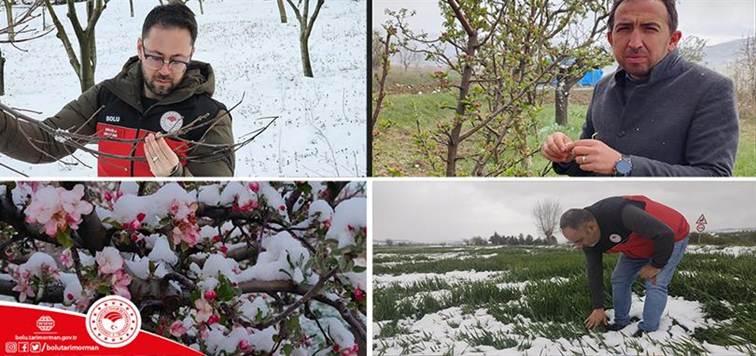
Farmers affected by the agricultural frost (Bolu Municipality).
Following the disaster, the Turkish Grand National Assembly (TBMM) directly intervened, deciding on 15 April 2025 to establish a “Investigation Commission on the Effects of the Agricultural Frost Disaster”. The commission includes representatives from five political parties, with its working period planned for three months. The commission’s purpose is to analyze the disaster’s impacts comprehensively and to develop legal and institutional recommendations to prevent similar disasters in the future.
At the local level, crisis tables have been established in many provinces under the coordination of provincial governorships. In provinces with high damage reports such as Malatya, Tokat, Amasya, Ordu, Manisa, and Rize, information meetings for producers have been organized in cooperation with agricultural cooperatives and chambers of agriculture, providing guidance on application procedures.
The official intervention process has been a test of the existing capacity in both disaster management and agricultural insurance practices. In particular, recommendations to protect small-scale producers, expand insurance coverage, and improve agricultural data monitoring systems have emerged as key priorities in evaluating the response.
The 2025 agricultural frost disaster has generated a broad agenda encompassing not only climatic and economic dimensions but also political and institutional aspects. In response to intense demands from the public and sector representatives immediately after the disaster, the Turkish Grand National Assembly (TBMM) decided to conduct a comprehensive investigation into the matter.
On 15 April 2025, the General Assembly of the TBMM resolved to establish a temporary investigation commission with the aim of determining the “Causes, Effects, and Necessary Measures for the Agricultural Frost Disaster”. The commission’s chairmanship was assigned to a member of parliament with an agricultural background, and representatives from five political parties were appointed as members. The commission’s tasks, planned to be carried out over three months, are as follows:
The commission has gathered data through contact with the Ministry of Agriculture and Forestry, the General Directorate of Meteorology, TARSİM, Chambers of Agriculture, and farmers’ unions; it has conducted field visits, expert hearings, and regional tours to collect information. Particularly, the geographic distribution of policies under TARSİM, the reliability of damage assessment procedures, and structural deficiencies in protecting small-scale producers have become central themes in the commission’s report.
The report, scheduled to be submitted to the TBMM Presidency in July 2025, is expected to be structured around three key axes:
This process is regarded as a significant institutional milestone in enhancing structural resilience against disasters in Türkiye’s agricultural sector.
A Haber. "Bakan Yumaklı'dan Zirai Don Açıklaması: Hasar Tespit Çalışmasına Başladık." A Haber, April 2025.
Anadolu Ajansı. "Bakan Yumaklı: Yurt içi gıda arzını olumsuz yönde etkileyecek bir risk bulunmuyor." April 14, 2025.https://www.aa.com.tr/tr/ekonomi/bakan-yumakli-yurt-ici-gida-arzini-olumsuz-yonde-etkileyecek-bir-risk-bulunmuyor/3538152.
Anadolu Ajansı. "Zirai Don 36 İlde Etkili Oldu." Anadolu Ajansı, April 2025.
BBC Türkçe. "Zirai Don Hangi Ürünleri Nasıl Etkiledi, Çiftçilerin Zararı ne Olacak?" BBC Türkçe, April 2025.
Ekonomi Haber. "Zirai Don Hangi İlde Neyi Etkiledi! Ürün Bazlı Zarar Listesi." Ekonomi Haber, April 2025.
Meteorology General Directorate. “Zirai Don Uyarı Sistemi.” mgm.gov.tr, April 2025.https://www.mgm.gov.tr/tarim/zirai-don-uyari-sistemi-harita.aspx#
Ministry of Agriculture and Forestry. "Minister Yumaklı: There Is No Negative Risk in Terms of Food Supply." *Ministry of Agriculture and Forestry*, April 2025.https://www.tarimorman.gov.tr/Haber/6576/Tarim-Ve-Orman-Bakani-Yumakli-Gida-Arz-Guvenligine-Iliskin-Bir-Problem-Yok
Sözcü. "Son 30 Yılın En Büyük Zirai Don Felaketi! 36 İlde Tarım Alarmda…" Sözcü, April 2025.
T.C. Bolu Provincial Directorate of Agriculture and Forestry. "Zirai Don Tehlikesi Devam Ediyor!" T.C. Tarım veOrman Bakanlığı Bolu İl Müdürlüğü, April 2025.https://bolu.tarimorman.gov.tr/Haber/1585/Zirai-Don-Tehlikesi-Devam-Ediyor.
TRT Haber. "Meclis’te Zirai Don Afetinin Araştırılması İçin Komisyon Kuruldu." TRT Haber, April 15, 2025.
Yeni Şafak. "Zirai Dondan Etkilenen İller ve Ürünler – Türkiye Don Haritası." Yeni Şafak, April 2025.

Türkiye Agricultural Pest Disaster (2025)
Type | Meteorological Disaster | ||||||||
|---|---|---|---|---|---|---|---|---|---|
Dates of Greatest Impact | 9-13 April 2025 | ||||||||
Main Affected Provinces | Aksaray Niğde Denizli Isparta Konya Karaman Bolu Afyonkarahisar Kayseri Yozgat Sivas Tokat Nevşehir Amasya Manisa Bursa | ||||||||
Affected Agricultural Products | Apple Apricot Cherry Peach Nectarine Plum Almond | ||||||||
Highest Yield Loss | 85% | ||||||||
The frost event that affected Türkiye, particularly the Central Anatolia, Aegean, and Marmara regions, between 9 and 13 April 2025 coincided with the flowering period of many agricultural products, especially apples, apricots, peaches, and cherries. Night temperatures falling below zero caused widespread damage to fruit trees, resulting in regional losses in agricultural production. The disaster has been officially recorded by the General Directorate of Meteorology and the Ministry of Agriculture and Forestry.
No Discussion Added Yet
Start discussion for "Türkiye Agricultural Pest Disaster (2025)" article
April 17, 2025
Affected Regions and Products
April 17, 2025
Meteorological Background
April 17, 2025
Official Statements and Intervention Process
April 17, 2025
TBMM Commission and Legal Processes