


This article was automatically translated from the original Turkish version.
The horse branding tradition is a historical practice used to identify ownership and trace bloodlines of horses. This historical tradition has taken various forms across different cultures and has become an integral part of cultural identity social structures and economic activities.
Turk and Mongol cultures regard horse branding as an important element for determining a horse’s gender age owner and sometimes its value. Among the Mongols this practice involves branding foals with a hot iron and is supported by special traditional events and celebrations. The Turks also have a similar branding tradition according to which brands made with chalk paste are applied on horses and cattle on the ears or above the nose back tail or head and on goats and sheep. In addition brands are also used on wheat or flour storage bins tombstones carpets kilims heybes and sacks.
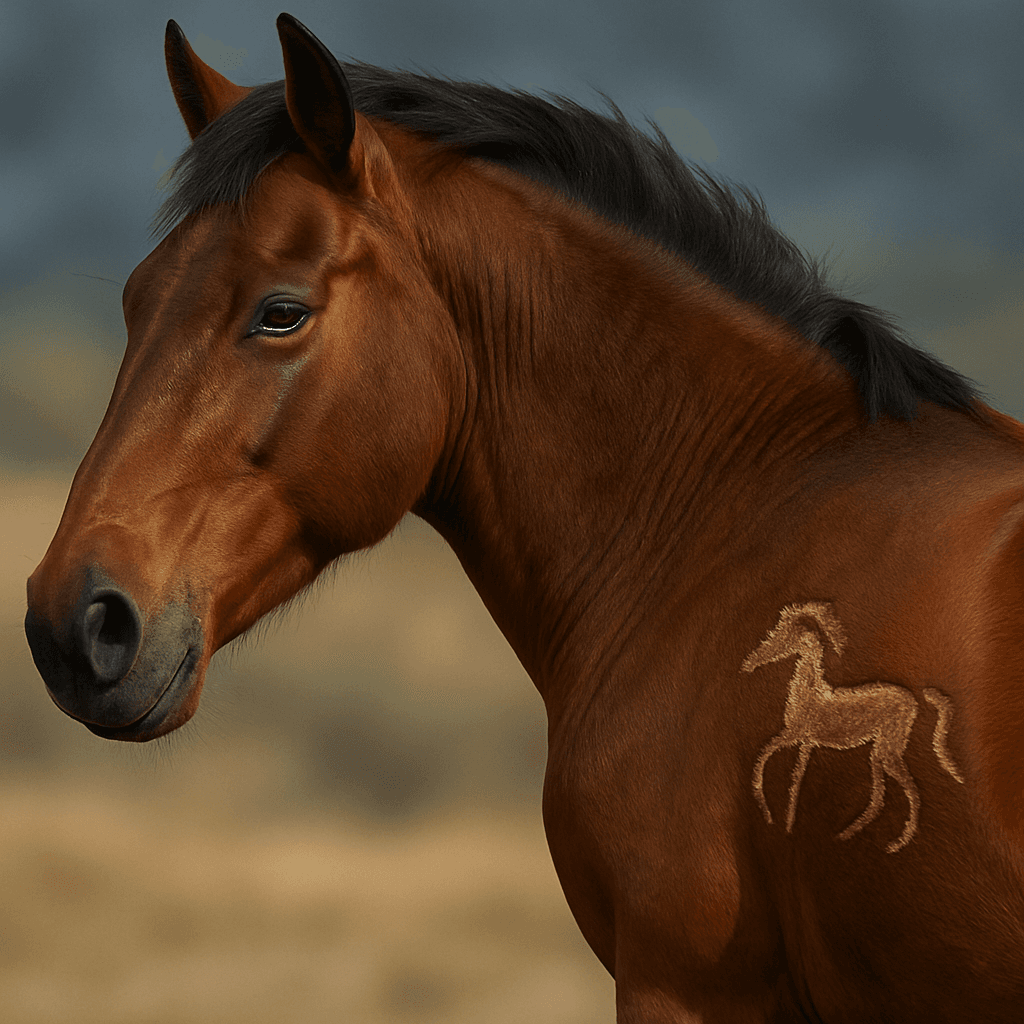
Image of a Brandled Horse (Generated by Artificial Intelligence.)
The horse branding tradition has been widespread especially among nomadic societies. These communities used horses both as a means of transportation and as animals of economic value. Therefore identifying horses was of great importance. Horses played crucial roles in both warfare and daily life and the Turks also used branding as a symbol of prestige wealth and status. In nomadic societies the number type and even the brands on horses were among the key factors determining a person’s social status. The horse branding tradition was reinforced during the Turks’ migrations from Central Asia to Anatolia and became a symbol of the Turks’ deep relationship with horses.
Horse branding is generally defined as a process performed with a heated iron. In this process a metal piece is heated to high temperatures and pressed onto the horse’s skin. The brand is typically applied to the back head or legs. These brands may serve as symbols indicating the owner lineage and sometimes the age or value of the animal.
Branding methods have varied across different periods. Some societies branded only the horse’s back while others also applied brands to the head or tail base. Moreover specific brand designs were used among different lineages and families to reinforce a sense of social affiliation. The brands could be adorned with symbols carrying different meanings such as geometric shapes animal figures or lineage names like symbols. These brands were seen not merely as identifiers of animals but also as symbols of social bonds and power relationships and these traditions were carefully preserved.
In Mongolia the horse branding tradition does not merely indicate individual ownership but also serves as a symbol of ethnic and clan identity. The use of identical or similar brands across vast distances reveals how deeply rooted and socially embraced this tradition is. For example despite a distance of approximately 2000 kilometers between Nalaikh district near the capital Ulaanbaatar and Bayan-Ölgii province in western Mongolia documented evidence shows the use of similar or identical brands. This situation is either explained by the shared clan origins of brand owners or by the fact that brands in Mongolia are individually determined resulting in coincidental similarities.
Mongol preferences for branding horses are centered on specific anatomical areas. The branding is typically applied to the left side the rider’s side. However if the same or a similar brand has already been used on another horse the new brand is applied to the right side to distinguish it.
It is known that Mongol shepherds traditionally use three types of brands.
This brand is applied using a mildly heated metal tool that touches only the horse’s wool not the skin. Üsen tamga is considered a temporary marking method and is commonly used on purchased or borrowed horses. It becomes invisible during the spring months when the wool sheds. Therefore it is preferred for non-permanent situations.
Positioned between üsen and mahan tamga the hörsön tamga is applied with slightly greater pressure on the skin but does not fully burn it. Hence it is a brand type that may fade over several years.
This is a permanent branding method achieved by applying a metal heated to high temperatures directly to the skin. The area where the brand is applied loses hair and the mark is completely permanent. Because it is painful it is not applied in cold weather. Since the brand requires time to heal it must be performed with great care.
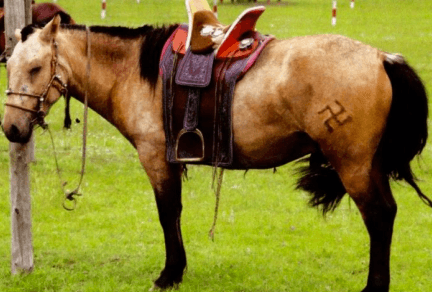
A Brandled Mongolian Horse (UTEKED)
The zürhen tamga derives its name from the Mongolian word zürkh meaning “heart” or “core.” Since the heart is regarded as a vital organ for both humans and animals this symbol holds great symbolic meaning in Mongolian culture. While one may imagine life continuing without limbs eyes or senses a life without a heart is inconceivable. Therefore the heart shape in branding does not merely indicate ownership but is also seen as the source of life and a mark of essence.
The zürhen tamga has been widely used by Mongols as an identifying mark for horses. This brand represents not only the animal’s affiliation with its owner but also its spiritual connection and value. The brand is typically shaped like a heart and in some regions has aesthetic variations. In Inner Mongolia this brand type is also known among the people as “buyvan tamga.” The term “buyvan” can mean “revered” or “sacred being” in local dialects further reinforcing the value attributed to this heart symbol.
The khas tamga is a special type of sign with deep historical and symbolic meanings among the Mongols. The word “khas” originates from the Sanskrit word “samgard.” In Mongolian this word means “original” “noble” “pure” or “sacred.” The brand is typically rendered as a geometric figure with four arms bent at right angles to each other. Although its appearance resembles a swastika its origins and meaning in Mongolian culture are much older and distinct.
The khas tamga represents movement continuity and life energy. It is also associated with peace balance and cosmic order. In Mongolian traditional beliefs this brand symbolizes themes such as the cyclical nature of the universe the harmony between animals and nature and the sacredness of human-animal relationships. In Mongolian society the use of the “khas” figure is not limited to horse brands; it also frequently appears in traditional textiles home decorations and war equipment. In this way the khas tamga has become deeply embedded in the cultural and belief systems of the Mongolian people.
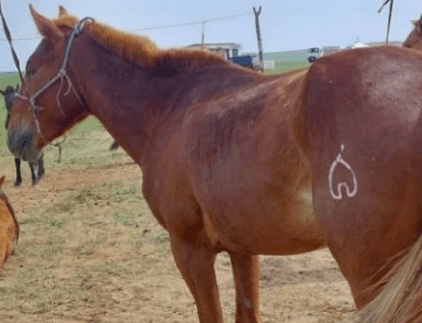
A Mongolian Horse with Zürhen Tamga (UTEDEK)
Today the horse branding tradition continues in some areas. In villages engaged in traditional animal husbandry branding is still used to establish ownership of horses. However with the advent of modern animal husbandry this tradition has become less common. Nevertheless it is being revived in certain cultural events festivals and celebrations.
The horse branding tradition is also preserved as cultural heritage and represents historical value. In this context the branding process is viewed not merely as a means of indicating ownership but as a cultural element symbolizing people’s connection to their past and cultural identity.
Aksoy, Halil İbrahim. *Türk Kültüründe Damga*. Master's thesis,Uludağ Üniversitesi Institute of Social Sciences, 2004. Accessed April 16, 2025.https://acikerisim.uludag.edu.tr/items/3f2e692c-f41f-44cb-8065-6686f7a866e7
Gül, Seyfullah. “Türk Kültüründe Hayvan Damgalama Geleneği: Samsun Yöresi Örneği.” *Millî Folklor* 18, no. 141 (2024): 115–132. Accessed April 16, 2025.https://dergipark.org.tr/en/pub/millifolklor/issue/83684/1243927
Karatayev, Olcabey, and Kayrıkan Janıbekova. “Damgalar ve Onların İşlevleri (Fonksiyonları).” *TÜRÜK: Uluslararası Dil, Edebiyat ve Halkbilimi Araştırmaları Dergisi* 4, no. 8 (2016): 163–179. Accessed April 16, 2025.https://dergipark.org.tr/en/download/article-file/632984
Syeıtkhan, Shynarbyek. “Moğollarda At Damgalama Gelenekleri ve Damga (Tamga) Türleri.” *Uluslararası Türkçe Edebiyat Kültür Eğitim (TEKE) Dergisi* 13, no. 1 (2024): 1–21. Accessed April 16, 2025.https://dergipark.org.tr/en/pub/teke/issue/83624/1426386

No Discussion Added Yet
Start discussion for "The Tradition of Horse Branding in Mongolian Culture" article
History of Horse Branding
Branding Methods and Meanings
Geographical Spread and Meaning of Branding
Branding Locations and Directional Preferences
Types of Brands
Üsen Tamga (Wool Brand)
Hörsön Tamga (Soil Brand)
Mahan Tamga (Flesh Brand)
Examples of Symbolic Mongolian Horse Brands
Zürhen Tamga (Heart Brand)
Khas Tamga (Sacred Brand)
The Horse Branding Tradition and the Present Day