This article was automatically translated from the original Turkish version.
Dear diary,
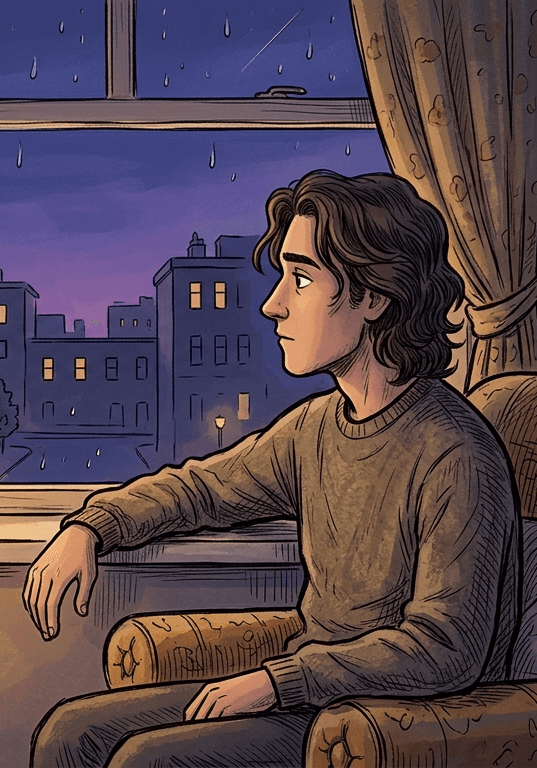
Young Man Suffering from Existential Pain (Generated with AI)
Today, I woke up again with that familiar, heavy, inexplicable ache. You know how sometimes a boulder seems to settle on your ribcage, making even breathing feel like a laborious task? That’s exactly how it was. I opened the window and looked outside. The sky outside was not gray, but a brilliant blue—but in my eyes, all its richness had been drained. It was as if someone had tampered with the world’s color palette, turning its vibrant greens and exhilarating blues into pale memories.
That endless pain of existence, today again, spins in my mind like the chorus of my favorite song. Truly, why are we here? And more importantly, why are we like this?
Today I went out into the street. My only goal was to walk, hoping that perhaps, by blending into the crowd, I might dissolve the emptiness inside me. But the opposite happened. Among all those people, I felt more alone, more profoundly “other,” than ever before. I looked at each face as they passed. Thousands went by. All in a rush to reach somewhere, all lost in their own mental labyrinths like ghosts. I met someone’s gaze—just for a second. A greeting passed through me, sincere and without expectation: “hello.” But his look was so dull, so distant, that the word stuck in my throat. Why do people run from a smile? Why has saying hello, acknowledging another’s presence, become such a heavy burden?
Has the world grown worse, or have we made it this way? I imagine that long ago, perhaps very long ago, people used to look into each other’s eyes and feel warmth in their chests. Now, everyone treats each other as obstacles, rivals, or worse—as empty voids. Even while waiting at a bus stop, the invisible walls between us are so thick it feels as if each of us is trapped inside our own glass dome. Our oxygen is running out, but we don’t notice.
Diary, do you know what I realized today? Are people bad, or are they merely “incomplete”?
Perhaps what we call evil is simply the drying up of the veins of kindness and gentleness within us. It is the end of faith and hope in life itself. The masses who never apologize when they shove past someone, who never thank you when you hold a door, who push ahead in line at the market—they all seem caught in some secret war. But who is their enemy? Themselves? Or life itself? What are we trying to win in this merciless race? More money? More career? Or is it simply “surviving” that has made us so cruel?
As I walk the streets, I look at the buildings—all colossal piles of concrete. These lifeless towers we’ve erected, crushing nature’s unique beauty, feel like reflections of our souls: cold, angular, gray. Do you know why the world’s colors have become colorless? Because we’ve forgotten how to see. We only look. Instead of noticing how a tree dances in the wind, how a cat sleeps peacefully on the edge of a sidewalk, how rain smells when it touches the earth, we bury ourselves in the artificial worlds glowing on our phones. We fear our own inner voice so much that we feed our minds with the endless noise of the outside world.
Sometimes I think this “pain of existence” I speak of is a warning signal—a cry from a soul trying to break free from the system. “Hey, something is wrong here!” That voice inside me says. In a world where people are so loveless and so alien to one another, where should I stand? Should I become like them? Should I withhold my greeting? Should I walk with my eyes fixed to the ground? I know I’m being pulled too quickly toward pessimism. It feels as if I’m standing on the edge of a cliff, and the wind behind me blows fiercely. Below is pitch black, with no glimmer of light. Why are there so many bad people? Or is it just that their voices are the loudest? We live in an age where compassion is seen as weakness and kindness as naivety. When you want to help someone, they assume you have an ulterior motive. When you want to love someone unconditionally, you’re labeled “crazy” or “obsessed.” Our hearts have grown so calloused that we believe even the smallest tenderness will make us bleed. So we extend our shields fully, greeting each other with swords.
Today I sat for a while in a park. I saw a child, whose hands had not yet been stained by the world’s grime. She chased a butterfly, fell, laughed, and got up again. In that moment, I realized something. The world is not evil. The world continues to turn with immense balance and astonishing grace. The sun rises every morning, warming everyone without distinction. The earth, no matter how much concrete we pour over it, still finds a crack to grow green. The evil is not in the world—it is in humanity, blind to this beauty, drowned in its own pride. We are the most advanced, yet also the most destructive, creatures on this planet. We have an insatiable appetite for destroying each other and our home.
And what about me? Where do I stand in this picture? Sometimes I feel so powerless. What can I change with a single essay, a single thought? I feel like a tiny candle flame in this dark sea. And then, pessimism, like a creeping vine, wraps around my soul. Everything feels meaningless. Why bother? Why do I write? Why do I read? Why do I try to learn? I am crushed under the weight of my own existence. The pain turns into a cramp in my stomach.
But then… then something strange happens, diary.
On my way home in the evening, I met that grumpy old uncle from the neighborhood—the one who never greets anyone and grumbles at everything. As I passed him, I saw him gently caress a small flower in his garden, as if it were the rarest diamond in the world. There was a faint softness on his face. In that moment, I understood: even in the worst among us, there is a hidden, suppressed delicacy. Perhaps he is tired, perhaps he is hurt, perhaps he, like me, is drowning in this pain—but all he shows the world are his thorns.
Yes, people can be unbearable. Yes, the world can seem unbearable. Colors fade, greetings disappear, hearts harden. I have seen the bottom of the abyss of pessimism too often. Yes, yes, yes… But even as I stand on the edge of that abyss, the cool, gentle breeze brushing my face reminds me of something. I can still feel. Isn’t the very ability to feel this pain proof that I am still alive, that I still have a soul?
I feel the dark clouds inside me beginning to disperse. Perhaps that is why we write—to pour our inner poison onto paper and leave behind only what is pure.
People can be cruel, the world can be unjust—but despite all this, even because of all this, to still be able to breathe, to chase an idea, to lose yourself in the rhythm of music…
I am looking outside now.
The streetlights are on.
The city, despite all its chaos and crudeness, glows like a sea of light.
Perhaps tomorrow, when I greet someone, I will receive no reply.
Perhaps I will again witness people’s selfishness and grow angry.
But do you know, diary?
Despite all this pain, all these “whys,” all this colorlessness…
Life is still beautiful.
Why shouldn’t it be?
If we think too much about all this, won’t we go mad?【1】
Cabadak, Gözde. "Yayımlanmamış Blog Yazısı." Date Published May 5, 2026.
[1]
Cabadak, Gözde. "Unpublished Blog Post." Date of Writing: May 5, 2026.