


This article was automatically translated from the original Turkish version.
When we cry, laugh, or feel sorrow, the voice that has always been beside us is that of the 20th–21st century dervish Cem Karaca. Would you like to take a closer look at him alongside Barış Manço? After reading about Barış Manço, I wanted to embark with you on a deep journey into the life of Cem Karaca, one of the most unique figures in Turkish music. He was a true "Anadolu rock poet," blending the thousand-year breath of Anatolia with the tones of rock.
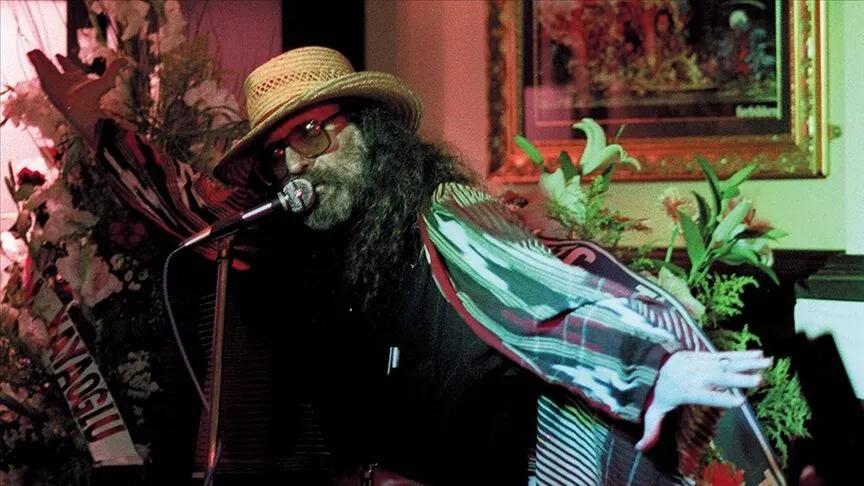
Cem Karaca (Anadolu Ajansı)
It all began on April 5, 1945, in Istanbul, in a house enveloped in the dust of theater. He was born as "Muhtar Cem," the son of Toto Karaca, an opera artist of Armenian descent, and Mehmet Karaca, a theater actor of Azerbaijani origin.【1】
At just six years old, encouraged by his mother, he took his first steps into music education. Yet his childhood was not always idyllic. Like many others, he faced his share of struggles. The dark period following the September 6–7 events was deeply felt even in the homes of Bakırköy. As a teenager during those years, he felt the intensity of those times acutely.【2】
Cem Karaca - Bu Son Olsun (Avrupa Müzik)
During his years at Robert College, like many youths of his generation, he fell under the spell of Rock ‘n Roll. While dreaming of becoming a doctor or engineer, his first song, sung in the middle of the street to impress a young girl named "Suadiyeli Nesrin," became a small but pivotal step that ignited his musical career.【3】
His professional journey began when he was pushed onto the stage at the Beyoğlu Sports Club. He continued with bands such as "Dinamitler" and "Jaguarlar." During those days, this young man who sang Elvis Presley songs on stage was met with fierce opposition from his father, Mehmet Karaca, who wanted him to become a physician. So determined was Mehmet that he even hired someone to disrupt Cem’s performances and shout him offstage.【4】
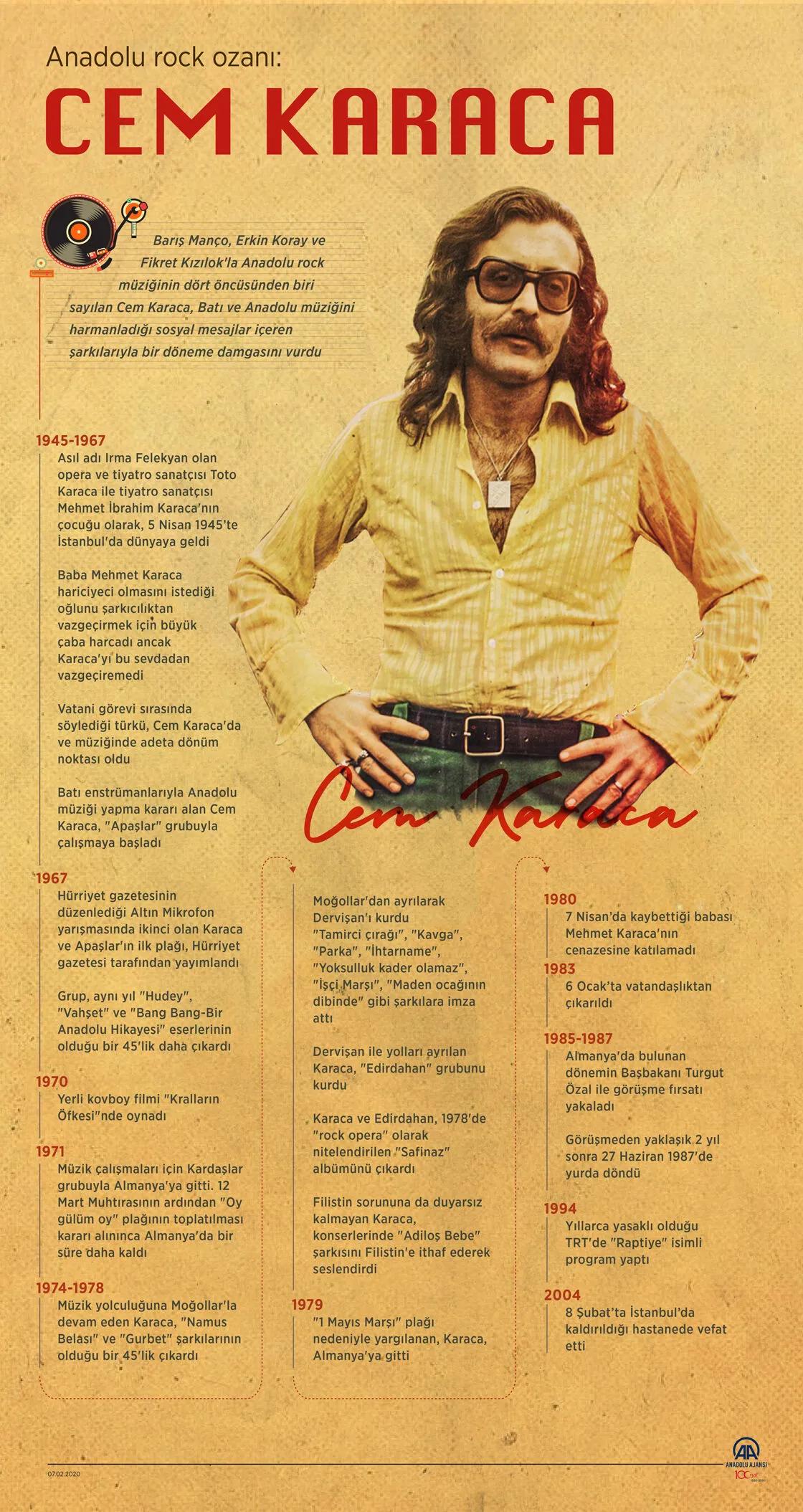
Cem Karaca İnfografik (Anadolu Ajansı)
The true turning point in Cem Karaca’s music came in 1965, during his national service in Antakya. Until then, this college-educated youth had viewed Anatolian music as "strange and primitive." But everything changed when he heard a soldier singing a folk song accompanied by a bağlama. Cem Karaca described this moment: "Until then, I thought of Anatolian music as strange and primitive, but then I realized that the very emotions I was experiencing at that moment were being expressed, articulated, and conveyed by that music."【5】
It was at that moment that he made the decision to fuse the essence of Anatolia with Western instruments—the most significant turning point in his life.【6】
Upon returning to Istanbul, he began working with the group Apaşlar. In 1967, he entered Hürriyet’s Altın Mikrofon Competition with a composition based on a poem by Emrah of Erzurum. Although he came in second, the originality and artistry of his work overshadowed the winners.【7】
The song that followed, "Resimdeki Gözyaşları," entered history as one of the most precious works in Turkish popular music and continues to accompany us to this day. Even as I write this, it is playing beside me. As he sang in the song: "A handful of memories remain," and we will always remember, and always will remember, these moments...
The 1970s revealed Cem Karaca not merely as a musician, but as a central figure in social movements—a true "Dervişan." After his time with Kardaşlar and Moğollar, he formed the Dervişan group, merging progressive rock sounds with political messages. Songs like "Tamirci Çırağı," "Kavga," "Parka," and "1 Mayıs Marşı" became the voice of class struggle and the working class on stage. He was now seen as one of the most iconic figures of the left movement, and his songs stood at the pinnacle of political protest.【8】
Cem Karaca - Dadaloğlu (Avrupa Müzik)
When we examine Karaca’s songs from this period, we see they are far more than mere melodies or simple tunes. Each one is a sociological document, portraying migrants, fathers, the poor, and laborers—figures whose realities we still witness today.
For instance, in his rock opera "Safinaz," he meticulously portrayed the life of a doorman’s family; in "Tamirci Çırağı," he brought to our faces the dreams and harsh realities of a young worker in love with a wealthy girl. In "1 Mayıs," he gave voice to the concepts of "worker" and "laborer." And when we listen to "Dadaloğlu," we hear the lines: "The state has issued a decree about us; the decree belongs to the sultan, brothers—the mountains are ours."
In 1979, as political tensions in Türkiye escalated, Cem Karaca was forced to leave for Germany after being prosecuted over his recording of "1 Mayıs Marşı." After the September 12 coup, he could not respond to calls to return home due to fears of torture and arrest. On January 6, 1983, he was stripped of his citizenship and became stateless.【9】
Cem Karaca - Tamirci Çırağı (MüzikPlay)
His years in Germany became a period of profound longing for a homeland he had lived in his bones. With the group he formed there, "Kanaken," he voiced the struggles of Turkish migrant workers and those perceived as "the other."【10】
When he sang in his songs, "You cannot become German from being Turkish," he was in fact expressing his own painful struggle with integration and his deep yearning for home. He even missed his father Mehmet Karaca’s funeral in 1980.【11】
When his longing became unbearable, he met with then-Prime Minister Turgut Özal in a Munich hotel. Although the media sensationalized the meeting as "Karaca kissing Özal’s hand," this time he appeared before us simply as a father who wanted only to return to his homeland and reunite with his son.【12】
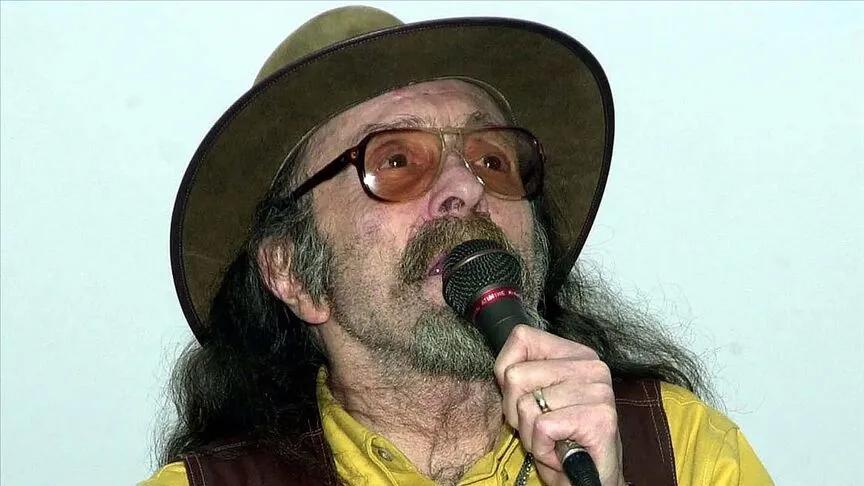
Cem Karaca (Anadolu Ajansı)
On June 27, 1987, after more than seven years in exile, he stepped onto Istanbul’s soil with his stateless passport. The moment he embraced his 11-year-old son Emrah at the airport, crying, transcended all political debates.【13】
Yet his return was met with accusations of betrayal from former comrades. In response, he sang with radiant sincerity: "If I am a traitor, then I betrayed for my homeland, oh my!" His songs, filled with a radiant longing for Türkiye, answered every criticism. In 1990, he won the Altın Güvercin award with "Kahya Yahya." He continued his musical journey with Cahit Berkay and Uğur Dikmen.【14】
When listening to Cem Karaca, I feel not only his rock songs but also his deep grounding in a thousand-year-old Turkish folk culture. He presented a culture that harmonized the old with the new, reviving the tradition of past poets in a modern form.
He masterfully introduced us to elements of folk literature. In his songs, he used numbers such as "3, 7, 40," embedding the Sufi cultural motifs of threes, sevens, and forties into our artistic consciousness. We frequently encounter references to Sufi teachings and spiritual figures. He wove proverbs and idioms like "Laf ile peynir gemisi yürümez" or "dünyaya kazık çakmak" into his music like delicate embroidery. When he recited the fire lit by Hoca Ahmet Yesevi in the song "Karabağ," he deeply conveyed the profound role these lands played in the Islamization of Anatolia.
And most importantly...
By saying "Allah yar!" he made us feel that everything is transient and only "El Baki"—the Eternal Allah—endures. He affirmed that being a Muslim Turk was not merely a label, but a core identity, and he never shied away from it.
Cem Karaca ve Dindarlık (Kanal 7 Arşiv)
When we look at Cem Karaca’s final years, we see a spiritual transformation—he became more devout. According to his wife İlkim Karaca, he no longer felt discomfort at the word "God"; instead, he would step onto the stage reciting 21 Bismillahs. It became common to hear him say, "I am the beloved servant of Allah."【15】
Although some circles disapproved of this change, he remained as sincere as ever and never abandoned his self-identification as "Turkish and Muslim." For him, these were not mere labels—they were his identity.
On February 8, 2004, at the age of 59, he passed away from a heart attack. As per his will, he was buried at Karacaahmet Cemetery with the recitation of the Takbir.【16】
Today, when I look back, I see that Cem Karaca was never "just like everyone else." He was a dervish who wandered at the boundaries, yearning for his homeland with every fiber of his being, and who conveyed the emotions of repairmen’s apprentices to us through his art.
Cem Karaca ve Tasavvuf (Kanal 7 Arşiv)
If you truly wish to know him, do not listen only to his famous songs—also listen to the bearded piri in "Sevda Kuşun Kanadında," and the profound sorrow in "Bence Artık Sen de Herkes Gibisin." When your hope fades or loneliness descends upon you, let the words "Allah Yar" accompany you. When sorrow settles over your life and tears fall from your eyes, listen to "Bu Son Olsun." When you have a quiet picnic with a long-lost friend beneath a tree, let the song "Ceviz Ağacı" be your companion.
I said he left us an unforgettable life story—and he did. Because he was one of the most authentic, rich, and unique voices this land has ever produced. He was one of us. He was with us.
May peace be upon him.
Anadolu Ajansı. "Anadolu rock ozanı: Cem Karaca." Accessed July 21, 2026.https://www.aa.com.tr/tr/kultur-sanat/anadolu-rock-ozani-cem-karaca/1727205
Anadolu Ajansı. "Anadolu rock ozanı: Cem Karaca." Accessed July 21, 2026.https://www.aa.com.tr/tr/kultur/anadolu-rock-ozani-cem-karaca/3823236
Anadolu Ajansı. "Rock müziğin 'Dervişan'ı: Cem Karaca." Accessed July 21, 2026.https://www.aa.com.tr/tr/kultur-sanat/rock-muzigin-dervisani-cem-karaca/2495957
Avrupa Müzik. "Cem Karaca - Bu Son Olsun (Official Audio)." YouTube. Accessed July 21, 2026.https://www.youtube.com/watch?v=1LCeemr-Yrc
Avrupa Müzik. "Cem Karaca - Dadaloğlu (Official Audio)." YouTube. Accessed July 21, 2026.
Delen, Mahmut. 2024. “Cem Karaca Şarkılarında Türk Halk Edebiyatı Unsurları”. Sosyal Ve Kültürel Araştırmalar Dergisi (SKAD) 10, no. 20: 50-60. Accessed July 21, 2026.
Kanal 7 Arşiv. "Cem Karaca: Dindarlık Bende Eksik Olan Bir Taraftı | Ahmet Hakan İle İskele Sancak | 26 Kasım 1999." YouTube. Accessed July 21, 2026.
Kanal 7 Arşiv. "Cem Karaca: Tasavvuf Zaten Mayamda Vardı Fakat Araştırarak Öğrendim!" YouTube. Accessed July 21, 2026.https://www.youtube.com/watch?v=yB9nFtzdto0
MüzikPlay. "Cem Karaca - Tamirci Çırağı (Official Lyric Video)." YouTube. Accessed July 21, 2026.https://www.youtube.com/watch?v=408tZ5_Zmw0
[1]
Anadolu Ajansı. "Anadolu rock ozanı: Cem Karaca." Erişim Tarihi 21 Temmuz 2026. https://www.aa.com.tr/tr/kultur/anadolu-rock-ozani-cem-karaca/3823236
[2]
Anadolu Ajansı. "Anadolu rock ozanı: Cem Karaca."
[3]
Anadolu Ajansı. "Anadolu rock ozanı: Cem Karaca."
[4]
Anadolu Ajansı. "Anadolu rock ozanı: Cem Karaca."
[5]
Anadolu Ajansı. "Anadolu rock ozanı: Cem Karaca."
[6]
Anadolu Ajansı. "Anadolu rock ozanı: Cem Karaca."
[7]
Anadolu Ajansı. "Anadolu rock ozanı: Cem Karaca."
[8]
Anadolu Ajansı. "Anadolu rock ozanı: Cem Karaca."
[9]
Anadolu Ajansı. "Anadolu rock ozanı: Cem Karaca."
[10]
Anadolu Ajansı. "Anadolu rock ozanı: Cem Karaca."
[11]
Anadolu Ajansı. "Anadolu rock ozanı: Cem Karaca."
[12]
Anadolu Ajansı. "Anadolu rock ozanı: Cem Karaca."
[13]
Anadolu Ajansı. "Anadolu rock ozanı: Cem Karaca."
[14]
Anadolu Ajansı. "Anadolu rock ozanı: Cem Karaca."
[15]
Anadolu Ajansı. "Anadolu rock ozanı: Cem Karaca."
[16]
Anadolu Ajansı. "Anadolu rock ozanı: Cem Karaca." Erişim Tarihi 21 Temmuz 2026. https://www.aa.com.tr/tr/kultur-sanat/anadolu-rock-ozani-cem-karaca/1727205
Entering the Heart of Art: Toto and Mehmet’s Son "Muhtar"
A Turning Point: Military Service
Years of Protest
Statelessness and Exile
The Price of Return
The Essence of Anatolia and Traces of Folk Literature
His Journey Toward God
