


This article was automatically translated from the original Turkish version.
Swarm intelligence is a subfield of artificial intelligence that studies systems in which individual units exhibit complex, problem-solving behaviors through collective actions. This field draws inspiration from social organization observed in natural systems; the collective behaviors of many species such as bees, ants, and birds serve as primary sources of inspiration for swarm intelligence.
Swarm intelligence relies on the ability of individuals to perform collective complex tasks by applying simple rules among themselves without centralized authority. These systems are distributed, scalable, and robust; that is, while information sharing and learning occur among individuals, the system can rapidly reorganize itself in case of failure.
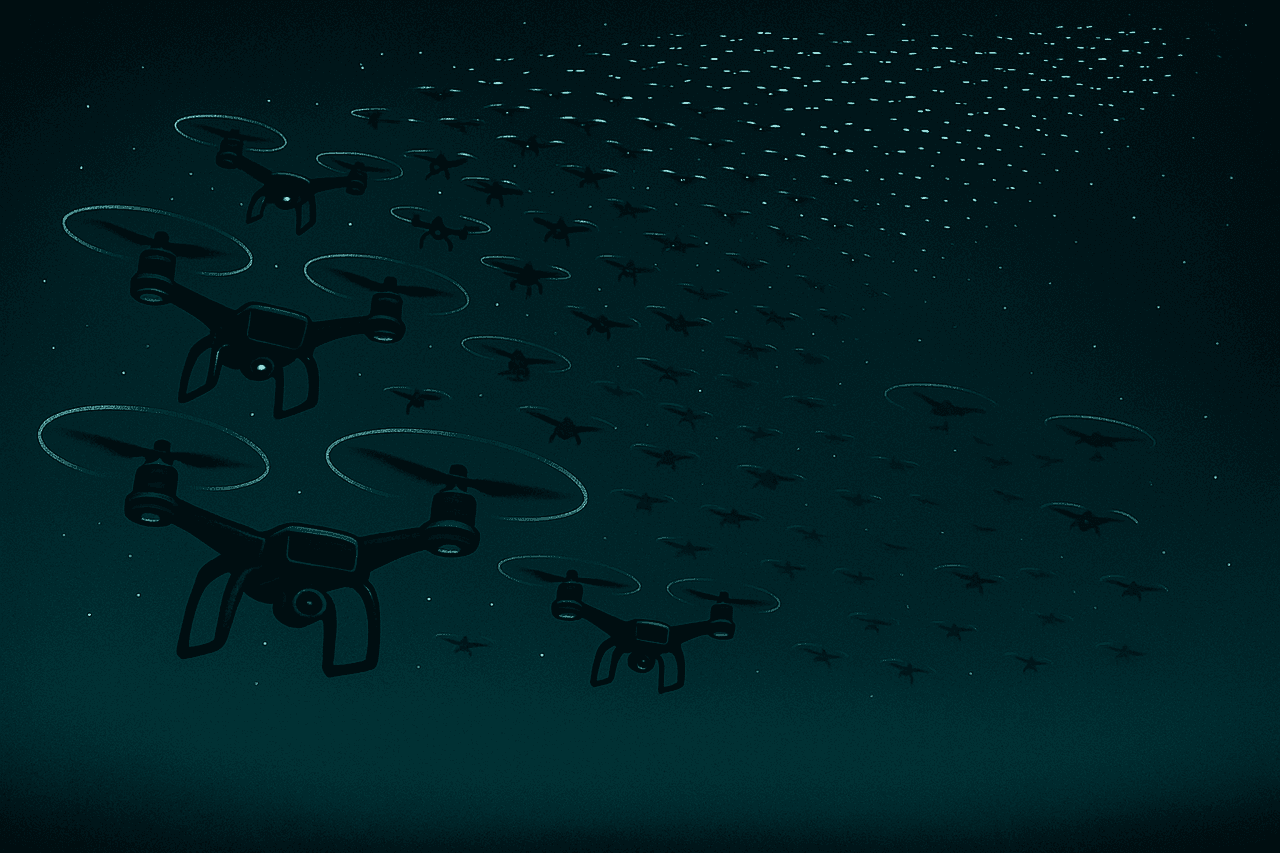
Swarm intelligence depiction (generated by artificial intelligence.)
The concept of swarm intelligence emerged in the late 1980s and developed through the transformation of collective behaviors observed in natural systems into mathematical and computer-based models. Initially, observations of the collective movements of bees and ants inspired researchers to understand how such behaviors solved complex problems. In 1999, Bonabeau, Dorigo, and Theraulaz provided a more comprehensive definition of swarm intelligence and established fundamental principles explaining how individual behaviors operate at the social level. Since then, algorithms such as Particle Swarm Optimization (PSO) and Ant Colony Optimization (ACO), especially developed for optimization problems, have accelerated the application of swarm intelligence in computer science and engineering. Today, swarm intelligence is used in numerous fields including robotics, data mining, telecommunications, and others, and has become an important research area for understanding the complexity of natural systems.
Swarm intelligence has significant application areas in the military domain. Autonomous systems and robots can acquire collective movement capabilities using swarm intelligence principles, enabling more effective execution of various military operations.
Swarm intelligence algorithms are used in numerous military tasks by enabling autonomous vehicles such as drones to move in coordination. These vehicles perform effectively in missions such as area scanning, target identification, and enemy surveillance. Autonomous drones can be deployed for aerial reconnaissance and surveillance operations. A group of drones can determine the optimal route through interaction, track enemy movements, and detect targets more effectively.
Swarm intelligence can be used to improve coordination among autonomous systems on the battlefield. For example, a group of autonomous vehicles can use swarm intelligence algorithms to coordinate a targeted attack plan. Each vehicle evaluates its local environmental information to determine the most effective attack strategy. Such a system is crucial for minimizing losses and enhancing mission success.
Swarm intelligence can also be applied in developing autonomous defense systems. In particular, groups of drones or robots interacting with each other can detect and respond to enemy attacks for the protection of specific areas. Such a system can accelerate the processes of monitoring enemy elements, identifying threats, and initiating responses. Additionally, these systems have the potential to reduce risks to human soldiers.
Swarm intelligence algorithms are also used in military logistics processes. Autonomous vehicles can perform material and supply operations more efficiently. Through swarm intelligence, these vehicles can communicate with each other to determine optimal routes and manage resources more effectively. This can enhance operational efficiency and save time.
Search and rescue and disaster management are critical areas where swarm intelligence principles can be applied. During natural disasters and emergencies, an effective and rapid intervention process is required. Swarm intelligence enables coordinated movement of individuals, vehicles, and resources in such scenarios. In particular, after a disaster, robotic systems and unmanned aerial vehicles (UAVs) operate according to swarm intelligence principles to conduct fast and effective searches over large areas.
These systems can guide rescue teams and identify targets by using local information and sensor data. For example, UAVs can be used for post-disaster damage assessment; they evaluate conditions in hard-to-reach areas through aerial imaging. Moreover, such systems enhance coordination among search and rescue teams by facilitating data sharing and accelerating information flow.
Swarm intelligence-based approaches also play a significant role in risk analysis and prediction during disaster management. For instance, based on historical data, potential disasters in specific regions can be predicted and preventive measures can be taken. This enables more efficient allocation of resources and development of intervention plans.
Swarm intelligence algorithms are effectively used in telecommunications to optimize data transmission and network management processes. These algorithms rely on interactions and information sharing among individuals to enhance network performance and ensure more efficient resource utilization.
In particular, Particle Swarm Optimization (PSO) and Ant Colony Optimization (ACO) algorithms are frequently used to optimize data transmission paths and network topologies. ACO stands out as an effective method for determining the shortest path in data transmission. Inspired by the pheromone-depositing behavior of ants in nature, this algorithm dynamically determines routes to ensure data packets are transmitted along the most suitable paths. This method is used to balance network traffic and improve communication continuity.
Additionally, the PSO algorithm is applied in areas such as load balancing and resource management in telecommunications networks. PSO is a system in which individuals search for optimal solutions based on local information; this feature enables telecommunications networks to respond dynamically to user demands. For example, using PSO, network traffic can be analyzed to automatically select the most suitable data paths according to network load conditions.
Another important application area of swarm intelligence methods is network security. Autonomous systems can use swarm intelligence algorithms to perform anomaly detection for identifying and preventing security threats. These systems monitor user behavior on the network and implement security measures by identifying unusual activities.
Smart cities aim to optimize urban management and service delivery through data collection, analysis, and processing. In these cities, individuals, vehicles, and infrastructure continuously interact to develop smarter solutions in areas such as energy efficiency, traffic management, water and waste management. For example, using swarm intelligence algorithms, traffic flow can be managed, optimal routes can be determined based on passenger density, and the efficiency of public transportation systems can be enhanced.
Autonomous vehicles also adopt swarm intelligence principles to become systems capable of independent movement and communication with surrounding vehicles. These vehicles can adapt to traffic conditions by interacting with each other and relying on local information. Swarm intelligence enables autonomous vehicles to operate together, enhancing driving safety and reducing traffic accidents. Research shows that the collective movement capability of autonomous vehicles can reduce traffic congestion and improve energy efficiency. Furthermore, their integration with smart city infrastructure, through improved data sharing and communication systems, is advancing to a higher level.
Swarm intelligence offers various applications in medicine and biomedical engineering. These applications are typically based on mimicking collective behaviors observed in biological systems and provide an effective approach for solving complex health problems.
Another application area is monitoring cell movements in medical imaging and analytical processes. Swarm intelligence algorithms are used to understand cell behavior and track the progression of diseases such as cancer. In particular, algorithms like ACO and PSO help determine the best image analysis methods during cell monitoring, assisting in more precise detection of tissue and cell boundaries. Micro-robotics is another area where swarm intelligence is effectively applied. Micro-robots are equipped with swarm intelligence algorithms to perform specific tasks within the human body. These robots can move collectively to reach a target and perform functions such as drug delivery or targeting cancerous cells. Such applications enable more precise surgical interventions.
Swarm intelligence is also used in conjunction with genetic algorithms for disease diagnosis and treatment recommendations. These systems can assist in developing personalized treatment plans based on patients’ genetic profiles by analyzing large datasets. In particular, swarm intelligence algorithms are employed to determine treatment methods tailored to individual genetic structures in cancer therapy.
Swarm intelligence is a concept that simulates the collective movement and decision-making abilities of various species. In this context, various algorithms have been developed. These algorithms, inspired by the functioning of natural systems, are used to solve complex problems. Below are detailed descriptions of some popular algorithms based on swarm intelligence.
The Ant Colony Optimization algorithm was developed by drawing inspiration from the food-finding processes of ant colonies. Ants leave pheromones on their paths to indicate the shortest and most efficient routes to other ants. This method, developed by Dorigo and colleagues (1991), is effectively used in combinatorial optimization problems such as the Traveling Salesman Problem (TSP). The ACO algorithm mimics ant behavior to find the optimal paths toward a specific goal.
Particle Swarm Optimization is an algorithm in which multiple agents work together in a search space to find optimal solutions. This algorithm is inspired by the flocking behavior of birds in nature. Each particle represents a potential solution and moves by learning from other particles. PSO has a broad application range in areas such as function optimization, parameter tuning, and machine learning.
Bee Colony Algorithm is an optimization algorithm that models the food-searching and colony-nourishing behaviors of bees. Bees attempt to locate the best resources during exploration and exploitation phases. During the exploration phase, bees that scout the environment for new food sources share information among themselves to identify the best resources. This process enables the discovery of the most effective solutions through collective bee movement.
Fish School Search is an optimization method that mimics the schooling behavior of fish. This algorithm models how fish are guided by environmental factors and how they move to reach optimal food sources. FSS provides effective results especially in high-dimensional and complex optimization problems.
Swarm modeling methods are mathematical and computational techniques used to simulate and analyze various swarm behaviors. These methods are used to understand and predict the movements of swarms in nature. Swarm modeling seeks to understand how groups move by considering individual interactions and relationships with environmental factors. Swarm modeling methods are generally divided into two main approaches: individual-based models and macro-level models. Individual-based models simulate in detail the behavior and interactions of each individual. Such models are ideal for understanding how individuals move within specific rules. For example, Reynolds’ three fundamental rules defined in 1987—separation, alignment, and cohesion—are widely used to model interactions among individuals within a swarm. These rules determine how individuals interact with others in their environment. Macro-level models, on the other hand, examine swarm movements from a broader perspective. These models use statistical and analytical methods to determine the overall behavior and dynamics of swarms. Macro-level modeling aims to obtain larger-scale results by studying general movement patterns of swarms, their processes of reaching targets, and environmental influences.
In recent years, the integration of artificial intelligence and machine learning techniques has further advanced swarm modeling methods. These techniques enable more complex and dynamic analysis of swarm behaviors. For example, deep learning algorithms allow more accurate modeling of interactions among individuals by using large datasets. Such innovations play a significant role in the development of autonomous systems and robotic applications.
Practical applications of swarm modeling methods span a wide range. In fields such as agriculture, transportation, urban planning, defense, and disaster management, these methods are used to manage and optimize systems more effectively. In this context, swarm modeling methods not only help understand natural swarm behaviors but also assist in comprehending interactions and dynamics within human-made systems.
Swarm intelligence is an approach that attracts attention due to its advantages in many fields. The most important of these advantages include:
Swarm intelligence applications also have some disadvantages:
Adhikari, Sudip Kumar, Prasenjit Dey, Sourav De, and Shouvik Paul. "Medical image analysis using swarm intelligence: A survey." In *Recent Trends in Swarm Intelligence Enabled Research for Engineering Applications*, pp. 89-130. Academic Press, 2024.Accessed Adresi.
Bijli, Mahvish Khurshid, Prabal Verma, and Amrit Pal Singh. "A systematic review on the potency of swarm intelligent nanorobots in the medical field." *Swarm and Evolutionary Computation* 86 (2024): 101524.Accessed Adresi.
Cai, Yinying, and Amit Sharma. "Swarm intelligence optimization: an exploration and application of machine learning technology." *Journal of Intelligent Systems* 30, no. 1 (2021): 460-469.Accessed Adresi.
Daud, Sharifah Mastura Syed Mohd, Mohd Yusmiaidil Putera Mohd Yusof, Chong Chin Heo, Lay See Khoo, Mansharan Kaur Chainchel Singh, Mohd Shah Mahmood, and Hapizah Nawawi. "Applications of drone in disaster management: A scoping review." *Science & Justice* 62, no. 1 (2022): 30-42.Accessed Adresi.
Di Caro, Gianni, and Marco Dorigo. "AntNet: Distributed stigmergetic control for communications networks." *Journal of Artificial Intelligence Research* 9 (1998): 317-365.Accessed Adresi.
Dorigo, Marco, Vittorio Maniezzo, and Alberto Colorni. "Ant system: optimization by a colony of cooperating agents." *IEEE Transactions on Systems, Man, and Cybernetics, Part B (Cybernetics)* 26, no. 1 (1996): 29-41.Accessed Adresi.
Ducatelle, Frederick, Gianni A. Di Caro, and Luca M. Gambardella. "Principles and applications of swarm intelligence for adaptive routing in telecommunications networks." *Swarm Intelligence* 4, no. 3 (2010): 173-198.Accessed Adresi.
Fakhrmoosavi, Fatemeh, Ramin Saedi, Ali Zockaie, and Alireza Talebpour. "Impacts of connected and autonomous vehicles on traffic flow with heterogeneous drivers spatially distributed over large-scale networks." *Transportation Research Record* 2674, no. 10 (2020): 817-830.Accessed Adresi.
Grosan, Crina, Ajith Abraham, and Monica Chis. "Swarm intelligence in data mining." In *Swarm Intelligence in Data Mining*, pp. 1-20. Berlin, Heidelberg: Springer Berlin Heidelberg, 2006.Accessed Adresi.
Iftikhar, Muhammad Saad, and Muhammad Raza Fraz. "A survey on application of swarm intelligence in network security." *Trans. Mach. Learn. Artif. Intell.* 1 (2013): 1-15.Accessed Adresi.
Karaboga, Dervis. "An idea based on honey bee swarm for numerical optimization." (2005): 1-10.Accessed Adresi.
Kennedy, James, and Russell Eberhart. "Particle swarm optimization." In *Proceedings of ICNN'95-international conference on neural networks*, vol. 4, pp. 1942-1948. IEEE, 1995.Accessed Adresi.
Khaldi, Belkacem, and Foudil Cherif. "An overview of swarm robotics: Swarm intelligence applied to multi-robotics." *International Journal of Computer Applications* 126, no. 2 (2015): 31-37.Accessed Adresi.
Meng, Yan. "A swarm intelligence based algorithm for proteomic pattern detection of ovarian cancer." In *2006 IEEE Symposium on Computational Intelligence and Bioinformatics and Computational Biology*, pp. 1-7. IEEE, 2006.Accessed Adresi.
Pérez-Castrillo, David, Marilda Sotomayor, and Filippo Castiglione. *Complex social and behavioral systems: game theory and agent-based models*. Springer New York, 2020.Accessed Adresi.
Reynolds, Craig W. "Flocks, herds and schools: A distributed behavioral model." In *Proceedings of the 14th annual conference on Computer graphics and interactive techniques*, pp. 25-34. 1987.Accessed Adresi.
Schoggins, John W., Donna A. MacDuff, Naoko Imanaka, Maria D. Gainey, Bimmi Shrestha, Jennifer L. Eitson, Katrina B. Mar et al. "Pan-viral specificity of IFN-induced genes reveals new roles for cGAS in innate immunity." *Nature* 505, no. 7485 (2014): 691-695.Accessed Adresi.
Shaikh, Palwasha W., Mohammed El-Abd, Mounib Khanafer, and Kaizhou Gao. "A review on swarm intelligence and evolutionary algorithms for solving the traffic signal control problem." *IEEE Transactions on Intelligent Transportation Systems* 23, no. 1 (2020): 48-63.Accessed Adresi.
Shladover, Steven E. "Connected and automated vehicle systems: Introduction and overview." *Journal of Intelligent Transportation Systems* 22, no. 3 (2018): 190-200.Accessed Adresi.
Sumpter, David JT. "The principles of collective animal behaviour." *Philosophical transactions of the royal society B: Biological Sciences* 361, no. 1465 (2006): 5-22.Accessed Adresi.
Sweetman, Bill. "THE NEED FOR COLLABORATIVE COMBAT AIRCRAFT FOR DISRUPTIVE AIR WARFARE." (2024).Accessed Adresi.

Historical Development
Application Areas
Military Strategies
Autonomous Vehicles and Drones
Coordination on the Battlefield
Autonomous Defense Systems
Logistics and Supply
Search and Rescue and Disaster Management
Telecommunications
Smart Cities and Autonomous Vehicles
Medicine and Biomedical Applications
Swarm Algorithms
Ant Colony Optimization (ACO)
Particle Swarm Optimization (PSO)
Bee Colony Algorithm
Fish School Search (FSS)
Swarm Modeling Methods
Advantages and Disadvantages
Advantages
Disadvantages