This article was automatically translated from the original Turkish version.
+1 More
Source | Sun | ||||||||
|---|---|---|---|---|---|---|---|---|---|
Driving Force | Solar Winds | ||||||||
Events | Coronal Mass Ejections Solar Flares | ||||||||
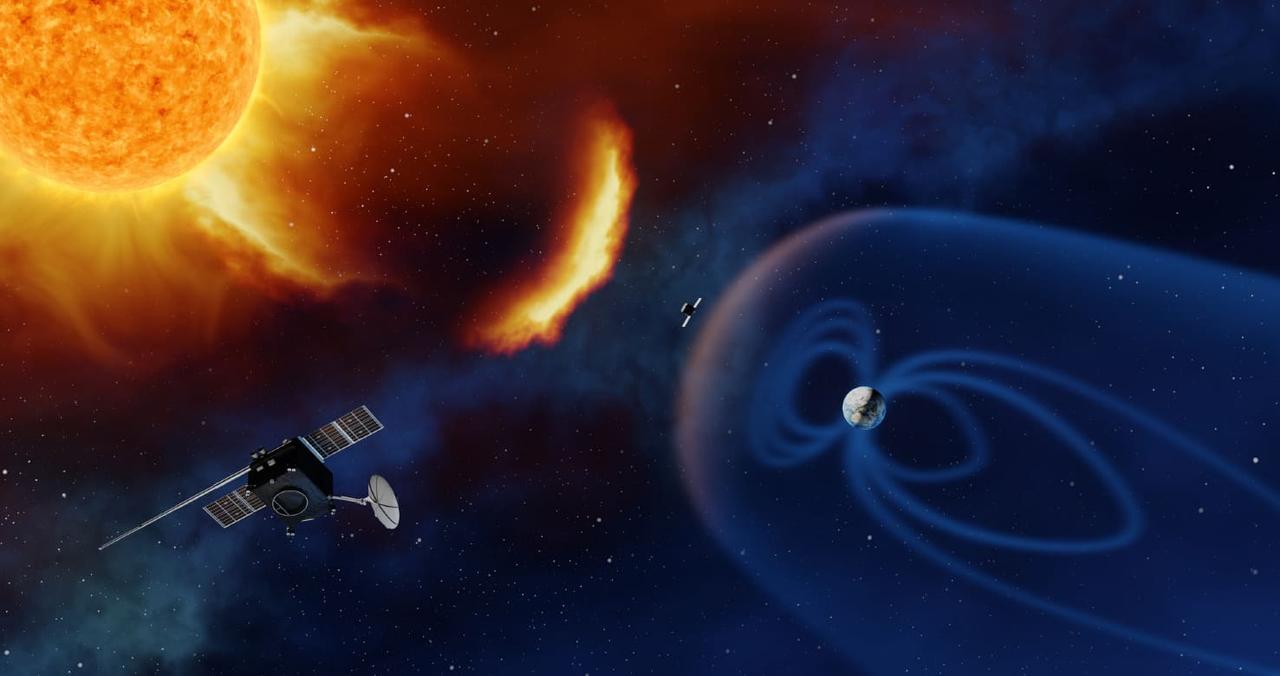
Space Weather refers to the condition of the space environment near the Sun, the behavior of solar winds, and the near-Earth space environment; it describes the potential of these conditions to disrupt space-based and ground-based systems and threaten human health. This phenomenon arises when the continuous stream of particles (solar wind) emitted due to solar magnetic activity intensifies and transforms into storms. Massive eruptions originating from the Sun’s outer atmosphere generate “storms” on Earth’s magnetic shield, leading to various adverse effects on technological infrastructure and biological systems. The increasing dependence of modern society on space-based services has made monitoring these variable space conditions and developing early warning systems a critical security issue.
The primary driver of space weather is the Sun, which is 4.6 billion years old and 1.3 million times larger than Earth【1】. The Sun is a massive, dynamic gas body that continuously emits energy and charged particles in all directions. This constant particle flow is known as the solar wind, and its intensity can increase due to variations in solar magnetic activity, leading to storms in space.
The solar wind is a continuous stream composed of electrons, protons, and heavier ions. Under normal conditions, this flow is steady, but it can become stormy due to fluctuations in solar magnetic activity. These particles, emanating from the Sun’s outer atmosphere, interact with Earth’s magnetic shield, creating “storms” on it. This interaction can cause compass needles to deviate and induce damaging electrical current fluctuations in long metallic structures such as power lines and pipelines.
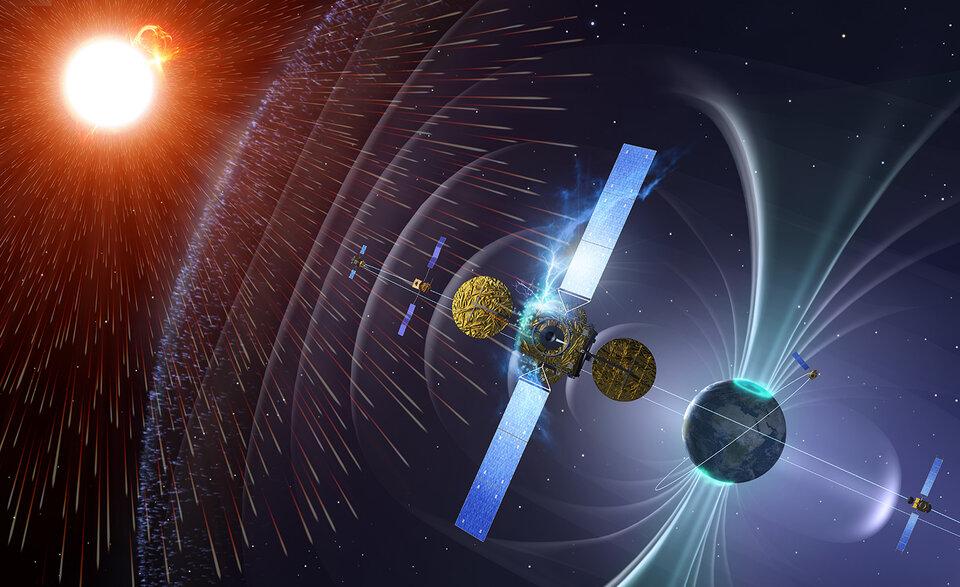
Representative Visualization of Solar Activity Directed Toward Earth (ESA)
Solar flares, among the most violent events on the Sun, are massive magnetic explosions capable of releasing energy equivalent to a billion atomic bombs【2】. As a result of these explosions, X-rays and ultraviolet radiation travel at the speed of light and reach Earth in approximately eight minutes, where they are absorbed by the ionosphere. Another critical phenomenon is Coronal Mass Ejections (CMEs). CMEs are massive clouds of solar plasma, weighing billions of tons, ejected from the Sun’s outer atmosphere into space. When these fast-moving plasma streams or high-speed solar wind flows reach Earth, they compress the planet’s magnetic field violently, triggering geomagnetic storms that pose risks to technological infrastructure.
Space weather events have the capacity to directly affect many sectors that form the backbone of the modern economy and society. Charged particles and radiation from the Sun can cause serious disruptions to both advanced technological systems in orbit and critical infrastructure on Earth.
Satellites in orbit are among the most vulnerable assets to space weather events【3】. During solar storms, the upper atmosphere heats up and expands, increasing drag on low-altitude satellites and potentially causing them to deorbit. Additionally, technical malfunctions such as reduced efficiency of solar panels, communication performance degradation, and shortened satellite lifespans have been observed【4】. Satellite navigation services such as Galileo can experience reduced accuracy due to disturbances in the upper atmosphere, negatively impacting activities requiring precise positioning such as aviation, maritime, and land transportation.
Solar storms can cause disruptions in power distribution networks and terrestrial communication systems, particularly at high northern latitudes. Damaging electrical current fluctuations (induced currents) can be triggered in long metallic structures such as power lines and pipelines. In aviation, electronic systems on aircraft flying at high altitudes may be damaged, and radio wave absorption by the ionosphere can completely disrupt shortwave radio transmissions.
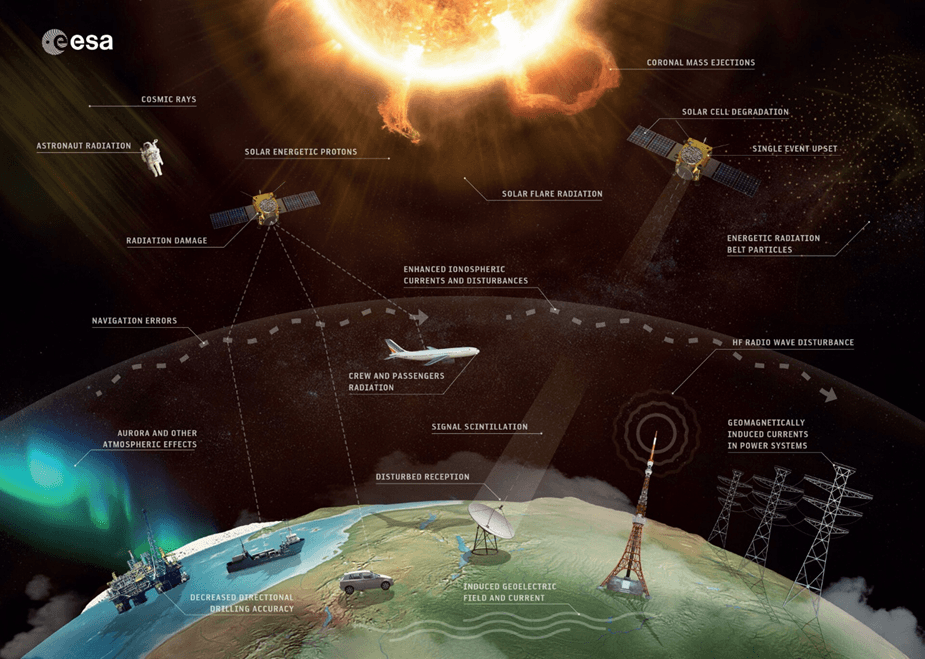
Representative Visualization of Space Weather Effects (ESA)
Space weather also poses a significant risk to biological systems. Increased radiation levels in space heighten health risks for astronauts aboard the International Space Station and for future crews on lunar or Mars missions. Similarly, during major space weather events, commercial airline crews and passengers on long-haul flights may be exposed to radiation doses higher than normal. On the other hand, solar storms can temporarily reduce the intensity of cosmic rays, acting as a kind of protective shield for Earth.
To protect against the potential harms of space weather, continuous monitoring of the Sun and the space environment from multiple locations is required, along with the rapid dissemination of collected data to relevant agencies. The growing dependence of modern society on space-based services has compelled organizations such as the European Space Agency (ESA) to develop comprehensive monitoring networks and early warning missions.
The Space Weather Office within ESA aims to provide timely and accurate information on current and forecasted space weather conditions to owners and operators of critical infrastructure. The Space Weather Service Network (SWE Service Network), established for this purpose, is a federated structure that brings together existing expertise and resources across Europe. This network delivers specialized products, toolsets, and reporting services tailored to the needs of diverse sectors including spacecraft design and operations, human spaceflight, navigation, aviation, and power grid management. Operated through the Space Weather Coordination Centre (SSCC) in Brussels, this system provides end users with near-real-time data and expert support.
One of the most important components of future protection strategies is the Lagrange (Vigil) satellite mission. This satellite will observe the Sun from a unique vantage point (L5 point) that is not visible from Earth, detecting potentially hazardous solar active regions and high-speed solar wind streams before they enter Earth’s field of view. This will enable far more accurate monitoring of solar events and their propagation toward Earth than current systems allow. Data from the Lagrange mission will be transmitted to ESA’s service network to generate earlier and more precise warnings, enabling timely protective measures to safeguard sensitive technological infrastructure.
European Space Agency. "ESA rocks space weather." Accessed March 9, 2026. https://www.esa.int/Space_Safety/ESA_rocks_space_weather
European Space Agency. "Space Weather Office." Accessed March 9, 2026. https://www.esa.int/Space_Safety/Space_weather/Space_Weather_Office
European Space Agency. "Space Weather | OPS Portal." Accessed March 9, 2026. https://esoc.esa.int/space-safety-space-weather
European Space Agency. "Space weather effects." Accessed March 9, 2026. https://www.esa.int/ESA_Multimedia/Images/2018/01/Space_weather_effects
European Space Agency. "Space weather." Accessed March 9, 2026. https://www.esa.int/Science_Exploration/Space_Science/Space_weather
European Space Agency. “Vigil Mission Overview.” Accessed March 15, 2026. https://www.esa.int/Space_Safety/Vigil/Vigil_mission_overview
[1]
European Space Agency. "ESA rocks space weather." Access date: 9 March 2026. https://www.esa.int/Space_Safety/ESA_rocks_space_weather.
[2]
European Space Agency. "Space weather." Access date: 9 March 2026. https://www.esa.int/Science_Exploration/Space_Science/Space_weather.
[3]
European Space Agency. "Space weather effects." Access date: 9 March 2026. https://www.esa.int/ESA_Multimedia/Images/2018/01/Space_weather_effects.
[4]
European Space Agency. "Space weather effects." Access date: 9 March 2026. https://www.esa.int/ESA_Multimedia/Images/2018/01/Space_weather_effects.

Source | Sun | ||||||||
|---|---|---|---|---|---|---|---|---|---|
Driving Force | Solar Winds | ||||||||
Events | Coronal Mass Ejections Solar Flares | ||||||||
Origin of Space Weather and Solar Activity
Solar Winds and Magnetic Explosions
Solar Flares and Coronal Mass Ejections (CMEs)
Technological and Biological Impacts of Space Weather
Effects on Satellite Operations and Navigation Systems
Aviation and Ground-Based Infrastructure
Radiation Risks and Human Health
Monitoring, Warning, and Protection Strategies
ESA Space Weather Service Network and Operations
Lagrange Mission and Early Warning Systems