


This article was automatically translated from the original Turkish version.
+1 More
Sleep Paralysis (commonly known in folk culture as "karabasan"), is a type of parasomnia characterized by temporary inability to move or speak while fully conscious during the transition from deep sleep to wakefulness, often accompanied by vivid and frightening hallucinations. This condition arises when the normal progression of the rapid eye movement (REM) sleep phase is disrupted, causing the muscle atony—paralysis—characteristic of REM sleep to persist into wakefulness. Isolated attacks in healthy individuals and sleep paralysis occurring as a symptom of an underlying neurological disorder such as narcolepsy represent distinct medical presentations.
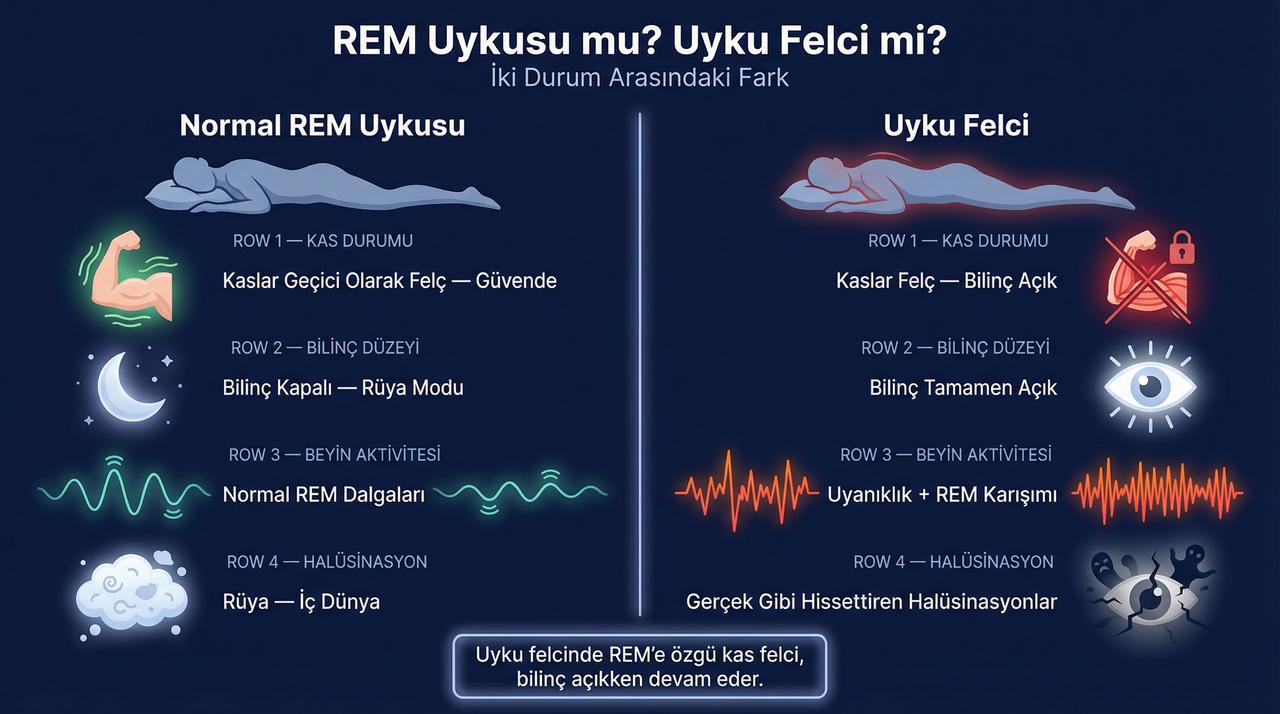
Normal REM Sleep and Sleep Paralysis: Differences Between the Two Conditions (Generated by Artificial Intelligence)
Sleep paralysis is a dysfunctional and neurochemically complex transitional phase in which REM sleep and wakefulness occur simultaneously. Under normal conditions, during REM sleep, a complete muscular paralysis occurs in the body to prevent physical enactment of dreams. In sleep paralysis, inhibitory neurotransmitters such as gamma-aminobutyric acid (GABA) and glycine, located in the pons and ventromedial medulla of the brainstem, become active. These neurotransmitters continue to suppress motor neurons in the spinal cord, blocking voluntary muscle movements. According to a neurochemical theory, overactivity of cholinergic "sleep-on" neurons and underactivity of serotonergic "sleep-off" neurons cause the brain to remain in a hybrid state between sleep and wakefulness.
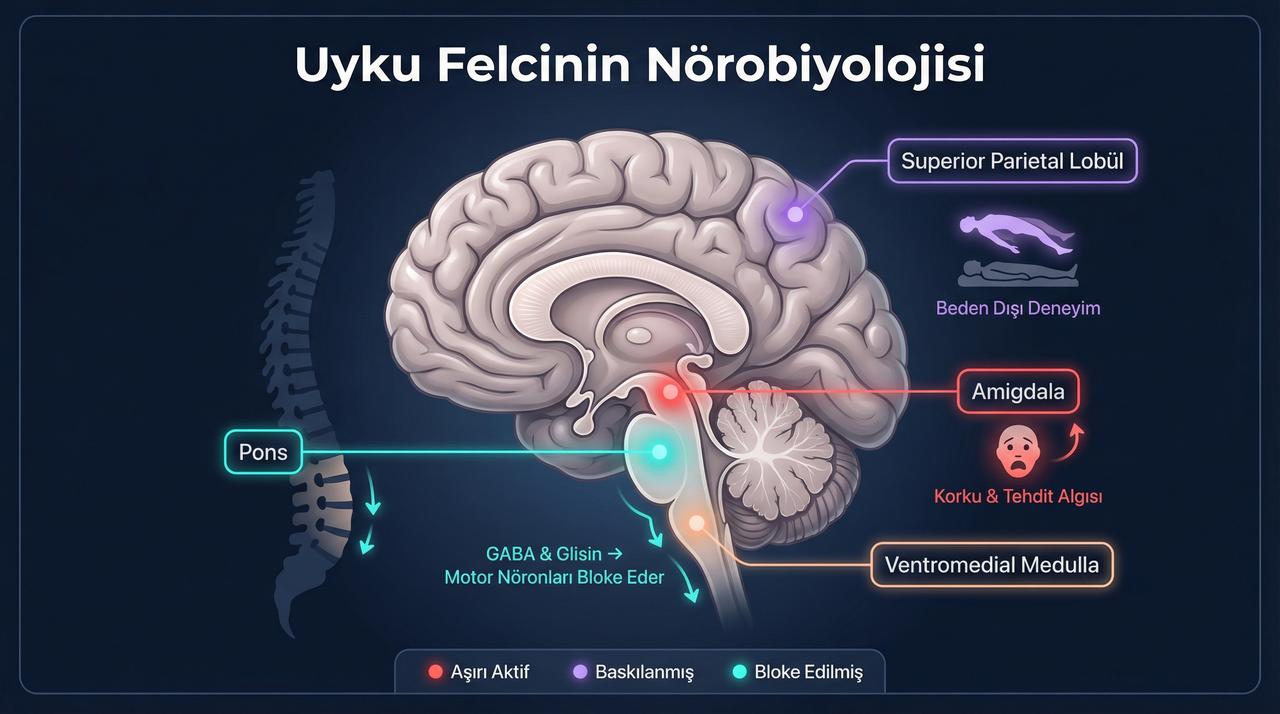
Neurobiology of Sleep Paralysis: Brain Regions and Functions (Generated by Artificial Intelligence)
During this process, the amygdala, thalamus, and brainstem enter into excessive activation interactions. This hyperactivity creates the neural basis for the individual's intense fear and perception of threatening elements in the environment. Distortions in bodily perception, such as sensations of flying or out-of-body experiences, are associated with dysfunction in the superior parietal lobule, a region responsible for sensorimotor integration and proprioception.
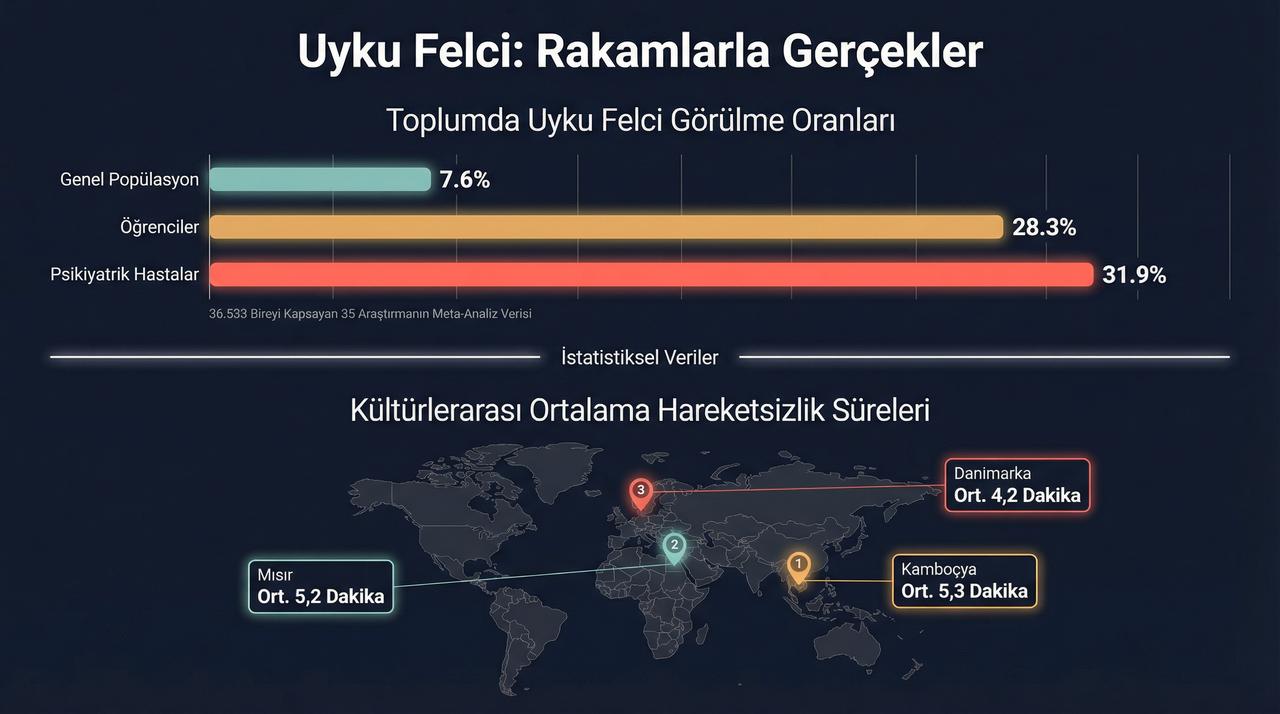
Epidemiological and Cultural Statistical Data on Sleep Paralysis (Generated by Artificial Intelligence)
A genetic predisposition to sleep paralysis has been identified. Polymorphisms in genes involved in regulating circadian rhythms and cellular-level sleep cycles—PER1, PER2, PER3, CLOCK, ARNTL2 and DBP—increase susceptibility to sleep paralysis.【7】Additionally, variants in the CACNA1C gene, which regulates calcium channels, and the ABCC9 gene, which affects sleep duration, contribute to abnormal sleep physiology. Recent neurogenetic studies have shown that activation of the SIRT1 (Sirtuin 1) gene, known as an anti-aging gene, regulates sleep cycles and stress responses.【8】This gene activation modulates neuroinflammatory pathways against sleep fragmentation, offering a potential therapeutic mechanism.
Episodes of sleep paralysis typically last from a few seconds to several minutes. During this transient paralysis, eye movements and the diaphragm muscle responsible for breathing remain unaffected. This is vital, as it ensures uninterrupted respiration and vision, preserving essential life functions. More than 75% of experiences are accompanied by prominent hallucinations, categorized into three main types:
Various lifestyle and environmental risk factors can trigger sleep paralysis episodes. These include:
Although isolated sleep paralysis is not typically considered a disease in itself, it frequently overlaps with various clinical disorders.
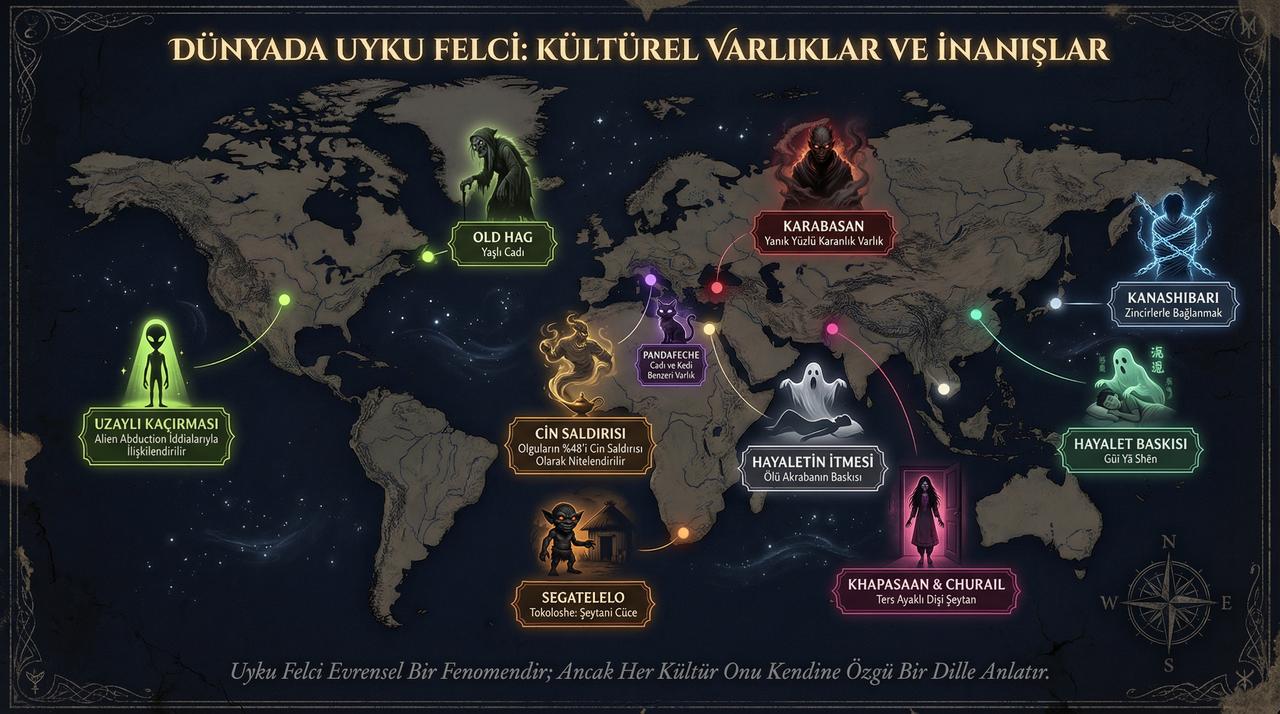
Sleep Paralysis Worldwide: Culture-Specific Entities and Beliefs (Generated by Artificial Intelligence)
Although sleep paralysis is a universal phenomenon, it is named differently across geographic regions under the framework of cultural priming and the "Salience Hypothesis of Supernatural Experiences." In Chinese culture, sleep paralysis is called "ghost pressure." In Egypt, 48% of cases are directly attributed to a "Jinn" attack, and patients often seek help from religious figures and Islamic healing methods (Ruqyah). In Italy, regional folklore attributes sleep paralysis to witch-like or cat-like entities known as Pandafeche, Ammuntadore, or Monaciello. In Newfoundland, Canada, the motif of the "Old Hag" sitting on the chest is used, while in Japan, the condition is described by the term Kanashibari, meaning "bound by chains." Among traumatized refugee groups in Cambodia, the phenomenon is called "the ghost pushing you down," while in South Africa it is known as Segatelelo, an attack attributed to a demonic dwarf-like creature called Tokoloshe. In the United States, it has been associated with alien abduction claims.
In Türkiye, the phenomenon of sleep paralysis has become intertwined with mythological narratives and religious beliefs. In a study conducted with university students in Istanbul, 88% of participants directly described sleep paralysis using the term "Karabasan".【11】 This term combines "kara" (black or evil) with "basmak" (to press or crush), symbolizing a dark force that suppresses. In folk culture, Karabasan is typically depicted as a burnt-faced, foul-smelling, terrifying entity feared for its ability to touch people and transform them into similar monstrous beings.
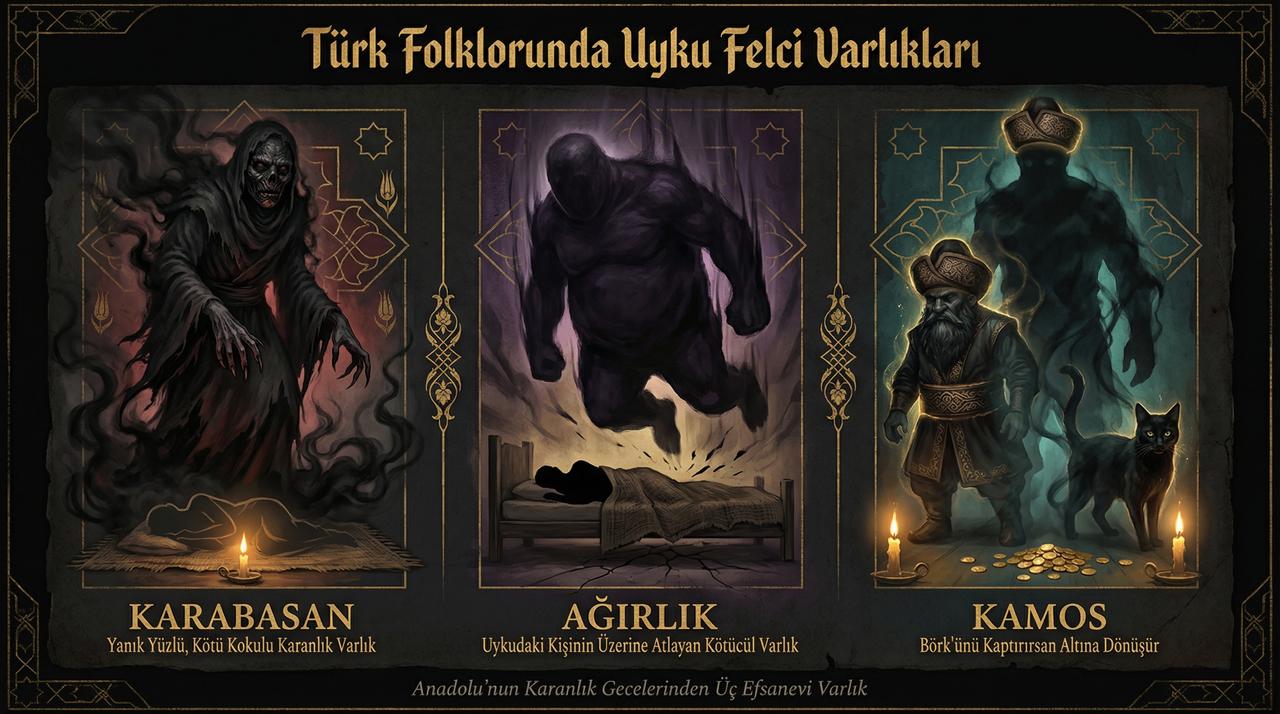
Sleep Paralysis in Turkish Folklore: Karabasan, Weight, and Kamos (Generated by Artificial Intelligence)
Other entities and concepts in Turkish folklore and literature that describe sleep paralysis have also been identified:
Some individuals in the region interpret sleep paralysis as a spiritual punishment resulting from neglecting religious duties. Religious and traditional methods used to prevent sleep paralysis episodes include prayer (the most commonly used method at 61% rate【12】), reciting the Quran, performing prayers, reciting the Asma al-Husna before sleep, consulting a religious teacher for a protective amulet (muska), and reciting the call to prayer. In similar Italian studies, people do not seek help from religious figures, whereas in Islamic cultures, the rate of consultation with religious healers and teachers is significantly higher.【13】
In ethnically diverse and Islamic-rooted societies such as Pakistan, perception of sleep paralysis varies according to language and ethnic background:【14】
When examining the role of gender in sleep paralysis experiences, studies show that men commonly report seeing female demon forms (Churail), while women report feeling the presence of a masculine entity.【15】 Women are more likely to seek help from Sufi figures, wear protective amulets, and recite prayers as defense mechanisms, while men tend to modify their sleep habits and seek support from their social environment.
Isolated sleep paralysis may not constitute a medical emergency on its own, but a comprehensive diagnostic process may be required to identify underlying sleep or psychiatric disorders. Diagnostic methods include the following steps:
Isolated sleep paralysis episodes typically do not require aggressive medical treatment. However, in chronic cases where quality of life is impaired or when occurring alongside narcolepsy, pharmacological and psychotherapeutic interventions are employed.
Selective serotonin reuptake inhibitors (SSRIs), tricyclic antidepressants, and stimulants are prescribed to suppress REM sleep, promote wakefulness, and treat narcolepsy. In the treatment of idiopathic hypersomnia, methylphenidate is preferred over modafinil as a final monotherapy. Additionally, anxiolytic agents such as clordiazepoxide and alprazolam support the establishment of a healthy postural atonia rhythm by reducing anxiety.
Cognitive Behavioral Therapy (CBT) teaches patients to challenge catastrophic thoughts during episodes and develop coping strategies for frightening hallucinations. Focusing on moving just one finger or toe during an attack (in vivo intervention) is a technique used to break the state of paralysis. Fundamental sleep hygiene practices—such as avoiding sleeping exclusively in the supine position, managing stress, and restricting caffeine and alcohol intake—form the foundation of preventive medical interventions.
Warning: The content presented here is intended solely for general encyclopedic informational purposes. The information provided should not be used for diagnosis, treatment, or medical advice. Before making any decisions regarding health, you must consult a physician or qualified healthcare professional. The author and KÜRE Encyclopedia assume no responsibility for any consequences arising from the use of this information for diagnostic or therapeutic purposes.
Akhtar, Zarif Bin. "Voices in the Night: Sleep Paralysis & The Intersection of Brain, Trauma, Traditions." Journal of Pain Research and Management 1, no. 1 (2025): 62–74. Accessed June 21, 2026. https://doi.org/10.46439/Painresearch.1.007
Bhalerao, Vijay, Shashank Gotarkar, Deepak Vishwakarma, and Sushim Kanchan. "Recent Insights Into Sleep Paralysis: Mechanisms and Management." Cureus 16, no. 7 (2024): e65413. Accessed June 21, 2026. https://doi.org/10.7759/cureus.65413
Jalal, Baland, H. Sevde Eskici, Ceren Acartürk, and Devon E. Hinton. "Beliefs about Sleep Paralysis in Turkey: Karabasan Attack." *Transcultural Psychiatry* 58, no. 3 (2021): 414–426. Accessed June 21, 2026. https://doi.org/10.1177/1363461520909616
Khan, Fariya Fatima, Muhammad Salman Ul Haq, Asia Ashfaq, Muhammad Saud, and Abdullah Ibrahim. "Monster of the Night: Identifying Pakistani Gender-Based, Religious, and Cultural Influences on Sleep Paralysis Among University Students." Culture, Medicine and Psychiatry 49 (2025): 561–584. Accessed June 21, 2026. https://doi.org/10.1007/s11013-024-09892-2
[1]
Bhalerao et al., "Recent Insights Into Sleep Paralysis," 6.
[2]
Vijay Bhalerao, Shashank Gotarkar, Deepak Vishwakarma, and Sushim Kanchan, "Recent Insights Into Sleep Paralysis: Mechanisms and Management," Cureus 16, no. 7 (2024): 4. https://doi.org/10.7759/cureus.65413
[3]
Bhalerao et al., "Recent Insights Into Sleep Paralysis," 4.
[4]
Zarif Bin Akhtar, "Voices in the Night: Sleep Paralysis and the Intersection of Brain, Trauma, Traditions," Journal of Pain Research and Management 1, no. 1 (2025): 65. https://doi.org/10.46439/Painresearch.1.007
[5]
Bhalerao et al., "Recent Insights Into Sleep Paralysis," 6.
[6]
Baland Jalal, H. Sevde Eskici, Ceren Acartürk, and Devon E. Hinton, "Beliefs about Sleep Paralysis in Turkey: Karabasan Attack," Transcultural Psychiatry 58, no. 3 (2021): 416. https://doi.org/10.1177/1363461520909616
[7]
Akhtar, "Voices in the Night," 63, 68.
[8]
Akhtar, "Voices in the Night," 63.
[9]
Bhalerao et al., "Recent Insights Into Sleep Paralysis," 6.
[11]
Jalal et al., "Beliefs about Sleep Paralysis in Turkey," 414, 417.
[12]
Jalal et al., "Beliefs about Sleep Paralysis in Turkey," 419.
[13]
Jalal et al., "Beliefs about Sleep Paralysis in Turkey," 423.
[14]
Fariya Fatima Khan, Muhammad Salman Ul Haq, Asia Ashfaq, Muhammad Saud, and Abdullah Ibrahim, "Monster of the Night: Identifying Pakistani Gender-Based, Religious, and Cultural Influences on Sleep Paralysis Among University Students," Culture, Medicine and Psychiatry 49 (2025): 570–574. https://doi.org/10.1007/s11013-024-09892-2
[15]
Khan et al., "Monster of the Night," 577.


Neurobiological and Physiological Mechanisms
Neurological Measurements and Statistical Data
Genetic Factors
Clinical Symptoms and Types of Hallucinations
Risk Factors
Psychiatric and Medical Comorbidities
Cultural and Religious Beliefs
Karabasan Beliefs in Türkiye and the Islamic World
Effects of Gender and Ethnic Diversity on Perception (Pakistan Example)
Diagnostic Methods
Medical Management and Treatment Strategies
Pharmacological Treatments
Psychotherapeutic Interventions