


This article was automatically translated from the original Turkish version.
Sirius is one of the brightest stars in the night sky and forms an important part of the Winter Triangle constellation. This star is located in the constellation Canis Major and derives its name from the Greek word meaning "glowing." At a distance of approximately 8.6 light years, Sirius is known as the brightest star visible from Earth.
Since ancient times Sirius has held great significance for many civilizations. In ancient Egypt it was regarded as the harbinger of the Nile River floods and played a crucial role in determining agricultural cycles. It also occupied an important place in Greek and Roman mythology. Today Sirius continues to attract the interest of scientists as a binary star system.
Sirius is in fact a binary star system composed of two stars: Sirius A and Sirius B. Sirius A is the bright star visible to the naked eye and is about 25 times more luminous than the Sun. Sirius B is a white dwarf a dying star that orbits Sirius A.
Sirius holds the distinction of being the brightest star in the night sky. It is also one of the closest stars to Earth at a distance of approximately 8.6 light years. Located in the constellation Canis Major Sirius is easily observable in the northern hemisphere during winter months.
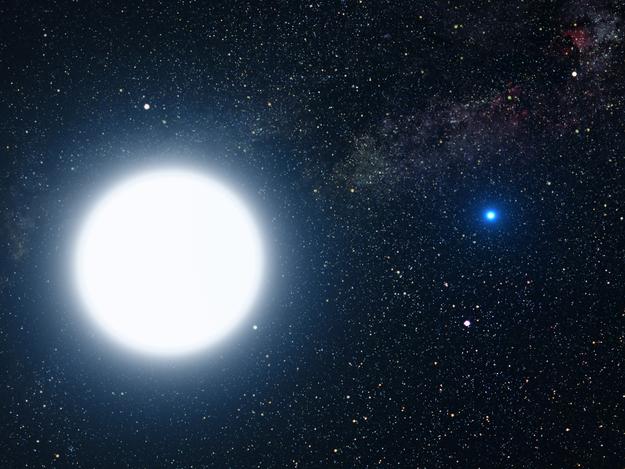
Sirius Star - ESA Science
Throughout human history Sirius has held an important place in many cultures. In ancient Egypt the appearance of Sirius was taken as a sign of the impending Nile floods and was used to establish agricultural calendars. The Egyptians associated Sirius with the goddess Isis and regarded its heliacal rising as the beginning of a new year.
In ancient Greece Sirius was called the Dog Star because its appearance heralded the hot summer days. This period known as the dog days is linked to Sirius becoming visible in the summer sky. The Romans also connected Sirius’s brightness to agricultural cycles and celebrated its rising with various rituals.
Some indigenous communities in Africa particularly the Dogon people have attributed great importance to Sirius. The Dogon are renowned for having known centuries ago that Sirius is a binary star system a fact later confirmed by modern astronomy. This knowledge is an important example of how traditional astronomical insights were passed down through generations.
Today Sirius is still regarded as an important symbol in many cultures. In astrology and popular belief it is thought to influence human life and is associated with various spiritual interpretations.
Sirius plays a significant role in scientific research. As a binary system it provides valuable insights into stellar evolution and the formation of white dwarfs. Sirius B was discovered in 1862 by Alvan Graham Clark and became one of the first identified white dwarf stars. This discovery marked a key milestone in understanding the life cycles of stars.
Observations of the Sirius system have provided detailed information about stellar mass temperature and composition. The surface temperature of Sirius A is approximately 9940 Kelvin which is higher than that of the Sun. Sirius B has a surface temperature of around 25000 Kelvin but is difficult to observe due to its small size and high density.
Moreover Sirius serves as an important reference point in astrophysical research. Due to its brightness and proximity it is used as a calibration source for telescopes and other observational instruments. Modern astronomers continue to study the orbital motion of the Sirius binary system to test gravitational interactions and general relativity theory.
Ongoing research using space telescopes and advanced technological instruments continues to enhance our understanding of Sirius’s properties and its surrounding structures.
Sirius holds a significant place in human history both astronomically and culturally. As the brightest star in the night sky it has been at the center of numerous myths and scientific investigations from ancient civilizations to the present day. Its nature as a binary system makes it a major focus of astronomical interest and plays a critical role in our understanding of white dwarf stars.
With future research it is expected that many more secrets of Sirius will be uncovered. Due to its brightness and its historical and scientific importance Sirius will continue to be a captivating object for anyone interested in the night sky.
Britannica. "Sirius Star." Britannica, 2023.www.britannica.com.
EarthSky. "Facts About Sirius." EarthSky, 2023.www.earthsky.org.
NASA. "Sirius Star Information." NASA, 2023.www.nasa.gov.
National Geographic. "Ancient Egyptian Astronomy." *National Geographic*, 2021.www.nationalgeographic.com.
Space.com. "Sirius: The Brightest Star in the Night Sky." Space.com, 2022.www.space.com.

Astronomical Properties
History and Mythology
Scientific Research on Sirius