This article was automatically translated from the original Turkish version.
+1 More
Location | Konya Province, Ayrancı District, Ambar Village (Ancient Sidamara) | ||||||||
|---|---|---|---|---|---|---|---|---|---|
Period | Roman Imperial Period (3rd century AD) | ||||||||
Material | White Marble | ||||||||
Dimensions | Length 381 cm, Width 200 cm, Height 313 cm | ||||||||
Weight | Over 30 Tons | ||||||||
Discovery | Late 19th Century | ||||||||
Museum Display | Istanbul Archaeology Museums | ||||||||
Significance | One of the Largest and Most Impressive Marble Sarcophagi in Anatolia | ||||||||
Type | Sidamara-Type Columnar Sarcophagus | ||||||||
Structure | Fluted Columns on All Four Sides Chest Shape | ||||||||
Sidamara Sarcophagus is one of the largest marble sarcophagi from the Roman Imperial period in Anatolia. The artifact was discovered near Ambar Village in the Ayrancı district of Konya Province, in the ancient settlement known as Sidamara in historical sources. Its discovery dates to the last quarter of the 19th century. Initial examinations of the site revealed the sarcophagus partially buried in soil and firmly set in place. Efforts by museum officials of the period initiated relocation work to preserve the sarcophagus. As a result of this transport operation conducted during the Ottoman period, the artifact was brought to Istanbul and incorporated into the collection of the Istanbul Archaeological Museums, where it remains on display today.
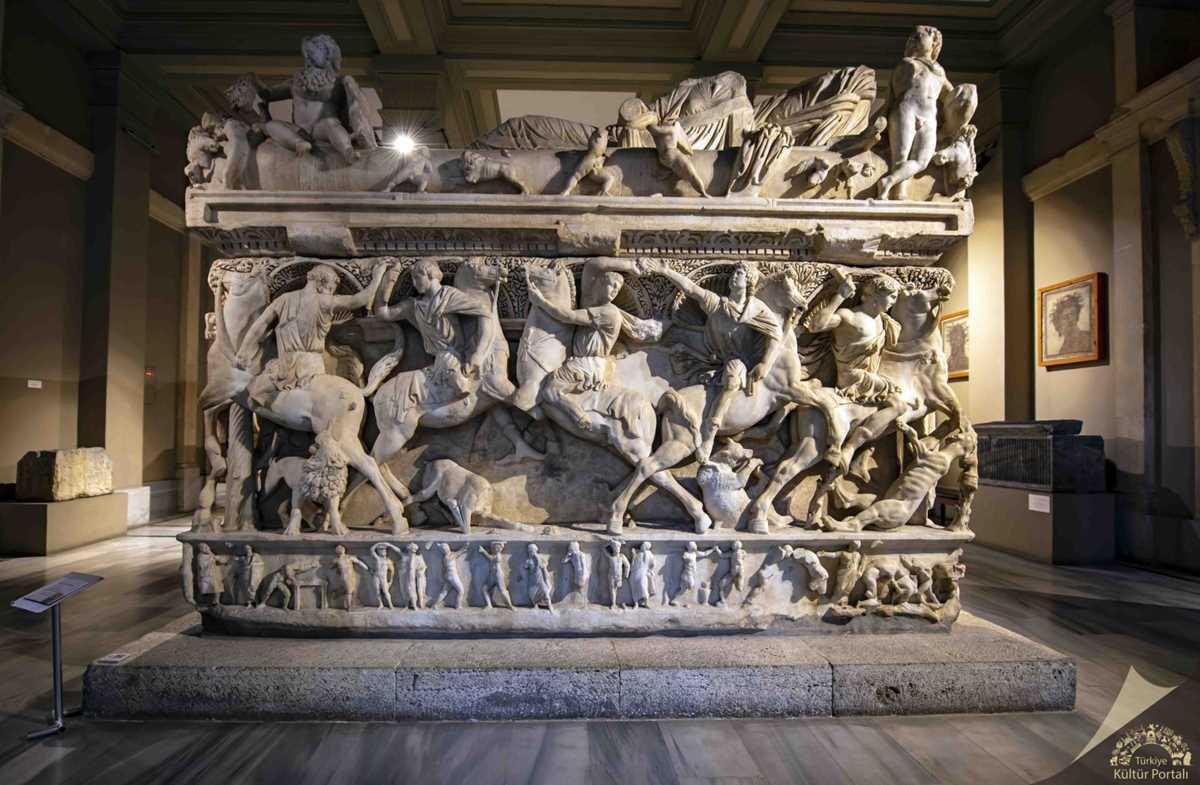
Sidamara Sarcophagus (Türkiye Kültür Portalı)
The sarcophagus represents a significant example of the elaborate burial tradition that developed in Anatolia during the Roman period. Its manufacturing technique, richness of figural decoration, and monumental scale reflect both the sculptural art of the era and the belief systems associated with death rituals. Its date of production is generally accepted as the 3rd century CE.
The sarcophagus is entirely carved from white marble and measures approximately 381 cm in length, 200 cm in width, and 313 cm in height; its weight exceeds 30 tons. The trunk, shaped like a chest, is surrounded by fluted columns along all four sides. Between the columns, high-relief panels are arranged as independent compositions. The figures attract attention through their dynamic poses, drapery, and hierarchical arrangement within the scenes.
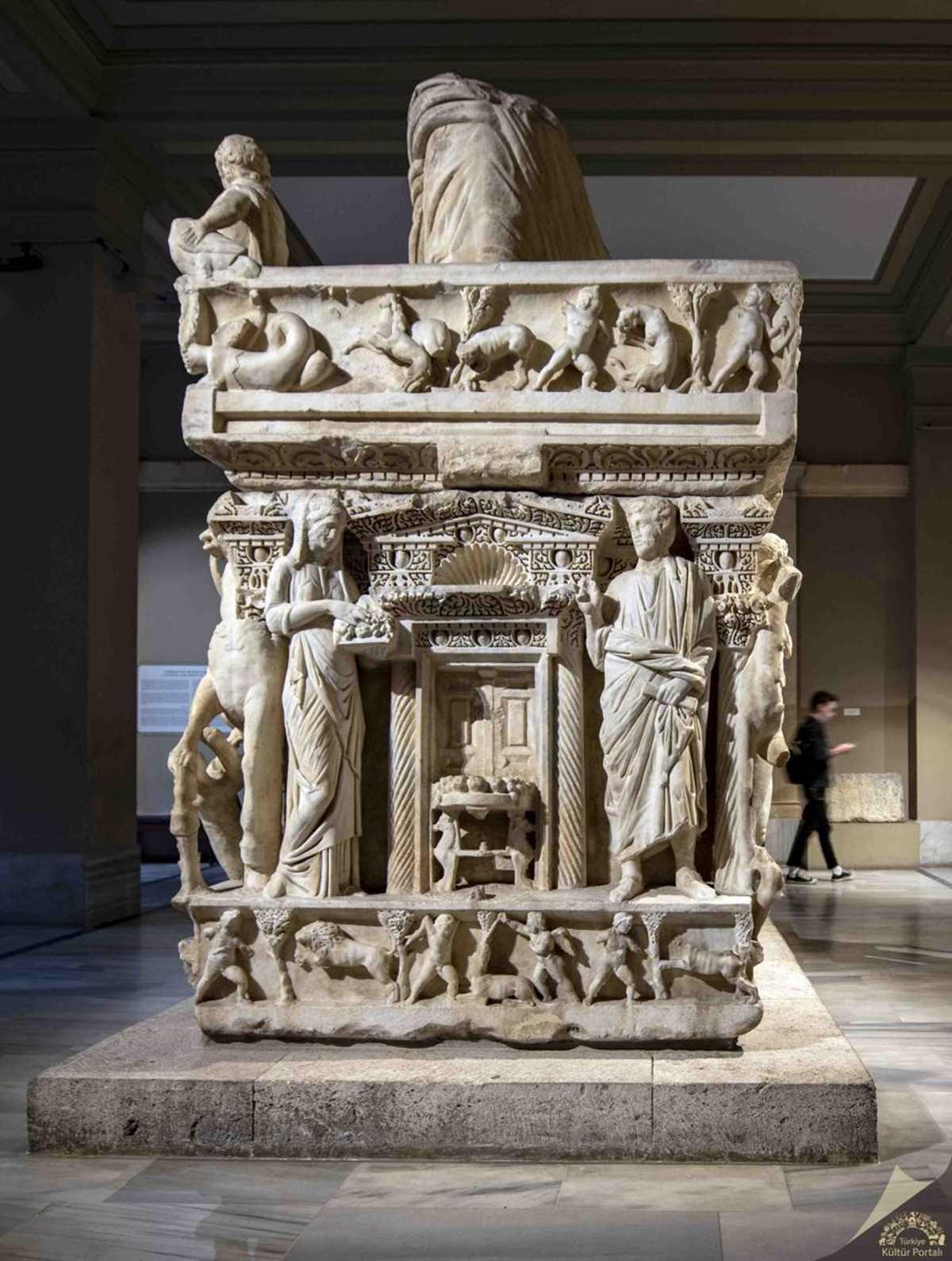
Sidamara Sarcophagus (Türkiye Kültür Portalı)
On the long face, a central figure depicts an elderly man; to his right is a young woman and to his left a figure with a covered head. At the corners of the composition, the Dioscuri are shown holding their horses. One of the short ends features a woman carrying a fruit tray alongside a bearded man holding a scroll; the other depicts a mounted hunting scene. These depictions unite themes of daily life, fertility, hunting, and heroism.
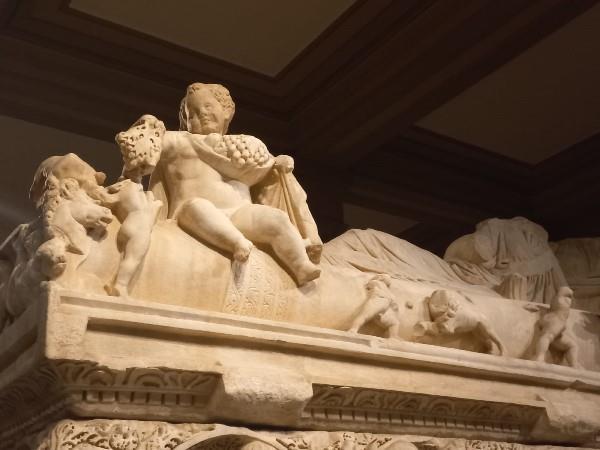
On the lid, the deceased and his spouse are portrayed lying side by side. The Eros figures located in the corner sections serve as symbolic references to beliefs in an afterlife. The reliefs are deeply carved, with figures distinctly separated from the background. This technique demonstrates the high level of craftsmanship achieved in stone carving during this period.
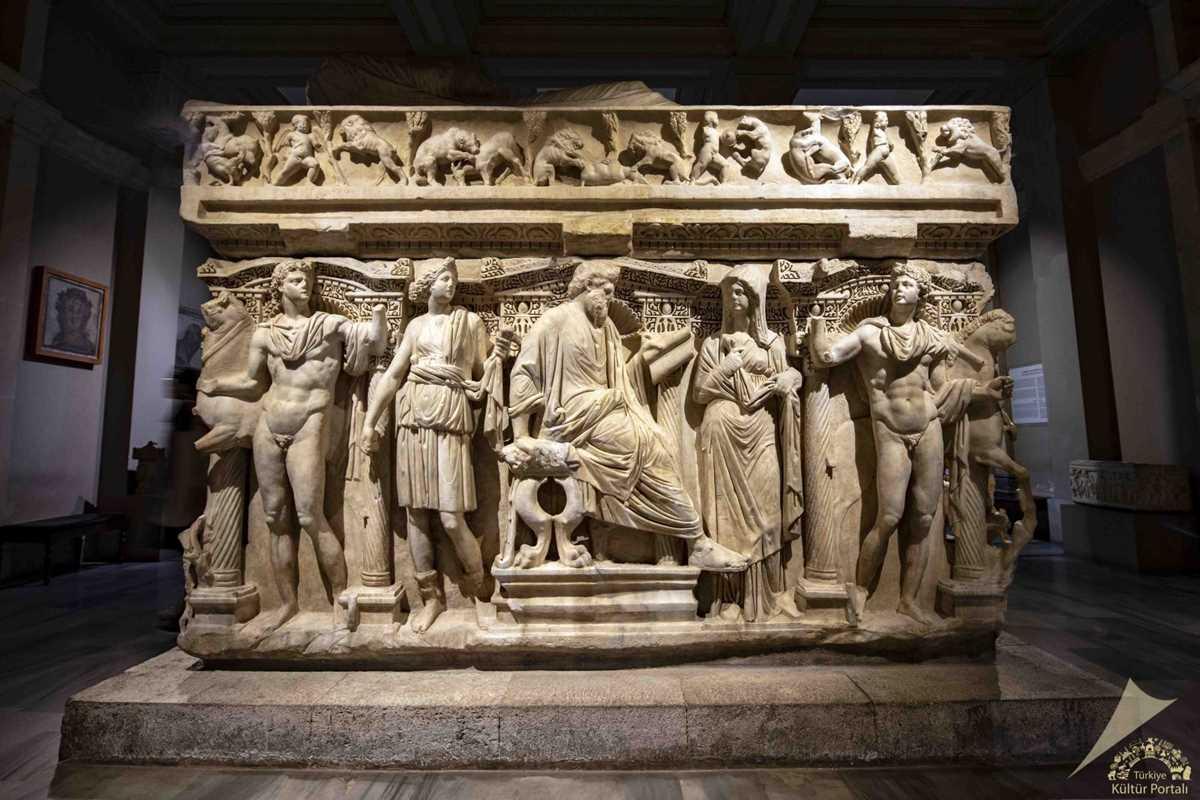
Sidamara Sarcophagus (Türkiye Kültür Portalı)
The Sidamara Sarcophagus is the namesake example of the group known as “Sidamara-type columned sarcophagi” developed in Anatolia. In this type, the front arrangement resembles an architectural facade; the scenes placed between the columns typically depict mythological or familial subjects. This stylistic approach reflects the elite class of the Roman period’s desire to express both their worldly and spiritual identity through monumental narrative.
Sidamara-type sarcophagi are found primarily in centers of artistic production in Central and Southern Anatolia shaped by Roman influence. In terms of material selection, compositional planning, and figural craftsmanship, the Sidamara Sarcophagus is regarded as the most mature example. Its dimensions, iconographic richness, and state of preservation have elevated it from being merely a funerary structure to a document of exceptional value representing the marble carving and sculptural art of Anatolia.
One of the Eros heads from the sarcophagus lid was taken to England in the late 19th century. The fragment remained for many years in the collection of the Victoria & Albert Museum in London. In 2022, following diplomatic and institutional discussions between the Ministry of Culture and Tourism of the Republic of Türkiye and the museum, the artifact was repatriated to Türkiye.
Eros Head (TRT 2)
The Eros Head, returned to Türkiye on 10 June 2022, was repositioned in its original location following restoration work by expert conservators, restoring the sarcophagus’s integrity. After the restoration was completed, the Sidamara Sarcophagus was opened to the public at the Istanbul Archaeological Museums on 1 July 2022. This process exemplifies international cooperation in the preservation and display of cultural heritage within its original geographical context.
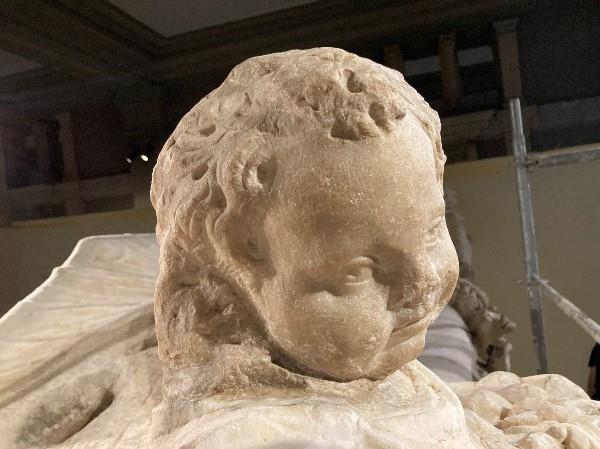
Eros Head (Kültür Varlıkları ve Müzeler Genel Müdürlüğü)
Today, the Sidamara Sarcophagus is among the most prominent exhibits in the Istanbul Archaeological Museums. Its display area has been designed to allow visitors to perceive the sarcophagus’s scale and the depth of its reliefs through careful control of natural light and environmental layout. Periodic conservation measures, including humidity and temperature monitoring, are carried out by museum specialists. With the completion of the 2022 repatriation process, the sarcophagus has been physically restored to completeness and is now preserved in its entirety.
Anadolu Ajansı. "Sidamara Lahdi, Eros başı ile yeniden buluştu." Accessed October 25, 2025.https://www.aa.com.tr/tr/kultur/sidamara-lahdi-eros-basi-ile-yeniden-bulustu/2627579
Culture and Heritage General Directorate. "129. Return from England (Victoria &Albert Müzesi of the Head ofEros Başı Piece) (2022)." Culture and Tourism Ministry, Culture and Heritage General Directorate. Accessed October 25, 2025.https://kvmgm.ktb.gov.tr/TR-323880/129-ingiltereden-victoria--albert-muzesi-iadesi-saglanan-eros-basi-1-adet-2022.html
Culture and Heritage General Directorate. "The Century-Long Longing of Sidamara, the Largest Sarcophagus of the Ancient World, Has Come to an End." *Culture and Tourism Ministry Culture and Heritage General Directorate.* Accessed October 25, 2025.https://kvmgm.ktb.gov.tr/TR-323882/antik-dunyanin-en-buyuk-lahdi-sidamara39nin-asirlik-hasreti-sona-erdi.html
Soslu, Ayşegül. “Sidamara Lahdi.” Türkiye Turizm Ansiklopedisi. Accessed October 25, 2025.https://turkiyeturizmansiklopedisi.com/sidamara-lahdi
TRT 2. "Eve Dönen Kültür Varlığımız: Eros Başı." TRT 2 Youtube Kanalı. Accessed October 25, 2025.https://www.youtube.com/watch?v=aHDeoE659Co
Türkiye Kültür Portalı. "Görülmesi Gereken 11 Lahit." T.C. Kültür ve Turizm Bakanlığı Türkiye Kültür Portalı. Accessed October 25, 2025.https://www.kulturportali.gov.tr/portal/tasa-yansiyan-sanat--lahitler
Location | Konya Province, Ayrancı District, Ambar Village (Ancient Sidamara) | ||||||||
|---|---|---|---|---|---|---|---|---|---|
Period | Roman Imperial Period (3rd century AD) | ||||||||
Material | White Marble | ||||||||
Dimensions | Length 381 cm, Width 200 cm, Height 313 cm | ||||||||
Weight | Over 30 Tons | ||||||||
Discovery | Late 19th Century | ||||||||
Museum Display | Istanbul Archaeology Museums | ||||||||
Significance | One of the Largest and Most Impressive Marble Sarcophagi in Anatolia | ||||||||
Type | Sidamara-Type Columnar Sarcophagus | ||||||||
Structure | Fluted Columns on All Four Sides Chest Shape | ||||||||
Structural Features and Decorative Layout
Sidamara-Type Sarcophagi and Their Place in Art History
The Eros Head and the Repatriation Process
Current Status and Conservation Efforts