



Securitization Theory (Generated by Artificial Intelligence.)
Type | Concept in Security Studies | ||||||||
|---|---|---|---|---|---|---|---|---|---|
Developed | Late 1980s–1990s | ||||||||
Principal Scholars | Ole Wæver Barry Buzan Jaap de Wilde | ||||||||
Theoretical Tradition | Copenhagen School | ||||||||
Main Areas of Application | Military security Migration Terrorism Environmental security Economic security Societal security Cybersecurity Public health | ||||||||
Related Concept | Desecuritization | ||||||||
Securitization is a theoretical concept in security studies that explains how issues become framed and accepted as matters of security rather than ordinary politics. Developed primarily by scholars associated with the Copenhagen School, securitization argues that security is not an objective condition inherent in a particular threat but an intersubjective process through which political actors construct certain developments as existential threats requiring exceptional measures.【1】 Instead of asking whether a threat objectively exists, securitization theory examines how an issue comes to be recognized as a security problem and under what conditions extraordinary political actions become regarded as legitimate.
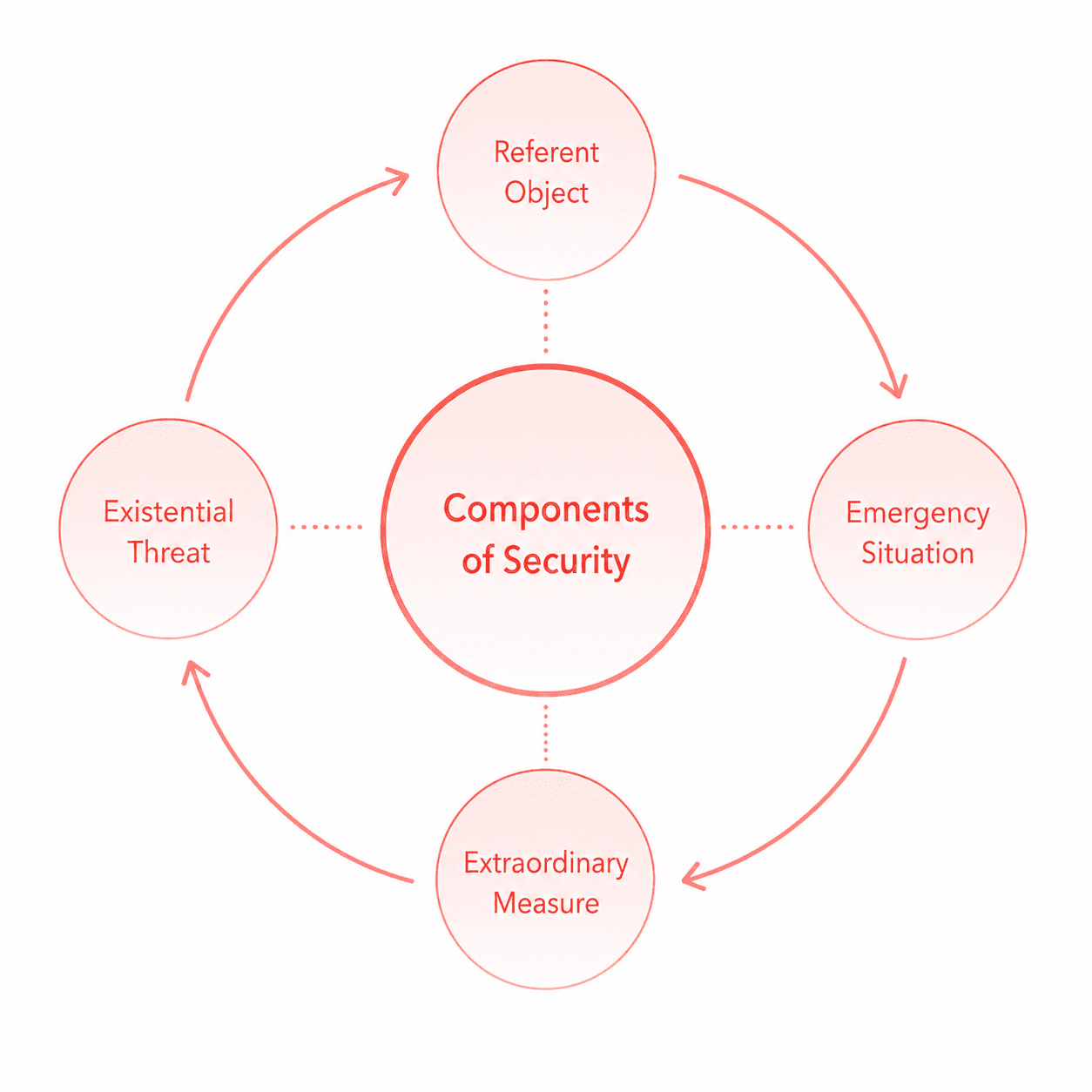
Generated by Artificial Intelligence
The concept emerged during the post-Cold War transformation of security studies, when scholars increasingly questioned the traditional understanding of security as being confined to military affairs and the survival of the state. Expanding upon earlier efforts to broaden the security agenda, securitization theory proposed that security should be understood as a particular mode of politics rather than a fixed category of threats.【2】 In this framework, issues relating to identity, migration, the environment, the economy, public health, and other fields may become security concerns if they are successfully presented and accepted as existential threats.【3】
Securitization constitutes one of the central contributions of the Copenhagen School to contemporary International Relations theory. Although rooted in constructivist thought, the theory also draws upon speech act theory, discourse analysis, and political sociology. It has become one of the most influential analytical frameworks in critical security studies and has generated an extensive interdisciplinary literature extending beyond International Relations into political science, sociology, media studies, environmental studies, migration research, and public health.【4】
The concept of securitization emerged in the late 1980s and early 1990s as part of broader efforts to rethink the scope and meaning of security in the post-Cold War era. Challenging the traditional view that equated security primarily with military threats and state survival, scholars associated with the Copenhagen School argued that security should be understood as a socially constructed and intersubjective phenomenon rather than an objective condition.【5】 Central to this perspective was the idea that security is produced through political discourse and social interaction, not merely by the existence of material threats.
The theoretical foundations of securitization were first formulated by Ole Wæver, who introduced the concept of security as a speech act. Building on insights from speech act theory, Wæver argued that by declaring an issue to be an existential threat, political actors seek to move it beyond the realm of ordinary politics and justify the adoption of extraordinary measures.【6】 This approach was further developed by Barry Buzan, Ole Wæver, and Jaap de Wilde in Security: A New Framework for Analysis (1998), which established securitization as one of the central concepts of the Copenhagen School and contemporary security studies.【7】
Since its introduction, securitization theory has been widely applied to issues beyond traditional military security, including migration, terrorism, environmental change, public health, and cybersecurity. At the same time, the framework has generated extensive scholarly debate regarding the role of discourse, the importance of context, the position of audiences, and the relationship between language and political practice.【8】
According to securitization theory, an issue becomes a matter of security through a process in which a securitizing actor presents it as an existential threat to a valued referent object and seeks the approval of a relevant audience for the adoption of extraordinary measures. Successful securitization therefore depends not only on the actor's declaration but also on whether the audience accepts the security claim as legitimate.【9】
The securitizing actor is typically a political leader, government official, state institution, or international organization with sufficient authority to articulate security claims. The referent object denotes the entity claimed to be under existential threat, such as the state, a nation, society, the environment, public health, or an international institution. The audience plays a decisive role because securitization is considered successful only when those whose support is required accept the proposed interpretation of the threat.
A central element of the theory is the concept of the speech act, which holds that security is not merely a description of reality but a performative act intended to transform political circumstances. By identifying an issue as an existential threat, the securitizing actor attempts to move it beyond the realm of ordinary political debate and justify the implementation of extraordinary measures that would otherwise be considered exceptional or unacceptable under normal political conditions.【10】
Desecuritization refers to the process through which an issue is removed from the realm of emergency politics and returned to the sphere of normal political deliberation and decision-making. Introduced by Ole Wæver alongside the concept of securitization, desecuritization is generally regarded by the Copenhagen School as the preferred political outcome, as it reduces reliance on exceptional measures and encourages the resolution of issues through ordinary democratic and institutional procedures.【11】
Desecuritization may occur when the perceived existential threat diminishes, when political actors deliberately reframe an issue as a matter of regular governance, or when audiences no longer accept security-based justifications for extraordinary action. Rather than eliminating political disagreements, desecuritization seeks to address them through conventional policy instruments, negotiation, and public debate instead of emergency responses.
Since its introduction, securitization theory has generated extensive scholarly debate. One of the principal criticisms concerns the Copenhagen School's emphasis on the speech act, which some scholars argue places excessive weight on discourse while overlooking the influence of political practices, institutions, and historical contexts. Critics maintain that security is produced not only through language but also through routine practices, bureaucratic processes, and material conditions.
Another major criticism relates to the role of the audience. While the original formulation identifies audience acceptance as a necessary condition for successful securitization, later studies have questioned how such acceptance can be identified and measured empirically. This has led to efforts to conceptualize audiences as active participants rather than passive recipients of security claims.
Subsequent scholarship has sought to refine rather than reject securitization theory. Researchers such as Thierry Balzacq, Holger Stritzel, and Matt McDonald have expanded the framework by incorporating contextual factors, social practices, and institutional dynamics into analyses of securitization. These contributions have broadened the theory's applicability while reinforcing its position as one of the leading approaches in contemporary security studies.
Buzan, Barry, Ole Wæver, and Jaap de Wilde. Security: A New Framework for Analysis. Boulder, CO: Lynne Rienner Publishers, 1998. Accessed July 4, 2026. https://www.degruyterbrill.com/document/doi/10.1515/9781685853808/html.
McDonald, Matt. "Securitization and the Construction of Security." European Journal of International Relations 14, no. 4 (2008): 563–587. Accessed July 4, 2026. https://wrap.warwick.ac.uk/id/eprint/1232/1/WRAP_McDonald_0671572-pais-270709-mcdonald_securitisation_and_construction_of_security_ejir_forthcoming_2008.pdf.
Wæver, Ole. "Securitization and Desecuritization." In On Security, edited by Ronnie D. Lipschutz, 46–86. New York: Columbia University Press, 1995. Accessed July 6, 2026. https://www.libraryofsocialscience.com/assets/pdf/Waever-Securitization.pdf.
[1]
Barry Buzan, Ole Wæver, and Jaap de Wilde, Security: A New Framework for Analysis (Boulder, CO: Lynne Rienner Publishers, 1998), 22, accessed July 4, 2026, https://www.degruyterbrill.com/document/doi/10.1515/9781685853808/html.
[2]
Matt McDonald, "Securitization and the Construction of Security," European Journal of International Relations 14, no. 4 (2008): 565, accessed July 4, 2026, https://wrap.warwick.ac.uk/id/eprint/1232/1/WRAP_McDonald_0671572-pais-270709-mcdonald_securitisation_and_construction_of_security_ejir_forthcoming_2008.pdf.
[3]
Buzan, Wæver, and de Wilde, Security: A New Framework for Analysis, 34.
[4]
Matt McDonald, "Securitization and the Construction of Security," European Journal of International Relations 14, no. 4 (2008): 563–587, accessed July 6, 2026, https://doi.org/10.1177/1354066108097553.
[5]
Ole Wæver, "Securitization and Desecuritization," in On Security, ed. Ronnie D. Lipschutz (New York: Columbia University Press, 1995), 46–86, accessed July 6, 2026, https://www.libraryofsocialscience.com/assets/pdf/Waever-Securitization.pdf.
[6]
Wæver, "Securitization and Desecuritization," 54.
[7]
Buzan, Wæver, and de Wilde, Security: A New Framework for Analysis, 21.
[8]
McDonald, Securitization and the Construction of Security, 571.
[9]
Barry Buzan, Ole Wæver, and Jaap de Wilde, Security: A New Framework for Analysis, 23–32.
[10]
Ole Wæver, "Securitization and Desecuritization," 56.
[11]
Ole Wæver, "Securitization and Desecuritization," 57.

Securitization Theory (Generated by Artificial Intelligence.)
Type | Concept in Security Studies | ||||||||
|---|---|---|---|---|---|---|---|---|---|
Developed | Late 1980s–1990s | ||||||||
Principal Scholars | Ole Wæver Barry Buzan Jaap de Wilde | ||||||||
Theoretical Tradition | Copenhagen School | ||||||||
Main Areas of Application | Military security Migration Terrorism Environmental security Economic security Societal security Cybersecurity Public health | ||||||||
Related Concept | Desecuritization | ||||||||
No Discussion Added Yet
Start discussion for "Securitization Theory" article
Origins and Development
Core Elements of Securitization
Desecuritization
Criticism
This article was created with the support of artificial intelligence.