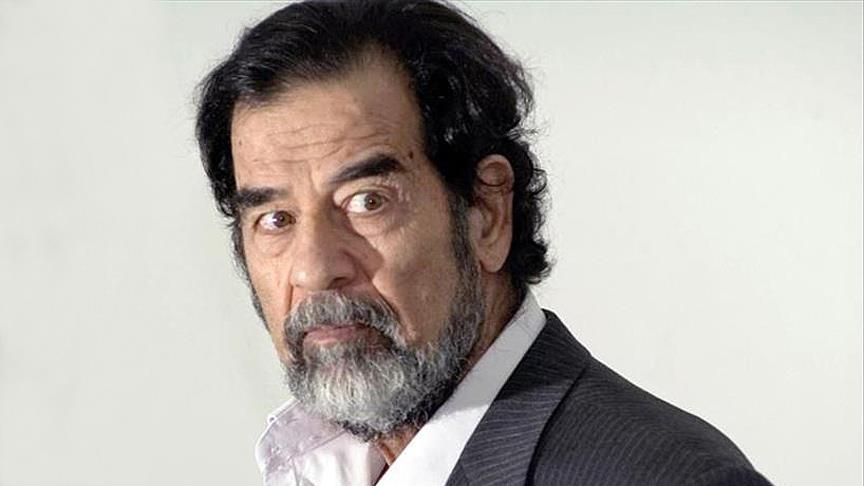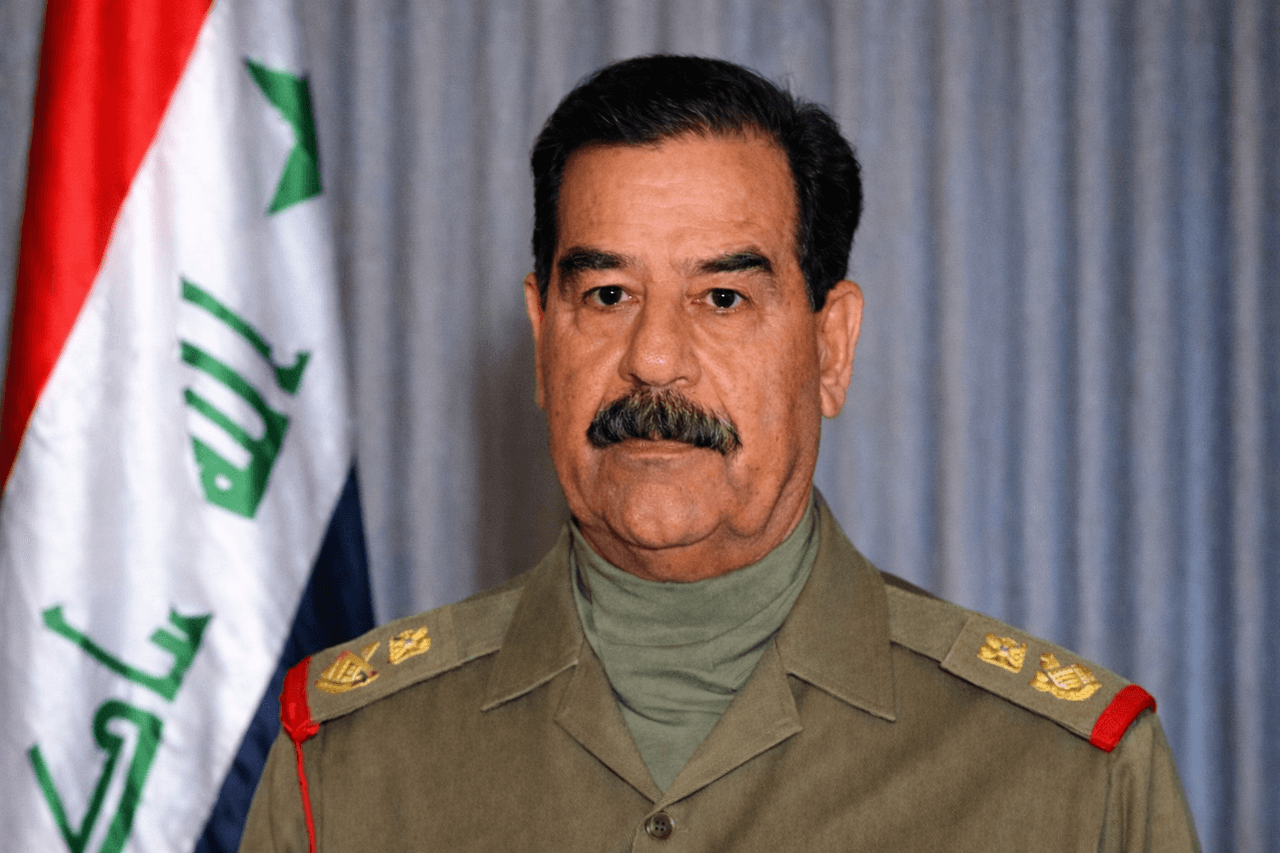

Spouse | Saddam Hussein (b. 1963) Samar Shahbandar (b. 1986) | ||||||||
|---|---|---|---|---|---|---|---|---|---|
Date of birth | 1937-04-28 | ||||||||
Date of death | 2006-12-30 | ||||||||
Cause of death | Execution by hanging | ||||||||
Office | President of Iraq (1979–2003) | ||||||||
Political party | Arab Socialist Ba'ath Party | ||||||||
Child | Ragad Hala Rana Kusay Uday | ||||||||
Wars commanded | 2003: US invasion 1980–1988: Iran-Iraq War 1990–1991: Invasion of Kuwait and the Gulf War | ||||||||
Rank | Marshal | ||||||||
Education | Cairo University | ||||||||
Religion | Islam | ||||||||
Saddam Hussein (1937–2006) was the president of Iraq and a leading figure in the Arab Socialist Ba'ath Party who implemented policies known as "Saddamism." During his rule, he nationalized Iraq's oil resources, launched extensive development initiatives, and carried out harsh military operations against Kurdish uprisings and Shia opposition.【1】He was viewed as a polarizing figure: by supporters and some scholars as a determined Arab leader resisting imperialism, and by opponents as a tyrant.【2】
Saddam Hussein was born near Tikrit into a Sunni Arab family. His father died before his birth, and he endured a difficult childhood. At age ten, he left his family to live with his uncle, Khairallah Talfah, in Baghdad. His uncle exerted a strong paternal influence on him.【3】
An Image of the Overthrown Iraqi Leader Saddam Hussein (AA)
He received his education at a nationalist high school in Baghdad and later studied law for three years at the University of Baghdad, but abandoned his studies in 1957 to join the Ba'ath Party. In 1959, he participated in an unsuccessful assassination attempt against Prime Minister Abd al-Karim Qasim and was forced to flee to Egypt via Syria.【4】 During his exile in Egypt, he continued his studies at the Faculty of Law in Cairo.
Saddam's political career began in 1957 with his membership in the Ba'ath Party. Gamal Abdel Nasser's pan-Arab nationalism in Egypt influenced Saddam and other young Ba'athists ideologically. The then Iraqi Prime Minister Abd al-Karim Qasim's rejection of the Egypt-Syria union and his adoption of a "Iraq First" (Wataniyya) policy, along with his alliance with communists, provoked the Ba'athists. This tension culminated in a planned assassination on 7 October 1959 on al-Rashid Street. Saddam, who was added to the team at the last minute and had no professional training, prematurely opened fire during the ambush, causing the operation to collapse.
After the failed attempt, in which Qasim's driver was killed and Qasim himself escaped wounded, Saddam and his companions fled the scene believing Qasim had been killed.【5】During his exile in Egypt (1960–1963), while studying at the Faculty of Law in Cairo, he expanded his network within the party.
After the 1963 coup, he returned to Iraq but was arrested and imprisoned. He escaped from prison in 1966 and became a key figure in the party's organization. He was appointed Deputy Secretary of the Regional Command by Ahmad Hasan al-Bakr and established a security service loyal solely to him.
During the 1968 coup, he served as deputy to Ahmad Hasan al-Bakr. He planned and executed the elimination of non-Ba'athist factions led by Prime Minister Abd al-Razzaq an-Naif, whose support was crucial to the coup's success. As vice president, he acted as the de facto leader. On 1 June 1972, he seized the shares of international oil companies in Iraq and nationalized the oil industry. Using revenue from rising oil prices during the 1973 energy crisis, he initiated modernization programs for the country's infrastructure, education, and healthcare systems.【6】
On 16 July 1979, he forced al-Bakr to resign on grounds of ill health and officially became president. Just days after assuming office, on 22 July 1979, he convened a conference of party leaders and ordered the arrest of 68 members whom he labeled "traitors," executing 22 of them. This event solidified his absolute control over power.【7】
The 1979 Purge of the Ba'ath Party by Saddam (YouTube)
Saddam aimed to make Iraq the leading power in the Middle East. During the Cold War, he pursued a pragmatic balancing policy: in 1972 he signed a Treaty of Friendship with the Soviet Union, and from the late 1970s onward he developed commercial ties with the West. As a supporter of the Palestinian cause, he adopted an anti-Israel stance and provided financial support to Palestinian organizations.【8】
Following the 1979 Iranian Islamic Revolution, Saddam feared Ayatollah Khomeini's threat to export the Shia revolution and disputes over the Shatt al-Arab waterway. On 22 September 1980, he launched an invasion of Iran and occupied some territories.【9】
Iran-Iraq War (YouTube)
Following its victory over Iran, Iraq emerged as the dominant military power in the Persian Gulf region. By the war's end, the Iraqi military had built a force of over one million personnel, including the well-equipped Republican Guard.【14】
However, the heavy debt burden from the Iran war (approximately $80 billion) and Kuwait's overproduction of oil, which drove down prices, triggered a crisis between the two countries. Saddam claimed that Kuwait had historically been part of Iraq and invaded it on 2 August 1990, annexing it as the "19th province."
The rapid collapse of Kuwaiti resistance posed a threat to Saudi Arabia, a major oil exporter in the region. If Saudi Arabia fell, Iraq would control one-fifth of global oil supplies. Saddam also defied the UN Security Council's deadlines and violated its resolutions.
The event that convinced the international community to launch a military operation against Saddam was the testimony of Nayirah. She claimed to be a volunteer nurse in a Kuwaiti hospital during the Iraqi occupation. Two months after the invasion, she testified that Iraqi soldiers had removed premature babies from incubators, looted the incubators, and left the infants to die on the floor. Her testimony was widely publicized and repeatedly used by the U.S. Senate to justify military action against Iraq.【15】
With the backing of the Security Council, a U.S.-led coalition launched continuous missile and air strikes against Iraq beginning on 16 January 1991. Following the air campaign, a ground offensive expelled Iraqi forces from Kuwait in January 1991.
The war ended in a decisive and heavy defeat for Iraq. Internal Shia and Kurdish uprisings erupted, but Saddam brutally suppressed them.【16】Iraq was placed under a prolonged and severe UN embargo.
After the defeat, Saddam survived the immediate crisis and retained control of Iraq, but the country never fully recovered economically or militarily from the Gulf War. Saddam portrayed his survival as a victory and sought to enhance his influence among other Arab nations.【17】
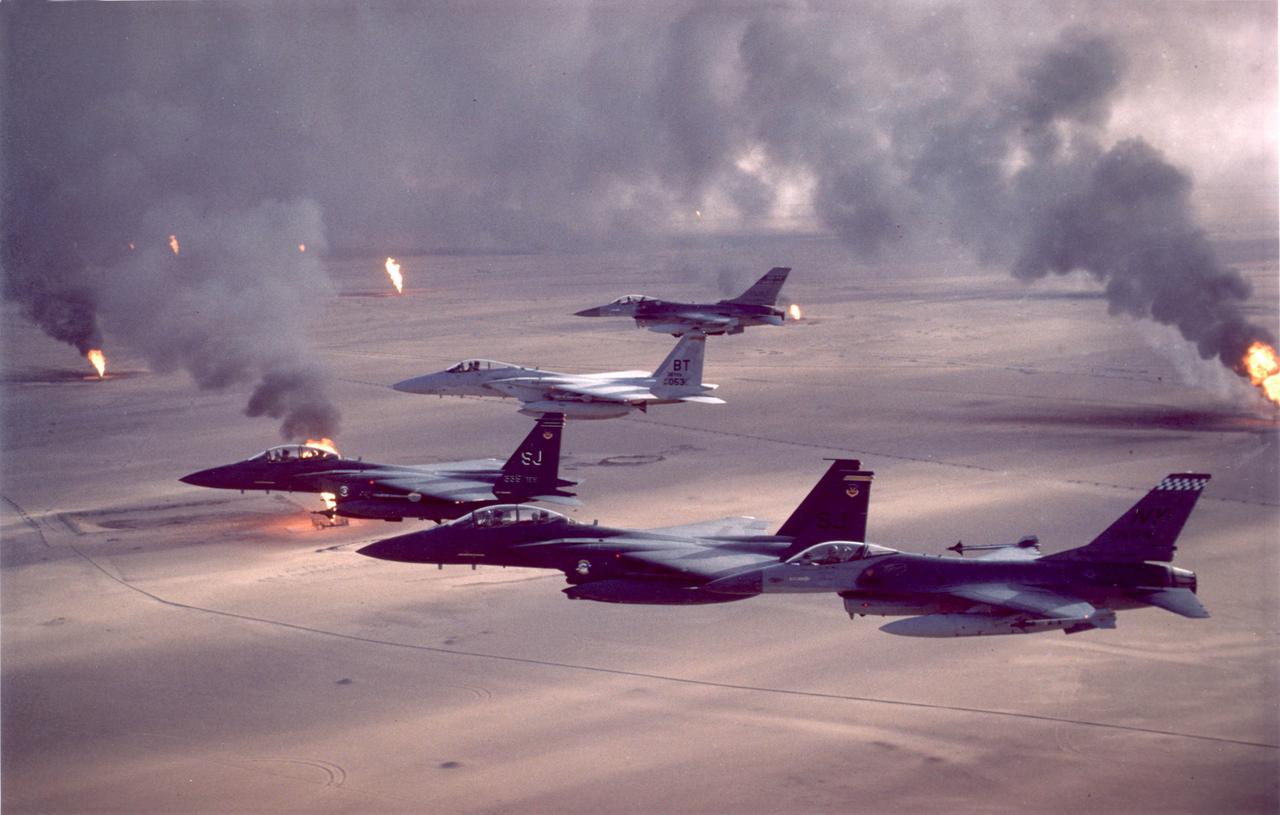
Coalition Jets Flying Over Burning Kuwaiti Oil Fields During Desert Storm (US Airforce)
After the Gulf War, Saddam's regime faced internal unrest and economic hardship. UN sanctions imposed over the invasion of Kuwait remained in place, and Iraq's oil exports were blocked. During this period, Saddam's Ba'athist ideology also underwent change.
Having maintained a secular regime for most of his career, Saddam launched the "Faith Campaign" in 1993 under the supervision of his deputy, Izzat Ibrahim al-Douri, to renew popular support and curb Islamist opposition.【18】 Beginning in 1993, he added the phrase "Allahu Akbar" in his own handwriting to the Iraqi flag, accelerated mosque construction, and increased Islamic rhetoric in public life.
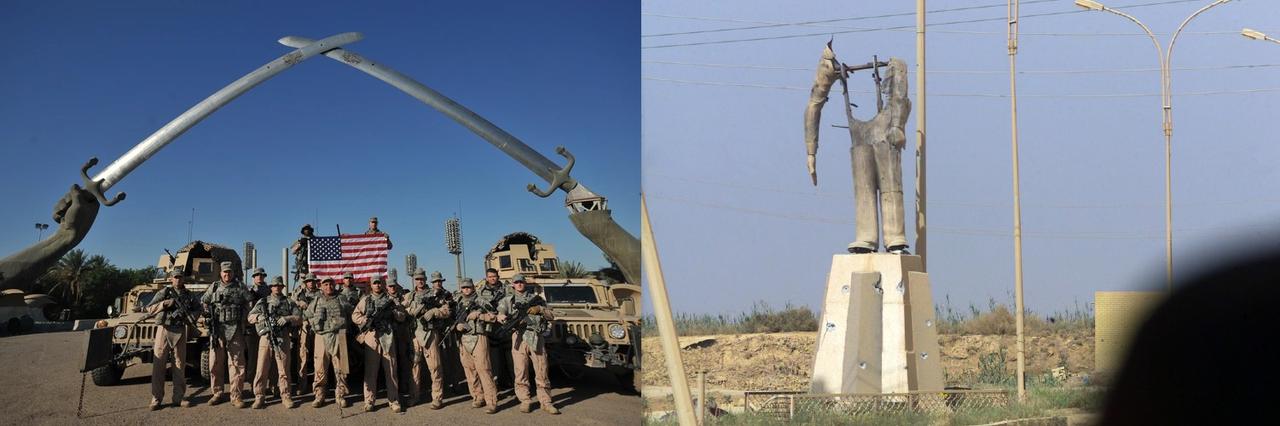
In 2003, the United States and coalition forces invaded Iraq, claiming Saddam possessed weapons of mass destruction and had links to al-Qaeda (claims later proven baseless).【19】 The Iraqi military and government collapsed within three weeks of the invasion's start. On 9 April 2003, the fall of Baghdad and the symbolic toppling of Saddam's statue in Firdos Square effectively ended the Ba'ath regime. After Baghdad's fall, Saddam went into hiding but was captured on 13 December 2003 at approximately 20:30 local time in a farmhouse near his hometown of Tikrit, during "Operation Red Dawn," in an underground bunker.【20】
Following his capture, Saddam Hussein was tried by the Iraqi Special Tribunal (later renamed the Iraqi High Criminal Court). The first case was the Dujail trial, concerning mass arrests, torture, and executions following a 1982 assassination attempt against him in the town of Dujail. He was convicted of crimes against humanity for the killing of 148 Shia men. On 5 November 2006, he was found guilty and sentenced to death. He was hanged on 30 December 2006.【21】
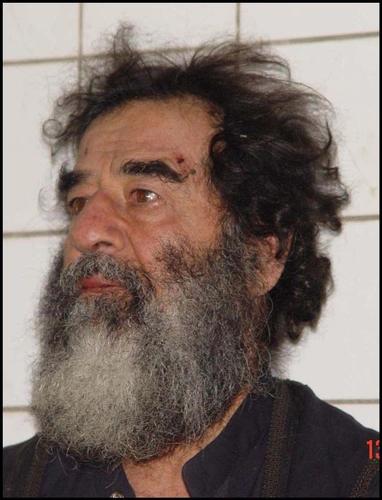
Saddam After His Capture (DVIDS)
Saddam Hussein was deeply committed to the ideology of the Ba'ath Party, which combined Arab nationalism with Arab socialism. During his rule, he fused this ideology with militarism and a cult of personality to create a doctrine known as "Saddamism." This doctrine sought to unite Iraq's ancient Mesopotamian heritage with Arab nationalism.【22】
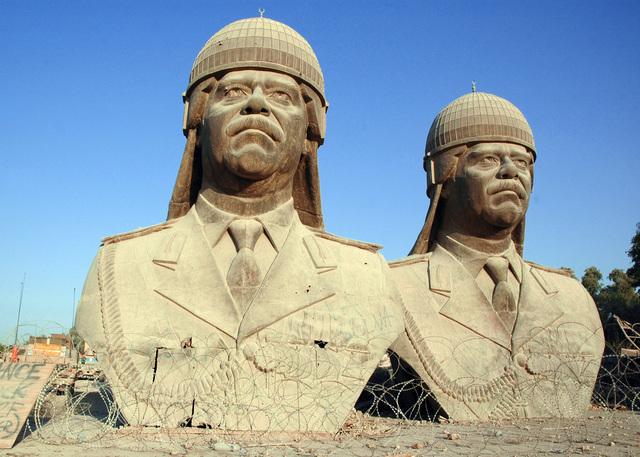
Bronze Sculptures Inspired by Babylonian Culture by Saddam (GetArchive)
Saddam viewed himself as the modern successor to historical leaders such as King Nebuchadnezzar of Babylon and Saladin. During the restoration of Babylon, he had his name inscribed on bricks to assert a claim of historical continuity.【23】
Saddam married his cousin Sajida Talfah in 1963, and they had five children: Uday, Qusay, Raghad, Rana, and Hala. He later married Samira Shahbandar. His sons Uday and Qusay held prominent positions within the regime but were killed in a 2003 clash with U.S. forces.【24】
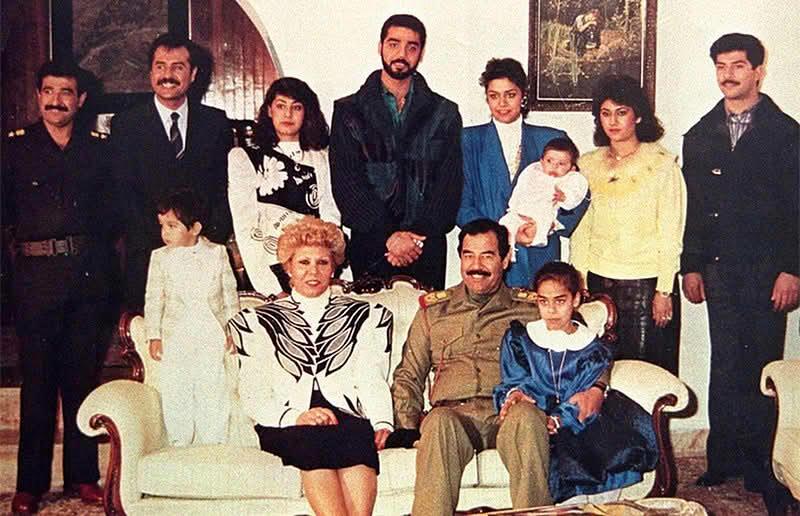
Family Photo of Saddam, Late 1980s (Store Norske Leksikon)
Saddam had an interest in luxury, cigars, and gardening. It is known that even during his imprisonment, he cultivated plants in the courtyard of his cell. In his final days in prison, he turned to poetry and literature.【25】
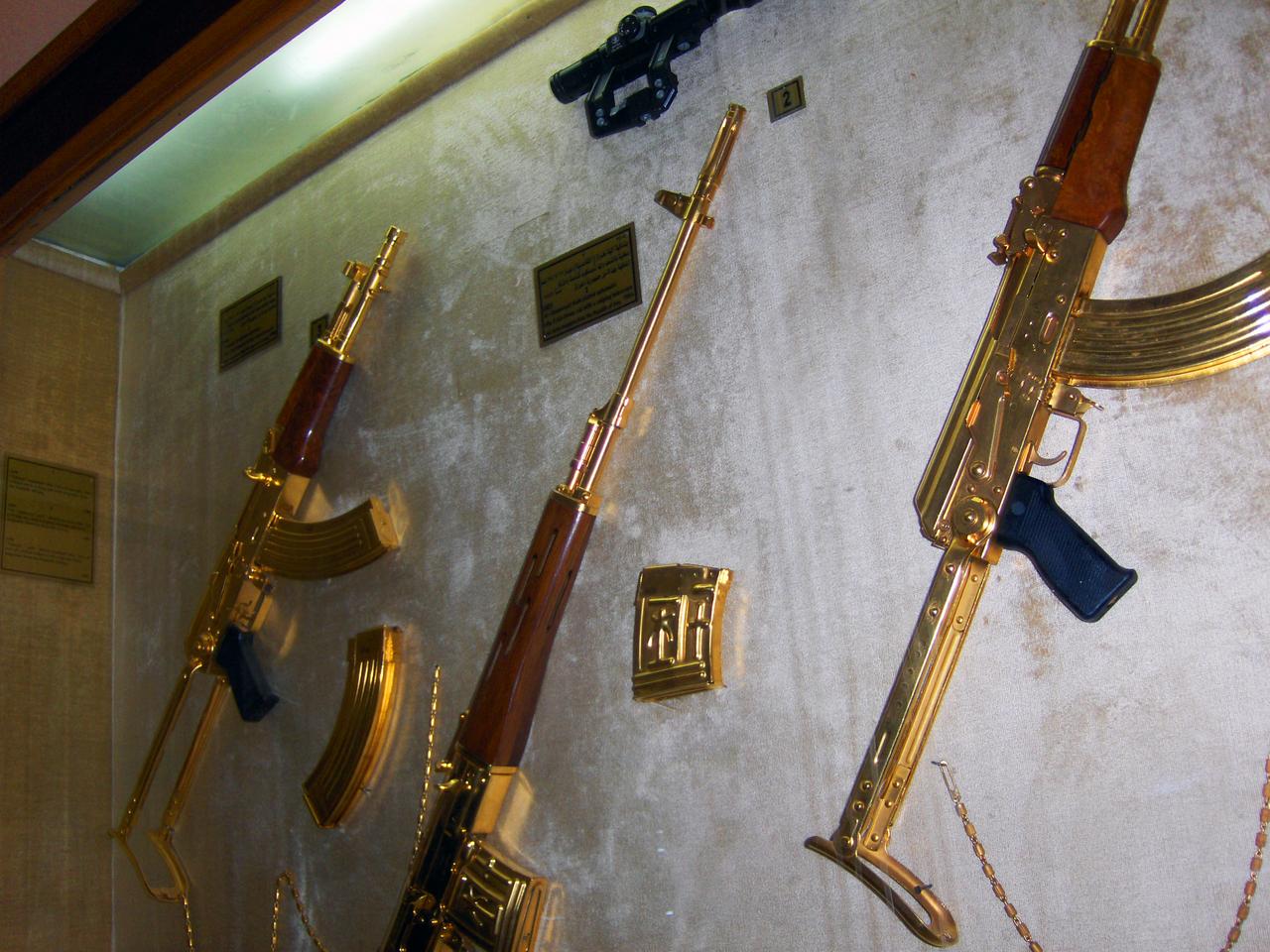
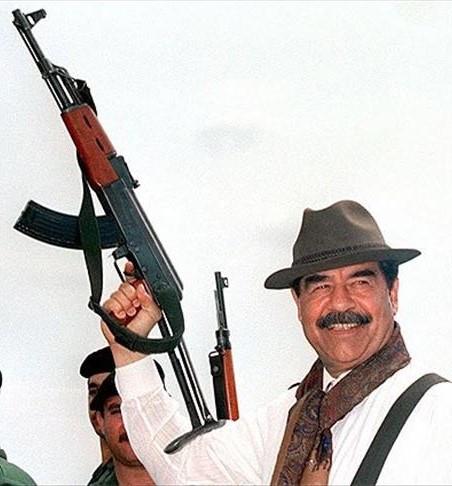
Gold-Plated AK-47 Collection Gifted by Saddam (Flickr)
Air Combat Command. “A USAF photo, showing F-16 A, F-15C and F-15E planes flying over the burning oil fields of Kuwait during Desert Storm.” Photograph. United States Air Force. Accessed December 25, 2025.https://www.acc.af.mil/News/Photos/igphoto/2000168949/mediaid/899590/
Anadolu Ajansı. “Kuveyt'ten Saddam'ın tüfeği için teşekkür.” May 3, 2012. Accessed December 25, 2025.https://www.aa.com.tr/tr/dunya/kuveytten-saddamin-tufegi-icin-tesekkur/370215
Anadolu Ajansı. “Saddam Hüseyin'in kızından DEAŞ açıklaması.” December 22, 2016. Accessed December 25, 2025.https://www.aa.com.tr/tr/dunya/saddam-huseyinin-kizindan-deas-aciklamasi/712463
BBC Türkçe. “Saddam Hüseyin’in idamına onay.” December 26, 2006. Accessed December 25, 2025.https://www.bbc.co.uk/turkish/news/story/2006/12/printable/061226_saddam_appeal.shtml
Bassil, Youssef. *The 2003 Iraq war: Operations, Causes, and Consequences*. LAP LAMBERT Academic Publishing, 2012. Accessed December 25, 2025.https://www.iosrjournals.org/iosr-jhss/papers/Vol4-issue5/G0452947.pdf
Bengio, Ofra. *Saddam's Word: Political Discourse in Iraq*. Oxford: Oxford University Press, 1998. Accessed December 25, 2025.https://archive.org/details/saddamswordpolit0000beng
Cline, Eric H. “Saddam Hussein and History 101.” BY George! Online. March 4, 2003. Accessed December 25, 2025.https://www2.gwu.edu/~bygeorge/030403/clineedit.html
Coughlin, Con. "Saddam: His Rise and Fall." *Historical Dictionary of Iraq*. 2005. Accessed December 25, 2025.https://archive.org/details/saddam00conc
Darda, Joseph. “Kicking the Vietnam Syndrome Narrative: Human Rights, the Nayirah Testimony, and the Gulf War.” *American Quarterly* 69, no. 1 (2017): 71–92. Accessed December 25, 2025.https://www.researchgate.net/publication/315930642_Kicking_the_Vietnam_Syndrome_Narrative_Human_Rights_the_Nayirah_Testimony_and_the_Gulf_War
Dawisha, Adeed. “‘Identity’ and Political Survival in Saddam's Iraq.” *The Middle East Journal* 53, no. 4 (1999): 553–567. Accessed December 25, 2025.https://www.jstor.org/stable/4329390?seq=1
Defense Visual Information Distribution Service. “Disheveled Dictator: Saddam Hussein Captured After Years in Hiding.” Photograph. December 16, 2003. Accessed December 25, 2025.https://www.dvidshub.net/image/9161281/disheveled-dictator-saddam-hussein-captured-after-years-hiding
Esposito, John L., ed. *Political Islam: Revolution, Radicalism, or Reform?*. Boulder, CO: Lynne Rienner Publishers, 1997. Accessed December 25, 2025.https://www.researchgate.net/publication/270923401_Islamic_Activism_Political_Islam_Revolution_Radicalism_or_Reform_John_L_Esposito_ed_Boulder_Lynne_Rienner_1997_287_pp_5500_cloth_1995_paper
Forsberg, Carl. “Iraq, the United States, and the Long Shadow of the Cold War.” *Cold War History* 19, no. 4 (2019): 457–476. Accessed December 25, 2025.https://www.tandfonline.com/doi/abs/10.1080/14682745.2019.1594784
Frantom, Todd. “Air Force security patrol [Image 27 of 49].” Photograph. DVIDS. December 4, 2008. Accessed December 25, 2025.https://www.dvidshub.net/image/136711/air-force-security-patrol
Gjelten, Tom. “Pentagon Report Fails to Link Saddam, Al-Qaida.” NPR. March 13, 2008. Accessed December 25, 2025.https://www.npr.org/2008/03/13/88177006/pentagon-report-fails-to-link-saddam-al-qaida
Helfont, Samuel. “War, Bureaucracy, and Controlling Religion in Saddam’s Iraq.” *Religion, Violence, and the State in Iraq* (2019). Accessed December 25, 2025.https://pomeps.org/war-bureaucracy-and-controlling-religion-in-saddams-iraq.
Hensel, Howard M. “Iraqi Invasion of Kuwait.” EBSCO Research Starters. 2023. Accessed December 25, 2025.https://www.ebsco.com/research-starters/military-history-and-science/iraqi-invasion-kuwait.
Hiltermann, Joost R. *A Poisonous Affair: America, Iraq, and the Gassing of Halabja*. Cambridge: Cambridge University Press, 2007. Accessed December 25, 2025.https://archive.org/details/poisonousaffaira0000hilt
Howard, Michael. “Saddam's routine: gardening, a muffin and writing poems.” *The Guardian*. July 24, 2006. Accessed December 25, 2025.https://www.theguardian.com/world/2004/jul/26/books.iraq
Jawad, Mohamed. "تسجيل كامل اجتماع قاعة الخلد 1979" [1979 Khuld Hall Toplantısının Tam Kaydı]. YouTube, 02:44:35. January 1, 2023. Accessed December 25, 2025.https://www.youtube.com/watch?v=XKBN_uh7MEI&t=6878s
Karsh, Efraim, and Inari Rautsi. *Saddam Hussein: A Political Biography*. New York: Grove Press, 2002. Accessed December 25, 2025.https://archive.org/details/saddamhusseinpol0000kars
Karsh, Efraim. *The Iran–Iraq War 1980–1988*. Oxford: Bloomsbury Publishing, 2014. Accessed December 25, 2025.https://archive.org/details/iraniraqwar0000unse
Ku, Gary. “Gold-plated assault rifles.” Photograph. Flickr. March 23, 2009. Accessed December 25, 2025.https://www.flickr.com/photos/garyku/3379457968
Kurzman, Charles. “Death Tolls of the Iran-Iraq War.” The University of North Carolina at Chapel Hill. October 31, 2013. Accessed December 25, 2025.https://kurzman.unc.edu/death-tolls-of-the-iran-iraq-war/
NARA & DVIDS. “Thirty-foot tall bronze sculpture of former Iraqi dictator Saddam Hussein...” Photograph. GetArchive. October 7, 2005. Accessed December 25, 2025.https://nara.getarchive.net/media/thirty-foot-tall-bronze-sculptures-of-former-iraqi-dictator-saddam-hussein-c6312c
Picryl. “A damaged statue of Saddam Hussein in Southern Iraq, along the road to Baghdad, during Operation IRAQI FREEDOM.” Photograph. April 4, 2003. Accessed December 25, 2025.https://picryl.com/media/a-damaged-statue-of-saddam-hussein-in-southern-iraq-along-the-road-to-baghdad-a83e14
Post, Jerrold M. “Saddam Hussein of Iraq: A Political Psychology Profile.” *Political Psychology* 12, no. 2 (1991): 279–289. Accessed December 25, 2025.https://www.jstor.org/stable/3791465?seq=1.
Rhem, Kathleen. “Military Commander Details Mission That Killed Hussein’s Sons.” Defense Visual Information Distribution Service. July 22, 2003. Accessed December 25, 2025.https://www.dvidshub.net/news/532836/military-commander-details-mission-killed-husseins-sons
Sanford, Jonathan E. *Iraq's Economy: Past, Present, Future*. Report No. CRSRL31944. Washington, D.C.: Congressional Research Service, 2003. Accessed December 25, 2025.https://apps.dtic.mil/sti/tr/pdf/ADA476247.pdf
Store Norske Leksikon. "Saddam Hussein med sin familie, trolig på midten av 80-tallet." Photograph. Accessed December 25, 2025.https://media.snl.no/media/203817/standard_compressed_Saddam-family-Pre1995.jpeg
TRT Arşiv. “İran - Irak Savaşı | TRT Arşiv.” YouTube. October 25, 2016. Accessed December 25, 2025.https://www.youtube.com/watch?v=uh0uxZfc01o
The Guardian. "Key events in the life of Saddam Hussein." December 14, 2003. Accessed December 25, 2025.https://www.theguardian.com/world/2003/dec/14/iraq.iraq3
Timmerman, Kenneth R. *The Death Lobby: How the West Armed Iraq*. Boston: Houghton Mifflin, 1991. Accessed December 25, 2025.https://archive.org/details/deathlobbyhowwes0000timm
USAICoE Command History Office. “Operation RED DAWN nets Saddam Hussein.” U.S. Army. December 6, 2013. Accessed December 25, 2025.https://www.army.mil/article/116559/operation_red_dawn_nets_saddam_hussein
Woods, Kevin M., David D. Palkki, and Mark E. Stout, eds. *The Saddam Tapes: The Inner Workings of a Tyrant's Regime, 1978–2001*. Cambridge: Cambridge University Press, 2011. Accessed December 25, 2025.https://assets.cambridge.org/97811070/16859/frontmatter/9781107016859_frontmatter.pdf
Woods, Kevin M., and Mark E. Stout. “Saddam’s Perceptions and Misperceptions: The Case of ‘Desert Storm.’” *Journal of Strategic Studies* 33, no. 1 (2010): 5–41. Accessed December 25, 2025.https://www.researchgate.net/publication/233444681_Saddam's_Perceptions_and_Misperceptions_The_Case_of_'Desert_Storm'.
Yusuf, Abdullah. “Saddam Hussein: how a deadly purge of opponents set up his ruthless dictatorship.” The Conversation. July 22, 2019. Accessed December 25, 2025.https://theconversation.com/saddam-hussein-how-a-deadly-purge-of-opponents-set-up-his-ruthless-dictatorship-120748.
İNSAMER. “Irak’ta Şii Gruplar ve Siyasete Etkileri.” March 25, 2016. Accessed December 25, 2025.https://www.insamer.com/tr/irakta-sii-gruplar-ve-siyasete-etkileri_274.html
[1]
Dawisha, Adeed. "" Identity" and political survival in Saddam's Iraq." The Middle East Journal (1999), s. 555.
[2]
Woods, Kevin M., and Mark E. Stout. 2010. “Saddam’s Perceptions and Misperceptions: The Case of ‘Desert Storm.’” Journal of Strategic Studies 33 (1), s. 8-10.
[3]
Post, Jerrold M. "Saddam Hussein of Iraq: A political psychology profile." Political Psychology 12, no. 2 (1991), s. 280.
[4]
The Guardian. "Key events in the life of Saddam Hussein." 14 Aralık 2003. Erişim Tarihi: 25 Aralık 2005. https://www.theguardian.com/world/2003/dec/14/iraq.iraq3.
[5]
Coughlin, Con. "Saddam: his rise and fall." Historical Dictionary of Iraq (2005).
[6]
Sanford, Jonathan E. Iraq's economy: past, present, future. No. CRSRL31944. Congressional Research Service. 2003. Erişim tarihi: 25 Aralık 2025. https://apps.dtic.mil/sti/tr/pdf/ADA476247.pdf.
[7]
Yusuf, Abdullah. "Saddam Hussein: how a deadly purge of opponents set up his ruthless dictatorship." The Conversation. 22 Temmuz 2019. Erişim tarihi: 25 Aralık 2025. https://theconversation.com/saddam-hussein-how-a-deadly-purge-of-opponents-set-up-his-ruthless-dictatorship-120748.
[8]
Forsberg, Carl. "Iraq, the United States, and the Long Shadow of the Cold War." Cold War History, vol. 19. no. 4. (2019), s. 457–476.
[9]
Karsh, Efraim. The Iran–Iraq War 1980–1988. s. 22.
[10]
Karsh, Efraim. The Iran–Iraq War 1980–1988. s. 22-29.
[11]
Timmerman, Kenneth R. The Death Lobby: How the West Armed Iraq. s. 13.
[12]
Hiltermann, Joost R. A poisonous affair: America, Iraq, and the gassing of Halabja. s. 104.
[13]
Kurzman, Charles. "Death Tolls of the Iran-Iraq War." The University of North Carolina at Chapel Hill. 31 Ekim 2013. Erişim tarihi: 25 Aralık 2025. https://kurzman.unc.edu/death-tolls-of-the-iran-iraq-war/.
[14]
Hensel, Howard M. "Iraqi Invasion of Kuwait." EBSCO. 2023. Erişim tarihi: 25 Aralık 2025. .
[15]
Darda, Joseph. "Kicking the Vietnam syndrome narrative: Human rights, the Nayirah Testimony, and the Gulf war." American Quarterly 69, no. 1 (2017), s. 79-83.
[16]
İNSAMER. "Irak’ta Şii Gruplar ve Siyasete Etkileri." 25 Mart 2016. Erişim tarihi: 25 Aralık 2025. https://www.insamer.com/tr/irakta-sii-gruplar-ve-siyasete-etkileri_274.html.
[17]
Esposito, John L., ed. Political Islam: revolution, radicalism, or reform?. s. 53.
[18]
Helfont, Samuel. "War, Bureaucracy, and Controlling Religion in Saddam’s Iraq." Religion, Violence, and the State in Iraq (2019), s. 6.
[19]
Gjelten, Tom. “Pentagon Report Fails to Link Saddam, Al-Qaida.” NPR. 13 Mart 2008. Erişim tarihi: 25 Aralık 2025. https://www.npr.org/2008/03/13/88177006/pentagon-report-fails-to-link-saddam-al-qaida.
[20]
USAICoE Command History Office. "Operation RED DAWN nets Saddam Hussein." U.S Army. 6 Aralık 2013. Erişim tarihi: 25 Aralık 2025. https://www.army.mil/article/116559/operation_red_dawn_nets_saddam_hussein.
[21]
BBC Türkçe. “Saddam Hüseyin’in idamına onay.” 26 Aralık 2006. Erişim tarihi: 25 Aralık 2025. https://www.bbc.co.uk/turkish/news/story/2006/12/printable/061226_saddam_appeal.shtml.
[22]
Bengio, Ofra. Saddam's word: political discourse in Iraq. s. 163.
[23]
Cline, Eric H. "Saddam Hussein and History 101." BY George! Online. 4 Mart 2003. Erişim tarihi: 25 Aralık 2025. https://www2.gwu.edu/~bygeorge/030403/clineedit.html.
[24]
Rhem, Kathleen. “Military Commander Details Mission That Killed Hussein’s Sons.” Defense Visual Information Distribution Service, 22 Temmuz 2003. Erişim tarihi: 25 Aralık 2025. https://www.dvidshub.net/news/532836/military-commander-details-mission-killed-husseins-sons.
[25]
Howard, Michael. "Saddam's routine: gardening, a muffin and writing poems." The Guardian. 24 Temmuz 2006. Erişim tarihi: 25 Aralık 2025. https://www.theguardian.com/world/2004/jul/26/books.iraq.

Spouse | Saddam Hussein (b. 1963) Samar Shahbandar (b. 1986) | ||||||||
|---|---|---|---|---|---|---|---|---|---|
Date of birth | 1937-04-28 | ||||||||
Date of death | 2006-12-30 | ||||||||
Cause of death | Execution by hanging | ||||||||
Office | President of Iraq (1979–2003) | ||||||||
Political party | Arab Socialist Ba'ath Party | ||||||||
Child | Ragad Hala Rana Kusay Uday | ||||||||
Wars commanded | 2003: US invasion 1980–1988: Iran-Iraq War 1990–1991: Invasion of Kuwait and the Gulf War | ||||||||
Rank | Marshal | ||||||||
Education | Cairo University | ||||||||
Religion | Islam | ||||||||
Youth and Education
Career and Rise to Power
Consolidation of Power and Vice Presidency (1968–1979)
Presidency and the 1979 Purge
Wars and Foreign Policy
Iran-Iraq War (1980–1988)
Course of the War
Gulf War (1990–1991)
Desert Storm
Final Years, Trial, and Execution
Religion and the "Faith Campaign"
Invasion and Capture
Trial and Execution
Ideology and Political Outlook
Ba'athism and Saddamism
Personal Life and Family
Interests