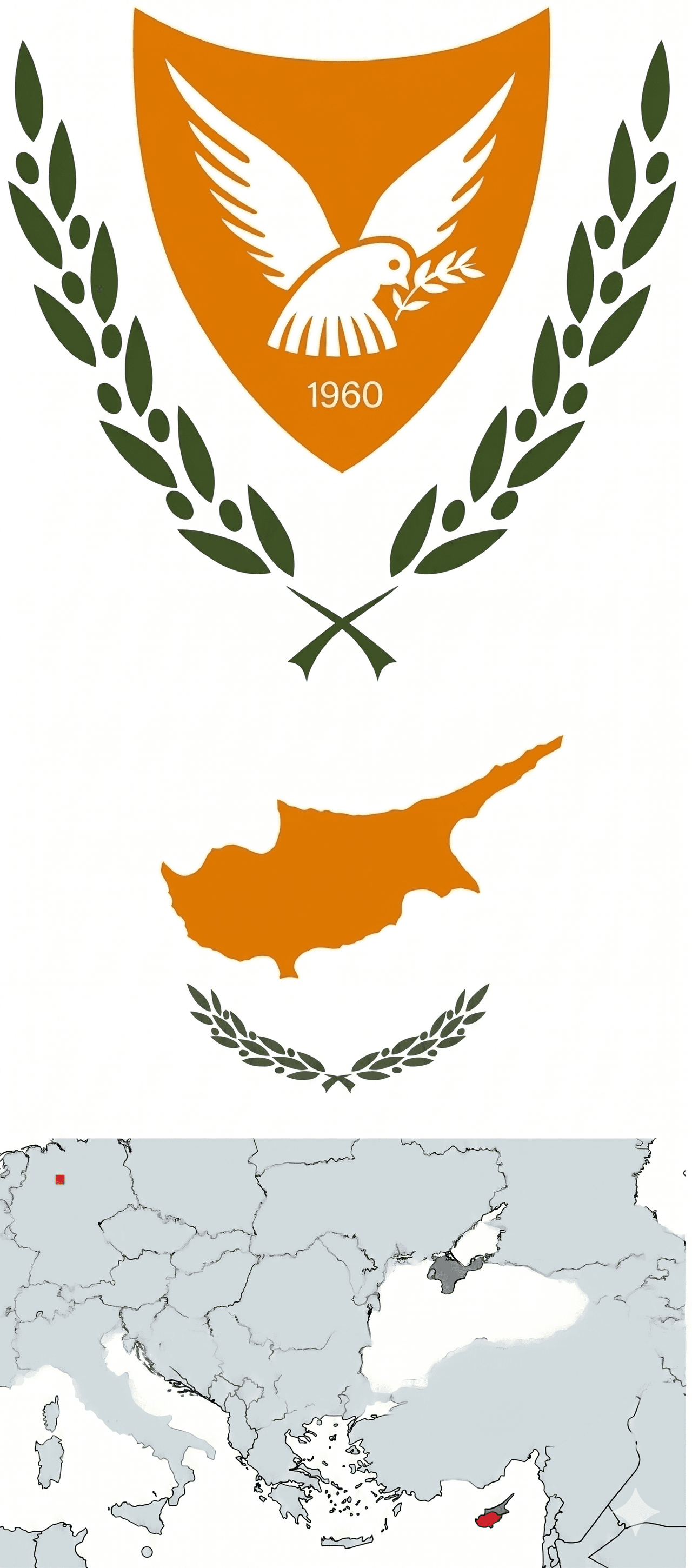
This article was automatically translated from the original Turkish version.
+2 More
Official Name | Republic of Cyprus | ||||||||
|---|---|---|---|---|---|---|---|---|---|
Surface Area | Approximately 5,896 km² (Actual area under control) | ||||||||
Governing System | Unitary constitutional republic governed by a presidential system | ||||||||
Capital | South Nicosia | ||||||||
Independence Date | 16 August 1960 | ||||||||
National Day | 1 October – Independence Day | ||||||||
Official Language | Greek and Turkish | ||||||||
Religious Structure | Greek Orthodox (≈89%) Catholics / Maronites (≈3%) Other Christians and non-believers (≈7%) Muslims (≈1%) | ||||||||
Head of State | Nikos Christodoulides | ||||||||
Ethnic Groups | Armenians Maronites Latins Foreign nationals (≈20%) Greek Cypriots (≈77%) | ||||||||
GDP | 36.48 billion euros | ||||||||
Common Languages | English Turkish Russian | ||||||||
GDP per Capita | 35,730 euros | ||||||||
Climate | Mediterranean climate | ||||||||
GDP (PPP) | Approximately 31 billion US dollars | ||||||||
Population | Approximately 1.3 million people Total | ||||||||
Ethnic Groups | Greek Cypriots ≈78–80% Armenian Maronite and Latin communities ≈3.2% Foreign nationals ≈20% | ||||||||
Religious Structure | Greek Orthodox ≈89–90% Roman Catholics/Latinists ≈ 2.9% Protestants ≈ 2% Muslims ≈ 1.8–2% Armenian Gregorians < 1% | ||||||||
Common Languages | Greek English Turkish Russian | ||||||||
Telephone Code | +357 | ||||||||
Internet Domain Code | .cy | ||||||||
The Republic of Cyprus Administration, is the political entity that exercises de facto control over the southern part of the island of Cyprus located in the Mediterranean. Cyprus is the third largest island in the Mediterranean after Sicily and Sardinia, situated south of Türkiye, west of Syria and east of Greece. Throughout history the island has been under the rule of various civilizations, resulting in a multi-layered development of its political, cultural and economic structures.

Petra tou Romiou - The Birthplace of Aphrodite (Visit Cyprus)
Today the island is de facto divided into two parts: north and south. The southern part is internationally recognized as the Republic of Cyprus and operates as a member of the European Union. The southern part of Nicosia serves as the administrative center. The economic structure is primarily based on services, tourism and finance sectors. Agriculture and mining remain limited but continuous areas of activity.【1】
The flag used by the Republic of Cyprus Administration gained official status with the republican system proclaimed in 1960. Its design and usage are regulated within the constitutional framework. The flag consists of a white background with a copper-colored map of Cyprus and two olive branches beneath it. The copper color references the island’s historical association with copper mining, while the olive branches symbolize peace. The flag is used in official ceremonies, public institutions and international representation.【2】
The national anthem of the Republic of Cyprus Administration is "Imnos eis tin Eleftherian". This anthem, which can be translated into Turkish as "Hymn to Freedom" or "Praise to Freedom", is the same as Greece’s national anthem. The lyrics were written by Dionysios Solomos and the music composed by Nikolaos Mantzaros. It is performed during official ceremonies, national holidays and international representation. In this respect the anthem is not merely a ceremonial element but also a symbolic expression of historical and political identity.【3】
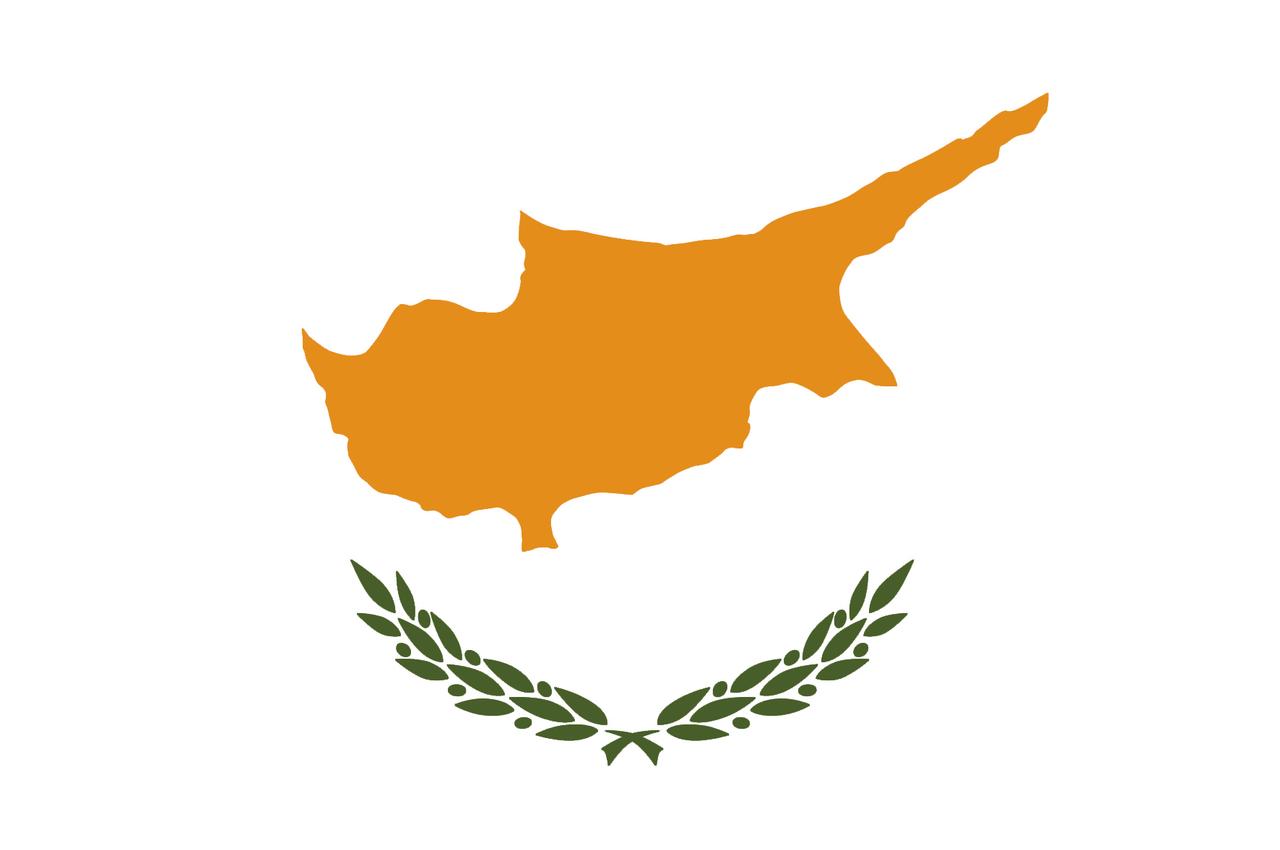
Official Flag of the Republic of Cyprus Administration (Presidency of the Republic)
Imnos eis tin Eleftherian
Se gnorizo apo tin kopsi
tou spathiou tin tromeri,
se gnorizo apo tin opsi,
pou me via metrai tin gi.
Ap’ ta kokkala vgalmeni
ton Ellinon ta iera,
kai san prota andriomeni,
chere, o chere, Eleftheria!
Turkish translation:
I recognize you by the terrible sharpness
of the sword’s cut;
I recognize you by your gaze,
that fiercely treads the earth.
Born from the sacred bones
of the Greeks,
Brave as ever,
hail to you, hail to you, O Freedom!
The state emblem used by the Republic of Cyprus Administration is designed in the shape of a copper-colored shield. At its center is a white dove carrying a green olive branch in its beak, with the year 1960 inscribed beneath it. This date refers to the year of the Republic of Cyprus’s independence. The shield is encircled by two green olive branches. The copper color is associated with the island’s historical copper resources. The white dove and olive branches represent the idea of peace. The design of the emblem, like the flag, was created by Cypriot Turkish artist İsmet Güney, who won the 1960 competition.【4】

Official Emblem of the Republic of Cyprus Administration (Presidency of the Republic)
Human presence in Cyprus dates back to the 10th millennium BCE, with the earliest significant settlements emerging during the Neolithic period, such as Khirokitia and Kalavasos. In the subsequent Chalcolithic period, copper processing enhanced the island’s economic importance. Cyprus’s ancient commercial significance stemmed from its rich copper deposits and its location along Eastern Mediterranean sea routes; the island became particularly prominent in copper and timber trade during this era.
Throughout the Bronze Age, Cyprus established intensive relations with Egypt, the Levant and the Aegean world. The settlement of Mycenaean Greeks on the island between the 13th and 12th centuries BCE led to the formation of local kingdoms along the coast and strengthened Hellenic influence. During the Archaic period, Cyprus came under the influence of Assyria, Egypt and Persia; during the Persian era, local kingdoms maintained a degree of autonomy. After the conquests of Alexander the Great, Cyprus became part of the Hellenistic world and later fell under Roman rule. Following the division of the Roman Empire in 395 CE, Cyprus became part of the Eastern Roman or Byzantine world, entering the medieval period.【5】
After the conquests of Alexander the Great, Cyprus became part of the Hellenistic world and came under the rule of the Ptolemaic Kingdom after 323 BCE. During this period, the island was integrated into the Hellenistic political structure centered in Egypt and maintained its commercial importance in the Eastern Mediterranean. Roman rule began in 58 BCE, but Cyprus’s definitive transition to Roman administration occurred in 30 BCE. Under Roman rule, Cyprus retained its strategic and commercial significance in the Eastern Mediterranean; Christianity also reached the island during this period. Following the division of the Roman Empire in 395 CE, Cyprus became part of the Eastern Roman or Byzantine Empire.
During the Byzantine period, Cyprus held military and commercial importance but was also affected by conflicts between the Byzantine Empire and the Islamic world. Although the island occasionally suffered attacks, it maintained its regional trade significance due to its ports and maritime location. In 1191, King Richard I of England seized the island during the Third Crusade, ending Byzantine rule. After Richard’s annexation, Cyprus became part of a new political structure of Crusader origin and passed under Lusignan control.【6】
Following the medieval Lusignan rule, Cyprus came under Venetian control. Due to its position along Eastern Mediterranean sea routes, the island retained its commercial and military importance during this period. Under Venetian administration, Cyprus became one of the key centers in the power struggles of the Mediterranean, particularly as the Ottoman Empire expanded its dominance in the Eastern Mediterranean, intensifying strategic competition over the island.
The Ottoman Empire launched its campaign to conquer Cyprus in 1570 under the command of Lala Mustafa Pasha. After capturing Limassol, Larnaca and Nicosia, the fall of Famagusta on 1 August 1571 completed the conquest. Thus, Ottoman rule began in Cyprus, and the island remained under Ottoman administration from 1571 to 1878. The Ottoman period marked a new phase in Cyprus’s administrative, social and economic structure; the institutional and social foundations of the Turkish presence on the island were strengthened during this time.
Throughout the Ottoman period, Cyprus maintained its military and commercial importance due to its position in the Eastern Mediterranean. The island was governed within the framework of centralized administrative reforms, while local communities of Turks and Greeks continued to exist through their own religious, social and cultural institutions. During this period, Cyprus was not merely an administrative province but also a strategic outpost in the Ottoman Empire’s Mediterranean policy.
After the Russo-Turkish War of 1877–1878, the Ottoman Empire’s political position weakened. In 1878, the administration of Cyprus was temporarily transferred to Britain, with sovereignty remaining formally with the Ottoman Empire. This transition was not the result of a local independence movement but the outcome of a political arrangement between the Ottoman Empire and Britain. Thus, Ottoman administration in Cyprus effectively ended and the island entered the British administration period.【7】
Under British rule, the island encountered new administrative and economic practices; simultaneously, the political objectives of the Greek and Turkish communities became more distinctly divided. While the Greek community increasingly advocated union with Greece, known as Enosis, the Turkish community rejected this goal. During World War I, Britain unilaterally annexed Cyprus in 1914 under the pretext of the Ottoman Empire and Britain being on opposing fronts. This development resulted in the effective end of Ottoman sovereignty over Cyprus and its tighter integration into British administration.
Through the Treaty of Lausanne, Türkiye recognized British sovereignty over Cyprus; this process created a new legal and political status for the Turkish Cypriot community. In 1925, Cyprus was officially declared a British Crown colony, solidifying its status within colonial administration. While the Greek community continued to press for Enosis, Turkish Cypriots opposed this goal and developed a stance aimed at preserving their historical, cultural and political ties with Türkiye.
The 1931 Greek uprising against British rule led to the imposition of new restrictions on political life on the island. After the uprising, British administration intensified its control over both communities and significantly restricted political activities. This situation persisted until the outbreak of World War II.
With the outbreak of World War II, Cyprus retained its strategic and logistical importance within the British Empire’s Eastern Mediterranean framework. The island remained under British administration throughout the war; many Cypriots participated in the war effort in various capacities. The formation of the Cyprus Regiment in 1940 became one of the primary indicators of the island’s military role during the war years.
The conditions of war also led to a partial relaxation of the strict colonial administration imposed after the 1931 uprising. In 1941, the British administration permitted local elections, enabling the revival of political activities that had been restricted since the 1930s. During this period, distinct political organizations emerged among Turkish and Greek Cypriots; groups such as KATAK and AKEL became prominent examples of political mobilization during the war years.
With the end of World War II, the future of colonial rule in Cyprus became a subject of increased debate. In the post-war period, Britain attempted to reshape its administration through limited constitutional reforms and advisory mechanisms; however, the Greek community’s demand for Enosis and the Turkish community’s opposition to it became more pronounced. By 1949, the issue in Cyprus had moved beyond merely the continuation of colonial rule and evolved into a political division shaped by the differing visions of the future held by the Greek and Turkish communities. This environment laid the groundwork for a new era that would soon take clearer shape through the 1950 plebiscite.
In 1950, an unofficial plebiscite organized by the Greek Orthodox Church made the goal of Enosis more visible. Subsequently, in 1955, EOKA launched an armed struggle against British rule. EOKA’s primary objective was the union of the island with Greece. In response, Turkish Cypriots also strengthened their own political and social organizations. Thus, the island entered a conflictual phase not only against colonial rule but also along the lines of the two communities’ divergent political goals. As a result, in 1960 the Republic of Cyprus was established, with a state structure built on a bi-communal constitutional system based on power-sharing between the Greek and Turkish communities.
The Republic of Cyprus established in 1960 was founded on a bi-communal constitutional system based on power-sharing between the Greek and Turkish communities; however, this structure quickly became unworkable. The intercommunal conflicts that began in 1963 led to the de facto exclusion of the Turkish community from state institutions and deepened the political division on the island. During this period, the United Nations Peacekeeping Force was deployed to the island, and the de facto dividing line in Nicosia became clearly defined as what would later be known as the Green Line. The crisis reached a new stage in 1974 with a coup supported by the military junta in Athens; the coup was interpreted as an attempt to forcibly implement Enosis, the union of Cyprus with Greece.
In response, Türkiye, invoking its rights under the 1960 Treaty of Guarantee, launched the Cyprus Peace Operation on 20 July 1974. Following the operation, the military and political balance on the island changed entirely, and the island was de facto divided with the Turkish population concentrated in the north and the Greek population in the south.【8】 This development not only formally ended the constitutional partnership arrangement that had already been de facto dissolved due to EOKA’s activities but also transformed the Cyprus issue into a permanent regional issue encompassing dimensions of security, sovereignty, representation, territory and international recognition.【9】
The “Green Line” in Cyprus refers to the buffer zone dividing the island de facto into northern and southern parts and under United Nations supervision. The line emerged following intercommunal conflicts in 1963 and acquired the status of an internationally monitored buffer zone with the deployment of the United Nations Peacekeeping Force (UNFICYP) in 1964. Although initially established to ensure security and control conflicts, over time it became a permanent boundary defining the de facto division of the island.【10】
Following the developments of 1974, the Green Line became a concrete border between the northern and southern parts of the island. Since then, it has not merely functioned as a military and security buffer zone but has also persisted as a structure reflecting administrative, economic and social division. The buffer zone along the line constitutes a unique geographical and administrative area comprising non-residential zones, abandoned settlements and controlled crossing points.【11】
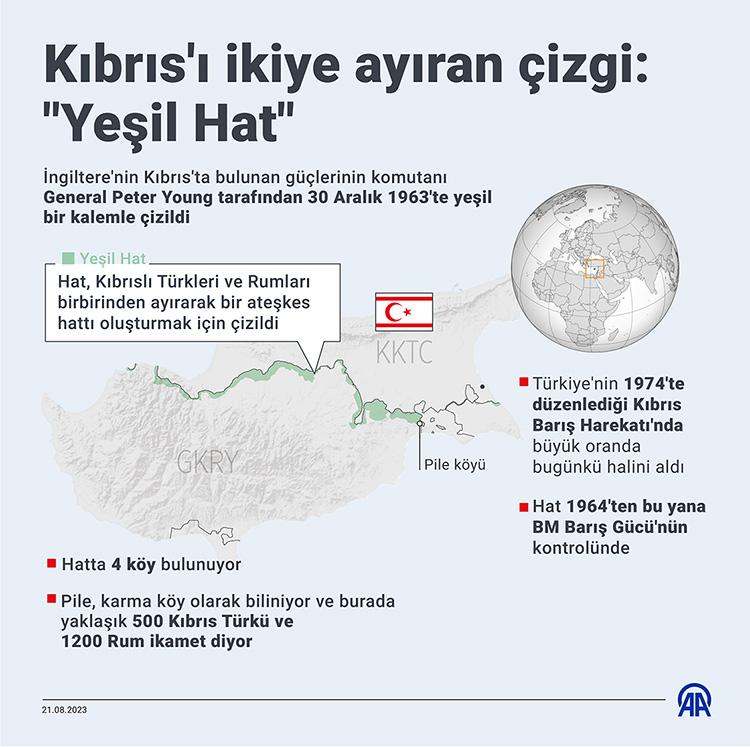
Kıbrıs'ı İkiye Ayıran Çizgi: Yeşil Hat (Anadolu Ajansı)
Within the framework of the European Union, the Green Line is addressed under a specific legal regulation. The “Green Line Regulation” establishes the primary regulatory framework governing the movement of goods, services and persons across the line. Within this framework, commercial activities, customs procedures, crossing protocols and monitoring mechanisms are conducted according to established principles. This regulation was developed in response to the unique situation arising from the suspension of European Union law in the northern part of the island and aims to ensure that interactions across the line occur within defined rules.
In conclusion, the Green Line has evolved into a multi-layered structure within the historical development of the Cyprus issue, acquiring legal, political and social dimensions. Maintained under United Nations supervision, the line serves not only as the spatial expression of the island’s de facto division but also as a unique buffer zone shaped by international law and European Union regulations.
Within United Nations-mediated negotiations, the fundamental parameters of a solution have long been shaped by the principles of bi-zonalism, bi-communality and political equality. The main stages of the negotiation process have been as follows:
After 2017, the Turkish side, emphasizing that federal solution negotiations had yielded no results over many years, began advocating a two-state solution based on sovereign equality and equal international status. Today, the Cyprus issue continues to exist within the framework of United Nations-led diplomatic initiatives, alongside energy resources in the Eastern Mediterranean, regional security dynamics and international law debates.【12】
Today, the Republic of Cyprus Administration is governed under a presidential republic system; the president serves as both head of state and head of the executive. Cyprus joined the European Union in 2004, yet despite the 2004 Annan Plan referendum, the island has not been reunified. Consequently, the de facto division of the island persists today. European Union acquis is not de facto applied in the northern part of the island. Current politics highlights energy resources, maritime jurisdiction areas, security policies and crossings along the Green Line. In this context, the Cyprus issue continues to maintain its importance in both regional and international politics.【13】
Cyprus stands out as the third largest island in the Mediterranean after Sicily and Sardinia. Cyprus lies between latitudes 34º33’ and 35º42’ N and longitudes 32º16’ and 34º36’ E. Approximately 70 km north of the island lies Türkiye, 102 km east lies Syria, 165 km northeast lies Lebanon, 233 km southeast lies Israel, 347 km south lies Egypt, and 835 km northwest lies Greece. Due to its location in the Eastern Mediterranean, the island has held strategic importance throughout history in terms of sea routes, trade corridors and military movements.
The Republic of Cyprus Administration exercises de facto control over the southern part of the island. The northern part of the island is occupied by the Turkish Republic of Northern Cyprus, with a United Nations-controlled buffer zone between the two regions. The capital, Nicosia, is one of the cities directly reflecting the de facto division of the island; the southern part of Nicosia serves as the administrative center. Additionally, there are British sovereign base areas on the island: Akrotiri and Dhekelia.【14】
The topography of the Republic of Cyprus Administration consists primarily of mountainous areas, inland plains and coastal regions. The Troodos Mountains, located in the southwest and central regions, form the highest and most prominent mountainous area of the island. The Troodos massif has a decisive influence on the island’s climate, vegetation, water resources and settlement patterns. The southern sections of the Mesaoria Plain lie in the interior and are significant for agricultural production and settlement. The Kyrenia Mountains, extending along the northern part of the island, lie outside the administrative area of the Republic of Cyprus Administration but remain an important mountain range within the overall physical geography of Cyprus. The coastal areas of the Republic of Cyprus Administration are prominent for tourism, port activities and economic dynamism.【15】
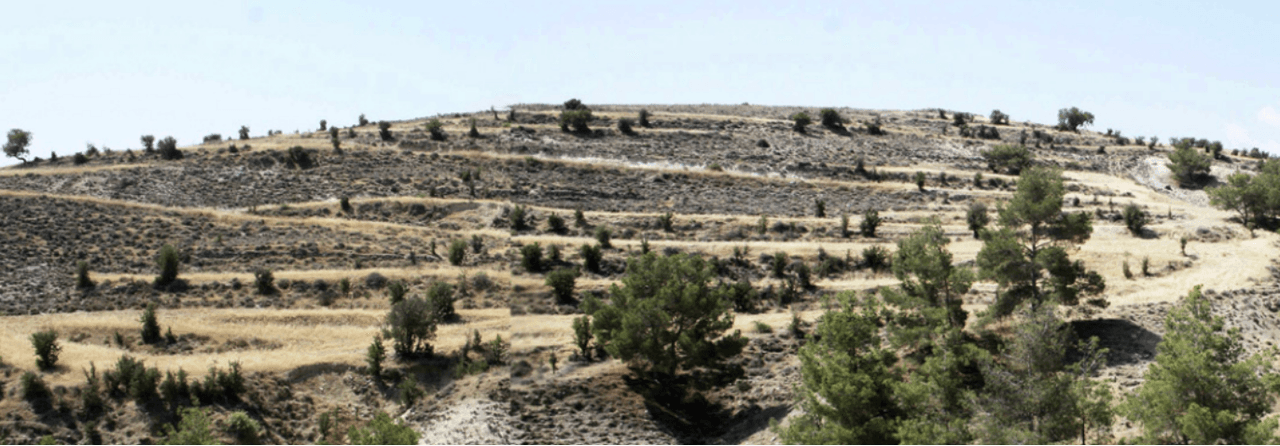
Troodos Mountains (Rachel Benkowski)
The main mountainous area of the Republic of Cyprus Administration is formed by the Troodos Mountains, which extend across the southern and western parts of the island. The highest point of the Troodos massif is Mount Olympus, at 1,952 meters above sea level. The Kyrenia Mountains, extending along the northern part of the island, lie outside the direct geographical area of the Republic of Cyprus Administration but remain an important mountain range within the overall physical geography of Cyprus.
The Troodos Mountains have a decisive influence on the climate, vegetation, water resources, distribution of agricultural land and transportation routes of the Republic of Cyprus Administration. Precipitation increases with altitude; annual rainfall in the lower elevations of the Troodos National Forest Park begins at approximately 750 mm and exceeds 1,000 mm in the higher elevations. Snowfall occurs in the higher elevations of Troodos during winter months, particularly around Mount Olympus, making it a significant destination for winter tourism.
The mountainous areas also contain a significant portion of the island’s forest cover. Many rivers on the island originate in the Troodos region, enhancing the importance of the mountainous terrain for water resources and agricultural production. The Troodos massif is also significant not only from a physical geography perspective but also due to its geological features; the region’s ophiolite structure is linked to Cyprus’s mineral resources and particularly its historical copper production.
In the Republic of Cyprus Administration, plain and valley areas are shaped around the southern sections of the Mesaoria Plain and coastal plains, as well as valleys formed by rivers originating from the Troodos Mountains. The Mesaoria Plain is one of the most important inland plains of Cyprus, located in the central part of the island and significant for agricultural production.【16】 Within the boundaries of the Republic of Cyprus Administration, areas south of Nicosia, around Larnaca and other lowland regions are prominent for agriculture and settlement.
Thanks to fertile soils, cereals, potatoes, vegetables and various agricultural products are cultivated in the plains and coastal lowlands. However, limited water resources remain one of the main factors affecting agricultural production. Plain areas are more favorable for settlement and transportation compared to mountainous regions. Valleys are mostly shaped by seasonal or periodic rivers originating from the Troodos Mountains. These valleys carry water during rainy seasons but largely dry up during summer months. This characteristic is directly linked to the Mediterranean climate of the island, characterized by hot, dry summers and mild, rainy winters.【17】
The majority of rivers in the Republic of Cyprus Administration exhibit seasonal characteristics; most of these rivers weaken or dry up during summer months. Consequently, the region has a limited hydrographic structure with few permanent and large rivers. Major rivers include Kouris, Dhiarizos, Ezousa, Xeros Potamos, Germasogeia, Vasilikos, Pentaschoinos, Pedieos and Gialias. A significant portion of these rivers originate in the Troodos Mountains and are vital for the water resources, agricultural production and dam systems of the Republic of Cyprus Administration.【18】
Due to the irregularity of water resources, rivers are evaluated not only as natural drainage elements but also in conjunction with irrigation and storage systems. In this context, the storage capacities of dams are reported as follows: Kouris Dam at 115,000,000 m³, Asprokremmos Dam at 52,375,000 m³, Kannaviou Dam at 18,000,000 m³, Evretou Dam at 24,000,000 m³, Lefkara Dam at 13,850,000 m³ and Germasogeia Dam at 13,500,000 m³.【19】
Lake areas are limited, but the main natural lakes in the Republic of Cyprus Administration include Akrotiri/Limasol Salt Lake, Larnaka Salt Lake, Paralimni Lake and Oroklini Lake. Among these, Akrotiri/Limasol Salt Lake, with a surface area of 10.65 km², is identified as the island’s largest inland water body. Larnaka Salt Lake, with a surface area of 2.2 km², is one of the important wetland areas within the Ramsar and Natura 2000 frameworks. These lakes are significant for migratory birds, flamingos and wetland ecosystems.
The Republic of Cyprus Administration experiences a typical Mediterranean climate. Summers are hot and dry, while winters are mild and rainy. The majority of precipitation falls between November and March, with annual rainfall increasing from coastal and lowland areas toward the higher elevations of the Troodos Mountains. Annual rainfall on the southwestern slopes begins at approximately 450 mm and can exceed 1,000 mm in the higher elevations of Troodos. Precipitation in the interior regions is lower than in coastal and highland areas; however, snowfall can occur in the higher elevations of Troodos during winter months.
This climatic structure directly affects the distribution of vegetation. In coastal and lowland areas of the Republic of Cyprus Administration, maquis and garrigue vegetation types are prevalent, while in higher and more humid areas, pine forests and mountainous forest cover are found. Approximately one-fifth of the land area of Cyprus is forested; when forests and other wooded areas are combined, this proportion increases further. Forest cover has been damaged throughout history due to shipbuilding, timber use, agricultural expansion, overgrazing and fires; this has led to the contraction and degradation of the natural vegetation in some regions.【20】
Among the natural resources of the Republic of Cyprus Administration, copper holds a special historical position. Cyprus has been known since antiquity particularly for its copper ores; the island’s mineral resources are largely associated with the geological structure of the Troodos Ophiolite Complex. The Troodos Ophiolite Complex covers approximately 3,200 km² in the central and southern parts of Cyprus and constitutes the island’s geological core. The sulfide copper deposits, pyrite deposits and other mineral formations within this structure form the basis of Cyprus’s historical mining activities.【21】
In addition to copper, pyrite, chromite, asbestos, gypsum, clay, bentonite, limestone, building stone, sand and gravel, and natural pigments are among the island’s main mineral and raw material resources. Historically, copper, iron pyrite, chromite and asbestos were significant export products; however, most of these activities have lost their former importance today. According to 2000 data, the mining and quarrying sector accounted for approximately 0.3 percent of Cyprus’s gross domestic product; in 2001, the value of mineral exports exceeded 11 million Cypriot pounds, while total turnover in mineral and related industrial sectors surpassed 93 million Cypriot pounds.
Today, metallic mining is limited compared to historical levels, but the Skouriotissa area has maintained its importance for copper production. In 1996, production resumed at this site using the solution mining/solvent extraction-electrowinning method, achieving copper cathode purity of 99.999 percent. Additionally, the mining strategy for the 2021–2050 period indicates that Cyprus has 328 closed mines and quarries and 120 active quarry licenses. This situation demonstrates that while metallic mining has been restricted, quarrying and construction raw materials continue to hold economic importance.
Asbestos has also held an important place in Cyprus’s mining history. The open-pit asbestos operation in Amiandos became operational in 1904 and closed in 1988 with the decline in asbestos use. Chromite deposits are associated with ultramafic rocks in the Troodos ophiolite; approximately 600,000 tons of chromite ore were extracted until 1985, but reserves could not be raised above 200,000 tons. Consequently, chromite is now primarily regarded as part of the island’s historical mining heritage.
Mining activities have historically contributed to the economy but have also resulted in environmental impacts, including abandoned mines, waste areas, land use changes and chemical residues. Official records indicate that there are 32 closed mining activities and 12 mining concessions registered in Cyprus; 28 of these are associated with copper-mixed sulfide mines and enrichment facilities, while four are linked to chromite mines and processing plants.
Current natural resource debates are not limited to minerals on land. The hydrocarbon exploration and licensing activities conducted by the Republic of Cyprus Administration in the Eastern Mediterranean are also an area of economic, diplomatic and geopolitical debate. In this context, the “Aphrodite” natural gas field in Block 12 was granted an operating license in November 2019; the field’s current estimated natural gas reserves are approximately 4.5 trillion cubic feet. The ownership shares in the field are Chevron Cyprus Limited at 35 percent, NewMed Energy Limited Partnership at 30 percent and BG Cyprus Limited at 35 percent. However, Türkiye and the Turkish Republic of Northern Cyprus emphasize that the Republic of Cyprus Administration’s unilateral hydrocarbon activities disregard the shared rights of Turkish Cypriots on the island and Türkiye’s rights regarding maritime jurisdiction areas in the Eastern Mediterranean.【22】
The energy resources around Cyprus have influenced regional balances. These resources are linked to energy security and maritime jurisdiction disputes. From the perspective of the Republic of Cyprus Administration, the potential of natural gas and oil in maritime areas is associated with economic development expectations. In this context, the Aphrodite natural gas field in Block 12 is one of the prominent issues in the Republic of Cyprus Administration’s energy policy.【23】
However, these areas carry a controversial nature due to the unresolved political situation on the island. The issue of marine resources has become a major topic in relations between Türkiye, the Turkish Republic of Northern Cyprus and the Republic of Cyprus Administration. Türkiye and the Turkish Republic of Northern Cyprus emphasize that the Republic of Cyprus Administration’s unilateral hydrocarbon activities disregard the rights of Turkish Cypriots regarding natural resources around the island. Therefore, the use of natural resources goes beyond a purely technical economic issue. Energy resources are one of the important elements of the diplomatic and security agenda in the Eastern Mediterranean.
In terms of energy infrastructure, the Republic of Cyprus Administration is developing various projects regarding electricity supply security and external connections. In this context, projects such as the Great Sea Interconnector are important for the island’s electricity supply security, renewable energy integration and connection to European energy markets. In transportation infrastructure, the ports of Limassol and Larnaca and the airports of Larnaca and Paphos are the main elements for the Republic of Cyprus Administration’s external connections, trade and tourism dynamics.【24】
One of the main environmental issues in the area governed by the Republic of Cyprus Administration is water scarcity. The hot and dry summers of the Mediterranean climate create pressure on water resources. The seasonal and irregular nature of rainfall also limits agricultural production. The historical destruction of forest areas has disrupted environmental balance. Mining, fires, deforestation for shipbuilding and intensive grazing are among the causes of this degradation. The risk of drought and fires increases during summer months. In mountainous regions, snowfall and harsh weather conditions can occur during winter. These environmental conditions make water management, agricultural planning and the protection of natural resources critically important.【25】
The economy of the Republic of Cyprus Administration exhibits a service-oriented structure. According to 2024 data, the sectoral distribution of gross domestic product shows services accounting for 86.2 percent, industry and construction for 12.5 percent, and agriculture for 1.3 percent. Gross domestic product at current prices was estimated at €36.48 billion in 2025; the economy grew by 3.8 percent in real terms that year. The main contributors to growth were information and communication, hotels and restaurants, wholesale and retail trade, and the construction sector.
Merchandise and service exports amounted to €35.60 billion in 2025, while merchandise and service imports reached €33.54 billion. Per capita gross domestic product stood at approximately €35,730 according to 2024 data. Regarding public finance, the general government balance recorded a surplus of 3.4 percent of gross domestic product in 2025; the gross government debt-to-GDP ratio declined to 55.0 percent. The unemployment rate reached 4.4 percent that year.【26】
Agriculture and livestock, while maintaining historical importance, hold a limited share in the current economic structure. According to 2024 data, the share of agriculture, forestry and fishing in gross domestic product is approximately 1.3 percent. In the same year, agricultural employment was recorded at 20
21st Century Turkey Institute. "Güney Kıbrıs Rum Yönetiminde (GKRY) Kriz." Accessed April 21, 2026. https://21yyte.org/balkanlar-ve-kibris-arastirmalari-merkezi/guney-kibris-rum-yonetiminde-gkry-kriz/3344
21st Century Turkey Institute. "Kıbrıs Rum Ortodoks Kilisesi ve Başpiskopos II. Hrisostomos." Accessed April 21, 2026. https://21yyte.org/teostrateji-arastirmalari-merkezi/kibris-rum-ortodoks-kilisesi-ve-baspiskopos-ii-hrisostomos/7221.
AVİM (Center for Eurasian Studies). "Güney Kıbrıs Rum Yönetimi'nin Savunma Maksadını Aşan Silahlanma Faaliyetleri." Accessed April 21, 2026. https://avim.org.tr/tr/Yorum/GUNEY-KIBRIS-RUM-YONETIMI-NIN-SAVUNMA-MAKSADINI-ASAN-SILAHLANMA-FAALIYETLERI
Anadolu Ajansı. "Alman Fırkateyni FGS Nordrhein-Westfalen GKRY’ye Ulaştı." Accessed April 21, 2026. https://www.aa.com.tr/tr/dunya/alman-firkateyni-fgs-nordrhein-westfalen-gkryye-ulasti/3855270
Anadolu Ajansı. "Ankara'da NATO Zirvesi tedbirleri." Infographic. Prepared by Yasin Demirci. Accessed April 21, 2026. https://www.aa.com.tr/tr/info/infografik/52566.
Anadolu Ajansı. "Dışişleri Bakanlığı Sözcüsü Keçeli: Türkiye, KKTC'yle Birlikte Kıbrıslı Türklerin Haklarını Savunmaya Devam Edecektir." Accessed April 21, 2026. https://www.aa.com.tr/tr/gundem/disisleri-bakanligi-sozcusu-keceli-turkiye-kktcyle-birlikte-kibrisli-turklerin-haklarini-savunmaya-devam-edecektir/3755195
Anadolu Ajansı. "GKRY'nin NATO'ya Alınma Çabası Bölge İçin Ne Anlama Geliyor?" Accessed April 21, 2026. https://www.aa.com.tr/tr/analiz/gkrynin-nato-ya-alinma-cabasi-bolge-icin-ne-anlama-geliyor/3418795.
Anadolu Ajansı. "KKTC Başbakanı Üstel, Güney Kıbrıs Rum Yönetimi’nde Türkiye ve KKTC bayraklarının yakılmasını kınadı." Accessed April 21, 2026. https://www.aa.com.tr/tr/dunya/kktc-basbakani-ustel-guney-kibris-rum-yonetiminde-turkiye-ve-kktc-bayraklarinin-yakilmasini-kinadi/3902984
Anadolu Ajansı. "KKTC Başbakanı Üstel: KKTC’nin Güvenliği İçin Tüm Tedbirler Alınmıştır." Accessed April 21, 2026. https://www.aa.com.tr/tr/dunya/kktc-basbakani-ustel-kktcnin-guvenligi-icin-tum-tedbirler-alinmistir/3906805.
Anadolu Ajansı. "KKTC Cumhurbaşkanı Tatar: GKRY Adeta Bir Silah Deposuna Dönüşmüş Durumda." Accessed April 21, 2026. https://www.aa.com.tr/tr/dunya/kktc-cumhurbaskani-tatar-gkry-adeta-bir-silah-deposuna-donusmus-durumda/3708366.
Anadolu Ajansı. "KKTC Dışişleri Bakanlığı Rum Liderin Türkiye ile İlgili Söylemlerini Şiddetle Kınadı." Accessed April 21, 2026. https://www.aa.com.tr/tr/dunya/kktc-disisleri-bakanligi-rum-liderin-turkiye-ile-ilgili-soylemlerini-siddetle-kinadi/3857314
Anadolu Ajansı. "KKTC Dışişleri Bakanlığından ABD ile Güney Kıbrıs Rum Yönetimi Arasındaki Anlaşmaya Tepki." Accessed April 21, 2026. https://www.aa.com.tr/tr/dunya/kktc-disisleri-bakanligindan-abd-ile-guney-kibris-rum-yonetimi-arasindaki-anlasmaya-tepki/3328136
Anadolu Ajansı. "KKTC'den GKRY Savunma Bakanının Silahlanma Bütçesi ile İlgili Açıklamalarına Tepki." Accessed April 21, 2026. https://www.aa.com.tr/tr/dunya/kktcden-gkry-savunma-bakaninin-silahlanma-butcesi-ile-ilgili-aciklamalarina-tepki/2745352
Anadolu Ajansı. "KKTC'ye Avrupa'dan Gelen Turist Sayısı Rumların Baskısıyla Düşüyor." Accessed April 21, 2026. https://www.aa.com.tr/tr/dunya/kktcye-avrupa-dan-gelen-turist-sayisi-rumlarin-baskisiyla-dusuyor/3501849
Anadolu Ajansı. "Kıbrıs Adasında Derin Bir Aktör: Kıbrıs Rum Ortodoks Kilisesi." Accessed April 21, 2026. https://www.aa.com.tr/tr/dunya/kibris-adasinda-derin-bir-aktor-kibris-rum-ortodoks-kilisesi/2736170.
Anadolu Ajansı. "Kıbrıs'ı İkiye Ayıran Çizgi: Yeşil Hat." Accessed April 21, 2026. https://www.aa.com.tr/tr/dunya/kibrisi-ikiye-ayiran-cizgi-yesil-hat/2972726.
Anadolu Ajansı. "MSB: GKRY'nin İsrail'den Savunma Sistemi Tedariki – KKTC'nin Güvenlik ve Huzuru İçin Gerekli Tüm Tedbirler Alınmaktadır." Accessed April 21, 2026. https://www.aa.com.tr/tr/gundem/msb-gkrynin-israilden-savunma-sistemi-tedariki-kktcnin-guvenlik-ve-huzuru-icin-gerekli-tum-tedbirler-alinmaktadir/3691171.
Anadolu Ajansı. "Rum Kesiminin Silahlanma Bütçesinde İHA, Füze ve Saldırı Helikopteri Tedariki Yer Alıyor." Accessed April 21, 2026. https://www.aa.com.tr/tr/dunya/rum-kesiminin-silahlanma-butcesinde-iha-fuze-ve-saldiri-helikopteri-tedariki-yer-aliyor/2706567
Anadolu Ajansı. "Rum Milli Muhafız Ordusu'nun Silah Kapasitesini Artırdığı Bildirildi." Accessed April 21, 2026. https://www.aa.com.tr/tr/dunya/rum-milli-muhafiz-ordusunun-silah-kapasitesini-artirdigi-bildirildi/2369637.
Anadolu Ajansı. "Rum Milli Muhafız Ordusundan KKTC Topraklarını Hedef Alan Açıklama." Accessed April 21, 2026. https://www.aa.com.tr/tr/dunya/rum-milli-muhafiz-ordusundan-kktc-topraklarini-hedef-alan-aciklama/3895926
Anadolu Ajansı. "Rusya ile Kıbrıs Rum Yönetimi Arasındaki Askeri İş Birliği." Accessed April 21, 2026. https://www.aa.com.tr/tr/dunya/rusya-ile-kibris-rum-yonetimi-arasinda-askeri-is-birligi/71782
Anadolu Ajansı. "Rusya, Güney Kıbrıs Rum Yönetimi'ne Nota Verdi." Accessed April 21, 2026. https://www.aa.com.tr/tr/dunya/rusya-guney-kibris-rum-yonetimi-ne-nota-verdi/3009756
Anadolu Ajansı. "Çin'den Kıbrıs'ta İki Tarafın Çıkarlarına Uygun Çözüm Açıklaması." Accessed April 21, 2026. https://www.aa.com.tr/tr/dunya/cinden-kibrista-iki-tarafin-cikarlarına-uygun-cozum-aciklamasi/1593185.
Anadolu Ajansı. "Ülke Profilleri: Kuzey Kıbrıs Türk Cumhuriyeti (KKTC)." Accessed April 21, 2026. https://www.aa.com.tr/tr/ulke-profilleri/kuzey-kibris-turk-cumhuriyeti-kktc/901503.
Anadolu Ajansı. "İngiltere ve AB Üyesi Bazı Ülkelerin Doğu Akdeniz ile GKRY'deki Askeri Varlıkları Artıyor." Accessed April 21, 2026. https://www.aa.com.tr/tr/dunya/ingiltere-ve-ab-uyesi-bazi-ulkelerin-dogu-akdeniz-ile-gkrydeki-askeri-varliklari-artiyor/3849319
Anadolu Ajansı. "İngiltere, İran'ın İngiliz Askeri Üslerinin Bulunduğu Kıbrıs Rum Kesimine Doğru İki Füze Fırlattığını Bildirdi." Accessed April 21, 2026. https://www.aa.com.tr/tr/dunya/ingiltere-iranin-ingiliz-askeri-uslerinin-bulunduğu-kibris-rum-kesimine-dogru-iki-fuze-firlattigini-bildirdi/3844984
Başak, Ünsal. "1993 Yunanistan-Güney Kıbrıs Rum Yönetimi Ortak Savunma Doktrini ve Doğu Akdeniz’deki Güvenlik Ortamına Etkileri." *Cumhuriyet Tarihi Araştırmaları Dergisi* 21, no. 42 (2025): 423–456. Accessed April 21, 2026. https://ctad.hacettepe.edu.tr/21_42/20.pdf
Boehm, Werner. "Cyprus." Flickr, January 25, 2025. Accessed April 21, 2026. https://www.flickr.com/photos/28432918@N04/54286137421/
Cyprus Mail. "Defence Ministry Issues Conscript Call for 16-Year-Olds." Accessed April 21, 2026. https://cyprus-mail.com/2026/01/12/defence-ministry-issues-conscript-call-for-16-year-olds/.
Cyprus National Commission for UNESCO. "Intangible Cultural Heritage of Cyprus." Accessed April 21, 2026. https://www.unesco.org.cy/Programmes-Intangible_Cultural_Heritage_of_Cyprus,EN-PROGRAMMES-04-02-03,EN.
Cystat (Statistical Service of Cyprus). *Cyprus in the EU Scale 2020*. Nicosia: Cystat, 2020. Accessed April 21, 2026. https://library.cystat.gov.cy/Documents/Publication/CYPRUS_IN_THE_EU_SCALE-2020-020620.pdf
Defense Visual Information Distribution Service (DVIDS). "24th Marine Expeditionary Unit (MEU) Special Operations Capable (SOC) Sustainment Training in the Republic of Cyprus" U.S. Department of Defense. Accessed April 21, 2026. https://www.dvidshub.net/news/480392/24th-marine-expeditionary-unit-meu-special-operations-capable-soc-sustainment-training-republic-cyprus
Deputy Ministry of Culture of the Republic of Cyprus. "Ποιοι είμαστε." Accessed April 21, 2026. https://www.gov.cy/culture-dcc/about/poioi-eimaste/.
Dilek, Mehmet Sait. "Güney Kıbrıs Rum Yönetimi’nin Ermenistan ve Türkiye’ye Yönelik Dış Politika Tutumları." TESAM Akademi Dergisi 2, no. 1 (2015): 195–220. Accessed April 21, 2026. https://dergipark.org.tr/tr/pub/tesamakademi/article/156429
European Commission. "Cyprus Green Line Crossings Reached Historic High in 2024." Representation in Cyprus. Accessed April 21, 2026. https://cyprus.representation.ec.europa.eu/news/cyprus-green-line-crossings-reached-historic-high-2024-2025-07-01_en
European Commission. "Republic of Cyprus Official Ceremonies and Leaders Digital Photo Archive." Audiovisual Service. Accessed April 21, 2026. https://audiovisual.ec.europa.eu/
European Commission. *Education and Training Monitor: Cyprus Report*. Brussels: European Commission, 2023. Accessed April 21, 2026. https://op.europa.eu/webpub/eac/education-and-training-monitor/en/country-reports/cyprus.html.
European Data Journalism Network (EDJNet). "Brain Drain: How the Exodus of Talent Is Redefining the Map of Europe." Accessed April 21, 2026. https://www.europeandatajournalism.eu/cp_data_news/brain-drain-how-the-exodus-of-talent-is-redefining-the-map-of-europe/.
European Union Information Center. "Green Line Regulation." Accessed April 21, 2026. https://www.abbilgi.eu/tr/green-line-regulation
European Union. "Cyprus." Europa Portal. Accessed April 21, 2026. https://european-union.europa.eu/principles-countries-history/eu-countries/cyprus_en
Eurydice. "Cyprus: Organisation and Governance." European Commission, 2024. Accessed April 21, 2026. https://eurydice.eacea.ec.europa.eu/eurypedia/cyprus/organisation-and-governance
Eurydice. "Cyprus: Overview." European Commission, 2024. Accessed April 21, 2026. https://eurydice.eacea.ec.europa.eu/eurypedia/cyprus/overview
Fall, Patricia L. et al. "Long-term Agrarian Landscapes in the Troodos Foothills, Cyprus." *Journal of Archaeological Science* 39(7):2335–2347. Accessed June 15, 2026. https://www.researchgate.net/publication/257154858_Long-term_agrarian_landscapes_in_the_Troodos_foothills_Cyprus
Food and Agriculture Organization of the United Nations (FAO). "Country Profiles: Cyprus." Accessed April 21, 2026. https://www.fao.org/countryprofiles/index/en/?iso3=CYP
Gazioğlu, Ahmet C. "Kuzey Kıbrıs Türk Cumhuriyeti." *TDV İslâm Ansiklopedisi*. Accessed April 21, 2026. https://islamansiklopedisi.org.tr/kuzey-kibris-turk-cumhuriyeti.
Günar, Altuğ. "Güney Kıbrıs Rum Yönetimi’nin (Kıbrıs Cumhuriyeti’nin) Avrupa Birliği Üyeliğinin Kıbrıs Sorununa Etkisi." *Yakın Dönem Türkiye Araştırmaları*, no. 37 (2020): 95–118. Accessed April 21, 2026. https://dergipark.org.tr/tr/pub/iuydta/article/758166
Gürsoy, Cevat Rüştü. "Kıbrıs." *TDV İslâm Ansiklopedisi*. Accessed April 21, 2026. https://islamansiklopedisi.org.tr/kibris.
IMF (International Monetary Fund). *Cyprus: 2021 Article IV Consultation—Press Release; Staff Report; and Statement by the Executive Director for Cyprus*. Washington, DC: IMF Publications, 2021. Accessed April 21, 2026. https://www.imf.org/-/media/files/publications/cr/2021/english/1cypea2021002.pdf
Işıksal, Hüseyin. "Güney Kıbrıs Rum Yönetiminin Çelişkili Avrupa Birliği Üyeliğinin İkilemleri ve Türkiye Avrupa Birliği İlişkileri." *Gazi Akademik Bakış* 12, no. 24 (2019): 119–133. Accessed April 21, 2026. https://izlik.org/JA86NA53WJ
Işıksal, Hüseyin. "Türkiye-Güney Kıbrıs Rum Yönetimi (Kıbrıs Cumhuriyeti) İlişkileri: Geçmişin Prangaları Arasında Gelecek Arayışları." In *Mavi Elma: Türkiye-Avrupa İlişkileri*, 2017. Accessed April 21, 2026. https://www.researchgate.net/publication/320232417.
KKTC Enformasyon Dairesi. "Genel Bilgi." Personel ve İdari İşler Dairesi (PİO). Accessed April 21, 2026. https://pio.mfa.gov.ct.tr/genel-bilgi/.
Keser, Ulvi. "Kıbrıs'ın Stratejik Önemi Bağlamında Adada Askeri Faaliyetler ve İlgili Tarafların Askeri Gücü." *Güvenlik Stratejileri Dergisi* 2, no. 3 (2006): 135–173. Accessed April 21, 2026. https://www.msu.edu.tr/GuvenlikStratejileriDergisi/dokuman/GSD_3/GSD_3_Art_7_062006.pdf
Klein, Christopher. "How Cyrus the Great Turned Ancient Persia Into a Superpower." HISTORY, 2023. Accessed April 21, 2026. https://www.history.com/articles/cyrus-the-great-persian-empire-iran
Kökyay, Ferhat. "Güney Kıbrıs Rum Yönetimi’nin Akdeniz Enerji Politikası." *Liberal Düşünce Dergisi* 26, no. 101 (2021): 143–168. Accessed April 21, 2026. https://dergipark.org.tr/tr/pub/liberal/article/866714
Library of Congress. "Cyprus: A Country Study." Accessed April 21, 2026. https://www.loc.gov/item/lcwaN0027120/
Library of Congress. *Cyprus: A Country Study*. Edited by Eric Solsten. Washington, DC: GPO for the Library of Congress, 1993. Accessed April 21, 2026. https://tile.loc.gov/storage-services/master/frd/frdcstdy/cy/cypruscountrystu00sols/cypruscountrystu00sols.pdf
Loizides, Antonios. "Ancient Cyprus." *World History Encyclopedia.* Accessed April 21, 2026. https://www.worldhistory.org/cyprus/.
Loizides, Antonios. "Cyprus." *World History Encyclopedia*. 2011. Accessed April 21, 2026. https://www.worldhistory.org/cyprus/
Ministry of Foreign Affairs of the Republic of Turkey. "Constitution of the Proposed Greek Cypriot Founding State under theAnnan Planı." Accessed April 21, 2026. https://www.mfa.gov.tr/annan-plani-ile-kurulmasi-ongorulen-kibris-rum-kurucu-devleti_nin-anayasasi.tr.mfa
Ministry of Foreign Affairs of the Republic of Turkey. "Kıbrıs Meselesinin Tarihçesi: BM Müzakerelerinin Başlangıcı." Accessed April 21, 2026. https://www.mfa.gov.tr/kibris-meselesinin-tarihcesi_-bm-muzakerelerinin-baslangici.tr.mfa
Ministry of Foreign Affairs of the Republic of Turkey. "On the Agreement on the Delimitation of the Exclusive Economic Zone between Lebanon and the Greek Cypriot Administration." No: SC-21, 2026. Accessed April 21, 2026. https://www.mfa.gov.tr/sc_-21_-disisleri-bakanligi-sozcusu-oncu-keceli-nin-lubnan-ile-guney-kibris-rum-yonetimi-arasinda-imzalanan-munhasir-ekonomik-bolge-sinirlandirma-anlasmasi-hk-sc.tr.mfa
Ministry of Foreign Affairs of the Republic of Turkey. "The Fundamental Structure of the Republic of Cyprus (Zurich, February 11, 1959)." Historical Treaties Archive. Accessed April 21, 2026. https://www.mfa.gov.tr/kibris-cumhuriyetinin-tempel-yapisi-zurih_11-subat-1959.tr.mfa
Ministry of Foreign Affairs of the Republic of Türkiye. "No: 66 – April 16, 2003, on the Accession Agreement of the Cypriot Greek Community to the EU." Accessed April 21, 2026. https://www.mfa.gov.tr/no_66--16-nisan-2003-gkry_nin_-ab_ye-katilim-andlasmasi_-hakkinda.tr.mfa
Ministry of Foreign Affairs of the Republic of Türkiye. "On the Defense Cooperation Agreement Signed Between France and GKRY." Official Statements, no. 39, 2020. Accessed April 21, 2026. https://www.mfa.gov.tr/no_39---fransa-ile-gkry-arasinda-imzalanan-savunma-isbirligi-anlasmasi-hk_.tr.mfa
Ministry of Foreign Affairs of the Republic of Türkiye. "Warning to Citizens Traveling to GKRY." Consular Affairs Announcements. Accessed April 21, 2026. https://www.mfa.gov.tr/gkry_ye-seyahat-edecek-vatandaslarimiza-uyari.tr.mfa.
Northern Cyprus Ministry of Foreign Affairs. "Dışişleri Bakanlığı Düzensiz Göç Konusunda Rum Tarafı ile İşbirliği Önerisini Yineledi." 2024. Personnel and Administrative Affairs Directorate (PİO). Accessed April 21, 2026. https://pio.mfa.gov.ct.tr/disisleri-bakanligi-duzensiz-goc-konusunda-rum-tarafi-ile-isbirligi-onerisini-yineledi/
Northern Cyprus Ministry of Foreign Affairs. "GKRY’s Assumption of the Presidency of the EU Council." 2026. Accessed April 21, 2026. https://mfa.gov.ct.tr/tr/3083/gkry-nin-ab-konseyi-donem-baskanligini-devralmasi-hk
Northern Cyprus Ministry of Foreign Affairs. "Güney Kıbrıs Rum Yönetimi (GKRY) ve Lübnan Arasında Münhasır Ekonomik Bölge Sınırlandırma Anlaşması İmzalanması Hk." 2026. Accessed April 21, 2026. https://mfa.gov.ct.tr/tr/3069/guney-kibris-rum-yonetimi-gkry-ve-lubnan-arasinda-munhasir-ekonomik-bolge-sinirlandirma-anlasmasi-imzalanmasi-hk
Northern Cyprus Ministry of Foreign Affairs. "Minister of Foreign Affairs Tahsin Ertuğruloğlu: I would like to state that we will not leave the Greek Cypriot side’s arms buildup activities, which increase tensions on the island and in the region, unanswered." 2024. Accessed April 21, 2026. https://mfa.gov.ct.tr/tr/2711/disisleri-bakani-tahsin-ertugruloglu-kibris-rum-tarafinin-ada-ve-bolgedeki-gerilimi-artiran-silahlanma-faaliyetlerini-karsiliksiz-birakmayacagimizi-ifade-etmek-isterim
Northern Cyprus Ministry of Foreign Affairs. "On the Continued One-Sided Activities of the Greek Cypriot Administration on the International Stage." 2023. Accessed April 21, 2026. https://mfa.gov.ct.tr/tr/2328/guney-kibris-rum-yonetiminin-uluslararasi-alanda-tek-yanli-faaliyetlerini-surdurmesi-hk
Northern Cyprus Ministry of Foreign Affairs. "On the Military Cooperations and Armament Activities of the Greek Cypriot Administration." 2026. Accessed April 21, 2026. https://mfa.gov.ct.tr/tr/2960/guney-kibris-rum-yonetiminin-askeri-isbirlikleri-ve-silahlanma-faaliyetleri-hk
Northern Cyprus Ministry of Foreign Affairs. "Rusya Rum Yönetiminin Borcunu Yapılandırdı." 2021. Accessed April 21, 2026. https://mfa.gov.ct.tr/tr/612/rusya-rum-yonetiminin-borcunu-yapilandirdi
Northern Cyprus Prime Ministry State Planning Organization. "Transfers to Southern Cyprus and Procedures under the Green Line Regulation." Policy and Strategic Reports Archive. Accessed April 21, 2026. https://devplan.org/arsiv/politika-stratejik-raporlar/yesil-hat-raporu.pdf
Northern Cyprus Prime Ministry. "Press Statements: Evaluation." Information Directorate. Accessed April 21, 2026. https://basbakanlik.gov.ct.tr/BASIN-VE-HALKLA-İLİŞKİLER/BASIN-AÇIKLAMALARI/degerlendırme
ORSAM (Center for Middle Eastern Studies). "Ürdün-GKRY Askeri Anlaşmasının Arka Planı." Accessed April 21, 2026. https://orsam.org.tr/yayinlar/urdun-gkry-askeri-anlasmasinin-arka-plani/.
Pekcan, Cemre, and Ayşe Gülce Uygun. "Çin’in Akdeniz Politikaları Kapsamında Avrupa Birliği-Çin Stratejik Ortaklığı." *Atatürk Üniversitesi İktisadi ve İdari Bilimler Dergisi* 35, no. 3 (2021): 1145–1164. Accessed April 21, 2026. https://dergipark.org.tr/tr/pub/atauniiibd/article/907251
Presidency of the Republic of Cyprus. "State Symbols." Gov.cy Portal. Accessed April 21, 2026. https://www.gov.cy/presidency/en/about/state-symbols/
Republic of Cyprus. "Cyprus to Assume EU Council Presidency in 2026." Gov.cy Portal, 2024. Accessed April 21, 2026. https://www.gov.cy/culture/en/uncategorized/cyprus-to-assume-eu-council-presidency-in-2026/
Republic of Cyprus. "Tourist Arrivals and Returns of Residents of Cyprus from Trips Abroad, February 2026." Statistical Service (Cystat). Accessed April 21, 2026. https://www.gov.cy/en/economy-and-finance/tourist-arrivals-and-returns-of-residents-of-cyprus-from-trips-abroad-february-2026/
Ružica, Savčić, et al. "Conscription and Educational Outcomes: Quasi-Experimental Evidence from the Republic of Cyprus." GLO Discussion Paper Series, no. 628 (2023). Accessed April 21, 2026. https://ideas.repec.org/p/zbw/glodps/628.html
SDE (Stratejik Düşünce Enstitüsü). "Lübnan ile Kıbrıs Rum Yönetimi Arasındaki Anlaşmaya Dışişlerinden Sert Tepki." Diplomatik Gelişmeler Analizi, 2022. Accessed April 21, 2026. https://www.sde.org.tr/haber/lubnan-ile-kibris-rum-yonetimi-arasindaki-anlasmaya-disislerinden-sert-tepki-haberi-61652
SIPRI (Stockholm International Peace Research Institute). "Military Expenditure Database." Accessed April 21, 2026. https://www.sipri.org/databases/milex
Stargiou, Andres. "CYPRUS History and Economy until 2022." Kurumsal Ortak Veri Tabanı. Accessed April 21, 2026. https://www.researchgate.net/publication/368691512_CYPRUS_History_and_Economy_until_2022
Statista. "Cyprus – Statistics & Facts." Accessed April 21, 2026. https://www.statista.com/topics/4191/cyprus/
Store norske leksikon. "Kypros." Accessed April 21, 2026. https://snl.no/Kypros
TASAM (Turk Asya Stratejik Araştırmalar Merkezi). "Kıbrıs Görüşmelerinde Esas Hedef Rusya." Accessed April 21, 2026. https://tasam.org/tr-tr/icerik/5206/kibris_gorusmelerinde_esas_hedif_rusya.
TASAM (Turkish Asian Strategic Research Center). "KKTC'ye Doğum Kontrolü, Rum Kesimine Teşvik." Accessed April 21, 2026. https://tasam.org/tr-TR/Icerik/50226/kktcye_dogum_kontrolu_rum_kesimine_tesvik
TRT Haber. "Profil: Güney Kıbrıs Rum Yönetimi." Accessed April 21, 2026. https://www.trthaber.com/haber/dunya/profil-guney-kibris-rum-yonetimi-581320.html.
The Global Economy. "Cyprus: Human Flight and Brain Drain Index (2007–2024)." Accessed April 21, 2026. https://www.theglobaleconomy.com/Cyprus/human_flight_brain_drain_index/.
The Leventis Municipal Museum of Nicosia. "Museum History." Accessed April 21, 2026. https://leventismuseum.org.cy/museum-history/.
UNESCO. "Cyprus: State Party Information." World Heritage Centre, 2024. Accessed April 21, 2026. https://whc.unesco.org/en/statesparties/cy
United Nations Population Division. "World Population Prospects." United Nations Department of Economic and Social Affairs, 2024. Accessed April 21, 2026. https://population.un.org/wpp/
Worldometers. "Cyprus Demographics." Accessed April 21, 2026. https://www.worldometers.info/demographics/cyprus-demographics/.
Worldometers. "Cyprus GDP." Accessed April 21, 2026. https://www.worldometers.info/gdp/cyprus-gdp/.
Yılmabaşar, Aysun, and Fügen Durlu Özkaya. "Kıbrıs Mutfak Kültürü Üzerine Bir İnceleme." *Journal of Gastronomy, Hospitality and Travel* 6, no. 4 (2023): 1580–1596. Accessed April 21, 2026. https://doi.org/10.33083/joghat.2023.355
Özden, Selen and Sevgi Gülü. "Özden Selen-Geniş's 'Sevgi Gülü' Musical Children's Play and What It Evokes." International Final University Publications. Accessed April 21, 2026. https://www.final.edu.tr/docs/ozden-selengenin-sevgi-gulu-adli-muziklicocuk-oyununu-dusundurdukleripdf[1599721507].pdf.
Öznur, Şevket, and Ahmet Uçar. "Traces of Cyprus Culture in Contemporary Cyprus Turkish Poetry." SHS Web of Conferences 150, 01004 (2022). Accessed April 21, 2026. https://www.researchgate.net/publication/365842926
İGAM (Center for Refugee and Migration Research). "ABD'nin Güney Kıbrıs Rum Yönetimi’ne Yönelik Silah Ambargosunu Kaldırma Kararının Uzatılması." 2024. Accessed April 21, 2026. https://igam.org.tr/abdnin-guney-kibris-rum-yonetimine-yonelik-silah-ambargosunu-kaldirma-kararinin-uzatilmasi/
Şahin, İsmail. "Geçmişten Günümüze Kıbrıslı Rumlar: Dil, Din ve Kimlikleri." *Journal of International Social Research* 8(39):340-340, 2015. Accessed April 21, 2026. https://www.researchgate.net/publication/283850488
[1]
Gürsoy, Cevat Rüştü. vd. "Kıbrıs." TDV İslâm Ansiklopedisi. Erişim 21 Nisan 2026. https://islamansiklopedisi.org.tr/kibris
[2]
Andres Stargiou. "CYPRUS History and Economy until 2022." Erişim 21 Nisan 2026. https://www.researchgate.net/publication/368691512_CYPRUS_History_and_Economy_until_2022
[3]
Store Norske Leksikon, “Kypros” Erişim 21 Nisan 2026. https://snl.no/Kypros
[4]
Store Norske Leksikon, “Kypros” Erişim 21 Nisan 2026. https://snl.no/Kypros
[5]
Antonios Loizides. "Cyprus." World History Encyclopedia. 2011. Erişim 21 Nisan 2026. https://www.worldhistory.org/cyprus/
[6]
Gürsoy, Cevat Rüştü. vd. "Kıbrıs." TDV İslâm Ansiklopedisi. Erişim 21 Nisan 2026. https://islamansiklopedisi.org.tr/kibris
[7]
Gürsoy, Cevat Rüştü. vd. "Kıbrıs." TDV İslâm Ansiklopedisi. Erişim 21 Nisan 2026. https://islamansiklopedisi.org.tr/kibris
[8]
T.C. Dışişleri Bakanlığı. "Kıbrıs Meselesinin Tarihçesi, BM Müzakerelerinin Başlangıcı." Erişim 21 Nisan 2026. https://www.mfa.gov.tr/kibris-meselesinin-tarihcesi_-bm-muzakerelerinin-baslangici.tr.mfa
[9]
Gürsoy, Cevat Rüştü. vd. "Kıbrıs." TDV İslâm Ansiklopedisi. Erişim 21 Nisan 2026. https://islamansiklopedisi.org.tr/kibris
[10]
Anadolu Ajansı. "Kıbrıs'ı İkiye Ayıran Çizgi: Yeşil Hat." Erişim 21 Nisan 2026. https://www.aa.com.tr/tr/dunya/kibrisi-ikiye-ayiran-cizgi-yesil-hat/2972726
[11]
AB Bilgi Merkezi. "Yeşil Hat Tüzüğü." Erişim 21 Nisan 2026. https://www.abbilgi.eu/tr/green-line-regulation
[12]
TÜBİTAK Ansiklopedisi. "Kıbrıs Sorunu." Erişim 21 Nisan 2026. https://ansiklopedi.tubitak.gov.tr/ansiklopedi/kibris_sorunu
[13]
Store Norske Leksikon, “Kypros” Erişim 21 Nisan 2026. https://snl.no/Kypros
[14]
KKTC Dışişleri Bakanlığı. “Coğrafi Bilgiler.” Erişim 21 Nisan 2026. https://pio.mfa.gov.ct.tr/cografi-bilgiler/
[15]
Store Norske Leksikon, “Kypros” Erişim 21 Nisan 2026. https://snl.no/Kypros
[16]
Gürsoy, Cevat Rüştü. vd. "Kıbrıs." TDV İslâm Ansiklopedisi. Erişim 21 Nisan 2026. https://islamansiklopedisi.org.tr/kibris
[17]
Gürsoy, Cevat Rüştü. vd. "Kıbrıs." TDV İslâm Ansiklopedisi. Erişim 21 Nisan 2026. https://islamansiklopedisi.org.tr/kibris
[18]
İlseven, Serkan, vd. Kıbrıs Coğrafyası. Erişim 9 Mayıs 2026. https://www.researchgate.net/profile/Serkan-Ilseven/publication/312159081_Kibris_Cografyasi/links/5873250608ae329d621bc6b9/Kibris-Cografyasi.pdf?__cf_chl_tk=0U5IGfNt21kx4fwUAT4kjH0MYYuFWvj42J_.SebUfEc-1778280855-1.0.1.1-5x86_gVbrbY8NoBl7owN1nTnhldDXv2PUoFn33WfSVY
[19]
İlseven, Serkan. Kıbrıs Coğrafyası. Erişim 9 Mayıs 2026. https://www.researchgate.net/profile/Serkan-Ilseven/publication/312159081_Kibris_Cografyasi/links/5873250608ae329d621bc6b9/Kibris-Cografyasi.pdf?__cf_chl_tk=0U5IGfNt21kx4fwUAT4kjH0MYYuFWvj42J_.SebUfEc-1778280855-1.0.1.1-5x86_gVbrbY8NoBl7owN1nTnhldDXv2PUoFn33WfSVY
[20]
İlseven, Serkan. Kıbrıs Coğrafyası. Erişim 9 Mayıs 2026. https://www.researchgate.net/profile/Serkan-Ilseven/publication/312159081_Kibris_Cografyasi/links/5873250608ae329d621bc6b9/Kibris-Cografyasi.pdf?__cf_chl_tk=0U5IGfNt21kx4fwUAT4kjH0MYYuFWvj42J_.SebUfEc-1778280855-1.0.1.1-5x86_gVbrbY8NoBl7owN1nTnhldDXv2PUoFn33WfSVY
[21]
Mustafa Ergün, “Kıbrıs Jeolojisi ve Maden Yatakları Üzerine Bazı Jeofizik İrdelemeler,” Jeoloji Mühendisliği 28 (1986): 35-42, erişim 9 Mayıs 2026 , https://www.jmo.org.tr/resimler/ekler/b9fc349601c6935_ek.pdf
[22]
Gürsoy, Cevat Rüştü. vd. "Kıbrıs." TDV İslâm Ansiklopedisi. Erişim 21 Nisan 2026. https://islamansiklopedisi.org.tr/kibris
[23]
Anadolu Ajansı. “Rum Milli Muhafız Ordusundan, KKTC topraklarını hedef alan açıklama.” 17 Nisan 2026. Erişim 17 Nisan 2026.
[24]
Store Norske Leksikon, “Kypros” Erişim 21 Nisan 2026. https://snl.no/Kypros
[25]
Anadolu Ajansı. “Rum Milli Muhafız Ordusundan, KKTC topraklarını hedef alan açıklama.” 17 Nisan 2026. Erişim 17 Nisan 2026. https://www.aa.com.tr/tr/dunya/rum-milli-muhafiz-ordusundan-kktc-topraklarini-hedef-alan-aciklama/3895926
[26]
Republic of Cyprus, Statistical Service of Cyprus, Cyprus in Figures 2025 (Nicosia: Statistical Service of Cyprus, 2025), erişim tarihi: 27 Haziran 2026, https://library.cystat.gov.cy/NEW/CYPRUS_IN_FIGURES-2025-EN-121225.pdf; Republic of Cyprus, Statistical Service of Cyprus, “National Accounts,” erişim tarihi: 27 Haziran 2026, https://www.cystat.gov.cy/en/SubthemeStatistics?s=45; Republic of Cyprus, Statistical Service of Cyprus, “Gross Domestic Product (Expenditure Approach), Annual,” CYSTAT-DB, güncelleme tarihi: 20 Nisan 2026, erişim tarihi: 27 Haziran 2026, https://cystatdb23px.cystat.gov.cy/pxweb/en/8.CYSTAT-DB/8.CYSTAT-DB__National%20Accounts__Annual%20National%20Accounts/0610030E.px/; European Commission, Directorate-General for Economic and Financial Affairs, “Economic Forecast for Cyprus,” 21 Mayıs 2026, erişim tarihi: 27 Haziran 2026, https://economy-finance.ec.europa.eu/economic-surveillance-eu-member-states/country-pages-including-country-reports/cyprus/economic-forecast-cyprus_en.


Official Name | Republic of Cyprus | ||||||||
|---|---|---|---|---|---|---|---|---|---|
Surface Area | Approximately 5,896 km² (Actual area under control) | ||||||||
Governing System | Unitary constitutional republic governed by a presidential system | ||||||||
Capital | South Nicosia | ||||||||
Independence Date | 16 August 1960 | ||||||||
National Day | 1 October – Independence Day | ||||||||
Official Language | Greek and Turkish | ||||||||
Religious Structure | Greek Orthodox (≈89%) Catholics / Maronites (≈3%) Other Christians and non-believers (≈7%) Muslims (≈1%) | ||||||||
Head of State | Nikos Christodoulides | ||||||||
Ethnic Groups | Armenians Maronites Latins Foreign nationals (≈20%) Greek Cypriots (≈77%) | ||||||||
GDP | 36.48 billion euros | ||||||||
Common Languages | English Turkish Russian | ||||||||
GDP per Capita | 35,730 euros | ||||||||
Climate | Mediterranean climate | ||||||||
GDP (PPP) | Approximately 31 billion US dollars | ||||||||
Population | Approximately 1.3 million people Total | ||||||||
Ethnic Groups | Greek Cypriots ≈78–80% Armenian Maronite and Latin communities ≈3.2% Foreign nationals ≈20% | ||||||||
Religious Structure | Greek Orthodox ≈89–90% Roman Catholics/Latinists ≈ 2.9% Protestants ≈ 2% Muslims ≈ 1.8–2% Armenian Gregorians < 1% | ||||||||
Common Languages | Greek English Turkish Russian | ||||||||
Telephone Code | +357 | ||||||||
Internet Domain Code | .cy | ||||||||
State Symbols
Flag
National Anthem
State Emblem / Official Symbols
History
Ancient Period
Medieval Period
Early Modern Period
Modern Period
World War II and Its Aftermath
De Facto Division, Green Line and Settlement Initiatives
Present Day
Geography
Location
Topography
Mountains
Plains and Valleys
Rivers and Lakes
Climate and Vegetation
Natural Resources
Energy and Transportation Infrastructure
Environmental Issues and Natural Disasters
Economy
Key Economic Indicators
Sectoral Distribution
Agriculture and Livestock