


This article was automatically translated from the original Turkish version.
In Greek mythology, Prometheus stands out as a figure from the generation of the Titans, particularly through his relationship with humanity. According to mythological accounts, his theft of fire from the gods and its delivery to humans has been regarded as the symbolic beginning of technological advancement and civilization. This act is not merely a physical gift but is also interpreted as a mythological representation of human reason and production power. Some narratives further state that Prometheus taught humans metallurgy and is sometimes identified with knowledge and scientific thought.
These actions provoked the wrath of the gods, who viewed them as a violation of the boundaries between gods and humans, resulting in severe punishment. Prometheus was chained to the Caucasus Mountains and condemned each day to have his liver devoured by an eagle. According to ancient beliefs, the liver’s daily regeneration is a mythological motif ensuring the continuity of this torment. This form of punishment reflects both the fate of a being who defies divine authority and the mythological concept of justice.
As a figure of the Titan lineage, Prometheus is the son of Iapetus and Clymene (or in some sources, Asia). Mythological sources highlight his sharp intellect, manual skill, and strategic thinking ability. The name Prometheus, meaning “foreseeing” or “one who sees ahead,” is frequently depicted as an inventor and planner. This character, possessing an independent thought structure, is portrayed as unafraid to challenge divine authority. His attitudes of questioning and opposing Zeus’s supremacy are clearly evident in mythological texts.
In one mythological account, Zeus calls a meeting to decide what kind of sacrifices humans should offer. Prometheus acts as an intermediary on behalf of humans and devises a trick: he hides the finest cuts of meat inside the unappealing hide of a bull, while placing only bones beneath a visually impressive mound. He then grants Zeus the right to choose between the two offerings. Zeus, deceived by appearances—or in some versions, making a deliberate choice—selects the pile of bones. According to Hesiod, this choice may also reflect the king of the gods’ desire to justify his displeasure toward humanity.
Prometheus’s deception, rather than improving humanity’s condition, opens the door for them to face divine wrath. Enraged by the incident, Zeus hides fire from humans. The concealment of fire is not merely the loss of comfort but also the cessation of production, technological progress, and cultural development. Thus, Prometheus’s act renders humanity’s position before divine power even more vulnerable.
According to mythological narrative, Prometheus stole fire from Mount Olympus, where the gods had concealed it, and returned it to humanity. He carried a few sparks from the divine fire, hidden inside a hollow fennel stalk, to the earth where humans lived. In this way, Prometheus opened access to fire for mortals, fundamentally transforming their daily living conditions. This event is interpreted as a turning point in human history.
The recovery of fire did not merely satisfy basic needs such as warmth, illumination, and protection from predators; it also laid the foundation for technological advancement. Over time, humans used fire to smelt ores, produce tools and weapons, and make progress in craftsmanship and construction technologies. Within the mythological context, this process is regarded as humanity’s first great step toward knowledge, production, and civilization. Each new technical skill triggered another, and humanity entered a symbolic developmental process at the mythic level.
Prometheus paid a heavy price for bringing fire to humanity. The god Zeus regarded this act as a challenge to divine authority and had Prometheus chained to a rock, where each day an eagle fed on his liver. According to ancient mythological belief, the liver regenerated each night, turning this punishment into an endless torment. Prometheus’s foresight and intelligence were not enough to free him from these chains.
However, later mythological accounts describe a change in this situation. Zeus, needing Prometheus’s knowledge of the future, eventually ends his punishment. Prometheus reveals that a child born from Zeus’s own lineage will one day dethrone him. Desiring to learn the source of this threat, Zeus releases Prometheus. Thus, the prophecy is disclosed and Prometheus’s long punishment comes to an end.
In Aeschylus’s tragedy Prometheus Bound, this mythological figure is portrayed as fully aware of the consequences of his actions and unrepentant:
“But what am I saying? Did I not know all this beforehand?”
I knew everything that would befall me.
I knew what was destined to happen to me:
Yet knowingly, I chose to commit this crime.
I must bear my lot with a tranquil heart.”
These lines reveal that Prometheus’s actions were the result of a conscious choice and position him within the mythological narrative as an agent of will.
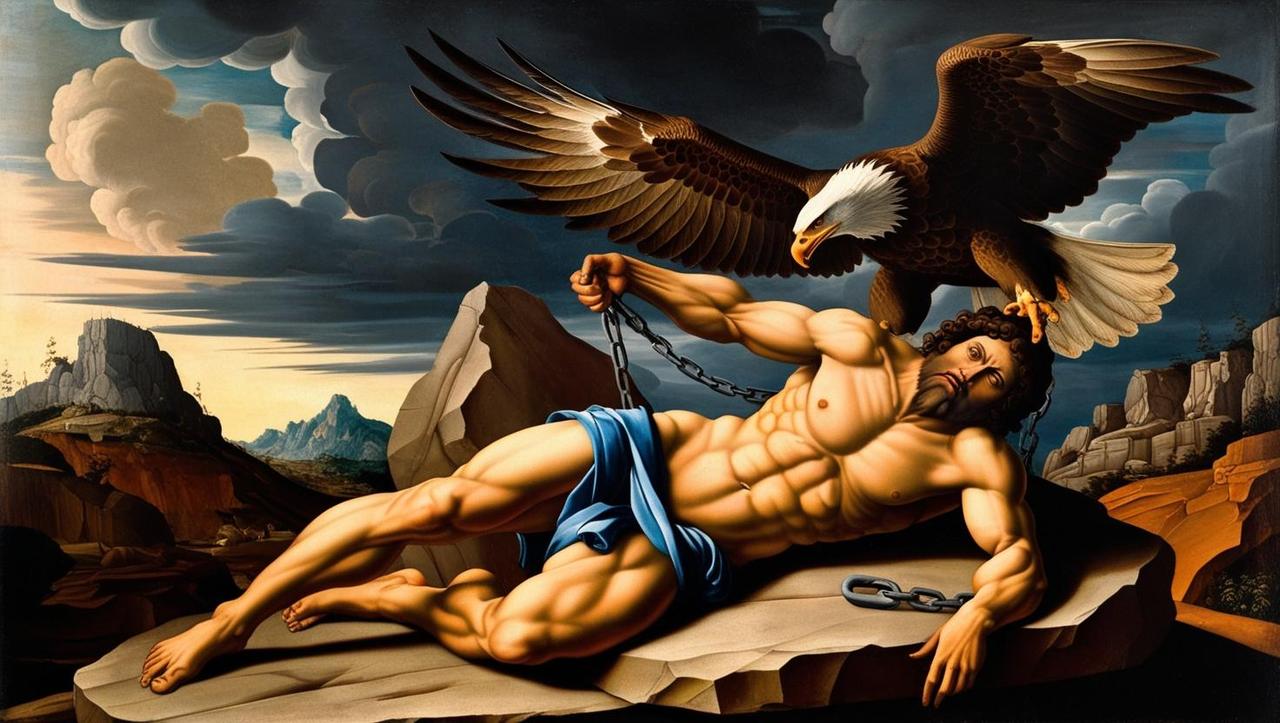
The Punishment of Prometheus, generated with artificial intelligence.
The myth of Prometheus is not only an important narrative in Greek mythology but also a symbolic expression of themes such as knowledge, free will, resistance to authority, and the ideal of humanity. While Prometheus’s theft of fire is accepted as the beginning of technological and cultural progress, his punishment reveals the conflict between this progress and divine order. The myth’s emphasis on individual consciousness and responsibility elevates it beyond mere religious or legendary storytelling into the realm of philosophical and ethical reflection.
Prometheus’s punishment and eventual liberation reflect the tense relationship between fate and will in mythology. The idea that his actions were a conscious choice, while his punishment was an integral part of the divine order, opens the door to layered interpretations concerning human nature and the relationship with the gods. In this sense, Prometheus continues to exist as a symbolic figure across many domains—from literature and philosophy to art and political discourse—from antiquity to the present day.
Aiskhylos. Zincire Vurulmuş Prometheus. Trans. Sabahattin Eyüboğlu and Azra Erhat. Istanbul: Türkiye İş Bankası Kültür Yayınları, 2013.
Hesiodos. Tanrıların Doğuşu. Trans. Sabahattin Eyüboğlu and Azra Erhat. Istanbul: Türkiye İş Bankası Kültür Yayınları, 2016.
Kolektif. Mitoloji Kitabı. Istanbul: Alfa Yayıncılık, 2019.
Sanatadair. “Ateşi Yakan Titanın Öyküsü: Prometheus.” Accessed April 12, 2025.https://www.sanatadair.net/atesi-calan-titanin-oykusu-prometheus/?amp
World History Encyclopedia. "Prometheus." Accessed April 12, 2025.https://www.worldhistory.org/trans/tr/1-11877/prometheus/

Prometheus’s Intelligence, the Sacrifice Deception, and Zeus’s Reaction
Prometheus’s Guilt
Prometheus’s Punishment