


This article was automatically translated from the original Turkish version.
The Persian Empire, whose origins date back to around 550 BCE, significantly expanded its borders by conquering the territories of the Babylonian Empire and the Lydian State in Anatolia. After annexing Anatolia, it organized the regions into local satrapies 【1】 and continued its expansion. Following the creation of the “Royal Road,” approximately 2500 km long, which facilitated trade between the East and the West, the Persians set their sights further afield. In 513 BCE, the Persian army crossing the Bosporus (modern-day Istanbul Strait) aimed at Greece. The objective was to intimidate the Scythians, who inhabited the lands from the northern Black Sea to Siberia, and to strike at Greek trade in the Black Sea region.
Having seized Thrace and the western Black Sea coast, the Persians blocked Greek city-states in Greece and western Anatolia from accessing Black Sea trade. The disruption of wheat traffic flowing from the Black Sea to the Aegean, combined with the establishment of a Persian satrapy in western Anatolia, placed the Greeks in a difficult position and simultaneously provoked them. The repercussions of this would later erupt as the Greco-Persian Wars.
The Persians, beginning their invasions in Ionia (western Anatolia), won over some Greek tyrants to their side. Other tyrants who rebelled against the Persians were neutralized and their revolts suppressed.
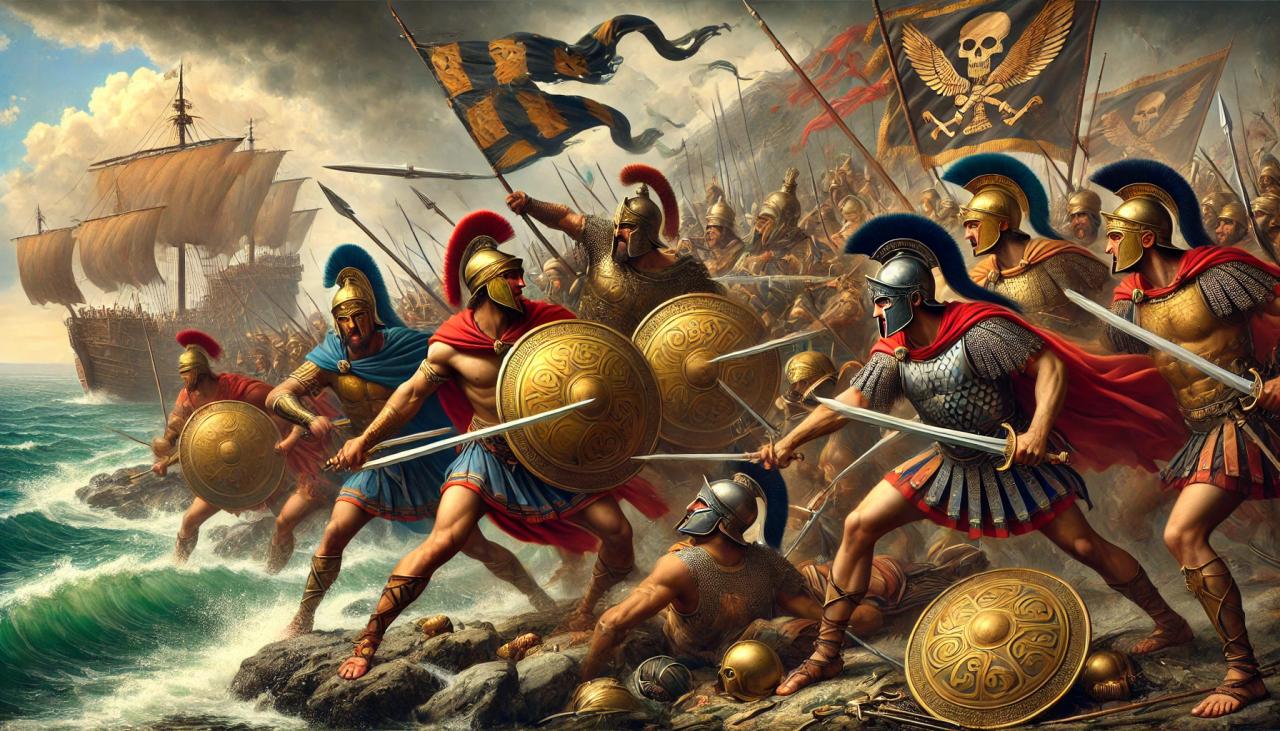
Generated with the aid of artificial intelligence.
After suppressing the Ionian Revolt, the Persians launched a campaign into Thrace. They then turned toward Greece, and by 490 BCE, most Greek city-states had surrendered to the Persians. Although the Eretrians resisted, many Greek cities were destroyed and their populations enslaved. When the Persian advance reached Athens, the Athenians sought aid from other city-states. In the ensuing battle, the Athenians suffered around 200 casualties, while Persian losses exceeded 6,000. This victory, named after the plain of Marathon in 490 BCE, granted the Greeks another ten years of respite.
Ten years later, in 480 BCE, the Athenians built a powerful navy. The Spartan city-state joined the Athenians in preparing for the next Persian assault. In response, the Persians, advancing through Thrace into Macedonia and Thessaly, launched an invasion with an army of approximately 150,000 men against the Greeks, whose forces numbered around 10,000. While the Spartans attempted to halt the Persian advance on land, the Athenians fought the Persians at sea. The main Persian force advanced overland and, with naval support, encircled and occupied the region, capturing central Greece. As a result, they burned and destroyed Athens. The Persian forces entering Athens also razed the Acropolis, which the Greeks regarded as sacred.
In 479 BCE, the Greeks rose in rebellion against the Persians, who were driven out of Greece and western Anatolia, and their ships were burned. The Greeks, however, did not consider their efforts sufficient. The islands and cities of western Anatolia remained under threat. After the wars of 490–479 BCE, which ended with the Persian retreat, the Greeks formed a naval alliance under the leadership of Athens and Sparta. Headquartered on the island of Delos and administered by Athens, this alliance, composed of around 300 allied city-states, became known as the Delian League.
The first task of the League was to clear the straits and Thrace of Persian forces. Subsequently, they sailed down the Aegean coast of Anatolia and inflicted a decisive defeat on the Persian fleet. Thus, the Greeks secured permanent control over the southern coasts of Anatolia, achieving a lasting victory.
Following all their victories, the Greeks launched an attack on Egypt, then under Persian rule, but achieved no military success. Nevertheless, they concluded the “Peace of Callias” with the Persians, formally securing their independence. The result was the end of nearly half a century of warfare. Thus, the city-states of Greece and western Anatolia gained full recognition of their independence, and the Aegean Sea was closed to the Persian navy.
Tekin, Oğuz. Eski Yunan ve Roma Tarihine Giriş. İstanbul: İletişim Yayınları, 2016.
[1]
(Perslerin kullandığı bir yönetim sistemidir. Her bir satraplık bir eyaleti ifade eder.)

Battle of Marathon
Battles of Artemisium and Thermopylae
Greek Counteroffensive and the Delian League
Peace of Callias