


This article was automatically translated from the original Turkish version.
Pastel de Nata
Origin(s) | Portugal Belém Lisbon | ||||||||
|---|---|---|---|---|---|---|---|---|---|
Creators | Hieronymites monks | ||||||||
Main Ingredients | cinnamon stick lemon peel egg yolk sugar milk butter water Wheat flour | ||||||||
Cooking Method(s) | Baking at high temperature (250–300°C) | ||||||||
Cultural Significance | One of Portugal's national sweet symbols | ||||||||
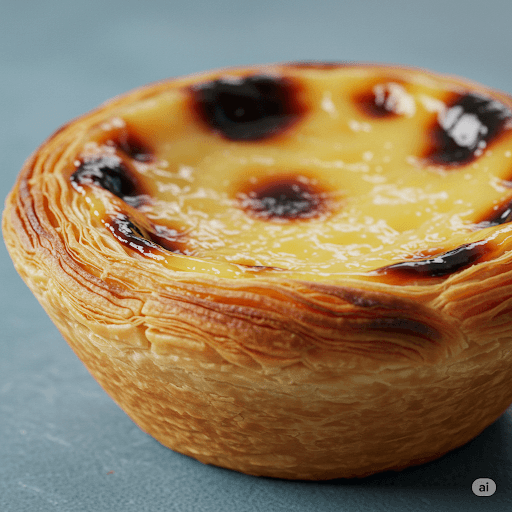
Pastel de nata is a baked dessert of Portuguese origin, consisting of a creamy, egg-based filling enclosed in a thin, flaky pastry crust. Originating in monastery kitchens in the early 18th century, this confection holds a prominent place in Portuguese cuisine and global gastronomy due to its historical development, continuous production, and strong cultural significance.
Pastel de nata emerged within the tradition of Portuguese monastery desserts. It is documented to have been first produced at the Mosteiro dos Jerónimos in Lisbon in the early 18th century. During this period, egg whites were commonly used for purposes such as laundry starching, while the leftover egg yolks were primarily utilized in dessert-making. The dense use of egg yolks in pastel de nata reflects this historical culinary practice.
Following the liberal revolutions of the 1820s in Portugal, monasteries were closed. The monks and staff of the Jerónimos Monastery sought to commercialize the pastel de nata recipe and in 1837 established a bakery in the Belém district of Lisbon called Fábrica dos Pastéis de Belém. This establishment remains the only place today that continues to use the original recipe; the version produced there is known as “pastel de Belém.” All other similar products are referred to as “pastel de nata.” This distinction aims to preserve both the geographical origin and the transmission of traditional knowledge.
Throughout the 20th century, production of the dessert increased significantly. Beginning in the 1980s, it gained widespread popularity in countries such as Brazil, Canada, the United Kingdom, and France through the Portuguese diaspora. Through international bakery chains and restaurant menus, pastel de nata has become a globally recognized product.
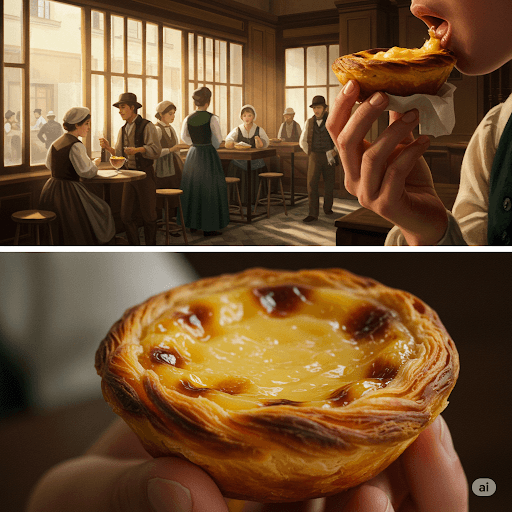
A Visual Representation of Pastel de Nata from 1850 (Generated by Artificial Intelligence.)
Pastel de nata consists of two main components: the filling and the pastry crust. The pastry is made from wheat flour, water, and butter, prepared in a layered, puff-pastry-like structure. Before being placed into metal molds, the dough is kneaded, coated with butter, and rolled out. It is then sliced and pressed into the molds to form the casing.
The filling begins with the cooking of a mixture of milk and flour. Separately, a syrup is prepared by boiling sugar with lemon zest and a cinnamon stick, which is then added to the cooked milk-flour mixture. After cooling, egg yolks are incorporated and vigorously whisked until smooth, then poured into the pre-formed pastry shells. The tarts are baked in ovens at temperatures of 250–300°C for approximately 10–15 minutes. During baking, characteristic dark spots form on the surface. Upon serving, cinnamon and powdered sugar may be optionally sprinkled on top.
The traditional recipe allows for no seasonal or regional variations. Although industrial versions may include some ingredient differences, the traditional pastel de nata recipe remains fixed in its components and standardized preparation method.
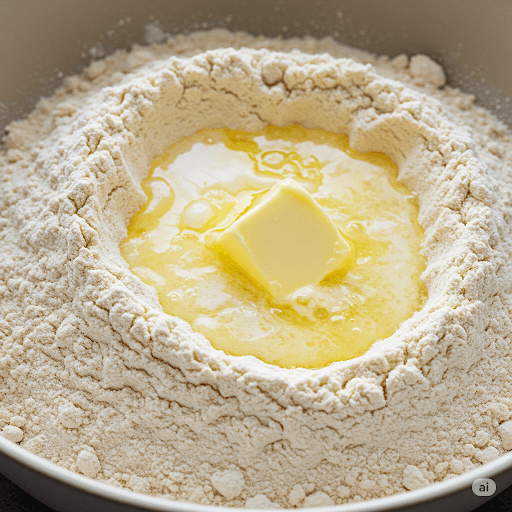
Pastel de Nata Pastry Composition (Generated by Artificial Intelligence.)
Pastel de nata is not merely a widely consumed dessert in Portuguese cuisine; it is also a cultural heritage element shaped by a specific historical and spatial lineage. Its origins in monastic dessert traditions play a vital role in preserving culinary practices linked to religious institutions.
The dessert is commonly served with coffee during breakfast and is also widely consumed as a snack throughout the day. Within the structure of Portuguese cuisine, which is defined by seafood, legumes, and olive oil, desserts have diversified significantly under the influence of monastic production traditions. Pastel de nata stands as one of the foremost representatives of this traditional heritage today.
The Fábrica dos Pastéis de Belém bakery in Lisbon is both the original production site of the dessert and a cultural attraction visited by millions of tourists annually. The Portuguese government and various cultural institutions are actively working to preserve the traditional knowledge of pastel de nata production and are pursuing its inclusion on UNESCO’s Intangible Cultural Heritage List.
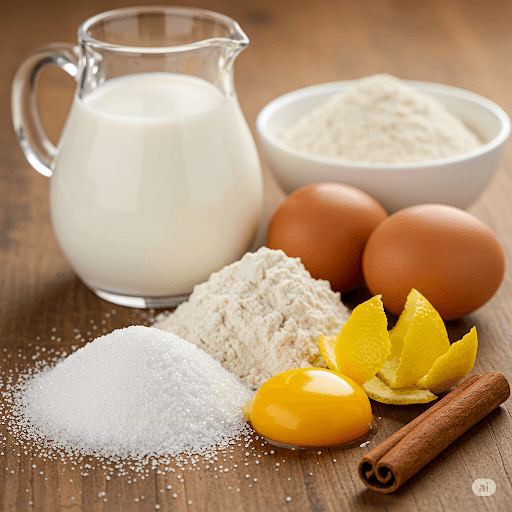
Pastel de Nata Filling Composition (Generated by Artificial Intelligence.)
To prepare the puff pastry, wheat flour and water are mixed to form a smooth, elastic dough. After kneading, the dough is rolled out and layered repeatedly with butter to create a flaky, multi-layered structure. This process ensures that the baked pastry becomes crisp and layered. The dough is then sliced into pieces approximately 3–4 cm thick and pressed into small metal molds using the fingers to shape the crusts.
Milk and wheat flour are combined and cooked over medium heat. Separately, a flavored syrup is prepared by simmering sugar with lemon zest and a cinnamon stick. This syrup is strained and added to the cooked milk-flour mixture. After cooling, only egg yolks are incorporated and thoroughly whisked until smooth. The prepared filling is then poured into the pre-shaped pastry shells.
The tarts are traditionally baked for 10–15 minutes in ovens heated to 250–300°C. During baking, characteristic dark spots form on the surface. After baking, the desserts are removed from their molds and typically served with a dusting of powdered sugar and cinnamon.
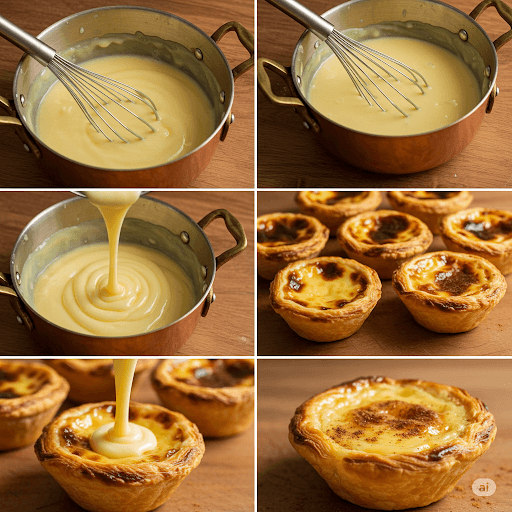
A Visual Representation of the Preparation of Pastel de Nata (Generated by Artificial Intelligence.)
Cloake, Felicity. "How to Make the Perfect Pastel de Nata – Recipe." The Guardian, March 11, 2023. https://www.theguardian.com/food/2023/mar/11/how-to-make-the-perfect-pastel-de-nata-recipe-felicity-cloake
Oliveira, Sónia, Patrícia Fradinho, Paulina Mata, Bruno Moreira-Leite, and Anabela Raymundo. "Exploring Innovation in a Traditional Sweet Pastry: Pastel de Nata." *International Journal of Gastronomy and Food Science*. pp. 17. (2019). https://www.sciencedirect.com/science/article/abs/pii/S1878450X19300320

Pastel de Nata
Origin(s) | Portugal Belém Lisbon | ||||||||
|---|---|---|---|---|---|---|---|---|---|
Creators | Hieronymites monks | ||||||||
Main Ingredients | cinnamon stick lemon peel egg yolk sugar milk butter water Wheat flour | ||||||||
Cooking Method(s) | Baking at high temperature (250–300°C) | ||||||||
Cultural Significance | One of Portugal's national sweet symbols | ||||||||
Historical Background
Traditional Preparation Process
Cultural and Gastronomic Position
Preparation Method
Pastry Preparation
Filling Preparation
Baking Process