This article was automatically translated from the original Turkish version.
Information Card
Location | It is located in the Saraçlı Neighborhood of the Ünye District, Ordu Province. | ||||||||
|---|---|---|---|---|---|---|---|---|---|
Plan Schema | The building has an octagonal architectural plan. | ||||||||
Buildings | The site includes a mosque, tomb, fountain, cemetery, and the Sufi Path. | ||||||||
Ordu Yunus Emre Türbesi
Location | It is located in the Saraçlı Neighborhood of the Ünye District, Ordu Province. | ||||||||
|---|---|---|---|---|---|---|---|---|---|
Plan Schema | The building has an octagonal architectural plan. | ||||||||
Buildings | The site includes a mosque, tomb, fountain, cemetery, and the Sufi Path. | ||||||||
The Yunus Emre Tomb, locally known as Şehnuz or Şehnus Tomb, is a makam tomb attributed to the Sufi poet Yunus Emre, located in the Saraçlı Neighborhood of the Ünye district in Ordu Province, on the site of the former village of Saca.【1】 It is one of fourteen makam sites dedicated to Yunus Emre across the geographical regions of Türkiye and Azerbaijan, and the only one situated directly adjacent to the sea. The tomb stands on a high elevation known locally as “Şeyh Yunus Tepesi,” offering views over the city of Ünye and the Black Sea, approximately 4.9 kilometers southwest of the urban center.【2】
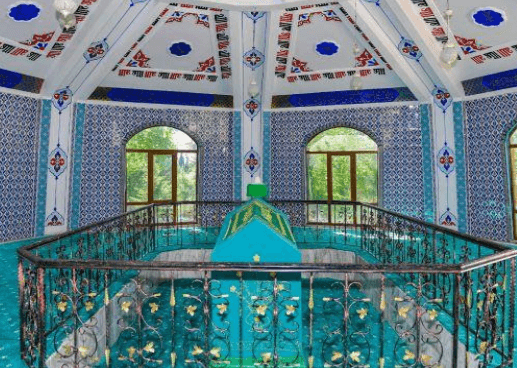
Architecturally, the tomb features a high dome resting on octagonal walls constructed of brick, topped by a sloping roof that inclines toward the surrounding enclosure wall. This structure evokes a “tent” form associated with the Central Asian nomadic heritage of the Turks and offers a distinctive, modern reinterpretation of traditional tomb architecture.
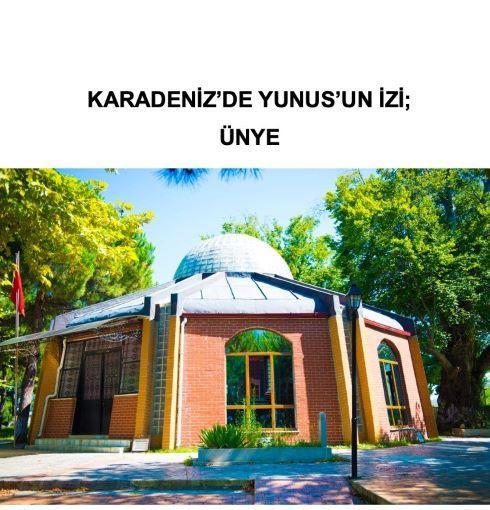
Yunus Emre Türbesi (Ordu İl Kültür ve Turizm Müdürlüğü)
In 1986, with the founding of the Society for the Construction and Preservation of Şeyh Yunus Emre Mosque, construction of the complex began in 1985 and was completed in 2017 following a restoration by the Ordu Metropolitan Municipality, transforming the site into a comprehensive Yunus Emre Külliyesi encompassing a mosque, şadırvan, tomb, and cemetery.【3】
The path extending from the entrance of the külliye to the tomb is called the “Sufi Path.” This route, continuously accompanied by the sound of the ney and hymns of Yunus Emre, symbolizes the journey of life from birth to death: entry into the site represents birth, walking the path represents life, and the tomb represents death.
The region came under Turkish rule during the 1200s and 1300s, coinciding with the lifetime of Yunus Emre.【4】 According to research by Ünye-based scholar Ömer Çam, traces of Seljuk-era inscriptions were found on the headstone and footstone of the grave, including the word “Emre” on the headstone; however, these stones have since been lost due to erosion or plastering over time.
Moreover, Yunus Emre frequently employed maritime imagery in his poetry—terms such as sea, ocean, ship, wave, foam, and fish—strengthening the possibility that he visited a coastal region like Ünye.【5】
His use of mill-related imagery and the regional term “çakıldak” or “şakıldak,” used in Ordu’s Akkuş-Salman and Fatsa-Beyceli areas to describe mill components, further reinforces his connection to Ordu and Ünye. It is also believed that the term “Oney,” the former name of Ünye, appears in one of his poems but was likely added later.【6】
Since the 1970s, the tomb has become a major site of pilgrimage and has inspired numerous local anecdotes and beliefs.
Located approximately 100 meters west and at a lower elevation than the tomb, the Yunus Emre Well is also surrounded by legends.【8】 One belief holds that Yunus Emre established a dergah here; moved by the suffering of a dervish who had become calloused from carrying water, he prayed and caused a miraculous spring to emerge. It is believed that after this dervish’s death, the water jars at the tomb continued to be filled with water from this well, and that Yunus Emre’s spiritual companions would come to the tomb to perform ablutions with this sacred water.
Although no definitive written documents confirm its ownership, the people of Ünye have embraced this site as “Yunus Emre” and transformed it into a sacred makam. Recognizing its historical and cultural significance, the Samsun Regional Board for the Protection of Cultural Heritage designated the site as a first-degree protected area in 2022.【9】
Bayhan, Ahmet Ali. "Anadolu İrfanının Sembol İsmi Yunus Emre'ye Atfedilen Mezar Anıtları ve Makamların Sanat Tarihi Açısından Değerlendirilmesi." *ODÜ Sosyal Bilimler Araştırmaları Dergisi* 13, no. 1 (2023): 159–186. Accessed May 16, 2023. https://doi.org/10.48146/odusobiad.1185561.
Eren, Mustafa. "Yunus Emre and the Yunus Emre Tomb in Ünye." *ODÜ Sosyal Bilimler Araştırmaları Dergisi* 15, no. 1 (2025): 501-528. Accessed May 16, 29026. https://doi.org/10.48146/odusobiad.1478716.
Yunus Emre Türbesi, Ünye/Ordu. Ordu İl Kültür ve Turizm Müdürlüğü. Accessed [insert date in Month Day, Year format if provided]. https://ordu.ktb.gov.tr/TR-130755/yunus-emre-turbesi-unyeordu.html. > **Note**: Since no access date is provided in the source, the "Accessed" date cannot be translated or inserted. If an access date appears in the original Turkish text (e.g., "Accessed 5 Nisan 2025"), it must be translated to "Accessed April 5, 2025". As currently given, only the structural elements are translated, and the URL is preserved as-is.
[1]
Ahmet Ali Bayhan, “Anadolu İrfanının Sembol İsmi Yunus Emre’ye Atfedilen Mezar Anıtları ve Makamların Sanat Tarihi Açısından Değerlendirilmesi,” Ordu Üniversitesi Sosyal Bilimler Araştırmaları Dergisi (ODÜSOBİAD) 13, no. 1 (2023): 168, https://doi.org/10.48146/odusobiad.1185561
[2]
Eren, "Yunus Emre and the Yunus Emre Tomb in Ünye," 507.
[3]
Mustafa Eren, "Yunus Emre and the Yunus Emre Tomb in Ünye," ODÜ Sosyal Bilimler Araştırmaları Dergisi 15, no. 1 (2025): 507,https://doi.org/10.48146/odusobiad.1478716.
[4]
Eren, "Yunus Emre and the Yunus Emre Tomb in Ünye," 506.
[5]
Eren, “Yunus Emre ve Ünye’deki Yunus Emre Türbesi,” 513.
[6]
Eren, “Yunus Emre ve Ünye’deki Yunus Emre Türbesi,” 511.
[7]
Eren, "Yunus Emre and the Yunus Emre Tomb in Ünye," 508.
[8]
Eren, "Yunus Emre and the Yunus Emre Tomb in Ünye," 508.
[9]
Eren, "Yunus Emre and the Yunus Emre Tomb in Ünye," 507.

Information Card
Location | It is located in the Saraçlı Neighborhood of the Ünye District, Ordu Province. | ||||||||
|---|---|---|---|---|---|---|---|---|---|
Plan Schema | The building has an octagonal architectural plan. | ||||||||
Buildings | The site includes a mosque, tomb, fountain, cemetery, and the Sufi Path. | ||||||||
Ordu Yunus Emre Türbesi
Location | It is located in the Saraçlı Neighborhood of the Ünye District, Ordu Province. | ||||||||
|---|---|---|---|---|---|---|---|---|---|
Plan Schema | The building has an octagonal architectural plan. | ||||||||
Buildings | The site includes a mosque, tomb, fountain, cemetery, and the Sufi Path. | ||||||||
No Discussion Added Yet
Start discussion for "Ordu Yunus Emre Türbesi" article
Külliye and the Sufi Path
History and Connection to Yunus Emre
Folk Culture, Beliefs, and Legends
Yunus Emre Well