


This article was automatically translated from the original Turkish version.
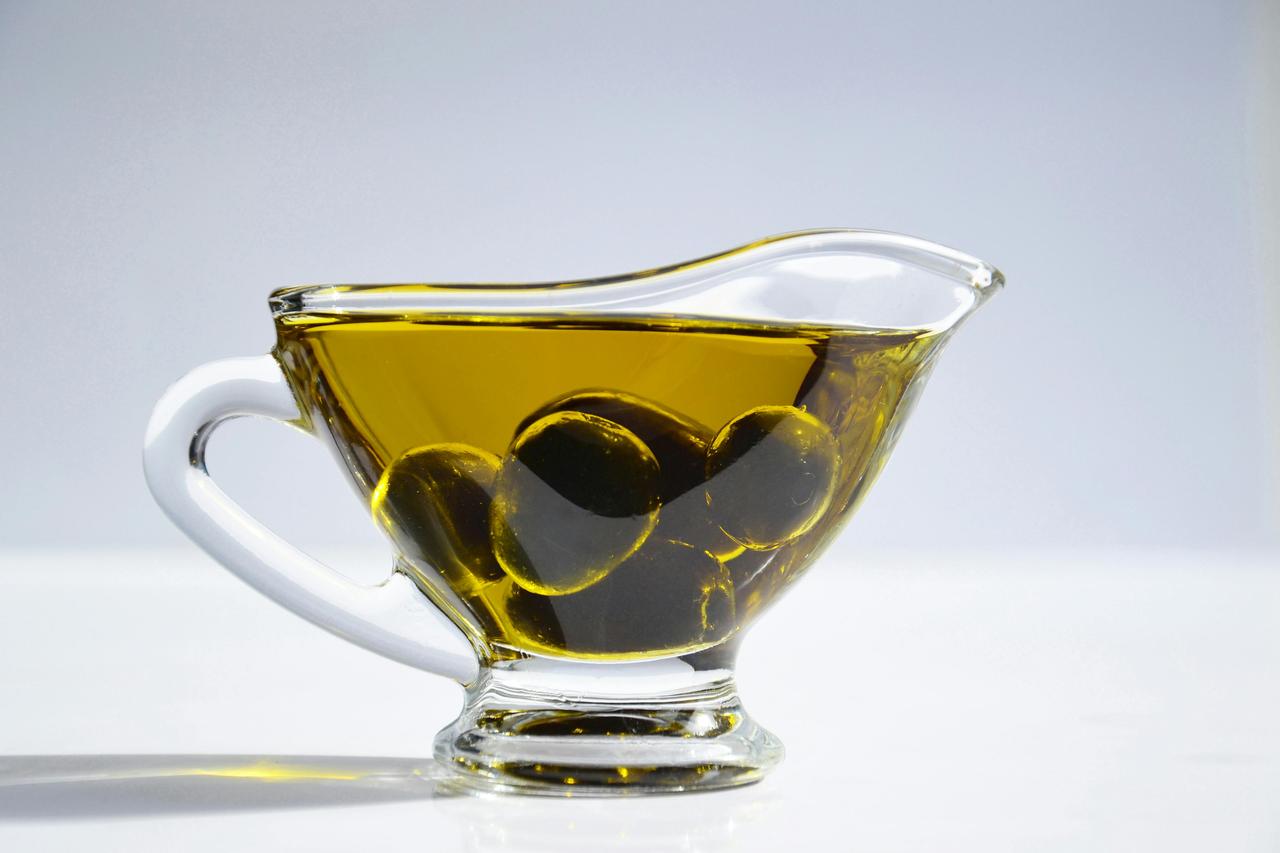
Olive oil
Definition | It is a natural vegetable oil obtained from olives through mechanical methods. | ||||||||
|---|---|---|---|---|---|---|---|---|---|
History | It emerged approximately 6000 years ago in Anatolia Syria and Palestine. | ||||||||
Usage and Benefits | Early harvest cold-pressed oils are rich in antioxidants and beneficial for the heart and immune system. | ||||||||
Among the world’s oldest and most valuable vegetable oils, olive oil is not merely a culinary ingredient but has historically been regarded as a functional product in diverse fields such as medicine, cosmetics, and religious rituals. As a fundamental component of the Mediterranean diet, olive oil holds significant nutritional value due to its high content of unsaturated fatty acids and antioxidants.
Olive oil is a natural vegetable oil obtained exclusively from the fruit of the olive tree (Olea europaea L. var. communis) through mechanical means without chemical processing. Olive fruits harvested at different stages of ripeness yield oils with varying flavors and chemical properties. The olive tree is resilient to hot and dry climatic conditions but is sensitive to humidity during flowering. Due to its fruit structure, the plant can produce higher quality yields under mild stress conditions.
Although the exact origin of the olive tree remains uncertain, genetic evidence suggests it originated in the Eastern Mediterranean (particularly Syria) or Sub-Saharan Africa. Written records indicate that as early as 2000 BCE, olive oil was traded as a more valuable commodity than wine or seed oils. The spread of olive cultivation across the Mediterranean basin occurred through trade routes and agricultural expansion. During the Roman era, olive oil production and use became systematic, with processing facilities established throughout the Mediterranean region. Olive oil was used for centuries as fuel in lamps, in religious ceremonies, for medicinal purposes, in soap making, and in cosmetics.
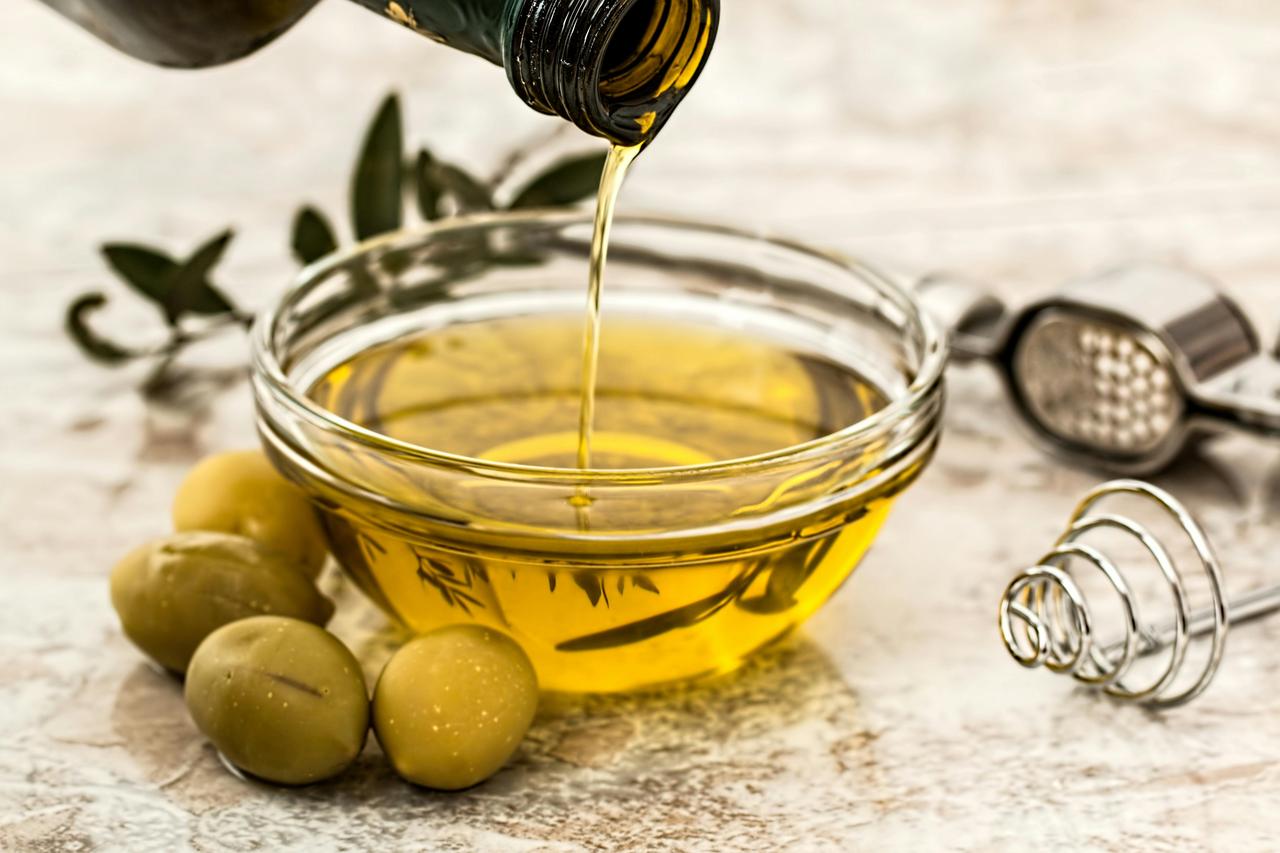
Zeytinyağı Görseli. (Pexels)
Today, approximately 23 million acres (9.4 million hectares) of land worldwide are dedicated to olive production. These trees yield about 16 million tons of olive fruit annually, producing approximately 2.56 million tons of olive oil. Spain, Italy, and Greece together account for 77% of global production. Spain, the largest producer, holds 36% of global output with an annual average of 800,000 tons of olive oil. Most production still occurs on dryland farms using traditional methods, but Spain and some newer producers (Australia, Chile, Argentina) have recently adopted super-high-density planting systems.
Türkiye has long been one of the major centers of olive production and lies within the Eastern Mediterranean basin, considered the ancestral homeland of the olive tree. Olive cultivation, with a history spanning thousands of years, is concentrated primarily in the Aegean, Marmara, Mediterranean, and Southeastern Anatolia regions. The Aegean Region leads Türkiye’s olive oil production, with local varieties such as Ayvalık, Memecik, Domat, Gemlik, and Nizip used for both table olives and olive oil.
Production Capacity and Development Process: The number of olive trees, which stood at 99 million in 2001, reached 205 million by 2024 due to state incentives and sapling support. During the same period, total olive production increased from 600,000 tons to 3.75 million tons, more than sixfold. In 2023, production rose by 150% compared to the previous year, setting a record in the history of the Republic.
In the 2024/2025 season, olive oil production reached 475,000 tons, while table olive production was recorded at 700,000 tons. With these figures, Türkiye has risen to first place globally in table olives and second place globally in olive oil. According to Mustafa Tan, President of the National Olive and Olive Oil Council, this success was achieved by fulfilling the goals established in 2007: doubling the number of olive trees and entering the top two in global rankings. Türkiye ranks second in the world in terms of olive tree numbers, after Spain.
Harvest Timing and Quality Relationship: In Türkiye, harvesting is generally conducted using traditional methods, and fruit ripeness is often not assessed based on scientific analysis. However, timely harvesting increases both yield and oil quality by preventing natural fruit drop. Early harvesting, despite yielding lower oil quantities, produces more aromatic, low-acid, and polyphenol-rich extra virgin olive oils.
Processing Techniques and Modernization: According to expert olive oil taster and judge Paul Vossen, Türkiye is among the countries with high potential for olive oil production. However, it is still in the process of developing its processing technologies. In many regions, olive collection and processing still follow traditional methods. Nevertheless, the recent adoption of modern techniques such as early harvesting and cold pressing has significantly improved product quality. High-quality oils are now distinguished by fruity aromas and low acidity levels.
Sustainability and Climate Policies: To mitigate the effects of climate change and maintain production quality, sustainable agriculture practices are of great importance. Olive trees contribute to climate mitigation by absorbing carbon dioxide from the atmosphere, making them one of the most climate-friendly crops.
Consumption Habits and Awareness: Olive oil consumption in Türkiye varies regionally. Per capita consumption is high in the Aegean and Marmara regions, while sunflower oil remains more commonly used in the Black Sea and inland areas. Compared to European countries, Türkiye’s per capita annual olive oil consumption remains low (approximately 2 liters), whereas in Greece it reaches up to 26 liters.
As awareness of quality increases, consumer interest is growing in oils with early harvest, low acidity, and high polyphenol content. These healthier oils demonstrate their benefits most effectively when consumed raw, such as drizzled over salads or cooked dishes.
Exports and Competitiveness: Türkiye has occasionally targeted foreign markets but has struggled to compete with Spain, Italy, and Greece. Key reasons include insufficient branding, incomplete quality standardization, and limited adoption of modern production techniques. However, Türkiye’s native olive varieties, climatic advantages, and growing production capacity offer strong potential for a more prominent position in the global olive oil market.
Early harvesting refers to oil produced from olives collected before full ripeness. Oils from this method are greener in color, more fruity, and sensorially richer. They contain higher levels of phenolic compounds and chlorophyll, which enhance the oil’s antioxidant capacity and extend its shelf life. Early harvesting also improves harvest performance by protecting fruit from environmental damage such as hail or storms. However, these oils can sometimes have a bitter taste, which diminishes over time.
In traditional systems, trees are planted at intervals of 7.5 to 18 meters, typically under dry farming conditions, and yield per tree is low. Harvesting is done manually or with poles. This system is low-cost but low-yield.
Modern high-density systems involve planting trees at densities of 250–900 trees per hectare, with increased yields achieved through advanced techniques such as mechanical harvesting and drip irrigation. In super-high-density systems, densities can reach up to 1,210 trees per hectare, enabling full mechanization. Compact varieties such as ‘Arbequina’, ‘Arbosana’, and ‘Koroneiki’ are used in these systems.
Super-high-density systems offer advantages such as early fruiting, lower harvesting costs, and production of high-quality oil, but their main disadvantages are high initial investment costs and the need for technical expertise.
Olive fruits must be processed within 12–24 hours after harvest. Crushed using stone or hammer mills, the paste undergoes malaxation at temperatures between 26–30°C. The oil is then separated from the pomace through methods such as pressing, selective filtration (sinolea), and centrifugation. Two-phase centrifuges provide lower waste and better preservation of aroma and polyphenols than three-phase systems.
Oils are stored in stainless steel tanks for 1–3 months to settle before being filtered and bottled.
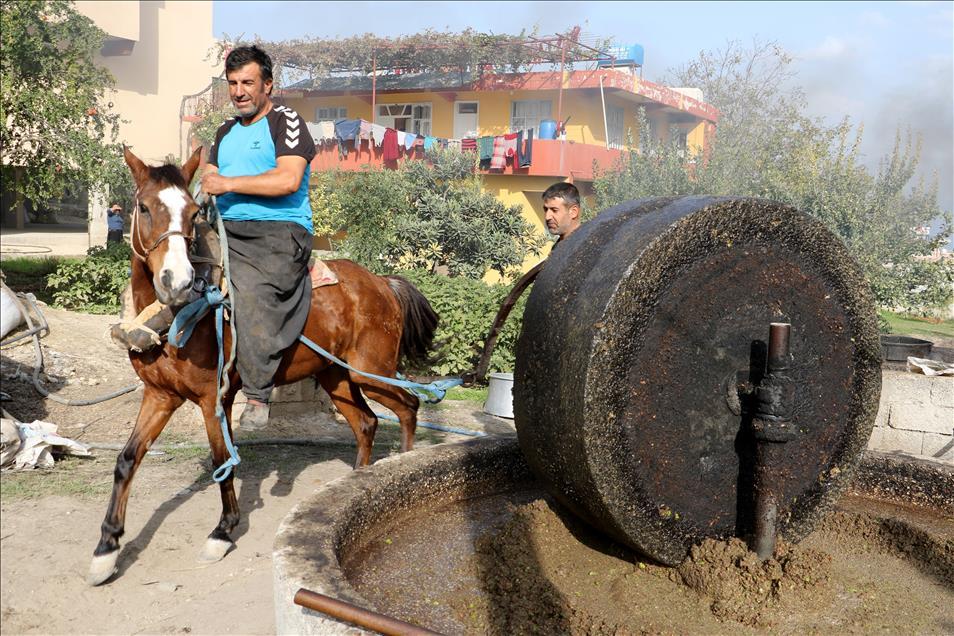
Değirmenle Ezilen Zeytinler. (Anadolu Ajansı)
According to the International Olive Council, high-quality olive oil exhibits clear sensory characteristics of “fruity,” “bitter,” and “pungent.” Defective oils display undesirable flavors such as “moldy,” “fusty,” “vinegary,” “rancid,” or “salty.” In good quality oils, the fruity note dominates, while bitterness and pungency vary according to ripeness.
Although olive oil production has historically been concentrated in the Mediterranean basin, it is now a widespread global agricultural and industrial activity. Worldwide, approximately 23 million acres (9.4 million hectares) of olive groves exist, producing an annual average of 16 million tons of olive fruit, which is converted into 2.5 million tons of olive oil.
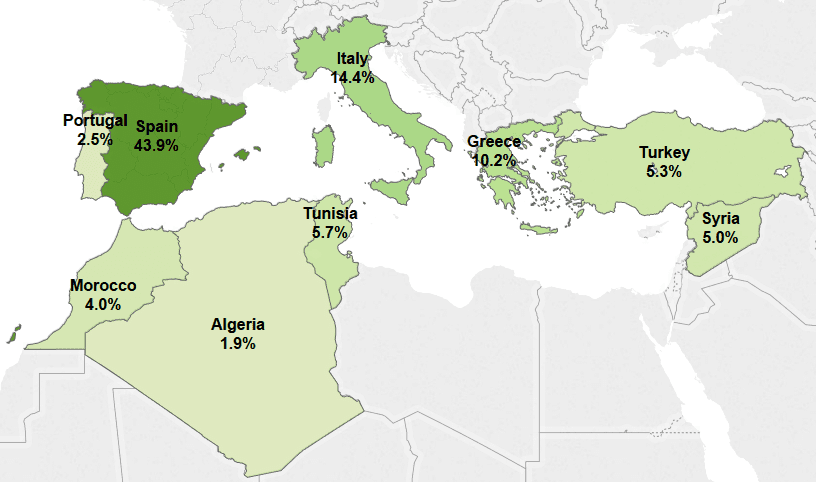
Dünya Zeytinyağı Üretiminde İlk 9 Üretici Ülke ve Payları (2007-2016) (Uluslararası Zeytinyağı Konseyi)
Spain is the undisputed global leader in olive oil production. From approximately 2.42 million hectares of olive groves, Spain produces around 800,000 tons of olive oil annually. In 2001–2002, due to high yields while other countries suffered poor harvests, Spain alone accounted for 50% of global production. The most widely cultivated variety is ‘Picual’, which produces high-polyphenol, strongly aromatic oils from early-harvested fruit. However, production from late-harvested and ground-collected fruit is also common, yielding generally lower-quality oils suitable for refining.
Italy ranks second in olive oil production. Approximately 1.43 million hectares are dedicated to olive cultivation, producing around 520,000 tons of olive oil annually. Production is diverse across regions; Tuscany, Puglia, Sicily, and Umbria are known for aromatic oils derived from distinct olive varieties. Italian production is largely artisanal, involving blending of different cultivars. Varieties such as ‘Frantoio’, ‘Leccino’, and ‘Coratina’ stand out.
Greece contributes approximately 17% of global olive oil production and has 1.03 million hectares of olive groves. The most common variety, ‘Koroneiki’, yields durable and aromatic oils with high polyphenol content. However, in some production processes, delaying fruit processing after harvest can negatively affect oil quality.
These three countries together account for 77% of global production.
Tunisia, Türkiye, Morocco, Syria, and Portugal possess extensive olive grove areas but lag in yield and quality. Production in these countries is predominantly traditional, with limited numbers of modern processing facilities. However, recent efforts aim to increase production through mechanization and export-oriented policies.
New World producers such as California (USA), Chile, Argentina, Australia, and South Africa are gaining prominence. The rapid adoption of super-high-density planting systems in these regions has increased yields and reduced production costs. Compact varieties such as ‘Arbequina’, ‘Koroneiki’, and ‘Arbosana’ are used, allowing producers to reach full yield within just 2–5 years.
In recent years, global olive oil production has increased at an average annual rate of 1.4%. Under dryland farming on arid and hilly terrain, average yields are about 0.5 tons per hectare, whereas in irrigated and high-density systems, yields can increase up to tenfold.
The olive oil market is also a battleground for quality competition. The European Union and the International Olive Council (IOOC) have tightened labeling standards to combat fraud, linking classifications such as “extra virgin” to chemical analysis and sensory testing. The mislabeling of pomace oils as virgin oils has underscored the necessity of these controls.
Per capita consumption is very high in traditional producing regions: 26 liters in Greece, 15 liters in Spain, and 13.5 liters in Italy. In contrast, consumption in the United States is only about 0.7 liters. Despite this low rate, the United States is the fourth largest consumer of olive oil in the world, importing over 60 million gallons annually. This demand has spurred growth in domestic production in regions such as California.
Accessed April 22, 2025.https://doi.org/10.21273/HORTSCI.42.5.1093
Anadolu Ajansı. "Türkiye Sofralık Zeytin Üretiminde Dünyada Zirveye Yerleşti."
Anadolu Ajansı. "Zeytin ve Zeytinyağı Üretiminde Sürdürülebilir Tarım Uygulamaları Öne Çıkıyor."
Anadolu Ajansı. "Zeytinyağını Geleneksel Yöntemle Çıkarıyorlar."
Grigg, D. "Olive Oil, the Mediterranean and the World." GeoJournal 53 (2001): 163–172.https://doi.org/10.1023/A:1015702327546
Pexels. "Bowl Being Poured with Yellow Liquid."
Pexels. "Photo of Olives on Cup of Olive Oil."
ResearchGate. "Top 9 Producer Countries and Their Share in World Olive Oil Production (2007–2016 Data)."
Sevim, Didar. "Antioksidanlar ve Zeytinyağı." Zeytin Bilimi 2, no. 1 (March 2011): 43–47.https://dergipark.org.tr/tr/pub/zeytin/issue/28962/309880
Tiryaki, Gülgün Yıldız. "Erken Hasatın Zeytinyağı Kalitesi Üzerine Etkileri." Gıda 30, no. 3 (June 2005).https://dergipark.org.tr/tr/pub/gida/issue/6997/93210
Vossen, Paul. "Zeytinyağı: Dünya Klasik Yağlarının Tarihi, Üretimi ve Özellikleri." HortScience 42, no. 5 (2007): 1093–1100.
Özata, Esra, and Menekşe Cömert. “Zeytinyağı ve Sağlıklı Yaşam.” Zeytin Bilimi 6, no. 2 (June 2016): 105–10.https://dergipark.org.tr/tr/pub/zeytin/issue/28971/309929#article_cite
Öztürk, F., M. Yalçin, and Harun Diraman. “Türkiye Zeytinyağı Ekonomisine Genel Bir Bakış.” Gıda Teknolojileri Elektronik Dergisi 12 (2009): 35–51.https://www.researchgate.net/publication/304575842_Turkiye_Zeytinyagi_Ekonomisine_Genel_Bir_Bakis

Olive oil
Definition | It is a natural vegetable oil obtained from olives through mechanical methods. | ||||||||
|---|---|---|---|---|---|---|---|---|---|
History | It emerged approximately 6000 years ago in Anatolia Syria and Palestine. | ||||||||
Usage and Benefits | Early harvest cold-pressed oils are rich in antioxidants and beneficial for the heart and immune system. | ||||||||
Definition and Biological Origin
History
Global Distribution and Production
Olive and Olive Oil Production in Türkiye
Effects of Early Harvesting on Olive Oil
Production Systems
Processing Procedure
Sensory Characteristics and Quality Assessment
Global Olive Oil Production
Major Producer Countries
Other Producer Countries and Emerging Markets
Global Trends and Trade
Consumption and Exports