


This article was automatically translated from the original Turkish version.
+1 More
Neptune
Discovery Date | 1846-09-23 | ||||||||
|---|---|---|---|---|---|---|---|---|---|
Number of Active Artificial Satellites | 0 | ||||||||
Number of Natural Satellites | 16 | ||||||||
Atmospheric Composition | Hydrogen, Helium and Methane | ||||||||
Diameter | 49.528 km | ||||||||
Mass | 10.2 x 10^25 kg | ||||||||
Average Distance from the Sun | 4.5 x 10^9 | ||||||||
Orbital Period (Year Duration) | 165 Earth Years | ||||||||
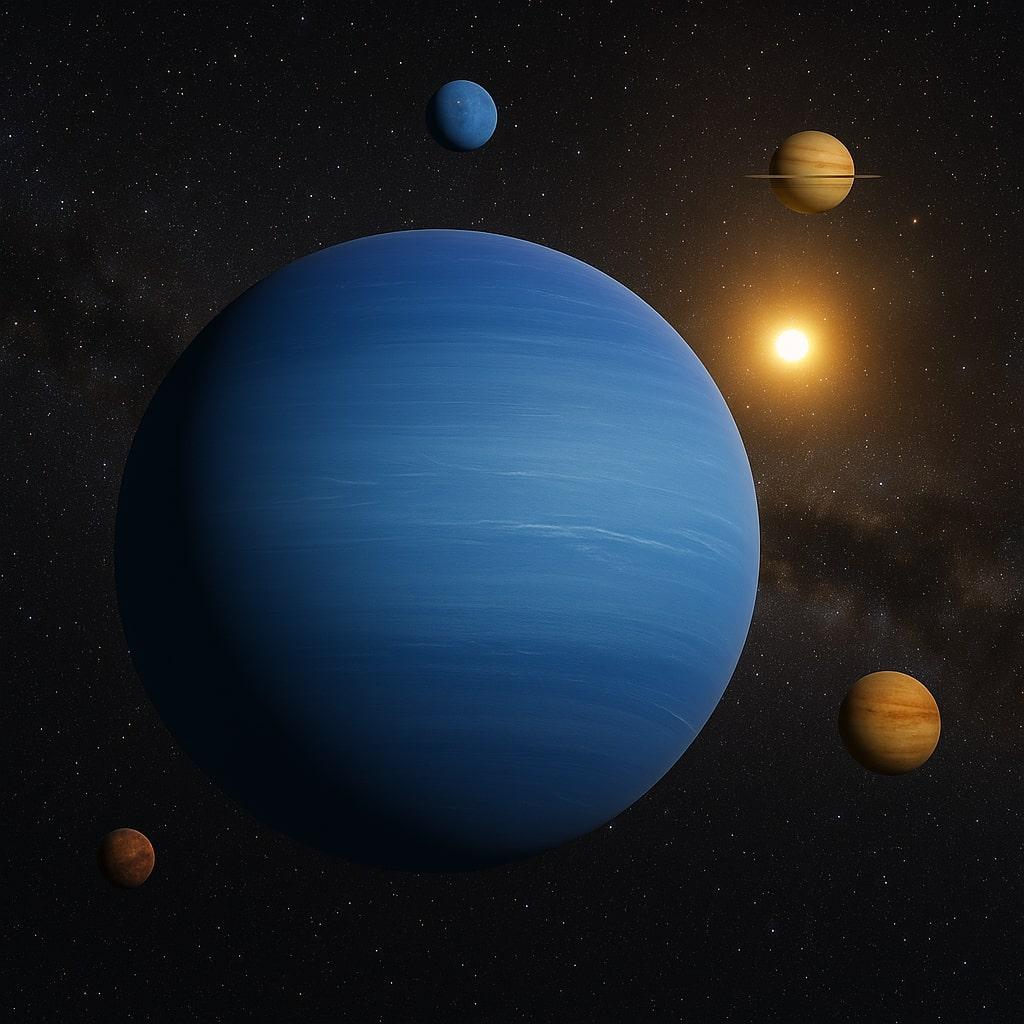
Neptune is the eighth and most distant planet from the Sun in the Solar System, located at an average distance of 2.8 billion miles (4.5 billion kilometers). At a distance of 30 astronomical units (AU), this planet was discovered in 1846 by Johann Gottfried Galle, following calculations by French mathematician Urbain Le Verrier.
Neptune is the only planet not visible to the naked eye and is notable for its bluish color. This color arises because methane gas in its atmosphere absorbs red light and reflects blue light. With an orbital period of approximately 165 Earth years, Neptune rotates on its axis in about 16 hours.
Neptune is an ice giant with a diameter of 49,528 kilometers (30,775 miles), roughly four times the width of Earth. The majority of its mass consists of a hot dense liquid layer made of “icy” materials such as water, ammonia, and methane. The planet’s core is solid and rocky, similar to Earth’s. Among the giant planets, Neptune has the highest density.
Neptune does not have a clearly defined solid surface. Its atmosphere, composed primarily of hydrogen, helium, and methane, gradually transitions into liquid layers as depth increases. Scientists believe that under extreme pressure deep within the planet, a superheated ocean of water may exist.
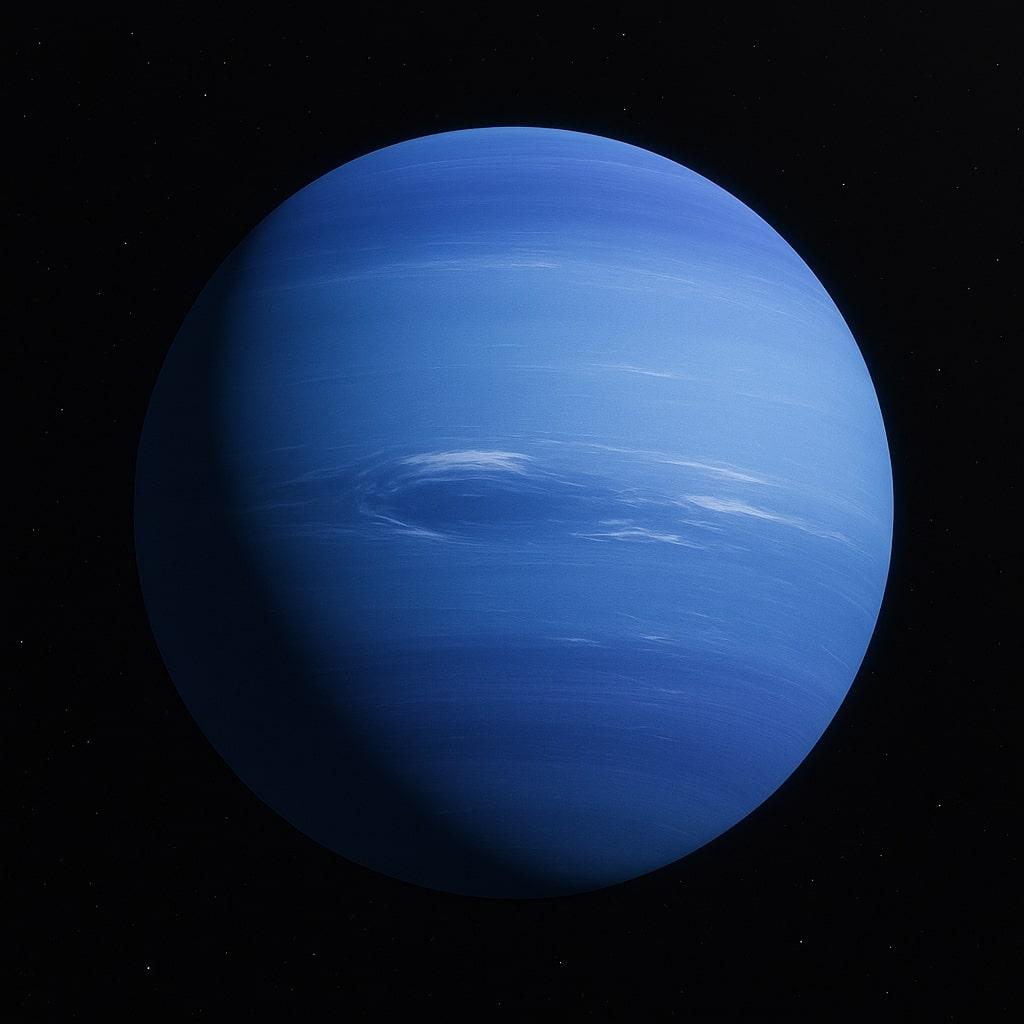
Artificially generated representative image of the planet Neptune
Neptune is known as the planet with the strongest winds in the Solar System. Wind speeds can reach up to 2,000 kilometers per hour (1,200 miles per hour), nearly nine times stronger than the most powerful hurricanes on Earth. Occasional massive storms occur in its atmosphere. The “Great Dark Spot,” discovered by Voyager 2 in 1989, was large enough to contain Earth but later disappeared.
Its atmosphere consists primarily of hydrogen (80%), helium (19%), and methane (1%). Neptune’s blue appearance results from methane absorbing red light and reflecting blue light. Reanalyses conducted in 2024 have shown that Neptune is more similar to Uranus than previously thought.
Neptune completes one orbit around the Sun in approximately 165 Earth years. This means that as of 2011, it had completed only one full orbit since its discovery. Its rotation on its own axis takes about 16 hours.
Neptune’s axial tilt is 28 degrees, similar to that of Earth and Mars. As a result, Neptune experiences seasons, but because a Neptunian year is so long, each season lasts approximately 40 years.
Because Pluto’s orbit is highly elliptical, there are periods when Pluto is closer to the Sun than Neptune. However, this situation does not lead to a collision between the two bodies because Pluto and Neptune are in a 2:3 resonance orbit. This means that for every three orbits Neptune completes around the Sun, Pluto completes two. This arrangement prevents the two celestial bodies from coming too close to each other.
Neptune has 16 known moons. Its largest moon, Triton, was discovered in 1846 by British astronomer William Lassell. Triton is unique among large moons in that it orbits in the opposite direction to Neptune’s rotation (retrograde orbit), suggesting it was a captured object. In the future, due to Neptune’s strong gravitational influence, Triton is expected to move closer to the planet, eventually break apart, and form a ring system.
Other important moons include Proteus, Nereid, and Larissa. Proteus is Neptune’s second-largest moon and is near the mass threshold at which it could assume a nearly spherical shape. Nereid has one of the most elliptical orbits in the Solar System.
Like other gas giants, Neptune has a ring system. Five main rings have been observed: Galle, Le Verrier, Lassell, Arago, and Adams. The outermost Adams ring contains four prominent arcs: Liberté (Freedom), Egalité (Equality), Fraternité (Brotherhood), and Courage (Courage). These rings remain clumped together due to the gravitational influence of Galatea, one of Neptune’s inner moons.
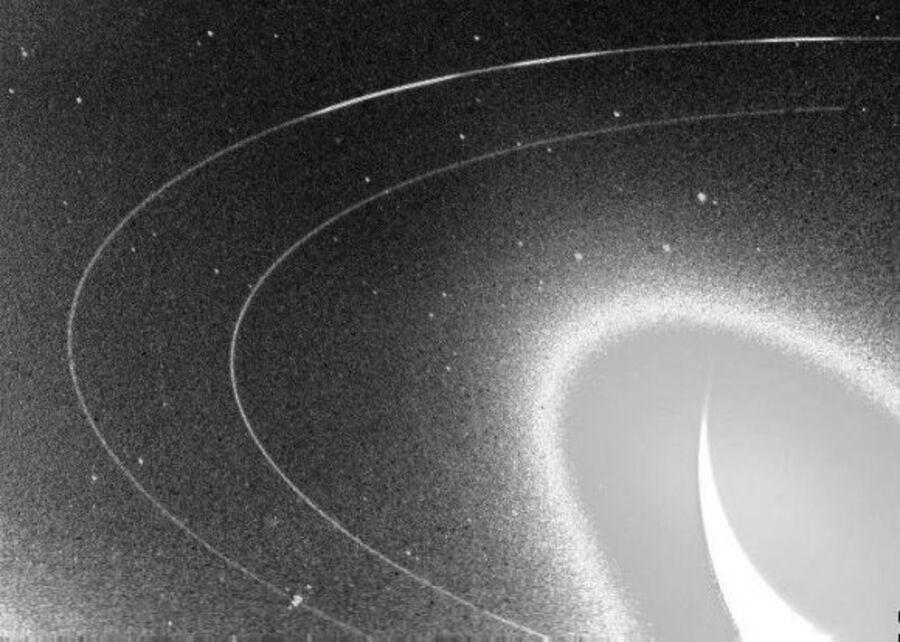
First detailed image of Neptune’s rings taken by the unmanned spacecraft Voyager 2 in 1989 image
Although Neptune was recorded as a star by Galileo in 1612 and 1613, its true identity was not confirmed until 1846. Its discovery is significant because it was the first planet found through mathematical prediction rather than direct observation.
The only spacecraft to study Neptune up close is Voyager 2. In 1989, Voyager 2 flew by the planet and captured detailed images of its rings, moons, and atmosphere. Today, advanced instruments such as the Hubble Space Telescope and the James Webb Space Telescope continue to gather additional data about the planet.
Neptune’s magnetic field is tilted approximately 47 degrees from its rotational axis, causing significant variations in its magnetic environment. The field is about 27 times stronger than Earth’s and has a highly inclined structure similar to Uranus’s magnetic axis.
NASA Science. "Neptune." Accessed April 3, 2025.(Accessed Adresi)
TÜBİTAK Bilim Genç. "Güneş Sistemini Tanıyalım: Neptün." Accessed April 3, 2025.(Accessed Adresi)
TÜBİTAK Bilim Genç. "Neptün’ün Sanıldığı Kadar Mavi Olmadığı Ortaya Çıktı." Accessed April 3, 2025.(Accessed Adresi)
Türkiye Uzay Agency (TUA). "Neptün." Accessed April 3, 2025.(Accessed Adresi)
Neptune
Discovery Date | 1846-09-23 | ||||||||
|---|---|---|---|---|---|---|---|---|---|
Number of Active Artificial Satellites | 0 | ||||||||
Number of Natural Satellites | 16 | ||||||||
Atmospheric Composition | Hydrogen, Helium and Methane | ||||||||
Diameter | 49.528 km | ||||||||
Mass | 10.2 x 10^25 kg | ||||||||
Average Distance from the Sun | 4.5 x 10^9 | ||||||||
Orbital Period (Year Duration) | 165 Earth Years | ||||||||
Physical and Structural Properties
Atmosphere and Weather
Orbit and Rotation
Moons
Rings
Discovery and Observations
Magnetosphere