


This article was automatically translated from the original Turkish version.
+2 More
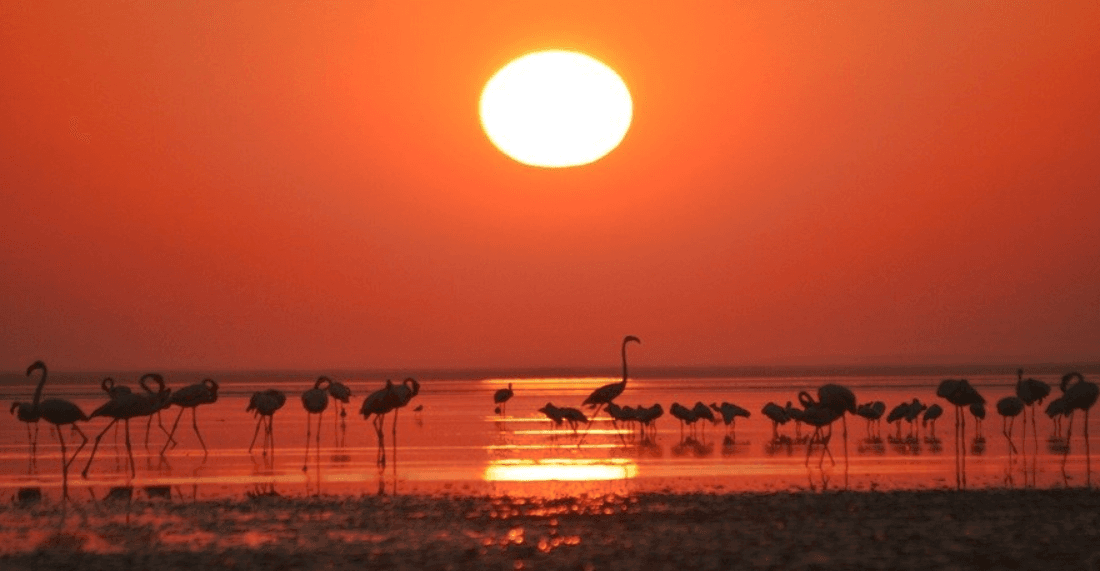
Manyas Bird Lake
Location | Balıkesir | ||||||||
|---|---|---|---|---|---|---|---|---|---|
Surface Area | 16,400 ha | ||||||||
Elevation | 15–60 m range | ||||||||
Depth | Average 2–3 m 15 m maximum 5 | ||||||||
Manyas Bird Lake is located within the boundaries of Balıkesir Province in Türkiye’s Marmara Region, between the districts of Bandırma, Manyas, and Gönen. It lies approximately 14 kilometers south of the Sea of Marmara and 7.5 kilometers south of Bandırma Airport. The lake’s average surface area is about 16,400 hectares, with a maximum extent of 21,821 hectares. Its average elevation above sea level ranges between 15 and 60 meters. Manyas Lake is a shallow and expansive freshwater lake with an average depth of 2–3 meters and a maximum depth of 5.15 meters. Its waters are consistently turbid due to the presence of colloidal clay.
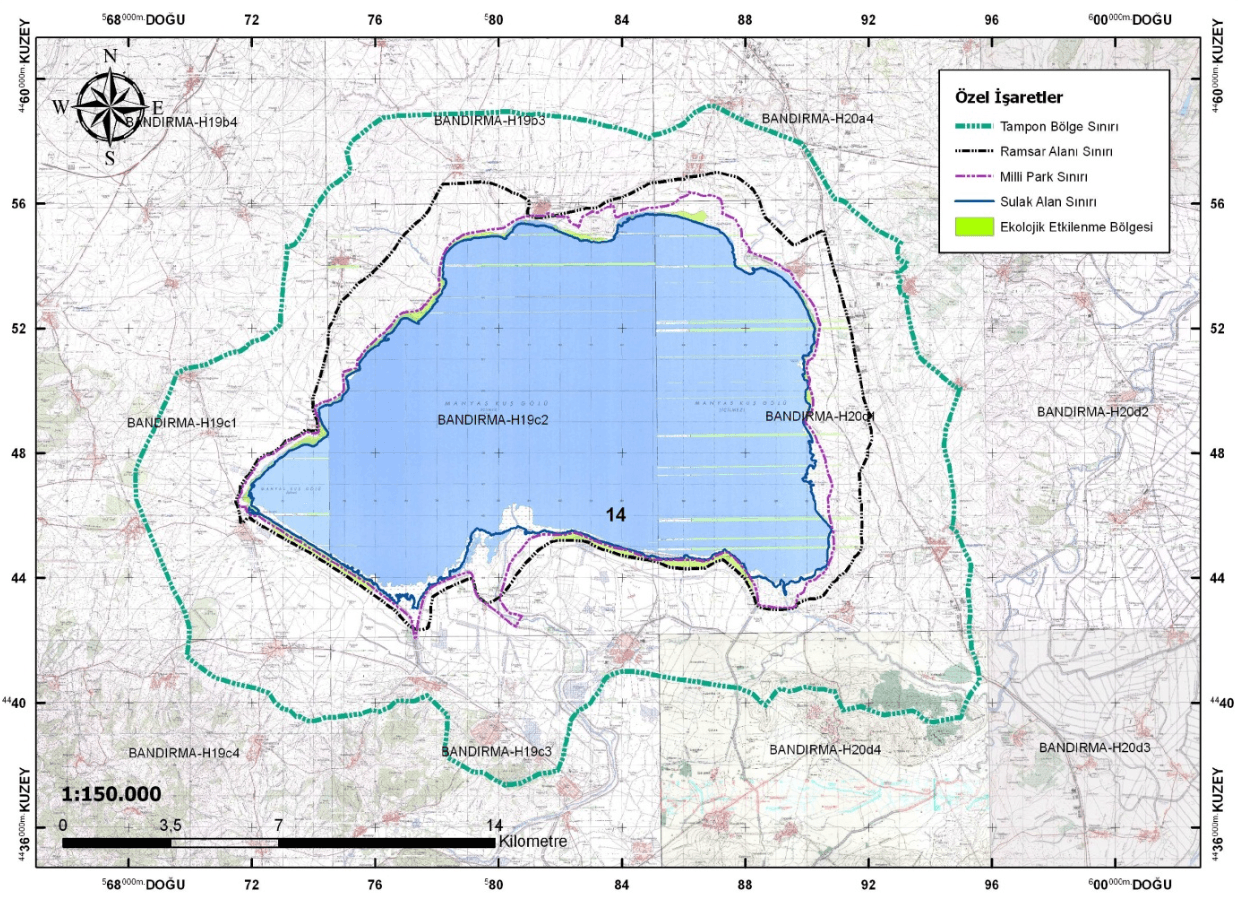
Manyas Kuş Gölü Haritası (Balıkesir Valiliği)
The lake is fed surface-wise by the Kocaçay (Manyas Creek) from the south, the Mürvetler Stream from the east, and the Sığırcı and Dutlu Streams from the north, as well as by groundwater and precipitation. Rivers flowing into the lake form deltas that contribute to the coastal ecosystem. The lake’s outflow occurs through Karadere in the southeast. A regulator and environmental dams constructed on Karadere in 1992 artificially influence the lake’s water regime. The highest water levels are reached in spring (March–April), while the lowest occur in autumn (September–October). The lowest recorded water level was 14.4 meters in 1983 and the highest was 17.8 meters in 1996.
Manyas Lake is a depression lake formed during the post-Miocene period. The surrounding area is covered by alluvial deposits, and the clay-rich substrate reduces permeability. This characteristic directly affects the water balance in the lake’s vicinity. The stratigraphic sequence includes units ranging from Precambrian to Quaternary. Permian-aged carbonate and clastic rocks are common around the lake.
The climate of the Manyas Basin exhibits transitional characteristics between Mediterranean and continental climates. Winters are mild and wet, while summers are dry and hot. The average annual temperature is 14–15 °C, with an average humidity of 66–75%. The lowest recorded temperature is -14 °C (January), and the highest is 41 °C (July–August). Annual evaporation averages 1,143 mm³. Precipitation is concentrated primarily between October and April.
Manyas Bird Lake (Youtube/PTT)
Manyas Lake and its surroundings are protected by the Bird Paradise National Park, established around the 64-hectare Sığırcı Delta, discovered in 1938 and declared a national park in 1959. In 2005, the park’s boundaries were expanded to include the lake, increasing its total area to 24,047 hectares.
To date, 266 bird species have been recorded in the area. Of these, 66 species breed annually, 22 breed in some years, and the remaining 178 species pass through during migration. Species such as the Pelecanus crispus (Dalmatian pelican), Phalacrocorax pygmeus (pygmy cormorant), Nycticorax nycticorax (night heron), Platalea leucorodia (spoonbill), and Plegadis falcinellus (glossy ibis) form breeding colonies. During migration, the Pelecanus onocrotalus (white pelican) and during winter, the Oxyura leucocephala (white-headed duck) use the lake as a stopover. The park lies along internationally significant bird migration routes.
Manyas Lake hosts 4.39% of Türkiye’s zooplankton fauna. A total of 29 zooplankton species have been identified: 17 Rotifera, 9 Cladocera, and 3 Copepoda. Some of these represent the first recorded occurrences in Manyas Lake. The zooplankton composition is 45% Rotifera, 33% Cladocera, and 21% Copepoda.
A total of 118 plant species have been recorded around the lake. Dominant species include reed (Phragmites australis), willow (Salix sp.), ash (Fraxinus sp.), bulrush, water chestnut, five-finger grass, and wild jasmine. Twenty-three fish species have been identified, including carp, tench, bream, and freshwater mullet, which have commercial value. Additionally, four species of salamander, six species of frog, four species of snake, two species of lizard, and two species of turtle have been recorded.
The lake faces threats from various pollution sources. Major issues include:
These threats lead to the loss of breeding habitats, degradation of water quality, and reduction in biological diversity.
Agriculture (rice, maize, wheat, sunflower, sugar beet), livestock farming (large and small ruminants), and fisheries are the primary livelihood sources around the lake. Modern poultry farms are concentrated in the lake’s vicinity. Agro-industrial facilities are located around Bandırma.
Recreational use is dominated by birdwatching. Bird Paradise is one of Türkiye’s most renowned nature tourism destinations. An environmental valuation study estimated the lake’s annual total economic value at approximately 14.8 million Turkish Lira.
Bird Paradise National Park is accessible via a 3-kilometer road branching south from the 15th kilometer of the Balıkesir–Bandırma highway. Facilities include a visitor center, museum, birdwatching tower, and camera systems. The most suitable visiting periods are March–July and September–October. Although there is no accommodation within the park, lodging is available in nearby villages and in the district of Bandırma.
Located southeast of the lake is the Daskyleion Ancient City, dated to the Lydian period (7th century BCE). During the Persian era, it was used as a “Paradeisos” (royal hunting ground). The lake is mentioned in Evliya Çelebi’s Seyahatname.
Balıkesir Valiliği. "Kuşcenneti." Balıkesir Valiliği Resmî Web Sitesi, Accessed May 11, 2025.http://www.balikesir.gov.tr/kuscenneti.
Balıkesir İl Directorate of Culture and Tourism. "Kuş Cenneti Milli Parkı." T.C. Kültür veTurizm Bakanlığı, Accessed May 11, 2025.https://balikesir.ktb.gov.tr/TR-65925/kus-cenneti-milli-parki.html.
Culture Portal. "Kuşcenneti Milli Parkı." T.C. Kültür ve Turizm Bakanlığı - Kültür Portalı, Accessed May 11, 2025.https://kulturportali.gov.tr/turkiye/balikesir/gezilecekyer/kuscenneti-milli-parki.
Doğa Derneği. "Manyas Kuş Gölü." Doğa Derneği, Accessed May 11, 2025.https://dogadernegi.org/manyas-kus-golu/.
Gürlük, Serkan and Erkan Rehber. “Manyas Gölü’nün Çevresel Değerlemesi Üzerine Bir Araştırma.” Dergipark, Accessed May 11, 2025.https://dergipark.org.tr/en/download/article-file/253418.
Gürlük, Serkan. *Manyas Gölü ve Kuş Cenneti’nin Çevresel Değerlemesi Üzerine Bir Araştırma*. PhD thesis, Uludağ Üniversitesi Fen Bilimleri Enstitüsü, 2006.https://www.proquest.com/openview/bc33c9cbc5c7ed81d39f0150fe74afd9/1?cbl=2026366&diss=y&pq-origsite=gscholar
Hacettepe University. "Manyas Gölü ve Çevresinin Hidrojeolojik İncelemesi." Prof. Dr. Serdar Bayarı, Accessed May 11, 2025.https://yunus.hacettepe.edu.tr/~serdar/Poster_MANYAS%20GOLU.pdf.
Manyas Municipality. "Manyas Kuş Cenneti." Manyas Belediyesi Kültür Sayfası, Accessed May 11, 2025.https://manyas.bel.tr/Kultur/Detay?kulturId=7088d720-a532-4705-83bf-2c7242a651a2.
Susurluk Kaymakamlığı. "Manyas Kuş Cenneti Milli Parkı Ziyareti." T.C. Susurluk Kaymakamlığı, Accessed May 11, 2025.http://www.susurluk.gov.tr/manyas-kus-cenneti-milli-parki-ziyareti.
Türkiye Turizm Ansiklopedisi. "Kuşcenneti Milli Parkı." Türkiye Turizm Ansiklopedisi, Accessed May 11, 2025.https://turkiyeturizmansiklopedisi.com/kuscenneti-milli-parki.
Türkmen, Elif Irmak. *Manyas Kuş Gölü'nün Zooplankton Kommunite Yapısı*. Unpublished PhD thesis,Balıkesir Üniversitesi Institute of Natural and Applied Sciences, 2018.https://dspace.balikesir.edu.tr/xmlui/handle/20.500.12462/3390
YouTube. *Manyas Kuş Cenneti - Kuşların Dansı*. March 12, 2020. Video, 6:04.https://www.youtube.com/watch?v=fMiebsOtd7E. Accessed May 11, 2025.

Manyas Bird Lake
Location | Balıkesir | ||||||||
|---|---|---|---|---|---|---|---|---|---|
Surface Area | 16,400 ha | ||||||||
Elevation | 15–60 m range | ||||||||
Depth | Average 2–3 m 15 m maximum 5 | ||||||||
Hydrogeological and Geological Structure
Climatic Characteristics
Biological Diversity
Bird Fauna
Other Fauna and Flora
Conservation Status and Management
Environmental Threats
Economic and Socioeconomic Use
Access and Visitation
Historical and Archaeological Value