


This article was automatically translated from the original Turkish version.

Major Debates in International Relations
Historical Stages | Positivism and Post-Positivism (1990-2016) Neorealism and Neoliberalism (1970-1990) Traditionalism and Behavioralism (1950-1970) Idealism and Realism (1919-1950) | ||||||||
|---|---|---|---|---|---|---|---|---|---|
The discipline of international relations has developed since the beginning of the twentieth century as a field enabling the understanding of global politics and has continuously undergone evolution in both academic and practical dimensions. During this process, the fundamental theoretical cleavages and methodological approaches within the discipline have over time crystallized into four major debates that have defined the framework of international relations theory.
These debates have offered different perspectives on how we should understand the nature of the international system, the roles of actors, and the interactions between states. First, the Idealism-Realism conflict focused on how peace could be achieved and what the fundamental motivations of states were. This was followed by the Behavioralism-Traditionalism debate, which highlighted a methodological divide in how international relations should be studied and brought to the fore the question of how far scientific methods could be applied to the discipline.
The Neorealism-Neoliberalism debate centered on state-centric analysis versus mutual dependence and the role of international regimes. Finally, the Positivism-Postpositivism debate expressed a fundamental cleavage regarding how knowledge should be acquired in international relations studies and on what epistemological and methodological foundations the discipline should be built.
These debates have gone beyond mere academic intellectual divisions to play a decisive role in shaping state foreign policies and understanding the international order. The discipline’s core theoretical orientations and methodological cleavages have deepened international relations scholarship and contributed to a multidimensional analysis of global politics.

【1】
Following the First World War, the discipline of international relations began seeking answers to questions about why wars occurred and how they could be prevented. Pre-war idealism was grounded in the belief that human nature was inherently good and that peace could be sustained through cooperation among states and mechanisms of international law. However, the devastation caused by the war demonstrated the inadequacy of idealist approaches in international politics. Increasing crises in global politics from the 1930s onward, the rise of authoritarian regimes, and the failure of the League of Nations accelerated the collapse of idealism and paved the way for the rise of realism.
Idealists prioritized moral values and the supremacy of law in international relations, focusing on how the world ought to be. They argued that states should not merely be actors driven by self-interest but should also be structures that promote peace and cooperation. The works of Grotius, Locke, and Kant, along with the rhetoric of Woodrow Wilson, formed the foundational pillars of idealism.
According to idealists, war is an accidental condition and peace can be established through tools such as strengthening international law, organization, trade, open diplomacy, self-determination, and disarmament. Developments such as the creation of the League of Nations, the Locarno Era, the Briand-Kellogg Pact, and the London and Washington Naval Disarmament Treaties were seen as concrete steps supporting these idealist views.
Human Nature and the Sources of Conflict
At the heart of idealism lies the belief that human nature is fundamentally good. It was argued that individuals are not inherently malevolent and that war and conflict stem not from human nature but from environmental factors. Humans are more inclined toward cooperation and mutual aid, but states cause war by using individuals as instruments to maximize their own interests.
Preventing War and Abolishing Secret Diplomacy
According to idealists, the first step toward preventing war is the abolition of secret diplomacy. Negotiations conducted behind closed doors foster an atmosphere of mistrust and deepen international crises. Therefore, open diplomacy and transparent international relations must be encouraged.
Multilateral Cooperation and Collective Security
Idealists argue that states should not act alone but engage in collective and multilateral cooperation. Instead of bilateral agreements, broad-based international organizations should be created, and disputes among states should be resolved through diplomatic and mediation mechanisms.
Self-Determination and Strengthening Democratic Institutions
The principle of self-determination, known as the right of peoples to determine their own destiny, is an important factor contributing to international peace. Its widespread adoption would encourage the development of democratic institutions and prevent authoritarian regimes from producing war-prone foreign policies. The proliferation of democratic governance has been viewed as one of the foundational pillars of a safer and more stable international system.
Authoritarian Regimes and Their Tendency Toward War
Idealists argue that non-democratic regimes are more prone to war. The absence of accountability mechanisms and the disregard of the public’s peaceful demands lead authoritarian regimes to adopt more aggressive foreign policy strategies.
Strengthening International Law and Institutions
According to idealism, strengthening international legal mechanisms will play a preventive role against war. The principle of the supremacy of law will make it possible to resolve interstate conflicts without resorting to armed struggle. The establishment of the Permanent Court of International Justice (1921) and the signing of the Briand-Kellogg Pact (1928) are important examples of these efforts. However, such initiatives failed in practice to prevent wars.
Realists criticized idealists for viewing states as actors guided by moral norms and argued that the fundamental dynamic of the international system is a struggle for power and interest. States should prioritize securing their security and enhancing their power over moral principles. To them, the international law and diplomatic norms advocated by idealists proved inadequate in the face of states’ calculations of interest.
In this transition, thinkers such as Reinhold Niebuhr, E. H. Carr, and Hans Morgenthau played a crucial role in theoretically shaping realism. Niebuhr argued that while individuals may be moral, states are actors that prioritize their interests. In his view, moral ideals alone cannot determine international relations and states must turn to policies of power balancing. In his 1932 work Moral Man and Immoral Society, he emphasized that preventing war requires attention to the struggle for power rather than moral values alone.
Similarly, E. H. Carr labeled idealists as “utopians” and defended the foundational principles of realism, arguing that moral and legal norms cannot be decisive in international relations. In his work The Twenty Years' Crisis, he criticized the fundamental assumptions of idealist thought. According to Carr, moral and intellectual theories are not absolute and universal principles but products of historical conditions and struggles for interest. The moral values and legal norms advocated by idealists are, in reality, discourses designed to protect the interests of powerful states.
Carr opposed the idealist notion of “the harmony of interests,” arguing that this understanding merely presented the interests of powerful states as “universal interests.” According to him, international peace is sustainable only as long as it serves the interests of powerful states. Peace is not the result of a universal moral order but of a balance of power, and major powers use this peace discourse to reinforce their own dominance.
Hans Morgenthau systematized realism and laid the foundation of the modern discipline of international relations. In his 1948 work Politics Among Nations, he demonstrated that international politics is “driven by interests” and that “power is the most important variable.” According to him, states are rational actors whose primary goal is to ensure national security and protect their interests. Morgenthau placed the concept of the balance of power at the center, arguing that wars could be prevented not merely by moral appeals but by a credible deterrent strategy.
In conclusion, idealism’s optimistic approach to peace was rapidly criticized from the 1930s onward, and realism came to be accepted as the primary determinant of international politics. Niebuhr’s pessimistic interpretation of human nature, Carr’s critiques of idealism’s failures, and Morgenthau’s power- and interest-centered analyses enabled realism to establish a lasting place in the discipline of international relations. The state’s competition based on power and the anarchic nature of the international system became the core arguments of realism.
From the 1950s onward, the discipline of international relations became the site of a new debate centered on methodology and scientific approaches. Following the first debate between realism and idealism, proponents of traditional methods confronted those who embraced new methodological approaches emerging in the social sciences.
This debate arose from methodological differences between Traditionalists and Behavioralists and focused on the place of scientific methodology in the discipline. Traditionalists sought to understand international relations through historical, legal, and philosophical perspectives, while Behavioralists argued that quantitative analysis, system models, game theory, and statistical methods used in the natural sciences could be applied to international relations studies.
This debate transformed the nature of the discipline and marked a critical turning point in its process of scientificization.
From the 1950s onward, behavioralism began to influence the discipline of international relations as an extension of the scientific transformation occurring in other areas of the social sciences. Primarily led by American academics, this approach argued that international relations research needed to be grounded in a more scientific and empirical foundation.
Behavioralists began challenging realism’s claim that the international system consists of states competing for power, arguing that this view was too narrow and restrictive. They questioned the assumption that the state is a unitary and rational actor and emphasized that international politics cannot be explained solely by power struggles. They also contended that the concept of power had been oversimplified and that non-security factors—economic, social, and psychological—had been neglected.
Some academics criticized realist assumptions, noting that systematic evidence supporting them was scarce and that realist arguments were often vague and lacking in precision. Behavioralists claimed to have provided conceptual and methodological alternatives to the traditional methodologies used in international relations.
Behavioralist methodology aimed to develop a systematic approach within the framework of scientific laws for analyzing international relations and argued that methods used in the natural sciences could be adapted to the social sciences.
Behavioralists argued that international relations should be studied within the framework of scientific laws and claimed that methods used in the natural sciences—such as observation, measurement, and experimental analysis—could be applied to international relations. For example, this view attempted to analyze states’ foreign policy preferences by correlating them with variables such as geographic size, GNP, per capita income, population size, and energy consumption.
Behavioralists criticized traditionalists’ methods as unscientific and claimed that their work remained largely at the philosophical level. While traditional approaches analyzed qualitative data such as historical events, diplomatic documents, and memoirs of statesmen, Behavioralists adopted a research approach based on statistics, simulation, and quantitative analysis.
The behavioralist school developed various approaches aimed at explaining international relations through modern social science methodologies. These include:
Many methodologies used in contemporary foreign policy analysis are based on the work of behavioralists during this period.
In response to behavioralist claims, traditionalists argued that international relations cannot be analyzed solely through quantitative methods and is too complex to be explained by scientific laws. For traditionalists, international relations is a field requiring consideration of human nature, history, and diplomacy.
Traditionalists criticized behavioralists for failing to understand the real nature of international relations and for ignoring the human factor. International relations cannot be reduced to statistics; historical context and cultural elements must also be taken into account. For example, Hedley Bull argued that behavioralists neglected theory, placed excessive value on models and empirical studies, and that such work harmed the discipline.
Another critique was that behavioralists ignored central issues and focused excessively on irrelevant variables. For instance, prioritizing variables such as economic size and energy consumption over core elements like power and security was seen as a misdirection from understanding the fundamental nature of international relations.
Behavioralist methodology introduced scientific methods into the discipline of international relations but failed to generate the expected theoretical innovations.
In conclusion, the Traditionalism-Behavioralism debate played a critical role in the methodological transformation of the discipline of international relations and contributed to its scientificization. However, because behavioralism could not resolve all its problems, international relations scholarship has since moved toward new methodologies that integrate both quantitative and qualitative approaches.
From the 1970s onward, while realism continued to dominate the discipline of international relations, new approaches emerged due to perceived shortcomings of classical realism. During this period, two theories—Neo-Realism and Neo-Liberalism—offered new explanations of how the international system operates and initiated the discipline’s third great debate.
Thinkers such as E. H. Carr, Hans Morgenthau, and Reinhold Niebuhr, representatives of classical realism, explained international politics in terms of power and interest struggles. In contrast, Neo-Realism, which emerged in the 1970s, constructed a new theory by placing the structural characteristics of the international system at its center.
Conversely, Neo-Liberalism (Institutional Liberalism) argued that not only power struggles but also economic, social, and institutional cooperation are decisive in international relations. Thinkers such as Robert Keohane and Joseph Nye contended that the international system is not composed solely of states and that transnational actors, international organizations, and multilateral dependencies must also be taken into account.
This debate took shape around questions of whether the international system is state-centric or multi-actor and whether cooperation is possible within an anarchic system.
Neo-Realism (Structural Realism), introduced by Kenneth Waltz in 1979, abandoned the individual- and state-centered approach of classical realism and focused on the structure of the international system. According to Waltz, the fundamental determinant of international relations is not the domestic politics of states but the anarchic nature of the international system itself. The core arguments of Neo-Realism are as follows:
The International System and Anarchy
According to Neo-Realism, the international system is anarchic and lacks a central authority. States are compelled to ensure their own security in order to survive. This condition leads to power balancing and military capacity becoming the most important determinants. Kenneth Waltz argued that in an anarchic international system, the primary goal of states is survival, which can only be achieved by maximizing their military power.
States’ Pursuit of Power Maximization for Security
Unlike classical realism, which assumes states are not inherently aggressive, Neo-Realism argues that states are forced to increase their power due to insecurity in an anarchic system. According to Waltz, state behavior is determined not by domestic politics but by the structure of the system. For example, the rivalry between the Cold War superpowers, the USA and the USSR, stemmed not from individual ideologies but from the bipolar structure of the international system.
Hegemony and Cooperation
Neo-Realism argues that international cooperation is possible only when imposed by a hegemonic power. A powerful state (hegemon) can compel other states into cooperation and thereby maintain international order.
Example: The United States’ establishment of the Bretton Woods System after World War II to ensure economic stability is an example of the Neo-Realist hegemony concept.
Neo-Liberalism, while preserving some assumptions of classical liberalism, challenged Neo-Realism by arguing that international cooperation is possible even within an anarchic system. Robert Keohane and Joseph Nye argued that international relations are shaped not only by power struggles but also by economic, social, and institutional interactions. The core arguments of Neo-Liberalism are as follows:
Mutual Dependence and Transnational Relations
Neo-Liberals viewed international relations as a multi-layered structure, like a web, in which states alone cannot determine all international processes. They argued that actors such as multinational corporations, international organizations, and civil society organizations are also influential.
Joseph Nye and Robert Keohane argued that as mutual dependence increases, states become economically interdependent, thereby reducing the likelihood of war.
Example: The European Union is a good example of the institutional cooperation model advocated by Neo-Liberalism.
Anarchy Does Not Prevent Cooperation
According to Neo-Liberals, even though the international system is anarchic, states can still cooperate. International organizations and agreements can help states overcome their security dilemmas.
Robert Keohane’s work After Hegemony demonstrated that international cooperation continues even after the decline of hegemonic power.
The debate between Neo-Realism and Neo-Liberalism centered on the question of what constitutes the fundamental determinant of the international system.
State-Centrism and Multi-Actor System
Possibility of Cooperation
The debate between Neo-Realism and Neo-Liberalism had a significant impact on the discipline of international relations and increased theoretical diversity.
As a result of this debate, international relations theories moved beyond being solely state-centric and incorporated economic, social, and institutional factors into their analyses.
The fourth great debate in international relations took shape around positivism and post-positivism and began to exert influence from the mid-1980s. The end of the Cold War, the effects of globalization, and transformations in world politics were decisive in its emergence, leading to the necessity of greater discussion within the discipline on issues such as Environmental concerns, human rights, identity, cultural factors, gender, migration, language, information, and power relations. At this juncture, post-positivism offered a framework that expanded the boundaries of the discipline and developed alternative theoretical approaches.
Positivism is an approach that regards the scientific method as the only valid means of producing knowledge. First used by Saint Simon and later systematized by Auguste Comte, positivism was also known as logical positivism and new positivism in the early twentieth century alongside the Vienna Circle.
In international relations, the positivist approach, grounded in Enlightenment thought, argues that knowledge can be produced in a neutral and objective manner. Positivists assert that politics constitutes an autonomous structure distinct from other fields and that the modern state should be the primary unit of analysis.
Traditional international relations theories such as realism, liberalism, behavioralism, and Marxism are considered positivist approaches. Neorealism and neoliberalism, as rationalist theories, argue that positivist knowledge should form the basis of international relations research. The core assumptions of positivism are as follows:
The positivist approach, alongside behavioralism, facilitated the widespread adoption of quantitative methods (statistical analysis, data modeling, game theory, etc.) in international relations. However, criticisms of positivism from the 1980s onward laid the groundwork for the rise of post-positivist theories.
Post-positivist approaches, challenging positivism, argue that international relations cannot be studied solely through state-centric and quantitative methods. Post-positivist theories constitute a broad framework encompassing various intellectual currents such as critical theory, post-structuralism, post-colonialism, feminism, green politics, and post-modernism.
Post-positivists have expanded the scope of the discipline by developing new methods and concepts. Concepts such as discourse analysis, deconstruction, genealogy, and power-knowledge relations have gained increasing importance in the study of international relations. Post-positivists argue that Western-centric narratives, the concept of the modern subject, European-specific moral codes, and Western lifestyles have been granted privileged positions and must be critically examined.
The fundamental differences between positivism and post-positivism can be summarized as follows:
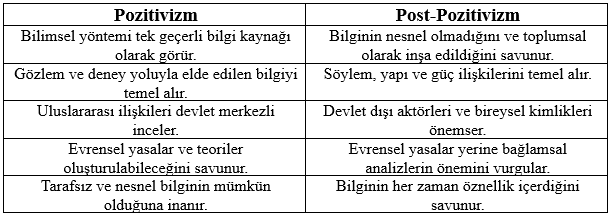
Within this framework, positivist approaches use rational actor models and system-level analyses to study international relations, while post-positivist approaches examine international relations through discourse, identity, and cultural dynamics.
Post-positivist theories have introduced new perspectives to the discipline of international relations:
Following the end of the Cold War, the positivism–post-positivism debate continued along two new axes:
The positivism–post-positivism debate is a methodological and epistemological cleavage conducted around critical questions such as how knowledge is acquired in international relations, whether the state is the primary actor, and how international relations should be studied. Positivists treat international relations as an empirical and measurable science, while post-positivists have developed alternative analytical methods centered on the subjectivity of knowledge, identities, and discourses.
This debate continues today and remains decisive in addressing new issues such as globalization, climate change, migration, and technology, where differences between positivist and post-positivist approaches remain significant.
"The ‘Great Debates’ in International Relations Theory." 2011. *E-International Relations.* May 20, 2011.https://www.e-ir.info/2011/05/20/the-%E2%80%98great-debates%E2%80%99-in-international-relations-theory/#google_vignette.
Arı, Tayyar. 1992. "Uluslararası İlişkilerde Büyük Tartışmalar ve Post-Modern Teoriler." Politics 54 (2): 283-84.
Aydın, Mustafa. 1996. "Uluslararası İlişkilerde Yaklaşım, Teori ve Analiz." Ankara Üniversitesi SBF Dergisi 51 (1).
BALCI, Ali, and Şaban Kardaş. "Uluslararası İlişkilere Giriş Tarih, Teori, Kavram ve Konular, 2." Baskı, İstanbul, Küre Yayınları (2014).
Carr, Edward Hallett. 2016. The Twenty Years' Crisis, 1919-1939: Reissued with a New Preface from Michael Cox. Springer.
Elman, Colin, and Michael Jensen. 2014. The Realism Reader. Routledge.
Keohane, Robert O. 2005. After Hegemony: Cooperation and Discord in the World Political Economy. Princeton University Press.
Morgenthau, Hans. 1948. Politics Among Nations: The Struggle for Power and Peace. New York: Alfred Kopf.
Waltz, Kenneth N. 2014. "Realist Thought and Neorealist Theory." The Realism Reader, 124-128. Routledge.
Çalış, Şaban, and Ertan Özlük. 2007. "Uluslararası İlişkiler Tarihinin Yapısökümü: İdealizm-Realizm Tartışması." Selçuk Üniversitesi Sosyal Bilimler Enstitüsü Dergisi (18): 225-243.
[1]
https://elements.envato.com/earth-globe-on-the-background-of-a-laptop-close-up-NBMTAET

Major Debates in International Relations
Historical Stages | Positivism and Post-Positivism (1990-2016) Neorealism and Neoliberalism (1970-1990) Traditionalism and Behavioralism (1950-1970) Idealism and Realism (1919-1950) | ||||||||
|---|---|---|---|---|---|---|---|---|---|
No Discussion Added Yet
Start discussion for "Major Debates in International Relations" article
First Great Debate: Idealism – Realism (1919–1950)
Idealist Arguments
Realist Critiques and the Rise of Realism
Second Great Debate: Traditionalism – Behavioralism (1950–1970)
The Rise of Behavioralism and Its Core Arguments
Scientific Method and Empirical Research
Questioning the Scientificity of Traditional Methods
New Methodological Approaches and Models
Traditionalist Critiques and Responses
Impacts and Aftermath of Behavioralism
Third Great Debate: Neo-Realism and Neo-Liberalism (1970–1990)
Neo-Realism (Structural Realism)
Neo-Liberalism
Neo-Realism and Neo-Liberalism Debate
Impacts of the Third Great Debate
Fourth Great Debate: Positivism and Post-Positivism (1990–2016)
Positivism and International Relations
Post-Positivism and the Rise of Critical Theories
Key Features of the Positivism–Post-Positivism Debate
Post-Positivist Approaches
New Dimensions of the Debate: Rationalists and Constructivists