


This article was automatically translated from the original Turkish version.
+2 More
Laser guidance technology is a high-precision targeting system that plays a critical role in modern combat arenas for target detection and destruction. Thanks to this system, missiles can effectively strike various objects such as tanks armor vehicles buildings and even moving land or air targets. The laser guidance system operates by illuminating the target with a laser and detecting the reflected laser energy using a sensor on the munition. First developed in the 1960s this technology has evolved through various defense industry applications and today has become a critical solution both in terms of cost-effectiveness and operational performance.

Illustration of the working principle of a laser-guided missile. (Generated by artificial intelligence.)
Laser guidance technology is a system that enables extremely precise targeting and typically operates on a semi-active principle. The fundamental concept relies on directing a laser beam onto a target and detecting the reflected laser energy using a sensor on the munition. The system identifies the target’s position by detecting the return signal from the laser beam and adjusts the missile’s trajectory accordingly.
The energy reflected from the laser directed at the target typically disperses in all directions. The intensity of this dispersed energy is detected by the missile’s sensor triggering a correction signal to guide the missile toward the source of the laser. This process is performed with increasingly frequent measurements as the missile approaches the target sampled guidance.
Through the combination of these methods modern laser guidance systems can be effectively employed even under complex geographical and structural conditions.
Guidance systems are the core technologies that determine how a missile directs itself toward a target. These systems are categorized into three main types based on how target data is acquired and processed by the missile: active semi-active and passive guidance systems.
In active guidance systems the missile carries all necessary sensor and transmitter hardware onboard to detect and track the target. For example an active radar-guided missile emits radar signals and determines the target’s position by detecting the reflections from the target.
Advantages:
Disadvantages:
Example: AIM-120 AMRAAM (active radar-guided air-to-air missile)
Semi-active guidance systems use an external source to illuminate the target and the missile responds to the reflected signals. In this system the missile acts only as a receiver and does not emit any signal itself. SAL (Semi-Active Laser) falls into this category.
Advantages:
Disadvantages:
Example: AGM-114 Hellfire (semi-active laser-guided)
In passive systems the missile homes in on energy emitted by the target such as heat sound or electromagnetic radiation. The missile emits no signal of its own and functions solely as a sensor.
Advantages:
Disadvantages:
Example: AIM-9 Sidewinder (infrared-guided)
Each of these three guidance systems offers distinct advantages depending on operational requirements and environmental conditions. Laser guidance systems particularly in their semi-active configuration have gained a significant role in modern combat due to their precision and operational flexibility.
Semi-active laser guidance (SAL) systems rely on an external laser source that designates the target and a missile-mounted detector that senses the reflected laser light. These systems provide extremely precise targeting and are commonly used in air-to-air air-to-ground and ground-to-air missiles. The technical structure of an SAL system consists of the following key components:
Optical components focus the laser beam and direct it toward the detector. Typically lenses made of glass quartz or silicon are used. These optics are designed to channel incoming laser reflections from within the field of view onto the detector surface with maximum efficiency.
The detector is usually a four-quadrant photodetector structure. This sensor determines the direction of the reflected laser beam to establish the angular position of the target. The sensor is precisely calibrated to respond to the laser’s wavelength (typically around 1064 nm).
The analog signal from the detector is converted into a digital signal by the A/D converter. These digital data are transmitted along with target direction information to the system’s processor.
Microcontroller or digital signal processor (DSP) calculates the difference between the target’s position and the missile’s current position. This difference is defined as the “target error vector” (dx dy) and is used to command the missile’s control surfaces.
The missile’s direction is adjusted according to commands from the processor. This is typically achieved using movable fins tail surfaces or control surfaces known as canards. Movement is driven by electric hydraulic or gas-powered mechanisms.
The energy source powering all these components is typically a battery. In modern systems power consumption is below 10W.
SAL systems are usually connected to the main missile system via serial ports that support digital data transmission such as RS422. This connection enables command exchange.
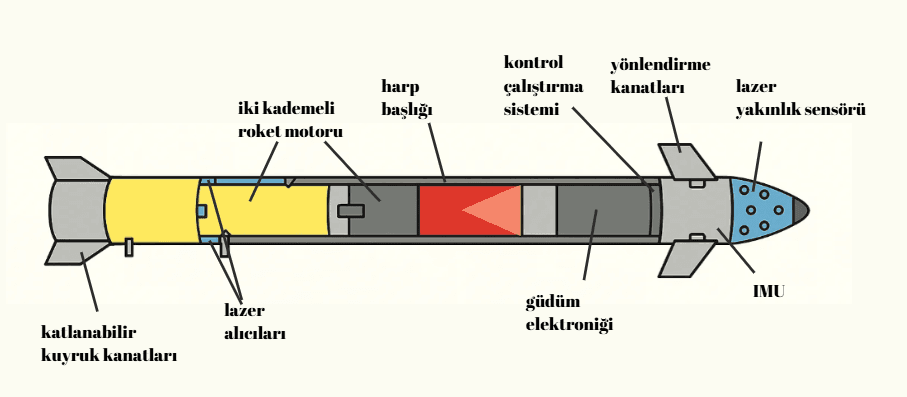
Diagram of a laser-guided missile. (Generated by artificial intelligence.)
SAL technology is an area of intense research in both algorithm development and hardware miniaturization and forms the foundation of next-generation systems.
The development of laser guidance technology represents a process directly linked to the evolution of modern warfare. The emergence of these systems was shaped by the low hit rates of classical munitions and advances in electronic warfare.
During World War II the accuracy of rockets in hitting targets was very low. Especially free-falling air-launched rockets required large numbers to achieve a single hit. This created a need for guided munitions. The first radar-based guidance systems were developed to meet this need but faced challenges such as complexity and signal jamming.
With the invention of the first laser by Theodore Maiman in 1960 its potential for military use was recognized. It became clear that lasers could be applied in target designation range finding and guidance.
The United States tested the first laser-guided missile prototypes in the war field during the Vietnam War. These systems began to be called “smart weapons” and achieved pinpoint accuracy. However due to limited range performance dependency on conditions and system complexity they could not be widely deployed.
In the 1970s semi-active laser-guided systems such as the AGM-65 Maverick M712 Copperhead and AGM-114 Hellfire entered service. These systems featured SAL detectors operating at a wavelength of 1.06 microns. During this period both air-to-ground and ground-to-air platforms began to be integrated with SAL technology.
The Gulf War confirmed the battlefield impact of laser-guided weapons. The US Air Force’s ability to achieve hit rates approaching 90 percent established the future operational role of SAL systems.
New-generation SAL seekers became smaller more precise and lower cost. Modern SAL systems developed by NSWC Dahlgren can operate without gimbals using fixed optics and software algorithms. This greatly facilitated integration especially with unmanned systems.
Current systems combine laser guidance with GPS and INS to provide precise strike capability under all weather conditions. This hybrid approach enhances target selection flexibility and overcomes line-of-sight limitations.
The evolution of SAL technology has not only improved technical capabilities but also advanced concepts such as battlefield flexibility efficiency and target verification.
Laser-guided missiles offer numerous operational advantages but are also subject to specific technical and environmental constraints. Their effectiveness varies depending on the application environment conditions and target characteristics.
The operational benefits of laser-guided systems can be maximized through proper tactical planning and appropriate environmental use. These systems serve as a critical force multiplier in operations where precision is paramount.
The production of laser-guided missiles is a complex process requiring advanced materials science precision electronic assembly and pyrotechnic expertise. This section details the manufacturing process key materials and system integration.
Manufacturing SAL-equipped missiles requires precision a multidisciplinary approach and continuous quality control. Recent advances have enabled the production of lower-cost and more integrated systems.
Laser-guided missiles are designed for use in various combat scenarios requiring precision and flexibility. The advantages offered by SAL systems are particularly evident in their ability to engage targets effectively in complex geographical and structural environments.
SAL systems provide significant advantages in striking vertical targets such as buildings window openings doors and walls. Precise strikes on structures targeted by ground forces or UAVs help prevent civilian casualties.
SAL missiles launched from air platforms especially fixed-wing aircraft and helicopters enable precise strikes on targets located in close proximity to ground forces. This allows simultaneous delivery of fire support and target destruction.
Laser-guided missiles demonstrate high effectiveness against armored targets. Particularly in top-attack scenarios the most vulnerable armored areas of tanks can be targeted.
Small and medium-sized vessels boats or landing craft can be effectively detected and destroyed using SAL systems. The high-altitude viewing angle provided by UAVs and helicopters facilitates target tracking in maritime environments.
In covert operations requiring secrecy and precision SAL technology enables the neutralization of targets within specific environments. For example targeted attacks on terrorist hideouts can be conducted using SAL systems.
Although laser-guided systems are primarily used in air-to-ground or ground-to-ground engagements they also have applications in certain air-to-air scenarios. SAL-based systems may be preferred for precise strikes against targets such as enemy UAVs or low-altitude helicopters.
SAL systems can be used collaboratively across land air and sea platforms. For example a target designated by ground forces can be engaged by a UAV or conversely a target designated by an air platform can be neutralized by ground artillery. This integration provides a significant tactical advantage by enhancing battlefield flexibility.
These tactical applications demonstrate how laser-guided systems create operational impact. The ability to integrate target identification designation and destruction into a seamless process is a fundamental reason for the widespread adoption of SAL technology.
The future of laser-guided systems is evolving toward much more autonomous precise and effective munitions driven by advances in artificial intelligence sensor technology and communication infrastructure. Within this context the future of SAL technology is shaped by the following key areas:
Current SAL systems require continuous laser illumination of the target. However in autonomous systems the missile can continue tracking the target using its internal algorithms after initial detection. This reduces operator dependency and enhances tactical freedom of movement.
Through image processing technologies the missile can recognize target characteristics such as shape motion and scale. This enables discrimination between similar targets reducing the risk of misidentification. It also enables munitions to operate effectively with limited intelligence.
Future SAL missiles will integrate GNSS INS electro-optical and thermal sensors to form multi-layered guidance systems. These systems will achieve the flexibility to strike targets even without direct line-of-sight using pre-programmed data.
Missiles equipped with focal plane array sensors can achieve wider fields of view and faster target tracking. New algorithms such as LSPL (last significant pulse logic) and SJI (spot jump inhibit) are being implemented in these systems.
Future SAL-based systems will be designed in modular form using the same sensor architecture to perform target designation autonomous navigation and identification functions. This provides logistical convenience and cost efficiency.
Immunity to advanced countermeasures is being developed by incorporating adaptive filtering and signal selectivity into algorithms. This will enable SAL systems to locate their targets even under heavy ECM (electronic countermeasures) conditions.
This vision anticipates that SAL systems will evolve beyond mere guidance to become intelligent systems capable of decision-making discrimination and active participation in multi-target engagements.
Abaza, M. O., and M. M. A. Shalaby. “Performance Improvement of Semi-Active Laser Guided Missiles Using the Second-Order Sliding Mode Controller.” *Air and Space Power Journal–Africa and Francophonie* 3, no. 2 (2014): 41–56.Accessed Adresi.
Defense-Update. “Laser Guidance Technology.” Accessed [insert date if provided].Accessed Adresi.
Heald, David A. *Laser Beam Rider Guidance System*. U.S. Patent US3995792A.Accessed Adresi.
International Defence, Security & Technology (IDST). "Semi-Active Lasers and Passive Seeker Technology."
Leonardo Electronics. *SAL Gen III Semi Active Laser Seeker*. Leonardo S.p.A, 2018.Accessed Adresi.
Scribd. *Laser Guided Missile*. Presentation.Accessed Adresi.
Şimşek, Ethem. Laser Guided Missile System Design and Simulation. Master's thesis, Orta Doğu Teknik Üniversitesi, 2004.

No Discussion Added Yet
Start discussion for "Laser-Guided Missiles" article
Foundations and Methods of Laser Guidance
Types of Laser Guidance
Target Painting (Laser Painting)
Operating Conditions
Platforms and Tactical Applications
Guidance Systems: Active Semi-Active and Passive
Active Guidance Systems
Semi-Active Guidance Systems
Passive Guidance Systems
Components and Operating Principle of SAL Technology
Optical System
Detector (Sensor)
Analog-to-Digital (A/D) Converter
Processor
Flight Control Actuators
Power Supply
Interface
Operating Principle
Development and History of Laser-Guided Missiles
Early Period: World War II and After
Discovery of the Laser and Military Applications
Vietnam War Experience
1970s: Introduction of SAL Systems
1991 Operation Desert Storm
2000s and Beyond
Integrated Systems and Next-Generation
Operational Advantages and Limitations
Advantages
Limitations
Manufacturing Process and Material Components
Key Material Components
Manufacturing Stages
Airframe Casting and Mechanical Assembly
Propellant Preparation and Casting
Guidance System Assembly
Final Assembly: Warhead and Sensor
Final Testing and Qualification
Waste and Byproducts
Application Areas and Tactical Uses
Urban Warfare
Close Air Support (CAS)
Tank and Armored Vehicle Defense
Use Against Maritime Targets
Border and Special Operations
Air-to-Air Applications
Multi-Platform Usage Scenarios
Future Vision: Autonomous Laser-Guided Systems
Fire-and-Forget Capability
Artificial Intelligence and Automatic Target Recognition
Hybrid Guidance Systems
New Algorithms and FPA (Focal Plane Array) Seekers
Multi-Use and Modular Designs
Electronic Warfare Resistant Systems