This article was automatically translated from the original Turkish version.
+2 More
Type | Epigraphic Text | ||||||||
|---|---|---|---|---|---|---|---|---|---|
Dating | 9th–10th centuries | ||||||||
Community to Which It Belongs | Oghuz Turks | ||||||||
Discovery Site | Oranğay Village, near Turkistan, Kazakhstan | ||||||||
Finding Site | Muhtar Awesov Middle School Museum | ||||||||
Scientific Discoverer | Assoc. Prof. Dr. Hayrettin İhsan Erkoç | ||||||||
Inscription Reading | "kazar kan kul", in Turkish Turkish "servant of the Khazar Khan" | ||||||||
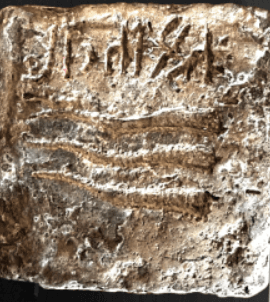
Kültöbe Inscription is an important archaeological and philological find in the context of Central Asian Turkic history and epigraphy. It is the only known single-line runic Turkic inscription attributed to the early Oghuz Turks, dated to the 9th–10th centuries. The inscription was discovered within the historical Oghuz settlement of Kültöbe, located within the boundaries of the village of Orañğay (Oranğay), near the city of Turkistan, in southern Kazakhstan.
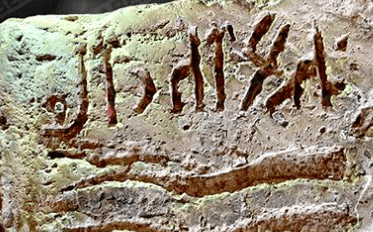
Image of the Kültöbe Inscription (TRT Haber)
The inscription was discovered by local students following an illegal excavation at the Kültöbe settlement in the 1990s and later delivered to a small museum within Muḫtar Äwesov Middle School in Orañğay. For a long time, the artifact was not subject to scholarly examination until it was accidentally identified in 2025 by Assoc. Prof. Dr. Hayrettin İhsan Erkoç of Çanakkale Onsekiz Mart University during a field study. Subsequent detailed epigraphic and historical analyses have since introduced it to the academic community.
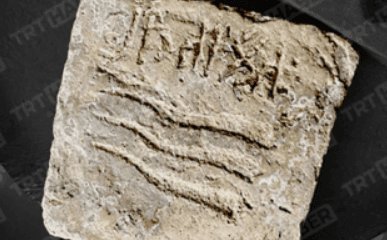
Image of the Kültöbe Inscription (TRT Haber)
The Kültöbe Inscription is carved in square relief on a locally sourced dolomitic limestone stone measuring approximately 25 × 25 cm. It consists of a single line containing seven letters and one separator mark. Directly beneath the text is a symbol composed of three wavy lines, interpreted as either a seal or a symbolic sign. Due to variations in letter depth and formal variants, reading and interpreting the text remains challenging.
The transliteration of the inscription is given as l¹wkn¹k¹r / ²zk¹. Based on this, two primary reading proposals have been advanced:
The second reading proposal stands out as it may mean servant of the Khazar Khan. This interpretation aligns with historical views suggesting that early Oghuz political structures may have been connected to the Oghuz political structure and the Khazar Khaganate. However, due to exceptional orthographic features in the spelling of the word ḳul, the reading and interpretation remain contested and have not been definitively established.
The symbol composed of three wavy lines beneath the inscription is thought to possibly represent an Oghuz tribal seal. Although it does not exactly match any of the classical lists of Oghuz tribal seals, it shows partial similarities with symbols associated with certain historical Turkic tribes.
It has also been suggested that this symbol may be a pictorial reference to the nearby river flowing past the Kültöbe settlement.
The dating of the inscription has been determined based on its archaeological context and the settlement history of the region. Archaeological studies in the Syr Darya basin indicate that the Oghuz settled in this area during the 9th century and largely migrated out by the early 11th century. Furthermore, the possible reference to the Khazar Khan in the inscription corresponds chronologically with the period of Khazar Khaganate’s prominence, between the 7th and 10th centuries. For these reasons, the Kültöbe Inscription is generally dated to the 9th–10th centuries.
The significance of the Kültöbe Inscription lies in its concrete evidence that the Oghuz Turks used Turkic script prior to the Seljuk and Islamic periods.【2】 This discovery necessitates a reevaluation of the widely held view that Oghuz Turkish only became a written language in the 13th century. By providing primary evidence regarding early Oghuz literacy, political affiliations, and symbolic expression, the inscription has become a foundational source for Turkic historiography and epigraphy.
Erkoç, Hayrettin İhsan, and Alparslan Kavaklı. “Kültöbe Yazıtı: Erken Oğuzlarda Yazı Kullanımına İlişkin Yeni Bir Buluntu.” *Yazıt Kültür Bilimleri Dergisi* 5, no. 2 (2025): 236–266. Accessed December 23, 2025.https://dergipark.org.tr/tr/pub/yazit/article/1813749
Şimsek, Ayşe. "Oğuz Türklerine ait 9-10. yüzyıldan kalma Kültöbe Yazıtı keşfedildi." TRT Haber. Accessed December 23, 2025.
[1]
Hayrettin İhsan Erkoç ve Alparslan Kavaklı, “Kültöbe Yazıtı: Erken Oğuzlarda Yazı Kullanımına İlişkin Yeni Bir Buluntu,” Yazıt Kültür Bilimleri Dergisi 5, no. 2 (2025): 240. Son Erişim: 23.12.2025. https://dergipark.org.tr/tr/pub/yazit/article/1813749
[2]
Erkoç ve Kavaklı, “Kültöbe Yazıtı: Erken Oğuzlarda Yazı Kullanımına İlişkin Yeni Bir Buluntu,” 245.

Type | Epigraphic Text | ||||||||
|---|---|---|---|---|---|---|---|---|---|
Dating | 9th–10th centuries | ||||||||
Community to Which It Belongs | Oghuz Turks | ||||||||
Discovery Site | Oranğay Village, near Turkistan, Kazakhstan | ||||||||
Finding Site | Muhtar Awesov Middle School Museum | ||||||||
Scientific Discoverer | Assoc. Prof. Dr. Hayrettin İhsan Erkoç | ||||||||
Inscription Reading | "kazar kan kul", in Turkish Turkish "servant of the Khazar Khan" | ||||||||
No Discussion Added Yet
Start discussion for "Kültöbe Inscription" article
Discovery and Identification Process
Physical and Technical Features
Text, Reading, and Interpretation
Seal
Dating
Historical and Cultural Significance