


This article was automatically translated from the original Turkish version.
Kula Ring is an anthropological concept studied in the early twentieth century by anthropologist Bronisław Malinowski using the method of participant observation in the Massim region of eastern Papua New Guinea (particularly the Trobriand Islands), referring to a ceremonial system of gift exchange between tribes. This system creates a complex, rule-bound, and continuous social bond among islands that are independent and geographically distant.

Visual Representing Kula Gift Exchange (Generated by Artificial Intelligence)
Kula trade operates through lifelong partnerships, distinct from ordinary economic exchange (gimwali). The system is based on the continuous and counter-directional circulation of two types of ceremonial objects known as vaygu'a:【1】
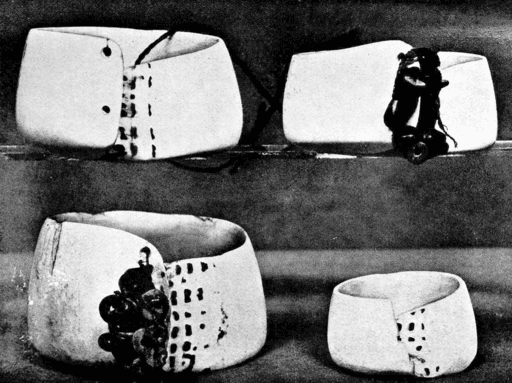
Mwali Armbands (Store Norske Leksikon)
The exchange operates on the principle of delayed reciprocity. The complementary gift in return for an initial offering is not given simultaneously but only during a subsequent visit, when the roles of the parties are reversed. When a suitable vaygu'a is unavailable, interim gifts known as basi are given to sustain the relationship. Holding a Kula object for longer than appropriate is perceived as stinginess and results in loss of prestige.【2】
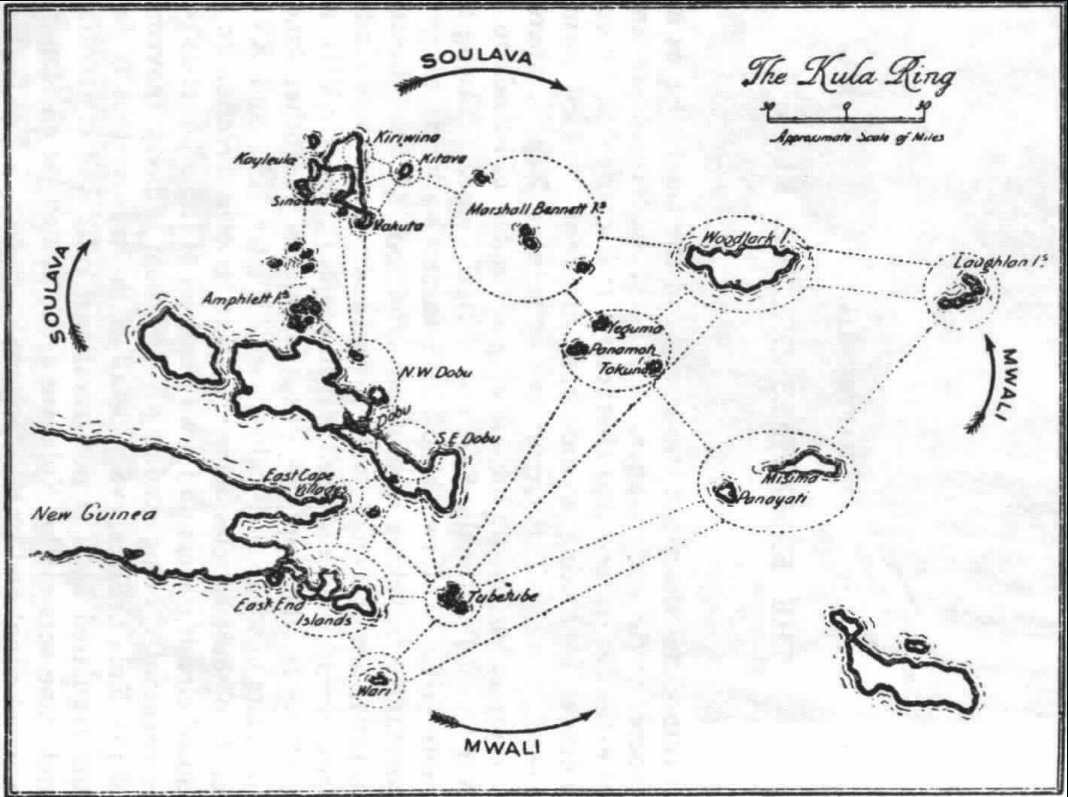
Malinowski’s Map of the Kula Ring (Store Norske Leksikon)
One of the key functions of the Kula system is to construct a peaceful social order in tribal societies lacking centralized authority or written laws. In an environment where suspicion of outsiders, potential conflict, and ritual or magical practices are significant, ceremonial gift-giving functions as a mechanism of trust and signaling, demonstrating peaceful intentions.【3】
Gift exchange serves the function of forging alliances among clans, tribes, and individuals, binding both giver and receiver under moral obligations. This principle of reciprocity not only facilitates peaceful intergroup relations but also generates status, generosity, and domains of power. Within Malinowski’s scientific theory of culture, the Kula is a cultural practice organized as an institution that indirectly serves the integrative, instrumental, and biological needs of society.【4】
Some early anthropologists held the prejudice that ownership in primitive societies followed a "communal" (communist) structure. However, Malinowski’s observations of the Kula ring refute this superficial generalization. For instance, the canoes that play a vital role in Kula voyages are not communal property freely and equally used by the entire community without rules.【5】
Ownership of a canoe, along with its associated clan and usage rights, is governed by clearly defined rules. The use of a canoe reflects a complex ownership system resembling a modern anonymous corporation, with clearly distributed rights, duties, and privileges. The economic benefits obtained at the end of a voyage are distributed within this framework of strict rules and hierarchy.
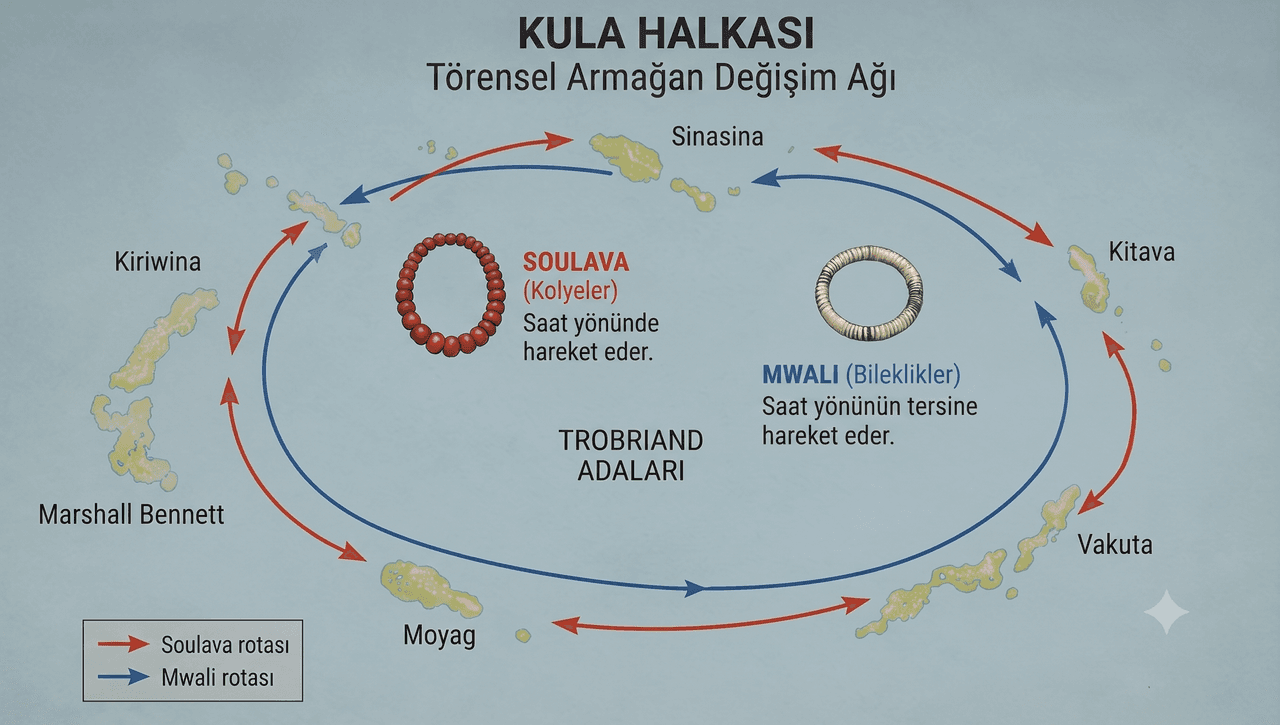
Kula Ring Cycle (Generated by Artificial Intelligence)
The communication established during the preparation and journey phases of Kula expeditions holds a central place in Malinowski’s theory of language. In the Kula system, language is not merely a passive medium for conveying ideas or thoughts; it is an essential and active component of jointly performed activities such as canoe building, sail raising, and rituals.
According to Malinowski, the magical formulas, prayers, and direct commands used in Kula rituals possess a "performative" (pragmatic) power.【6】Speech functions as a tool for exercising control over objects and actions, that is, for bringing things into being. In this context, words in Kula rituals cannot be separated from their practical context; they are active forces employed to achieve concrete outcomes and maintain social harmony.
Altınörs, S. Atakan. "Malinowski’ye Göre Dilin Edimsel İşlevi." *USBAD Uluslararası Sosyal Bilimler Akademi Dergisi* 5, no. 11 (2023): 148–166. Accessed June 29, 2026. https://dergipark.org.tr/tr/download/article-file/2968706
Alver, Alv, and Astrid Anderson. "Kula." *Store norske leksikon*. Accessed July 1, 2026. https://snl.no/kula
Aman, Fatih. "Bronislaw Malinowski’nin Kültür Teorisi." *Ağ Üniversitesi İlâhiyat Fakültesi Dergisi* 21, no. 1 (2012): 135–151. Accessed June 29, 2026. https://dergipark.org.tr/tr/download/article-file/143625
Ziegler, Rolf. "The Kula Ring of Bronislaw Malinowski: Co-evolution of an Economic and Ceremonial Exchange System." *Review of European Studies* 4, no. 1 (2012): 15–25. Accessed June 29, 2026. https://www.researchgate.net/publication/47108861_The_Kula_Ring_of_Bronislaw_Malinowski_Co-evolution_of_an_Economic_and_Ceremonial_Exchange_System
[1]
Rolf Ziegler, "The Kula Ring of Bronislaw Malinowski: Co-evolution of an Economic and Ceremonial Exchange System," Review of European Studies 4, no. 1 (2012): 16. https://www.researchgate.net/publication/47108861_The_Kula_Ring_of_Bronislaw_Malinowski_Co-evolution_of_an_Economic_and_Ceremonial_Exchange_System
[2]
Ziegler, "The Kula Ring of Bronislaw Malinowski: Co-evolution of an Economic and Ceremonial Exchange System," 16.
[3]
Ziegler, "The Kula Ring of Bronislaw Malinowski: Co-evolution of an Economic and Ceremonial Exchange System," 20-22.
[4]
Fatih Aman, "Bronislaw Malinowski’s Theory of Culture," Ağ University Faculty of Theology Journal 21, no. 1 (2012): 140-141. https://dergipark.org.tr/tr/download/article-file/143625
[5]
Aman, "Bronislaw Malinowski’s Theory of Culture," 146.
[6]
S. Atakan Altınörs, "The Performative Function of Language According to Malinowski," USBAD International Social Sciences Academy Journal 5, no. 11 (2023): 156-159. https://dergipark.org.tr/tr/download/article-file/2968706

Mechanism and Rules
Sociological Functions and Social Order
Concept of Ownership and Economic Dimension
Rituals and the Performative Function of Language