


This article was automatically translated from the original Turkish version.
The Kuiper Belt is a flat ring of icy minor bodies orbiting the Sun beyond the orbit of Neptune. It is named after Dutch-American astronomer Gerard P. Kuiper, who proposed that hundreds of millions of such objects—remnants from the formation of the outer planets and orbiting close to the plane of the solar system—must exist. The Kuiper Belt is believed to be the source of most observed short-period comets, particularly those with orbital periods shorter than 20 years around the Sun, as well as of icy Centaur objects whose orbits lie between the giant planets. Although its existence had been theorized for decades, the Kuiper Belt was not directly observed until the 1990s, when large telescopes and sensitive light detectors became available.
Objects in the Kuiper Belt orbit at an average distance greater than Neptune’s mean orbital distance (approximately 30 astronomical units (AU), or 4.5 billion kilometers) from the Sun. The outer edge of the Kuiper Belt is less precisely defined, but it is conventionally taken to exclude objects that come closer than 47.2 AU (7.1 billion kilometers) to the Sun, corresponding to the 2:1 Neptune resonance, where an object completes one orbit for every two orbits of Neptune. The Kuiper Belt contains large bodies such as Eris, Pluto, Makemake, Haumea, and Quaoar, as well as likely millions of smaller objects.
Irish astronomer Kenneth E. Edgeworth proposed in 1943 that the distribution of small bodies in the solar system was not limited to Pluto’s current distance. In 1951, Kuiper developed a stronger argument: based on an analysis of mass distribution during the formation of the solar system, he concluded that a large reservoir of icy remnants—active comet nuclei—must persist beyond Neptune. Dutch astronomer Jan Oort proposed the existence of a much more distant spherical reservoir of icy bodies, now called the Oort Cloud, which continuously replenishes comets. His hypothesis adequately explained the origin of long-period comets (those with orbital periods longer than 200 years). However, Kuiper noted that the many short-period comets (20 years or less), which orbit the Sun in the same direction and near the plane of the solar system, required a closer, flatter source. This explanation, clearly restated by American astronomer Martin Duncan and colleagues in 1988, remained the strongest argument for the Kuiper Belt’s existence until its direct detection.
The Oort Cloud has never been directly observed, but it is thought to consist of a spherical distribution of icy bodies orbiting the Sun at distances between 3,000 and 100,000 AU. It is also widely believed to be the origin of most long-period comets in the solar system. Objects in the Oort Cloud likely formed closer to the Sun, near the current orbits of Uranus and Neptune, and were later scattered to their present positions by gravitational interactions with the planets. Astronomers theorize that the Oort Cloud contains approximately 10¹² to 10¹³ objects with a total mass of about 100 Earth masses. Objects within the Kuiper Belt are affected by the gravity of the planets. Farther out, between 50 and 2,000 AU, lies a region where objects are no longer significantly influenced by the planets. Between 2,000 and 15,000 AU, objects in the cloud are affected by galactic tidal forces. In the outer Oort Cloud, from 15,000 to 100,000 AU, objects are influenced by the gravity of nearby stars. Beyond this, the Sun’s gravity is too weak to hold objects in orbit.
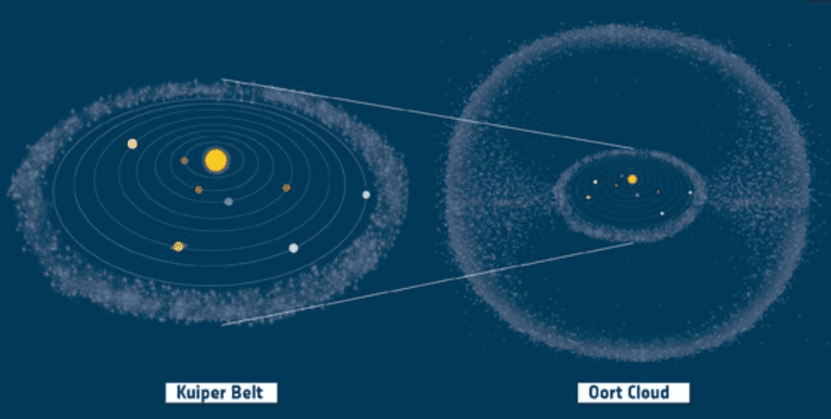
Position of the Kuiper Belt and the estimated location of the Oort Cloud [1]
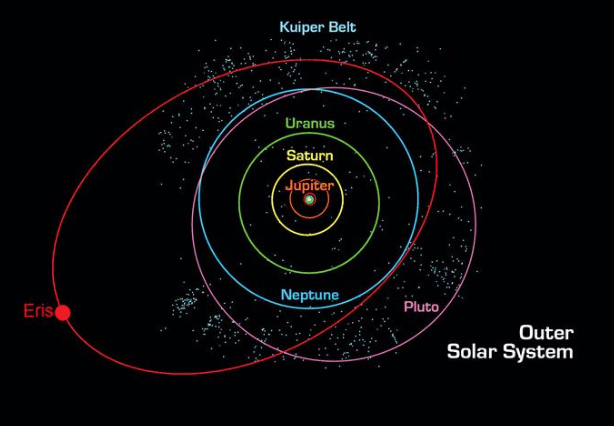
Position of the planets and the Kuiper Belt in the solar system [2]
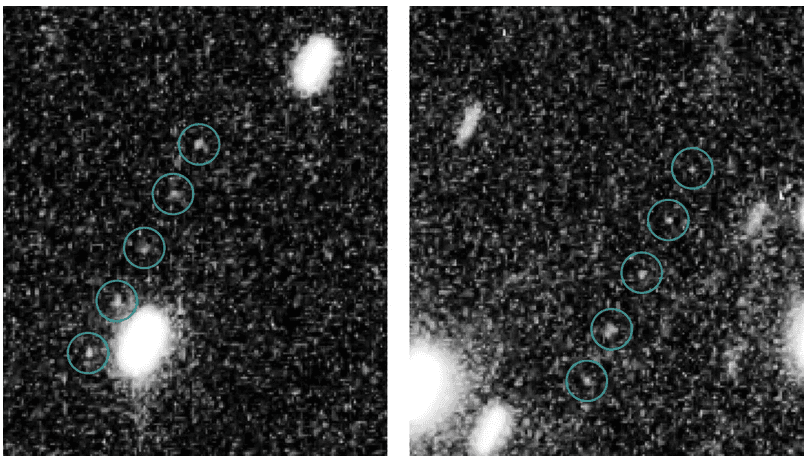
Objects in the Kuiper Belt [3]
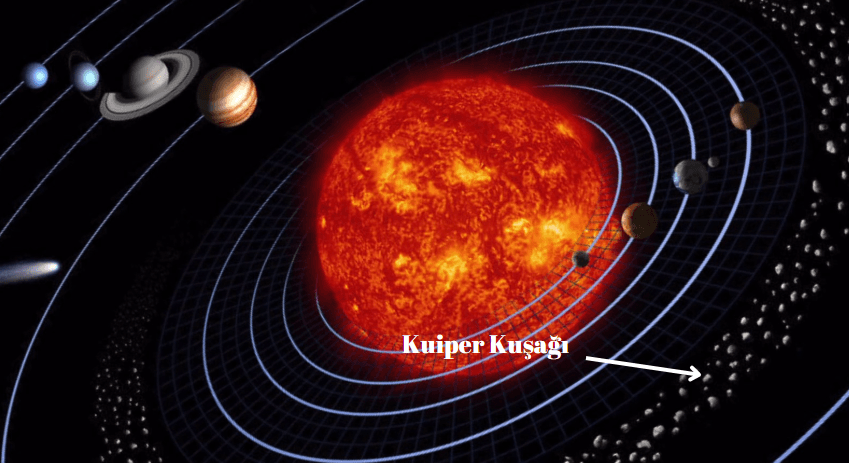
Position of the Kuiper Belt in the solar system [4]
Ad Astra Space. *The Kuiper Belt and the Oort Cloud: What to know.*https://www.adastraspace.com/p/kuiper-belt-oort-cloud
Britannica. *Kuiper Belt.*https://www.britannica.com/place/Kuiper-belt/Families-binaries-and-satellites
Independent. "A New Ring Could Be Added to the Solar System."https://www.indyturk.com/sites/default/files/styles/1368x911/public/article/main_image/2023/10/06/1198651-339584044.jpg?itok=5U0Moueh[4]
Las Cumbres Observatory. *Comets, the Kuiper Belt and the Oort Cloud.*https://lco.global/spacebook/solar-system/comets-kuiper-belt-and-oort-cloud/
NASA SCIENCE. The Kuiper Belt.https://science.nasa.gov/solar-system/kuiper-belt/
Space Center Houston. "What is the Kuiper Belt?"
Space.com. "What is the Kuiper Belt?" Accessed [insert date].https://www.space.com/16144-kuiper-belt-objects.html
Space.com. "What is the Kuiper Belt?" [1]
Space.com. "What is the Kuiper Belt?"

Discovery of the Kuiper Belt
Oort Cloud