


This article was automatically translated from the original Turkish version.
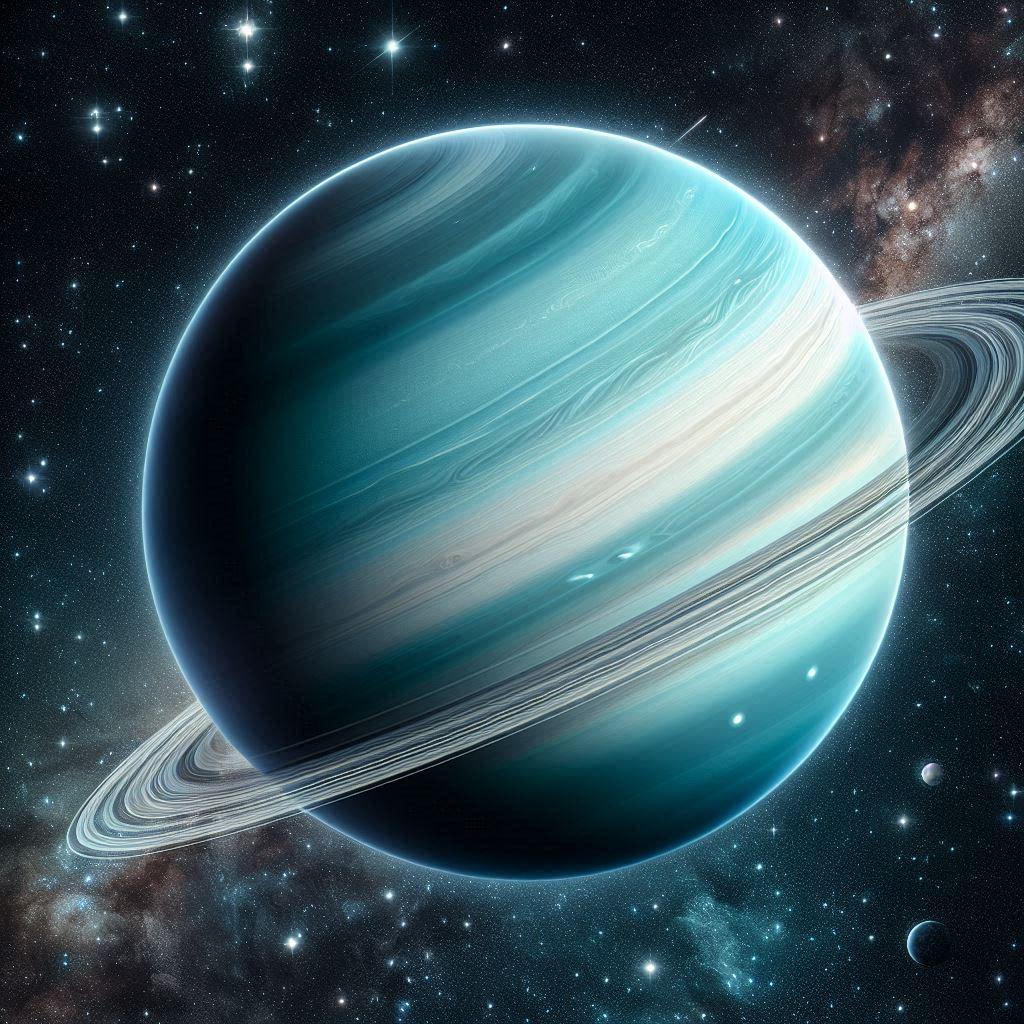
Generated with Artificial Intelligence.
Uranus
Number of Active Artificial Satellites | 0 | ||||||||
|---|---|---|---|---|---|---|---|---|---|
Diameter | 51.112 km | ||||||||
Number of Natural Satellites | 28 | ||||||||
Average Distance from the Sun | 2.9 x 10^9 km | ||||||||
Date of Discovery | 1781-03-13 | ||||||||
Mass | 8.6 x 10^25 kg | ||||||||
Uranus is an ice giant that ranks seventh in distance from the Sun in the Solar System. It is the third largest planet by diameter in the Solar System and has the lowest mass among the four giant planets.
Discovered in 1781 by William Herschel, Uranus was the first planet to be identified using a telescope. However, Herschel believed the celestial object he discovered was either a star or a comet. Observations made two years later by Johann Elert Bode confirmed it was a planet, and it was named Uranus.
Uranus is classified not as a gas giant like Jupiter and Saturn, but rather as an "ice giant" alongside Neptune. The planet’s interior is composed largely of dense liquids such as water, methane, and ammonia. It has no solid surface; its core is a rocky center primarily made of iron and nickel.
The atmosphere consists mostly of hydrogen (82.5%) and helium (15.2%), with methane making up an additional 2.3%. Methane absorbs red light and does not reflect it, giving Uranus its distinctive blue-green color.
Uranus’s atmospheric temperature can drop as low as -224°C, making it the coldest planet in the Solar System. The planet’s exosphere extends up to 25,000 km above its surface, where temperatures can reach 480°C. Uranus’s atmosphere also features winds reaching speeds of up to 900 km/h and massive storms.
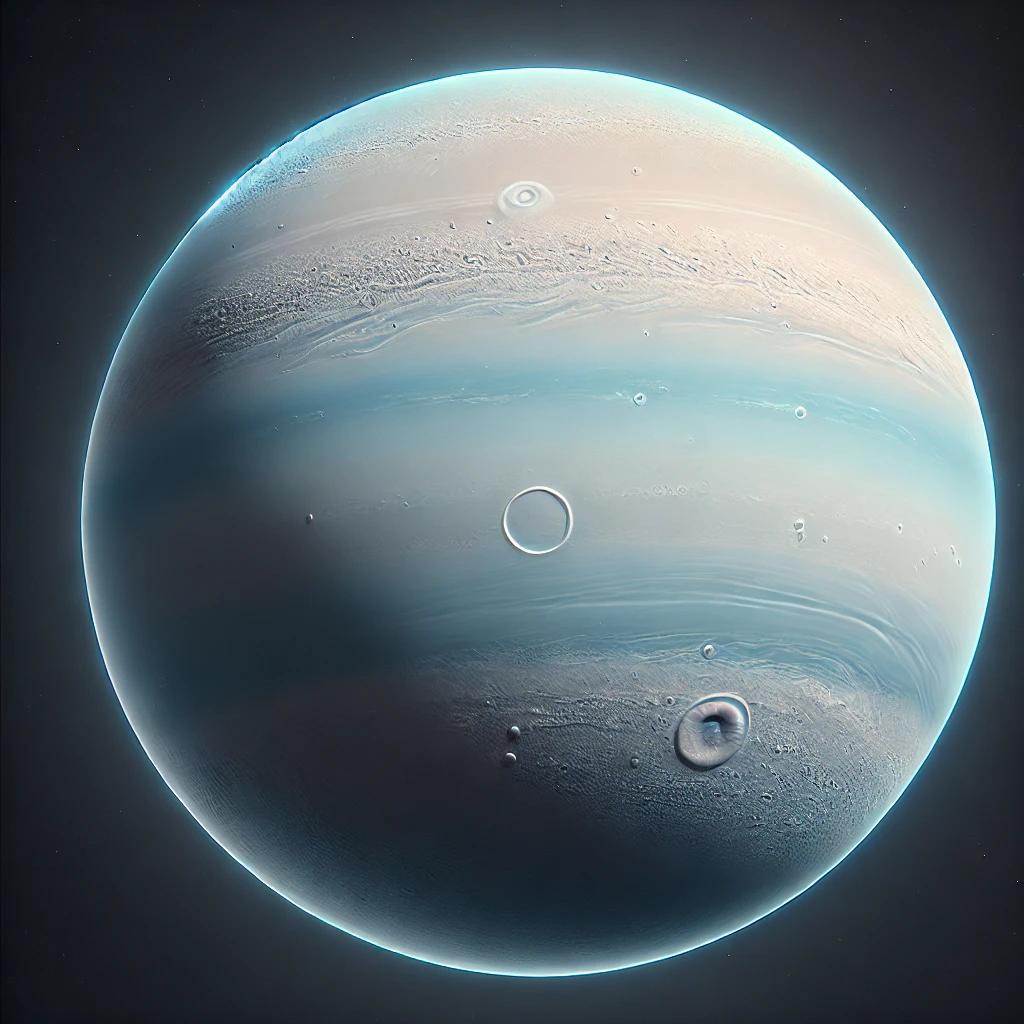
Artificially generated representative image of the planet Uranus
Uranus completes one orbit around the Sun in 84 Earth years. Its axial tilt is approximately 97.77 degrees, causing it to rotate on its side. This unusual orientation results in seasons that are vastly different from those of other planets. Each pole of Uranus experiences 42 years of continuous sunlight followed by 42 years of complete darkness.
Uranus rotates on its axis once every 17 hours and 14 minutes. Along with Venus, Uranus is one of only two planets in the Solar System that rotate in a retrograde direction.
Uranus has 28 known natural satellites. These are divided into inner and outer moons. Most of the inner moons consist of a mixture of ice and rock, while the composition of the outer moons is not yet fully understood. The two largest moons are Titania, with a diameter of 1,578 km, and Oberon, with a diameter of 1,522 km; both were discovered by William Herschel in 1787.
The planet has 13 rings. These were discovered in 1977 by James L. Elliot and his team during observations from Earth. The Voyager 2 spacecraft confirmed their existence during its flyby in 1986. Compared to the rings of other gas giants, Uranus’s rings are very faint. The inner rings are narrow and dark, while the outer rings are brighter and more distinct.
Uranus’s magnetic field is highly irregular compared to those of other planets. The magnetic axis is tilted by 60 degrees relative to the rotational axis and is offset from the planet’s center. This causes the auroras observed on Uranus to be misaligned with its magnetic poles.
The planet’s magnetic field lines twist into a corkscrew shape due to its axial tilt and extend for millions of kilometers. The cause of this unusual magnetic field configuration on Uranus has not yet been fully understood.
To date, the only spacecraft to have visited Uranus is Voyager 2. During its closest approach in 1986, Voyager 2 transmitted extensive data on the planet’s atmosphere, magnetic field, moons, and rings. It was also during this mission that scientists discovered Uranus’s magnetic field is stronger than Saturn’s.
In recent years, observations made with the Hubble Space Telescope have revealed previously undetected atmospheric phenomena and auroras on Uranus. These observations show that powerful storms also occur in the planet’s northern hemisphere.
NASA Science. "Uranus: Facts." Accessed March 23, 2025.[Accessed Adresi]
Topal, Doç. Dr. Selçuk. "Güneş Sistemini Tanıyalım: Uranüs." TÜBİTAK Bilim Genç, July 15, 2024.[Accessed Adresi].
Türkiye Uzay Agency. "URANÜS." Accessed March 23, 2025.[Accessed Adresi]
Generated with Artificial Intelligence.
Uranus
Number of Active Artificial Satellites | 0 | ||||||||
|---|---|---|---|---|---|---|---|---|---|
Diameter | 51.112 km | ||||||||
Number of Natural Satellites | 28 | ||||||||
Average Distance from the Sun | 2.9 x 10^9 km | ||||||||
Date of Discovery | 1781-03-13 | ||||||||
Mass | 8.6 x 10^25 kg | ||||||||
Structure and Atmosphere
Orbit and Rotation
Moons and Rings
Magnetic Field and Magnetosphere
Discoveries and Space Exploration